 thesilkroadtoday
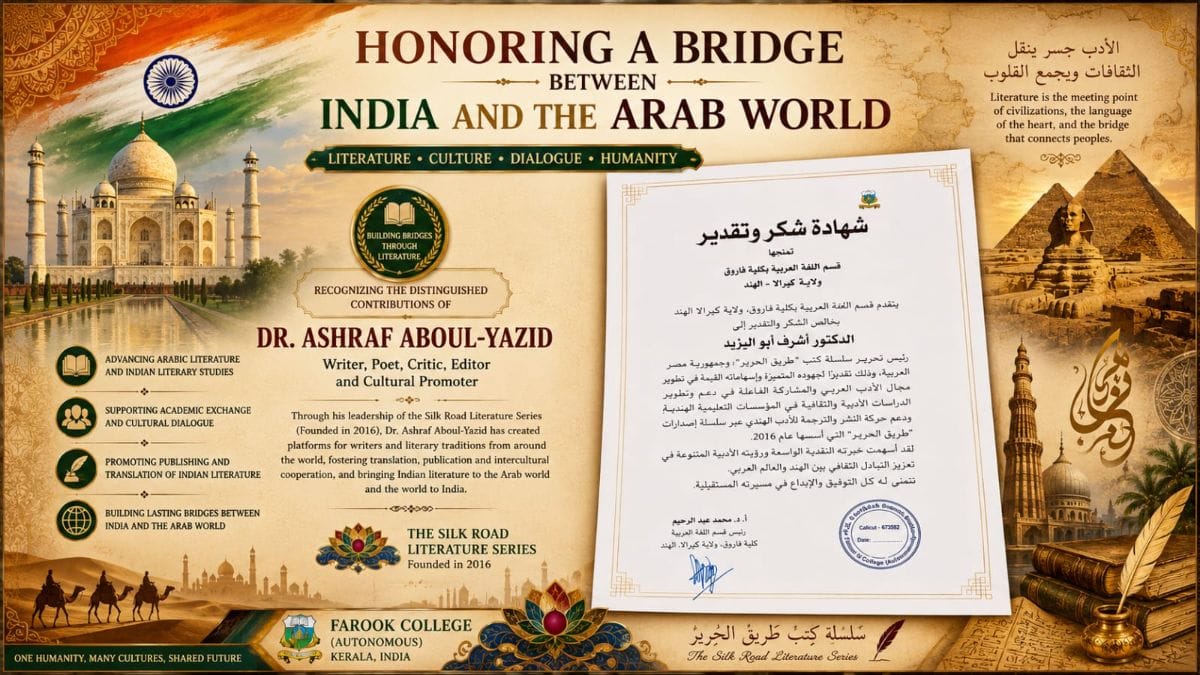
KERALA, INDIA — The Department of Arabic at Farook College (Autonomous), Kerala, India, has honored the Egyptian writer, poet, critic, and editor Dr. Ashraf Aboul-Yazid with a formal Certificate of Thanks and Appreciation, recognizing his distinguished contributions to Arabic literature, literary and academic exchange, and the strengthening of cultural relations between India and the Arab world.
The certificate, issued by the Department of Arabic of Farook College, highlights Dr. Aboul-Yazid’s sustained contribution to literary and cultural dialogue between India and the Arab world, particularly through his work as Editor-in-Chief of the Silk Road Literature series and his long-standing engagement with Indian writers, translators, academics, and cultural institutions.
Recognition of a Cross-Cultural Literary Mission
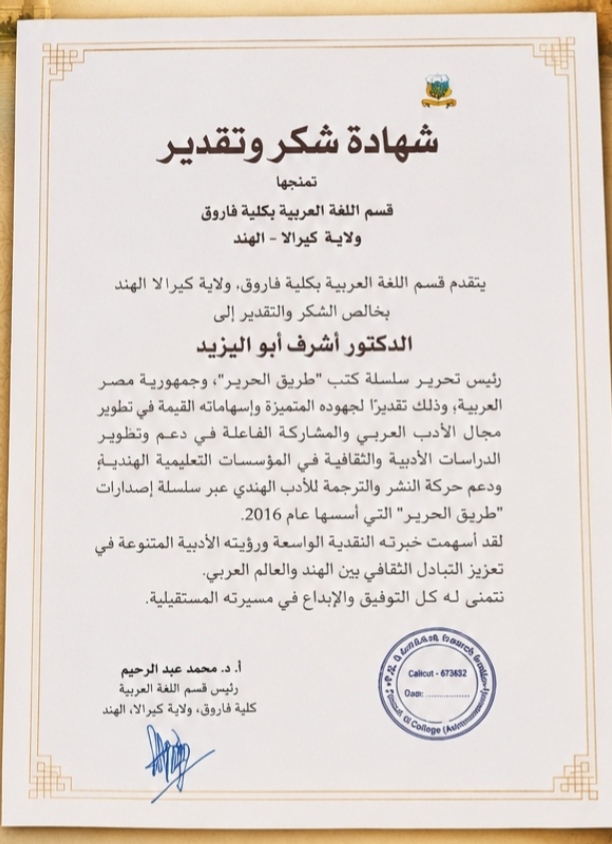
According to the certificate, the Department of Arabic expresses its sincere thanks and appreciation to Dr. Ashraf Aboul-Yazid, describing him as a writer, poet and critic, and recognizing his distinguished role and valuable contributions to the field of Arabic literature.
The document particularly acknowledges his active participation in supporting and developing literary and academic studies in Indian educational institutions, as well as his contribution to the movement of publishing and translation of Indian literature into the wider international literary sphere.
A central element of the recognition is Dr. Aboul-Yazid’s work through the Silk Road Literature series, which he founded in 2016. The series has developed into a platform for bringing together writers and literary traditions from different countries and regions, with a particular emphasis on translation, intercultural communication and the discovery of literary voices beyond linguistic and geographical boundaries.
The certificate recognizes this work as an important contribution to the dissemination of Indian literature and to the creation of new channels of literary communication between India and the Arab-speaking world.
Building Bridges Between India and the Arab World
Farook College’s recognition also emphasizes the wider cultural significance of Dr. Aboul-Yazid’s work. His literary and editorial activities have contributed to creating opportunities for dialogue among writers and intellectuals from different cultural backgrounds.
The certificate notes that his broad critical experience and independent literary vision have helped enrich academic dialogue and strengthen cultural exchange between India and the Arab world.
This aspect of the recognition is particularly significant because literary translation and publishing can serve as instruments of cultural diplomacy, allowing readers to encounter the history, imagination and contemporary concerns of societies beyond their own linguistic traditions.
Through his international literary activities, Dr. Aboul-Yazid has consistently promoted the idea of literature as a meeting point between civilizations. His work with the Silk Road Literature series reflects an effort to reconnect cultures historically linked by the ancient Silk Road while creating contemporary networks among poets, writers, scholars, translators and cultural institutions.
Farook College and the Department of Arabic
The certificate was issued by the Department of Arabic at Farook College, Kerala, an institution with an established academic interest in Arabic language and literature.
The formal document bears the signature of the Head of the Department of Arabic and the institutional seal of the P.G. & Research Department of Arabic, Farook College (Autonomous).
By honoring Dr. Aboul-Yazid, the Department has recognized not only his individual literary career but also his contribution to a broader process of academic and cultural cooperation.
The recognition reflects the importance of sustained relationships between literary practitioners and educational institutions. Such relationships provide opportunities for scholars and students to engage with international literature, translation and comparative cultural studies.
The Silk Road Literature Series
Founded in 2016, the Silk Road Literature series has become one of Dr. Aboul-Yazid’s major international cultural projects. The initiative seeks to present literature from different countries and cultures through multilingual publishing, translation and international literary cooperation.
The project has featured literary voices from across Asia, Africa, the Middle East and other regions, reflecting the geographical and cultural diversity historically associated with the Silk Road.
Its activities have included anthologies, literary exchanges, translations and international cultural events, creating opportunities for writers to reach audiences beyond their native languages.
The recognition from Farook College therefore highlights an important dimension of the series: its role in bringing Indian literature into dialogue with Arabic literature and other literary traditions.
A Recognition of Cultural Diplomacy Through Literature
The certificate may also be viewed as recognition of the role of literature in cultural diplomacy.
Rather than limiting cultural exchange to official institutions, literary initiatives create direct relationships among writers, universities, translators, publishers and readers. In this context, the work recognized by Farook College demonstrates how literary publishing and translation can contribute to mutual understanding between societies.
India and the Arab world possess centuries-old historical connections, including commercial, intellectual and cultural exchanges across the Indian Ocean and the broader Silk Road networks. Contemporary literary cooperation offers an opportunity to renew those connections in the modern era.
Dr. Aboul-Yazid’s work has sought to place literature at the center of this process, using translation and international publishing as tools for dialogue.
Appreciation for Continuing Literary Contributions
The certificate concludes by extending its wishes to Dr. Aboul-Yazid for continued success and creativity in his literary and humanitarian career.
The recognition from the Department of Arabic at Farook College represents an appreciation of a career that has combined writing, criticism, journalism, editing, translation and international cultural cooperation.
For Dr. Aboul-Yazid, the honor also underscores the importance of the relationships developed over many years with Indian academic and literary circles. It highlights the continuing potential of cooperation between Indian and Arab scholars and writers and reinforces the role of literature as a shared space for dialogue.
A Symbol of India–Arab Literary Friendship
The Certificate of Thanks and Appreciation from Farook College stands as a symbolic acknowledgment of the growing literary relationship between India and the Arab world.
By recognizing Dr. Ashraf Aboul-Yazid’s contribution to Arabic literature, academic exchange, publishing and the translation of Indian literature, the Department of Arabic has highlighted a model of cultural cooperation based on literature, translation, education and mutual understanding.
The honor further demonstrates that the contemporary Silk Road is not merely a geographical or historical concept. It can also be understood as a living network of ideas, languages, books and human relationships—one in which writers and translators continue to build bridges between civilizations.
The certificate was issued by the Department of Arabic, Farook College (Autonomous), Kerala, India, and presented to Dr. Ashraf Aboul-Yazid in recognition of his contributions to Arabic literature, Indian literary studies, publishing, translation, and India–Arab cultural exchange.