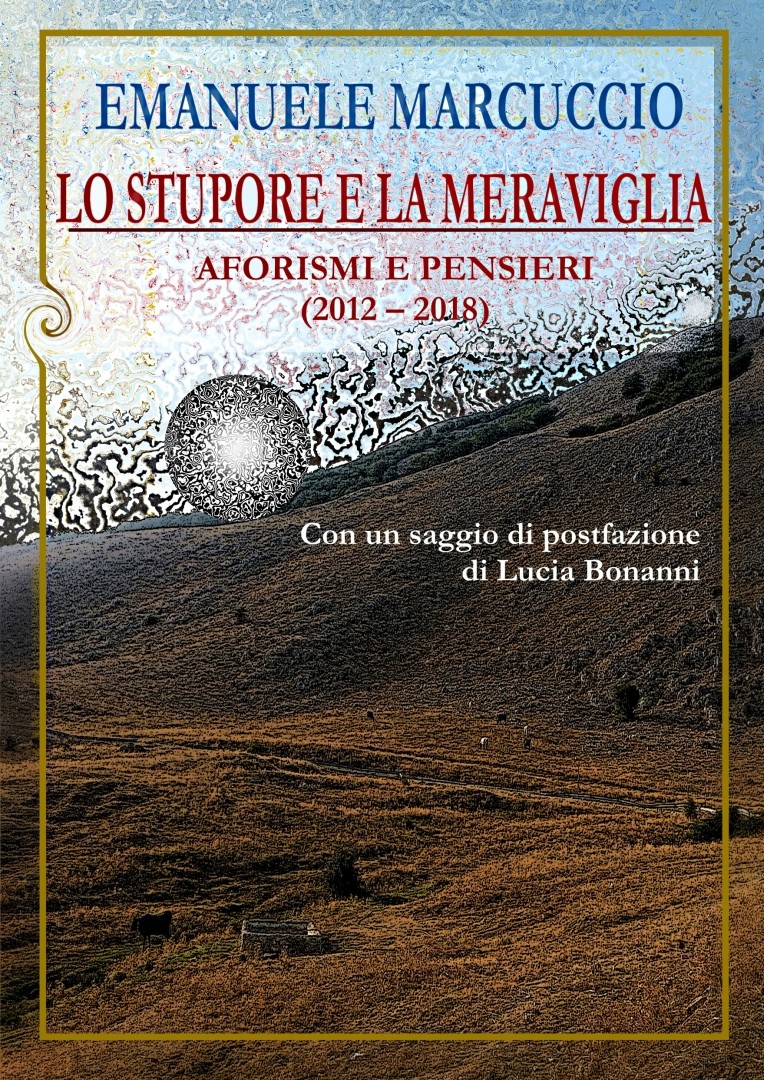
Emanuele Marcuccio’s New Book: Wonder and Amazement: Aphorisms and Thoughts

Vetrina delle Emozioni

This blog was born from the meeting of Authors and Artists. It is a space where music, writing, and above all poetry find a showcase capable of giving voice to the emotions that you know how to transform into art. An invitation to share and allow your words and your notes to reach those who know how to listen to them.

 “Vetrina delle Emozioni” Presents Emanuele Marcuccio’s New Book: Wonder and Amazement: Aphorisms and Thoughts

The work is available through the major Italian and international webstores and through the Youcanprint distribution website.

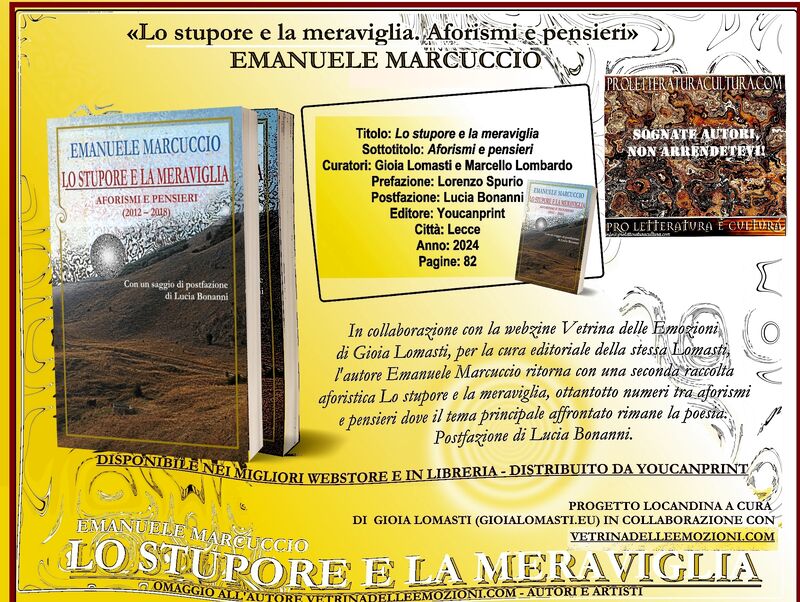
In collaboration with the webzine Vetrina delle Emozioni, founded and edited by Gioia Lomasti, and under Lomasti’s editorial supervision, author Emanuele Marcuccio returns with a second collection of aphorisms, Wonder and Amazement, comprising eighty-eight aphorisms and reflections in which poetry remains the principal theme.

Wonder and Amazement: Aphorisms and Thoughts, a collection by Italian poet and aphorist Emanuele Marcuccio, has now been published. The writings were developed between 2012 and 2018, under the editorial care of poet and writer Gioia Lomasti, with graphic design by Marcello Lombardo, and published by Youcanprint in Lecce, Italy.

Opening the book, we find a preface by the Italian poet, literary critic, and writer Lorenzo Spurio, followed by an editorial note by Gioia Lomasti. The book then presents its eighty-eight reflections and aphorisms, with poetry remaining, throughout, the central theme.
The volume concludes with a postface entitled “With Wonder and Amazement: An Approach to the Aphoristic Writing of Emanuele Marcuccio,” by the late Italian poet, literary critic, and essayist Lucia Bonanni (1951–2024), to whose memory the Author dedicates the book.

The Appendix contains an essay by the Author himself presenting the poetry project “Dipthycha,” conceived and editorially curated by Marcuccio. To date, the project has produced four anthological volumes, published between 2013 and 2022, featuring forty-two contemporary Italian poetic voices.

“This collection of Aphorisms and Thoughts—as the subtitle reminds us—gathers creative fragments that the Author committed to paper over a period of six years, from 2012 to 2018. We may conceive it as the natural continuation of an earlier period of aphoristic writing, subsequently brought together in the previous publication Pensieri Minimi e Massime of 2012.

The new work is preceded by a fascinating yet mysterious Lorca-inspired epigraph, in which the concept of ‘wonder’ is evoked—a concept that Marcuccio makes his own throughout the work. Wonder arises from an act of human participation through observation—not merely visual, but also interior and emotional—and through attentive listening, by which one passionately connects with the object, and the mystery, of one’s attention.”

— From the Preface by Lorenzo Spurio

“Every aphorism is like a pearl of wisdom, capable of leaving a profound impression on the reader. These texts are imbued with an understanding of the human soul and are able, within a few moments of reading, to touch upon complex and universal thoughts.”

— Gioia Lomasti

“The historical reality of the entire corpus of Marcuccio’s works reveals a remarkably broad, organic, and finely structured range of contents, always nourished and cultivated by a genuine love of Literature. Each text produced ‘always remains a dear creature’ (from Aphorism No. 62), almost like an individual who needs to be left free to be read, and in whom every reader can recognize themselves and experience it as their own.

Yet, in intellectual honesty, ‘an author is never satisfied with what he has written’ (from Thought No. 66), because if he were satisfied, he would cease to write.”

— From the Postface by Lucia Bonanni

Bibliographical Information

Title: Wonder and Amazement
Subtitle: Aphorisms and Thoughts
Editors: Gioia Lomasti and Marcello Lombardo
Preface: Lorenzo Spurio
Postface: Lucia Bonanni
Publisher: Youcanprint
City: Lecce, Italy
Year: 2024
Pages: 82
Genre: Essays / Aphoristic Literature
ISBN: 9791222774794

The work is available through major national and international online bookstores and through the Youcanprint distribution channel.

An accessible e-book edition will soon be available through major national and international webstores.

About Emanuele Marcuccio

Emanuele Marcuccio (Palermo, Italy, 1974) is a poet, aphorist, and editorial curator.

In poetry, he has published Per una strada (2009), Anima di Poesia (2014), and Visione (2016). His aphoristic work includes Pensieri Minimi e Massime (2012), while his theatrical work includes the epic drama in verse, set in Iceland, Ingólf Arnarson (2017).

He has appeared in numerous anthologies by different authors, including L’evoluzione delle forme poetiche. La migliore produzione poetica dell’ultimo ventennio (1990–2012) (2012).

He is also the creator and curator of the poetry project “Dipthycha,” which has so far produced four anthological volumes. The project explores the poetic forms of the diptych and triptych, respectively articulated through the voices of two and three different authors.

Vetrina delle Emozioni
Sunday, December 1, 2024

Related Posts

A Look at Alfred Nyagaka Nyamwange’s Collection of Books

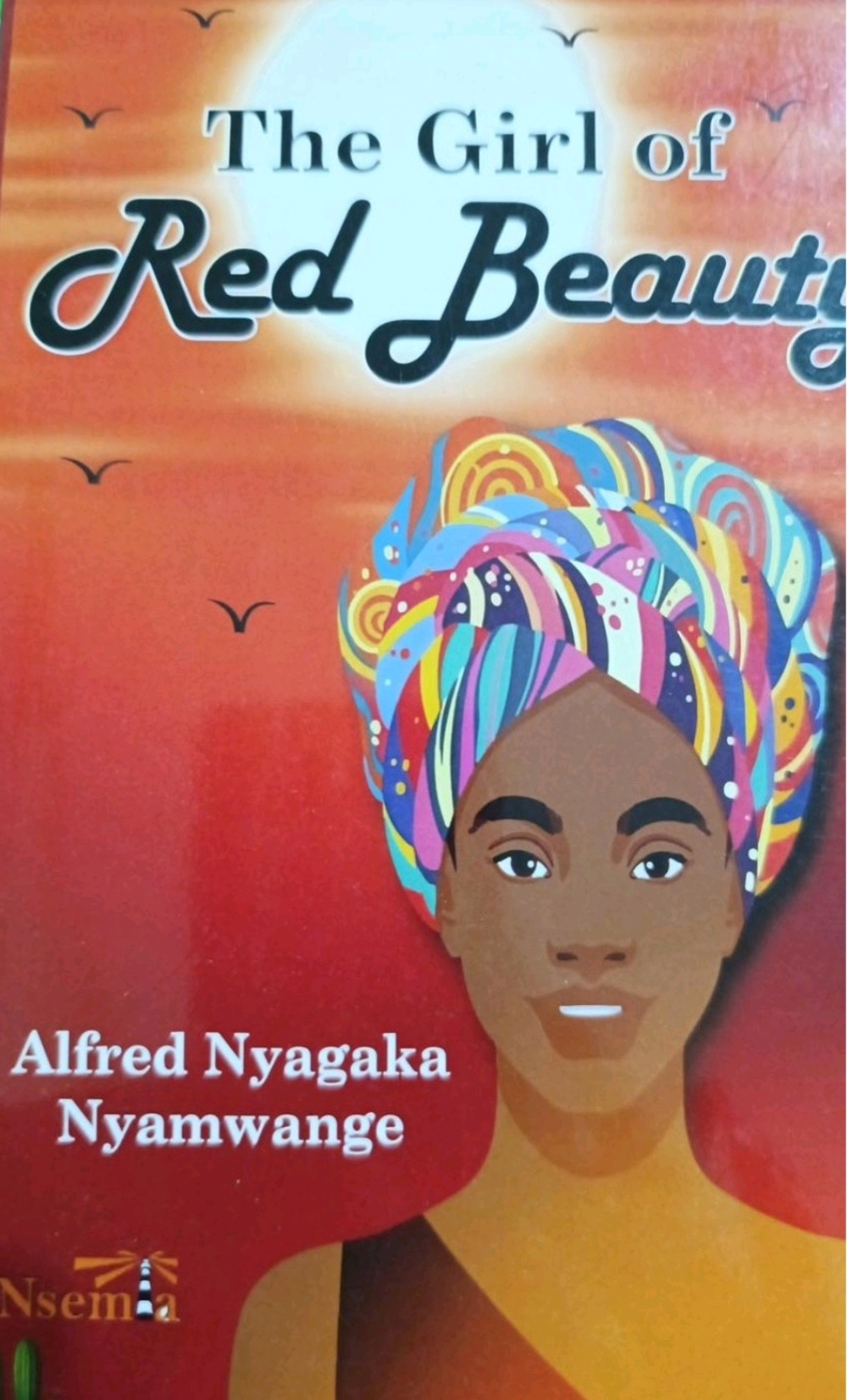
  THE GIRL OF RED BEAUTY  What does it mean to belong to a people, and how can a community preserve its identity when the voices of its ancestors begin to fade beneath the pressures of modernity? In The Girl of Red Beauty, Alfred Nyagaka Nyamwange invites readers into the cultural universe of the AbaGusii through a sustained poetic engagement with the community’s oral traditions, beliefs, social practices and philosophies. Presented in thirteen chapters of verse, the work draws upon songs, proverbs, sayings, stories, play games and the rhythms of everyday life in the Gusii highlands. Its poetic world follows the human journey from birth and childhood through initiation and marriage to old age and death. Along the way, it evokes relationships between individuals, families, the land, the ancestors and the divine. The girl at the centre of the work becomes a poetic point of entry into a much wider cultural landscape: a world shaped by communal memory, inherited wisdom, social expectations and changing relationships. The collection is distinctive in its creative negotiation between written poetry and African orature. Its language draws on indigenous expressions and direct translations from EkeGusii, bringing local imagery and proverbial thought into English. Songs, performance rhythms and the imagined presence of the lyre and drum give the written verse an oral energy, inviting readers not merely to observe the culture but to hear, sing and imaginatively participate in it. The Girl of Red Beauty is both a literary work and an act of cultural remembrance. It does not present tradition as a museum piece; rather, it opens a space for considering cultural continuity, the tensions between inherited practices and contemporary life, and the responsibility of transmitting indigenous knowledge to future generations. Rooted in Gusii experience yet attentive to wider questions of identity and belonging, the book offers international readers an encounter with the imaginative resources of an African community. A poetic celebration of identity, a preservation of memory and an invitation to return to the living sources of cultural knowledge. THE FOOTFALLS OF MY HEART  Love may begin with attraction, but in a traditional community its consequences reach far beyond two individuals. In The Footfalls of My Heart, Alfred Nyagaka Nyamwange presents a narrative poem that explores courtship and marriage in the cultural world of the AbaGusii, giving particular prominence to the voice, perspective and agency of the bride. The poem centres on Gechemba and Rimura. Rimura is a celebrated warrior and prospective groom whose reputation, strength and determination do not automatically guarantee success in love. Gechemba is a young woman who observes, questions, teases and responds to the man seeking her affection. Through her perspective, the reader encounters the emotional play of attraction, hesitation, playful resistance and growing attachment. The courtship becomes a spirited exchange in which wit and persuasion matter alongside status and material wealth. Beyond the romantic encounter, the work traces the social processes through which marriage connects families and lineages. It evokes the meeting between prospective partners, family introductions, negotiations over bride wealth, preparations, marriage rituals, songs, communal celebrations and the incorporation of the bride into a new household. Cattle and other forms of bride wealth carry meanings that extend beyond payment: they express commitment and create networks of relationships between families. The poem is rich in EkeGusii expressions, proverbs, indigenous imagery, humour and the rhythms of oral performance. It draws on cultural memory while allowing readers to consider the values and tensions embedded in marriage practices. The bride’s voice is especially important: she is not simply an object of pursuit but a participant whose response, judgement and choice shape the unfolding relationship. As a companion to The Girl of Red Beauty, this work extends Nyamwange’s poetic exploration of Gusii cultural life. Where the earlier poem approaches the community through a girl’s growth and the wider cycle of life, The Footfalls of My Heart foregrounds the woman’s perspective in the journey towards marriage and family continuity. A warrior pursues; a woman responds and chooses; families negotiate; a community gathers. The Footfalls of My Heart is a poetic exploration of love as both an intimate emotion and a communal bond. THE BROKEN COLUMN  What happens when a society’s established ways of life encounter forces that challenge its institutions, beliefs and sense of identity? The Broken Column by Alfred Nyagaka Nyamwange is a historical and cultural novel set in the world of the AbaGusii, tracing the experiences of a warrior and the wider transformations of his community. At the centre of the narrative is Okeyo, a young man renowned for courage, physical strength and exceptional skill. His reputation as a warrior places him within a social order that values protection, honour, responsibility and service to the community. Yet Okeyo’s life is not a simple succession of heroic achievements. His relationships, personal struggles, choices and encounters with adversity expose the vulnerabilities beneath the public image of the fearless warrior. His destiny is shaped by the demands of his calling and by the changing circumstances of the society around him. The novel evokes a community organised through kinship, village life, ancestral expectations, warrior traditions and collective obligations. Its landscape is not merely a backdrop: it is a lived environment in which cattle, homesteads, social relations and communal security carry cultural significance. Okeyo’s experiences intersect with those of other people, particularly the women whose presence and decisions influence his path. A profound historical change gathers around this personal story. The arrival of foreign authority, missionary Christianity and colonial power unsettles the foundations of the community. Established loyalties are questioned; inherited practices encounter new religious and political claims; and individuals must negotiate the competing demands of continuity, resistance and accommodation. The meaning of courage itself becomes uncertain as the society confronts a future it cannot fully control. The Broken Column therefore operates on two connected levels: it is the story of a man whose life contains both achievement and vulnerability, and the story of a people experiencing a difficult historical transition. Through its engagement with masculinity, identity, power, faith, tradition and colonial encounter, the novel invites readers to consider what happens when the structures that sustain a community begin to fracture.…

Dance in Silence, Poem by Anwar Rahim

They speak without a sound Their steps upon the ground No music needs to play Their hearts still find the way Two shadows in the light They hold each other…

اترك تعليقاً

لن يتم نشر عنوان بريدك الإلكتروني. الحقول الإلزامية مشار إليها بـ *