 thesilkroadtoday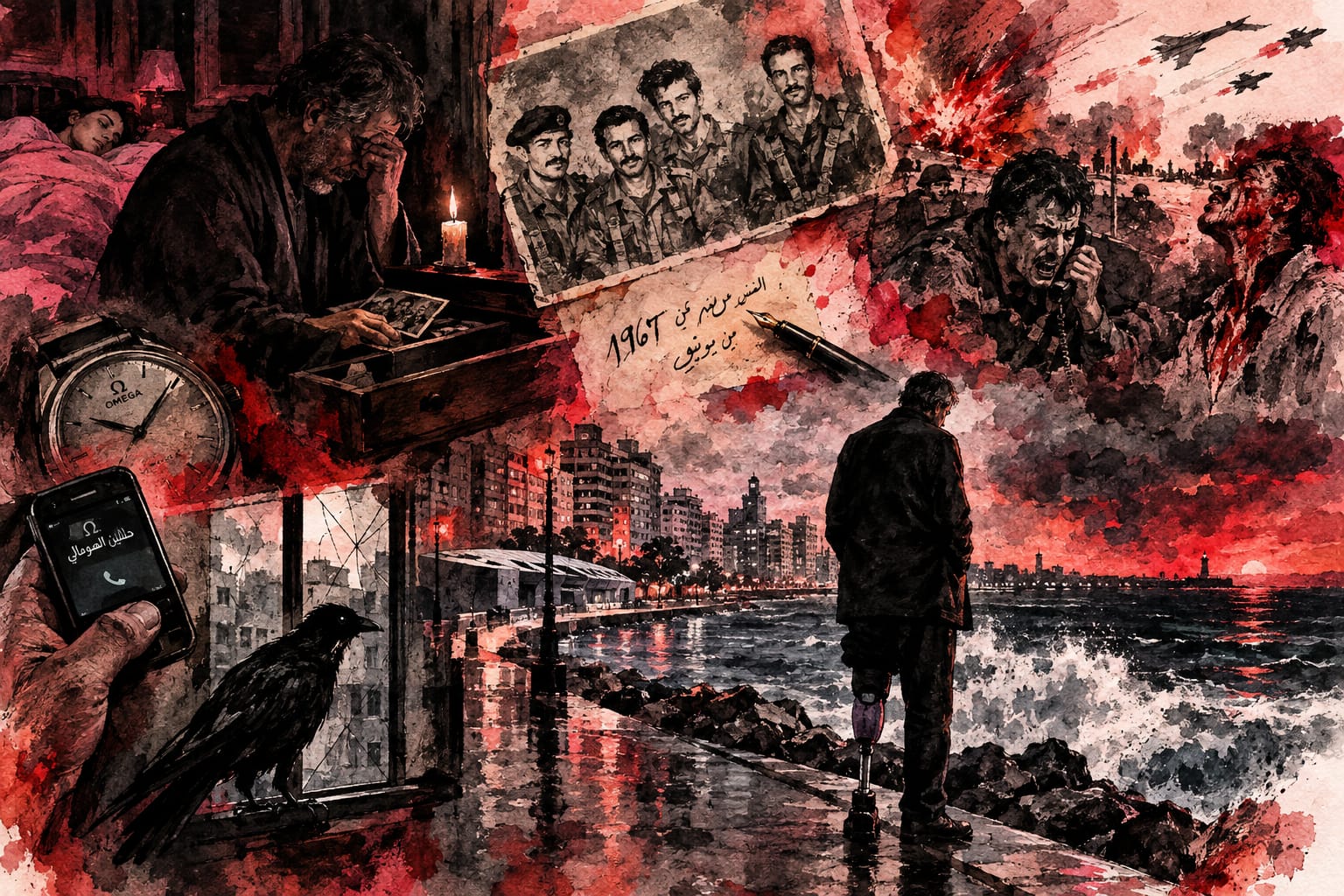
A chapter of KATO, a new novel by
Egyptian novelist Hussain Abdel-Rahim, Egypt
Ahmed Metwally
It was a posture he had assumed countless times since leaving the service and being honored by General Adel Khalil: standing on a balcony, dark as ever. He had never cared much for light. He had grown accustomed to the belief that clarity of mind was complete only in darkness.
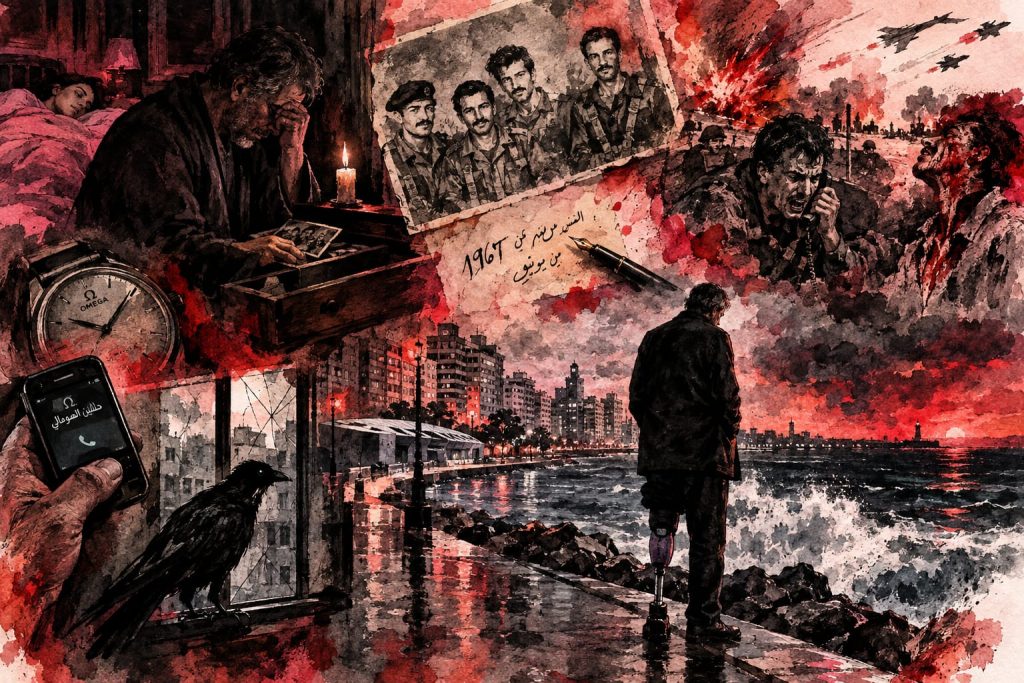
He looked at Yara, wrapped in a pink sheet in her bed. A kiss on her forehead brought tears to his eyes. He returned to the bar and lit a single candle. He opened the large drawer and took out his old photographs, gazing at his comrades-in-arms: Rabie al-Bazzaz, Yousry Hammam, Hamouda al-Nabaa, and Abdel Rahim Gamal.
June 5, 1967.
The words were written in black Ruq‘ah script with a Koopy pen. He no longer wept as he had after leaving the service, after the ceremony at Deversoir, when he had been presented with a bag. Yet he could still hear the whispering, the drone of aircraft. He could see charred bodies, limbs flying from a burned body, Rabie spewing blood from his mouth. He saw himself retreating into a distant corner, into the trench beneath the earthen embankment; Yousry Hammam with his face ablaze, burned by an incendiary projectile. Yousry screaming, cursing the commanders as he listened to the radio, turning the dial of a transistor through station after station, until the news reached him: fighter planes had been struck at the airport west of Cairo without ever having moved.
He wept bitterly that night and felt a suffocation in his chest. He raised his face toward the sky and searched the horizon beyond the black waves of the sea, looking out from deep among the buildings crowded behind him in Camp Caesar. He decided to go downstairs just as a bewildered crow collided with the glass of the window overlooking the Corniche. Through the narrow gaps that Metwally pierced every night with his gaze, he could see beyond sight itself. His intuition galloped ahead of his eyes.
Only now did he begin to regain his balance.
He stood alone, five minutes before midnight. He had walked from Camp Caesar. His eyes never left the hands of his Omega, its cloudy dial. The mobile phone he had carried for ten years, since buying it from Sayed the butcher on Nabi Daniel Street, no longer seemed important. He stared at its screen to make out the name clearly:
Hussein al-Somali.
He laughed, then wept, then drifted into a reverie. His left leg, amputated above the knee, rested heavily and awkwardly inside the sheath of his prosthetic. It remained fixed upon the Corniche pavement after he had crossed the Bibliotheca Alexandrina and come to stand facing the high rocks. He had watched the violent agitation of the waves, listening to the sea at Shatby.
A salty tear escaped his eye. He took a single step to rest his sound right leg.
He remembered what had happened the night before, when his son Mahmoud had awakened him, alerting him to the sound of the mobile phone. He rose in terror, frightened, staring at the illuminated screen of the Nokia. He saw the name and drifted away into thought. He felt his way through the room in darkness, nearly falling from his bed. When his son saw him, he rushed to support him, but Metwally shoved him away violently. He leaned against the cracked wall and listened to the sound of water dripping into the tin bucket in his little bathroom. He belched, coughed, rubbed his eye, and opened the window.
Seventh floor.
He looked at the clouds and their brilliant stars filling the Alexandrian sky, in an autumn he had come to regard as the last of his life, now that he was nearing seventy-five.
Everything that had happened in his house the previous night churned inside him again as he stood watching strange birds settle on distant rocks in the darkness. The Corniche was almost deserted, except for a few night wanderers and girls running nearby, close to the corn seller absorbed in his work over a sheet-metal brazier. He threw a bag of charcoal into it. His red eyes seemed to project some hidden anger, sparks shooting arrows of rage toward an unknown target, toward something yet to come.
He had felt it since the beginning of the year, since January 2020: that the days had run out, that life itself was about to be folded away. He felt that death was near, and that this night had already been appointed by fate. And he felt that God had finally reconciled him to Himself by allowing him to see Hussein al-Somali again—Hussein, of whom he had heard nothing since his departure, or escape, from Port Said in 1989.
He exhaled and began walking toward the corn seller.
“Give me a hot ear in your hand, Ramzy.”
Ramzy raised his head, unable to believe his eyes, as he studied the features of Captain Ahmed Metwally, hero of the War of Attrition.
Ramzy began to cry. Metwally stretched out his arm and, with a gesture of his broad palm and long fingers, ordered him to carry on with his work after the feather fan had fallen from his hand.
Ramzy fell silent.
He too began remembering, his eyes fixed on Metwally, who had drifted away again, watching a blond girl as she walked toward the rocky barrier. He said not a word until Metwally returned and gently patted his shoulder. He unbuttoned his shirt to let in the autumn air and looked again at his watch. The hands were approaching twelve-thirty.
He hopped forward on one foot.
The young women turned to watch him, almost birdlike, balancing on a single leg. He sat on the Corniche with his back to the passers-by, leaving Ramzy behind. Ramzy’s eyes flashed, their redness deepening as he blew into the fire and muttered words no one could hear.
His gaze lingered in the distance.
“Tell me when you’re finished,” Ramzy said, “and I’ll order you some tea from Mando.”
Metwally cut him short.
“Something cold. My insides are on fire.”
Quail had settled upon the rocks of Shatby in the darkness of the sea. The waves rose higher, foam appeared, whitening the water as it boiled and crashed violently against the barriers.
Ahmed Metwally appeared there, watching the fishermen below his left foot, which hung lifeless.
He tried to fold his right leg beneath him. He lit a second cigarette and began to watch.
His sharp right eye seemed to pant. An extraordinary inner light examined the surroundings, scrutinizing the faces of passers-by. From where he sat, his gaze traveled along the Corniche all the way to Qaitbay Citadel.
Suddenly he turned and asked Ramzy:
“Do you remember the lighthouse, Ramzy?”
Ramzy looked at him in astonishment.
“You still remember, hero?”
Metwally laughed.
“Hero? Who’s the hero? You’re the hero, Ramoos. We are the generation of defeat—even after victory.”
He returned to the surface of the sea. His tears fell as he repeated silently to himself:
“Hero!”
He laughed wildly, mockingly. The ringing and buzzing in his ear grew longer and louder.
He heard the words again and again:
“Stay alert, hero.”
“Take cover in the bunker, Sergeant Major. Secure your helmet. Crawl. Crawl. Fire! Fire! Stay down. Let Rabie, Yousry, Hamouda, and Gomaa al-Naghy pass beneath the earthen embankment.”
Metwally laughed and wept, repeating the words, rubbing his eye. Passers-by stared at him in bewilderment and fear, their confusion deepening as his laughter rose hysterically and his eyes reddened. His features emerged sharply: a dark, round face, white teeth, and coarse, curly hair dyed a vivid brown with henna.
He came to himself when the Blockamin stopped.
An officer bearing the rank of brigadier general got out. He walked slowly toward Ahmed Metwally, saluted, and Metwally answered:
“Good evening, Commander. Anything I can get you, hero?”
Ahmed Metwally looked at him tenderly.
“Thank you, Commander. I thought I’d walk along the Corniche. You know how much I love autumn—and how I’m obsessed with seeing quail in the dark sky.”
The officer climbed into his black car, and the soldier drove away lightly toward Ramleh Station.
Metwally looked again at his mobile screen, then said to Ramzy:
“Do you remember Hussein al-Somali, Ramzy? Haven’t you seen him around here these past few months?”
Ramzy stared at him in astonishment.
He said nothing.
He was stunned, his head lowered, staring at the ears of corn. Then he leapt over the Corniche wall almost like a bird, extending his right arm in the air level with his chest, while his left leg struck firmly against the sheet-metal brazier.
He threw his empty Pepsi bottle beside the Corniche wall and resumed speaking to Ramzy:
“Something filthy, brother.”
“Can a man in his seventies still masturbate?
“Damn ignorant women. Wasn’t it enough that they condemned us to poverty, ignorance, and disease for thousands of years? And then my own wife comes along to complete the whole system.”
Ramzy scratched his head.
He began to cry.
He turned his sorrowful face away, opposite Metwally, who raised his head toward the sky and cast his gaze toward Qaitbay.
In a whisper, his voice weak:
“Could it be, Hussein? Could it really be, Somali? You died drowned?
“I said you would come after the Revolution, and you were so late. Then I saw you by chance standing opposite me in the courtyard of El-Mursi Abu al-Abbas. I cried that day. We cried together. Yes, we cried—cried so much.
“It was February 2012, the month that brought all the disasters. Then all the messages stopped.
“You were crying bitterly and saying to me: ‘Yes, the prophecy was true. Port Said will face ruin—burned or drowned.’
“And here it is, burning, Ahmed. More than one hundred and twenty-seven men were killed because of a football match. Even the funerals of the martyrs were not spared the firing of the Interior Ministry officers.
“Port Said, hero. Do you remember it?”
He walked away violently, alone, striking his feet against the air, dragging his legs, opening his chest to the sea breeze.
He remembered his platinum cane, the one he leaned upon, just before making another attempt.
Ramzy had already hurried after him when Metwally called out:
“Throw it away.”
He caught the cane and walked toward Ramleh Station.
The passers-by watched quietly.
He stopped, bewildered, on the pavement opposite Athenios. He stared, then swept the place with steady eyes as the blond girl passed by in a pink lamé skirt and a black top. She tossed her hair, its locks swinging behind her tightly drawn back, a bra visible beneath the haze of a streetlamp whose source could not be identified.
Her mother called to her from the Corniche.
Metwally walked cautiously and slowly, remembering his daughter Sophie, who would enter university the following year.
Like a twenty-year-old, he suddenly began walking lightly, until a young man came from behind him, wearing a burlap sack that covered his nakedness down to just below the knee.
Metwally stopped and called:
“Kato! Hey, boy! Kato!”
A young man appeared, approaching thirty, his face dusted with fine earth.
Kato began to dance, delighted, swaggering along the Corniche parallel to Athenios, laughing joyfully as he called out:
“Uncle Hero! Did you see me yesterday dancing ‘Anna Magnani’ on the Cecil pavement, you old fox of Deversoir?”
Ahmed Metwally laughed.
Then he wept.
He cast his gaze toward the various buildings in the direction of the National Bank, which had once housed the Italian consulate. He walked slowly toward the statue of Saad Zaghloul.
He saw Saad walking on bronze feet.
The leader strode through the darkness toward Bahary.
Metwally turned and saw the Metropole moving slowly as well, leaving Ramleh Station, bidding farewell to its street, its gaze falling upon the sign:
Saad Zaghloul.
Metwally drew near the sea, rubbing his eyes, now overflowing with tears that streamed down his cheeks. They reached his mouth, making his eyes burn redder.
He imagined the buildings of central Alexandria moving through the city, abandoning their old quarters until nothing remained but Nabi Daniel Street.
The ringing in his ear grew louder.
He heard the shriek of a train at some strange station.
Memory returned, hurling great events at him: Misr Station, Sidi Gaber, Bab al-Hadid.
He saw soldiers in camouflage uniforms and a screaming military train that never seemed to leave the station. He saw sand dunes, the thunder of explosions, land mines scattered across Bir al-Abd, dense sands stretching before Al-Milz airfield, legs flying through the air.
He saw Yousry Hammam, Rabie al-Bazzaz, Hamouda al-Saket, and Gomaa al-Naghy screaming before dawn on the fifteenth of October.
And he felt for his limp—
for the leg that had been cut away.
Translated by: Dr. Ashraf Aboul-Yazid