 thesilkroadtoday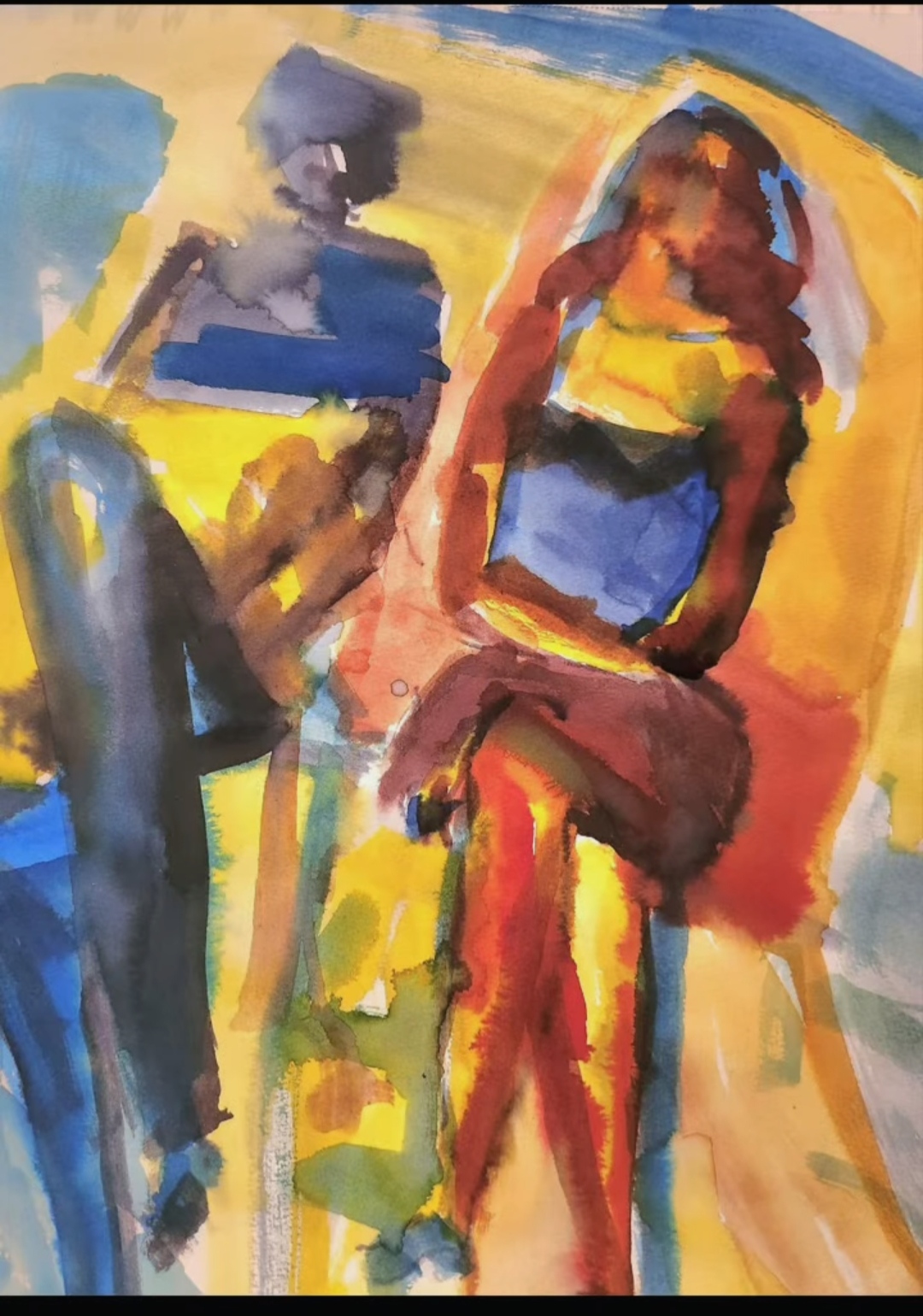

A Critical Reading of Paintings by Abdel Razek Okasha
By Dr. Ashraf Aboul-Yazid
In his new exhibition, Tales from Our Streets , the Egyptian artist, novelist, and art critic Abdel Razek Okasha, founder of Darna Museum in Egypt, invites us to enter a Paris that exists beyond the familiar postcards, monumental landmarks, and carefully framed tourist views. His Paris is a city of intimate encounters, fleeting gestures, neighborhood memories, and ordinary people whose lives quietly transform the street into a living narrative, where he has been living for more than three decades.
Through his paintings, Okasha takes us into the emotional geography of his Parisian neighborhood, particularly the streets of Montmartre and Rue des Abbesses, in the 18th arrondissement. Here, the street is not merely a physical setting; it becomes a stage, a meeting place, a witness, and an extension of human memory. Every corner seems to carry a story, every figure suggests an unwritten biography, and every color contributes to the atmosphere of a life being lived.
The Street as a Human Story
The title Tales from Our Streets establishes the exhibition’s central idea: belonging. The possessive pronoun “our” transforms an ordinary urban space into a shared home. The street belongs not only to those who live there but also to those who pass through it, pause upon a bench, meet a neighbor, or sit down to eat. Okasha discovers a universal human experience within a particular Parisian neighborhood.
This approach is especially significant for an Egyptian -French artist who has made his home in the visual and cultural landscape of Paris. Rather than treating the city as an external subject to be observed from a distance, he approaches it as an intimate environment, absorbed through daily experience. His gaze is that of a storyteller who recognizes that the most revealing aspects of a city often emerge from its unremarkable moments.
The paintings can therefore be read as interconnected fragments of an urban novel. Each offers a different scene, but together they construct a portrait of a neighborhood in which physical spaces and human emotions continually overlap.
“At the Door of Our Street”: The Individual and the City
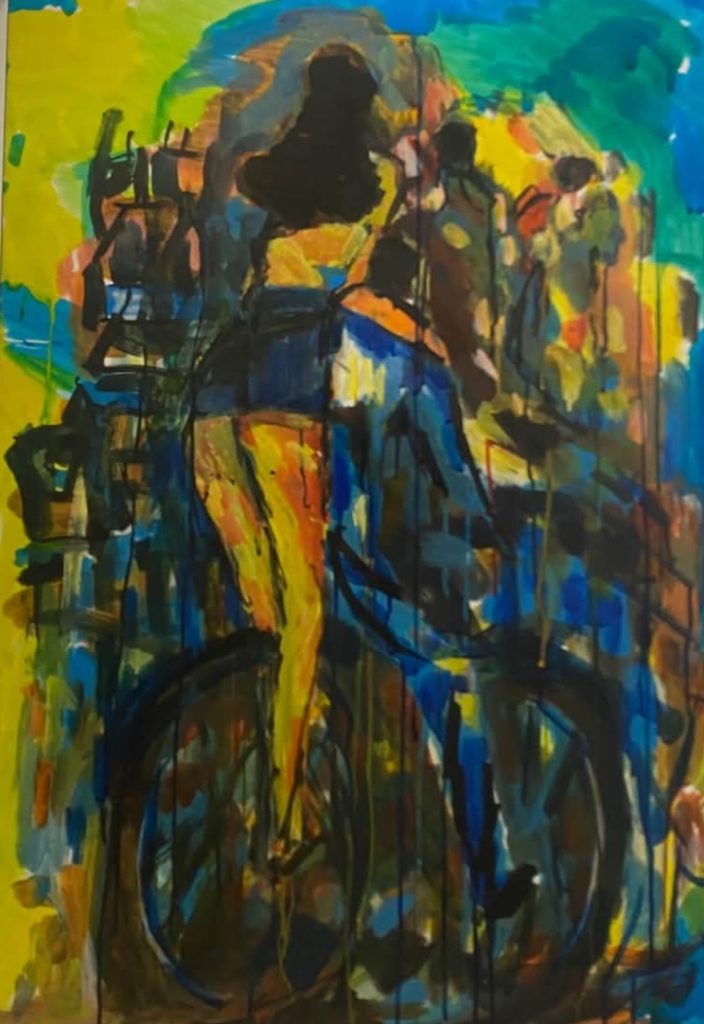
In At the Door of Our Street, the human figure emerges through vigorous brushwork and a warm, expressive palette. The body is suggested rather than meticulously defined, and its fragmented forms seem to merge with the surrounding architecture and atmosphere. Ochre, yellow, red, brown, and blue compete and converse across the canvas, giving the scene an emotional intensity that transcends literal description.
The figure becomes more than an individual portrait. It can be understood as a symbolic inhabitant of the street: someone whose presence gives the place its identity. The doorway, suggested by the title, becomes a threshold between private life and public space, between the familiar interior and the unpredictable world outside.
Okasha does not appear interested in freezing his subject into a formal pose. Instead, he allows the figure to remain active within the painting’s visual rhythm. The looseness of the brushwork gives the scene a sense of immediacy, as though the artist has encountered a moment that must be recorded before it disappears.
The result is a portrait of belonging in which a person and a place seem inseparable. The street acquires a human face, while the human figure becomes part of the street’s enduring memory.
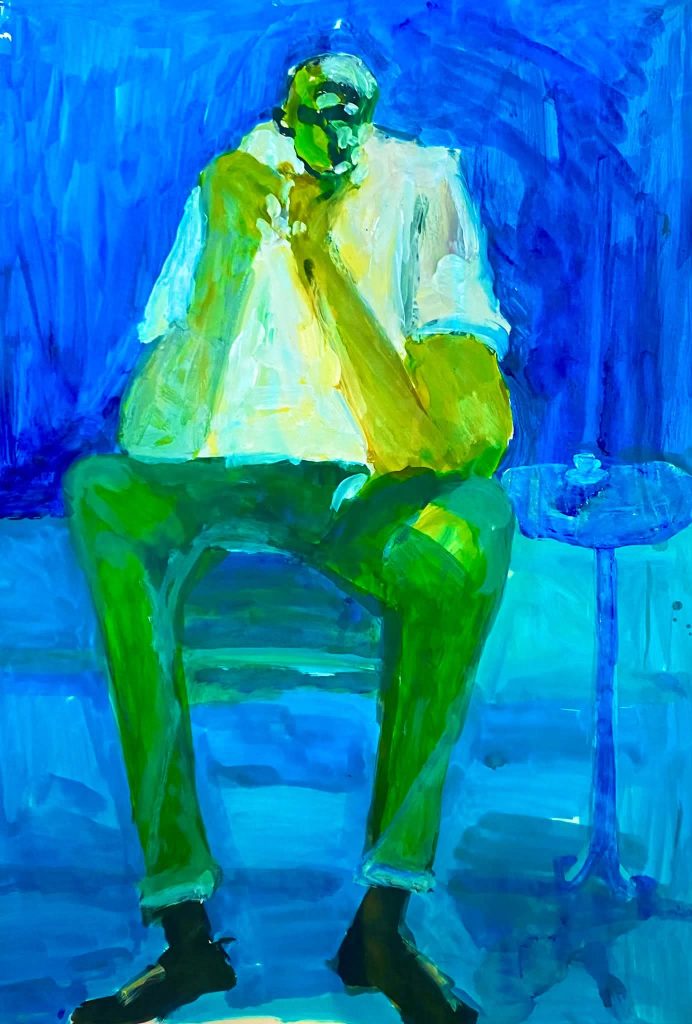
“Sitting on the Bench Opposite the Metro”: The Art of Waiting
A bench may be one of the simplest objects in a city, yet it offers an extraordinary position from which to observe life. In I Sat on the Bench Opposite the Metro, the act of sitting becomes an artistic and philosophical gesture.
To sit is to interrupt movement. The city continues to hurry around us, commuters come and go, and the metro carries people toward destinations unknown to the observer. Meanwhile, the person on the bench occupies a moment outside the city’s relentless rhythm. Waiting becomes a form of attention.
The painting’s energetic handling of color and form suggests that stillness does not necessarily mean silence. Even when the body rests, the eye remains active, collecting impressions and registering the movement of the surrounding world. The bench becomes a modest observatory from which the artist can contemplate the human theater unfolding before him.
There is also a literary dimension to this scene. The first-person construction of the title turns the painting into a fragment of personal testimony. We are not simply looking at a bench; we are invited to occupy the artist’s position, to share his pause and experience the city through his act of seeing.
In this sense, the painting transforms an ordinary urban object into a place of reflection. It reminds us that a city reveals itself not only to those who move through it but also to those who stop long enough to observe.
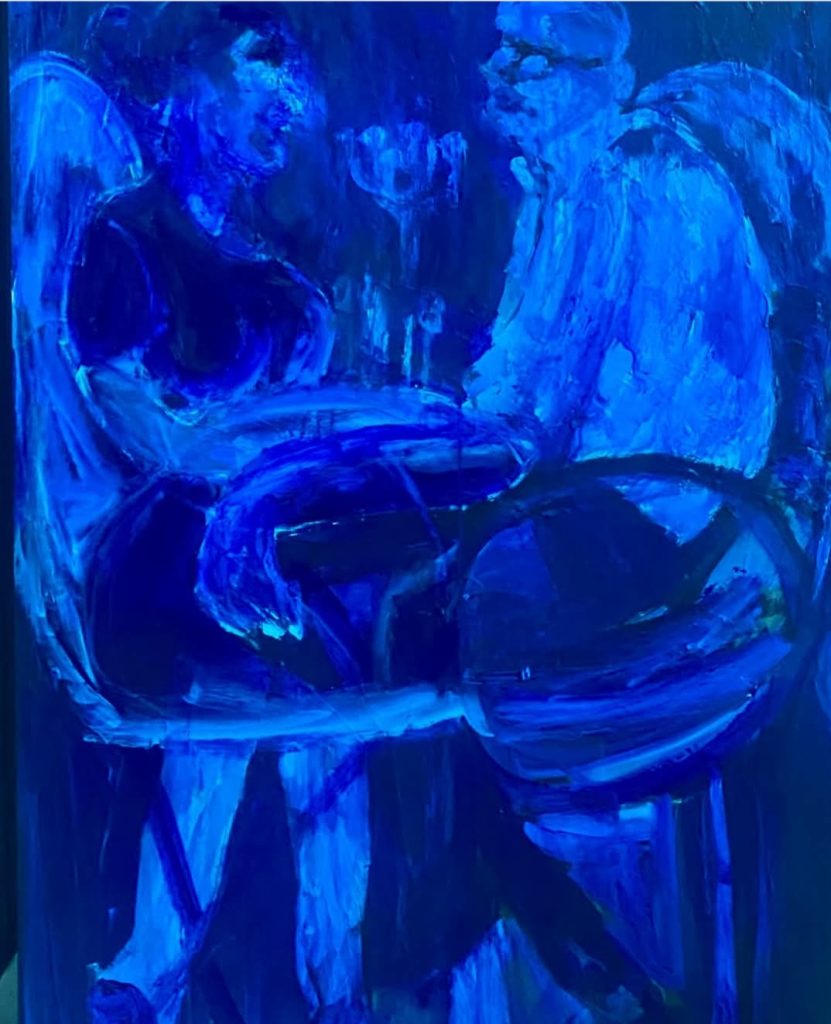
“Dinner on Mouffetard Street, Paris”: The Warmth of Shared Life
With Dinner on Mouffetard Street, Paris, Okasha moves from individual contemplation toward collective experience. The human figures gather within a vibrant composition dominated by reds, oranges, yellows, and deep earthy tones. The colors appear to spill across the canvas, dissolving rigid boundaries and creating an atmosphere of movement, warmth, and social proximity.
The figures are not presented as isolated portraits. Their relationships, gestures, and shared presence matter more than individual identification. The composition suggests that eating together is not merely a practical necessity but a social ritual through which people affirm their connections to one another and to the place they inhabit.
Okasha’s expressive treatment of the figures also resists the detached precision of documentary representation. Instead of reproducing every detail of a meal or a street scene, he captures its emotional temperature. The intensity of the colors conveys something of the experience itself: the warmth of conversation, the animation of bodies, and the pleasure of being among others.
Food, in this context, becomes a language of belonging. Across cultures, a shared meal can transform strangers into companions and a public street into an extension of the home. The painting therefore speaks beyond its Parisian location, touching on a familiar human ritual that connects different societies.
Mouffetard Street becomes not simply a geographical reference but a space where urban life acquires intimacy. The city is experienced through the senses, through human proximity, and through the ordinary pleasure of sharing time and food.

“Our Street — Rue des Abbesses, Montmartre”: A Portrait of Belonging
In Our Street, Okasha explores the neighborhood through a different visual vocabulary. Strong blues, luminous greens, and yellow highlights create a striking contrast, while the simplified forms of the street furniture and surrounding structures approach abstraction. The objects remain recognizable, yet their identities are shaped as much by color and rhythm as by physical description.
This transformation is essential to understanding Okasha’s artistic vision. He does not merely reproduce the appearance of Rue des Abbesses; he reconstructs the experience of living within it. The street becomes a personal landscape, shaped by memory, mood, and repeated encounters.
The intense blue background establishes an atmosphere that seems at once urban and dreamlike. Against it, the green forms create a visual anchor, suggesting the ordinary objects through which a neighborhood becomes familiar. Their importance lies not in grandeur but in repetition: these are the things one encounters day after day until they become part of one’s internal map of home.
The title itself is revealing. By naming the street and locating it in Montmartre, Paris 75018, Okasha gives the painting a precise geographical identity. Yet the possessive phrase “Our Street” simultaneously carries the work beyond geography. It expresses an emotional claim, a relationship built through presence and experience.
The painting thus occupies a productive space between the actual and the imagined. Its location is specific, but its emotional meaning is universal. Anyone who has developed an attachment to a street, a café, a familiar corner, or a neighborhood bench can recognize something of their own experience in it.
Between Painting and Literature
One of the most compelling aspects of Tales from Our Streets is the dialogue between Okasha’s visual practice and his literary imagination. As a painter and a novelist, he appears to approach the canvas with a storyteller’s instinct for scenes, characters, and atmosphere.
The titles function almost like the opening lines of short stories. They establish a place, introduce a situation, or suggest an encounter, leaving the viewer to imagine what preceded the depicted moment and what might happen afterward. The paintings consequently resist closure. They are not complete narratives so much as invitations to continue the story in the imagination.
His expressive brushwork reinforces this open-ended quality. Forms are frequently suggested rather than fully delineated, while contrasting colors carry emotional meanings that cannot be reduced to literal description. The paintings preserve the spontaneity of an encounter, allowing the viewer to experience the scene rather than merely decode it.
This is where Okasha’s literary and artistic identities converge. The novelist builds a world through words; the painter constructs one through color, gesture, and composition. Both practices depend upon selection, rhythm, and the ability to make an ordinary moment resonate beyond itself.
Tales from Our Streets is ultimately an invitation to reconsider how we look at the places we inhabit. Abdel Razek Okasha finds artistic significance not in the monumental image of Paris but in its everyday human fabric: a figure at a doorway, a person sitting opposite the metro, people sharing dinner, and the familiar visual elements of a neighborhood street.
Across these paintings, the city becomes a repository of lived experience. The figures and objects are not simply subjects to be represented; they are fragments of a larger human narrative, held together by memory, color, and the intimate relationship between people and place.
Okasha’s Paris is therefore neither entirely foreign nor exclusively French. It is a Paris experienced through the sensibility of an Egyptian artist, shaped by the meeting of cultures and by the universal desire to find familiarity within the vastness of the modern city.
Perhaps the deepest achievement of these paintings lies in their modesty. They remind us that the history of a place is not written only in its monuments or recorded in its official archives. It is also preserved in the small gestures of everyday life, in the benches where people pause, the tables around which they gather, and the streets they gradually learn to call their own.
A street becomes a home when it accumulates memories. And when an artist transforms those memories into images, a private experience opens itself to the world.
Through Tales from Our Streets , Abdel Razek Okasha makes the Parisian neighborhood a meeting point between painting and literature, between individual memory and collective experience, and between the particular identity of a place and the shared humanity that gives it meaning.
A street, in Okasha’s hands, is never merely a street. It is a tale that continues to unfold.