 thesilkroadtoday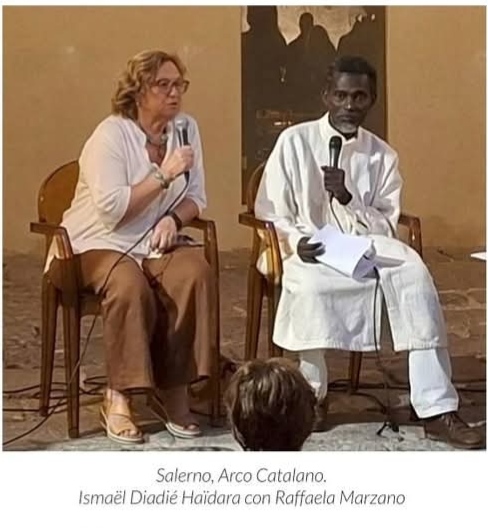
By Sergio Lagulli
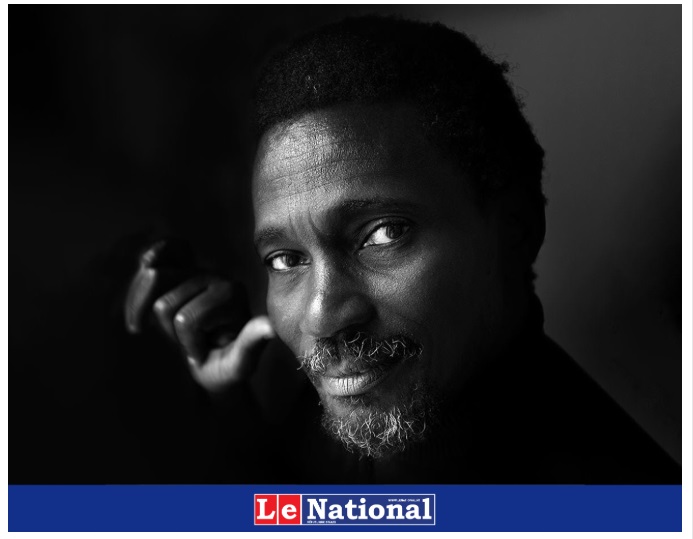
 There is an ancient poetic form that the women of the Sahara used to compose at night, among the dunes, for their beloved: the tebrae. Two lines, six and eight syllables, and a single theme: love. They circulated anonymously, like the wind. Ismaël Diadié Haïdara, poet, philosopher, and historian, born in 1957 in Bajindé, Timbuktu, collected these poems from the oral memory of his people and transformed them into something radically new: an open form capable of embracing the entire world.
But who is Ismaël Diadié Haïdara? The answer crosses centuries and continents. Haïdara is the last descendant of Ali ben Ziyab al Kuti, a citizen of Toledo who was expelled from the city in 1468 and settled in Timbuktu. He brought the family manuscripts with him, and from that forced departure emerged the Fondo Kati, the Andalusian library of Timbuktu—the most important documentary legacy of Andalusian origin outside Spain—with more than twelve thousand manuscripts preserved from generation to generation.
This story reveals much about what the word exile means to this man: not a biographical event, but an inherited condition, a wound transmitted through both blood and paper. “Those who have known Toledo will never be able to forget it,” one of his ancestors wrote nostalgically, knowing that he would never return.
The first tebrae written by Haïdara arose from an intimate wound: the death of his mother. But those collected in this volume have a different origin. In 2012, first the Tuareg rebellion and then the jihadists’ conquest of Timbuktu forced Haïdara into exile, not before he had managed to save as many documents as possible from the Fondo Kati.
It was during his flight, in exile, and amid the memories of his family history that the story of Ali ben Ziyab—who had travelled this same road five hundred years earlier—returned with overwhelming force. The tebrae multiplied, eventually reaching 1,203 poems. It was as though the form, once inhabited by private grief, had now become ready to accommodate a much greater sorrow: mourning for a homeland, the loss of an entire world.
Salerno, Arco Catalano. Ismaël Diadié Haïdara with Raffaela Marzano.
Brevity as an Ethical Choice
Tebrae is a book that approaches brevity as an ethical choice as much as an aesthetic one.
Haïdara preserves the dual structure of the classical tebrae: the first line conveys a thought, a feeling, or the emotion of the moment; the second evokes a natural phenomenon. Yet he liberates this form from its exclusively amorous themes, opening it to everything life brings: death, childhood, famine, war, nostalgia, wandering, and that refuge in the order of nature which seems to be the only space beyond the reach of history’s brutality.
It is worth remembering that tebrae originated anonymously and were created by women. Women composed and transmitted them without signatures or claims of authorship. Haïdara performs an act that is at once preservative and subversive: he gives the form an individual voice, a name, and a biography, while preserving its essential vocation and the emotional reserve that lies at the heart of the Sahara’s Hassaniya tradition.
Exile is the underlying tone of the book, but not in the conventional sense of lamentation and loss. Haïdara inhabits it with a clarity reminiscent of certain Stoics and Epicureans. He does not renounce the world; he redefines it from within:
It is not up to you whether you live for one day or a thousand;
what is up to you is to fly with the dragonfly’s joy.
Or, with disarming simplicity:
Open the door when love arrives.
Open it again, with gratitude, when it leaves.
And again, with an intensity that surprises precisely because it does not seek to surprise:
I am all the kisses that brought me back to life,
every word of light and love that kept me awake.
Pain is not denied but transfigured, carried to a point where it ceases to be merely individual and becomes universal.
The brevity of the tebrae demands absolute economy. Every word must earn its place within the two lines; there is no room for ornament, explanation, or commentary. And it is within this compression that the paradox erupts:
I can do without everything except silence.
With words begins the world’s misunderstanding.
A poet who warns us against words, using words to do so, in two lines that stand entirely on their own.
The reader is compelled to do the poet’s work: to complete the poem, let it resonate, and bring personal experience into that small vessel which nevertheless manages to contain everything.
In this respect, Haïdara belongs to a tradition that crosses cultures and centuries, from Japanese haiku to classical Arabic poetry, from the Greek epigram to the Persian couplet, while remaining deeply rooted in his own Hassaniya heritage.
Translating Silence
The translation by Rossella Nicolò and Giancarlo Cavallo confronts a considerable challenge: recreating in Italian the tension of a poetic form conceived in another language and within a different mental and cultural climate.
Translating tebrae means resisting two opposing temptations: the temptation to explain, to open up what the text deliberately keeps closed; and the temptation to smooth over, to make fluent what must retain a certain roughness, a certain strangeness.
The result is restrained and respectful, with lexical choices that pursue the essential without yielding to the seduction of stylistic embellishment.
Rossella Nicolò’s contribution to the volume goes beyond translation. Her introduction is a valuable and generous guide, accompanying Italian readers into a distant poetic, cultural, and historical universe. With knowledge and passion, she leads them through Haïdara’s biography, the roots of this poetic form in the Hassaniya oral tradition, and the historical context of contemporary Mali.
This is a text that does not explain poetry—which would be both impossible and pointless—but prepares a space in which poetry can truly be heard.
The glossary and thematic index at the end of the volume complete this carefully curated editorial work. They reveal a book conceived not only for poetry readers but also for anyone wishing to understand more about Timbuktu, sub-Saharan Africa, and what it means to preserve a memory when everything around it is burning.
In the end, a question remains—a question the book itself poses, and one the reader carries away:
What shall I do with my life
after sixty-three rainy seasons?
Perhaps continue travelling, loving, and sleeping.
And then, with the lightness that only someone who has endured the worst can afford:
One day, grass will grow over my grave,
but do not weep. A drifting cloud, I laughed at everything.
This is not resignation. It is wisdom—the rare kind that has no need to prove itself.
It is the same wisdom with which a man has endured two exiles, saved thousands of manuscripts, and found in the desert’s tebrae a way to say everything in two lines.
Publishing this book in Italy today is not a neutral gesture. It is an act of restoration, a way of remembering that poetry, even when born anonymously, even when born of mourning, refuses to be scattered and lost. Like the manuscripts of the Fondo Kati, it always finds a way to survive those who would seek to erase it.
Tebrae is a book that asks us to slow down. Each poem is a small gesture requiring a pause, silence, and a return. In an age of verbal excess, this silence contained in two lines feels necessary.
Like the desert itself, which is not empty but full of what cannot be seen.
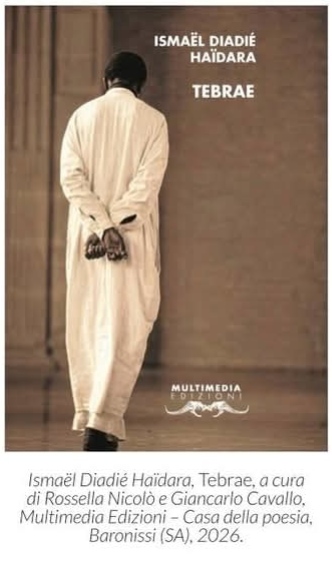 Book Details
ISMAËL DIADIÉ HAÏDARA
TEBRAE
Multimedia Edizioni
Ismaël Diadié Haïdara, Tebrae, edited by Rossella Nicolò and Giancarlo Cavallo, Multimedia Edizioni – Casa della poesia, Baronissi (Salerno), 2026.
Bibliography
Ismaël Diadié Haïdara, Tebrae, edited by Rossella Nicolò and Giancarlo Cavallo, Multimedia Edizioni – Casa della poesia, Baronissi (Salerno), 2026.