 thesilkroadtoday
Rabat Becomes a Crossroads of Literature and Imagination: The Royal Academy of Morocco Launches the House of the Worlds of Books and Hosts an International Symposium on Mediterranean Correspondences and the Sense of History
From 14 to 16 October 2026, the Royal Academy of Morocco will bring together writers, poets, academics, translators and cultural figures from around the world for two major events: the international symposium “Mediterranean Correspondences – The Sense of History” and the inaugural ceremony launching the activities of the House of the Worlds of Books.
RABAT, MOROCCO — The Royal Academy of Morocco is preparing to host an international cultural event from 14 to 16 October 2026, dedicated to dialogue between literature, historical memory and civilizations. Over three days, the Academy’s headquarters in Rabat will welcome intellectual discussions, literary exchanges and the launch of a new institution expected to contribute to the international visibility of books, writers and cultures, particularly across Africa and beyond.
Organized under the auspices of Mr. Abdeljalil Lahjomri, Permanent Secretary of the Royal Academy of Morocco, the programme revolves around two complementary highlights: the international symposium “Mediterranean Correspondences – The Sense of History,” taking place on 14 and 15 October under the direction of writer, translator and publisher Jean-Noël Schifano, followed by the inaugural ceremony marking the launch of the activities of the House of the Worlds of Books on Friday, 16 October.
Through these gatherings, Rabat will serve as a meeting place for ideas and literary works, bringing Mediterranean, African and international literature into conversation to explore their historical legacies, examine shared memories and open new horizons for intellectual and cultural cooperation.
“Mediterranean Correspondences”: Exploring History Through Literature
The international symposium, scheduled for 14 and 15 October 2026, will explore the Mediterranean as a space of correspondence, cultural exchange and transformation. Beyond its geographical significance, the sea emerges as a landscape of shared memories and encounters between languages and religions, as well as a witness to historical divisions, displacement and the reshaping of identities.
Under the direction of Jean-Noël Schifano, writer, translator and director of the Continents Noirs collection at Gallimard, the symposium will bring together participants from diverse literary, academic and artistic backgrounds.
Following the opening address by Mr. Abdeljalil Lahjomri, Jean-Noël Schifano will deliver the inaugural lecture entitled “Mediterranean, I Shall Translate Your Name.”
This evocative title places translation at the heart of the gathering. To translate the Mediterranean is also to make accessible the human experiences, imaginative worlds and histories that have developed along its shores, allowing them to travel between languages and cultures.
The first session will feature several speakers whose work illuminates the diversity of Mediterranean connections.
Writer Gaëlle Bélem will present a contribution entitled “I Bring You the Rarest Fruit…”. Academic and essayist Keren Mock will speak on “From Mount Carmel, Where Elijah Heard the Silence,” in a letter addressed to Abdelkrim Boufarra, an academic and translator from Hebrew into Arabic. Boufarra will respond with “Oujda or the Fountain of Youth.”
This epistolary exchange will demonstrate how correspondence can serve both as a literary form and as a means of bringing different cultures and sensibilities closer together.
Fayza Benzina, an essayist at the University of Tunis, will explore “From Byblos to Carthage: The Mediterranean of Metamorphoses.”
Writer and journalist Mohammed Aïssaoui, of Le Figaro Littéraire, will address “The Furcy Slave Case or the Memory of Archives,” opening a discussion on historical documentation, slavery and the role of archives in understanding the past.
Memory, Heritage and Narratives Between the Two Shores
The programme on Thursday, 15 October, will continue these discussions through perspectives combining history, anthropology, poetry, fiction and literary studies.
The morning session will be chaired by Mohammed Essaouri, academician and administrator of the Chair of Comparative Literature. It will feature writer Marie Ferranti, who will examine whether the sense of history can take the form of autofiction, and writer and literature teacher Asya Djoulaït, whose contribution is entitled “Inheriting the Backwash.”
Anthropologist Maria Angels Roque Alonso will explore “Sacred Spaces and Shared Rituals on Both Shores of the Mediterranean.” Historian Rita Aouad will present “The Thickness of Maps, the Distance Between Shores,” while poet and photographer Pierre Amrouche will examine De Gaulle, André Gide and Amrouche in the shadow of The Little Prince in Algiers.
Writer and academic Abdellah Baïda will contribute “Epistolary Resurrection: El Maleh Calls Out to Us,” exploring how correspondence can reactivate literary memory and restore the presence of writers and their ideas in contemporary cultural discourse.
In the afternoon, the session will be chaired by Najia Hajjaj Hassouni, academician and administrator of the Chair of Medical Humanities.
Poet Najwan Darwish will present a personal reflection entitled “The Metamorphosis of ‘Identity Card’ Between Two Eras and Two Poems.” Novelist Hajar Azell will conclude the presentations with “A Needle Fallen into the Strait.”
The diversity of these contributions reflects the symposium’s central ambition: to approach the sense of history not simply as a succession of events, but as a living human experience inscribed in languages, bodies, landscapes, archives and literary works.
The House of the Worlds of Books: A New Institution Serving Imagination and Creativity
Friday, 16 October, will mark the second major stage of the event with the inaugural ceremony launching the activities of the House of the Worlds of Books.
The ceremony will open with an address by Mr. Abdeljalil Lahjomri, marking a new phase in the Academy’s efforts to promote the international circulation of literary works, encourage translation, strengthen exchanges among writers and enhance the visibility of literary heritage across cultures.
One of the ceremony’s principal highlights will be the unveiling of a presentation box containing 54 reference books representing Africa’s 54 countries, forming the core of the African Reference Library.
This collection aims to present the continent in all its diversity through the works of classical African authors, prominent women writers, essential voices of the diaspora and landmark works of Moroccan literature. It will also encompass significant songs, elegies and traditions of writing, calligraphy and graphic expression that form part of Africa’s cultural memory.
The ceremony will also feature Nobel laureates in Literature Wole Soyinka and J. M. G. Le Clézio, alongside Michel Boko, who is listed in the programme among the personalities associated with the inaugural event.
Readings from Wole Soyinka’s The Road and J. M. G. Le Clézio’s The African will illustrate the House’s mission: to establish dialogue between texts, experiences and human imaginations across geographical and cultural boundaries.
Translating, Publishing and Circulating Literary Works
The House of the Worlds of Books intends to develop several major programmes, including international literary residencies; publishing, translation and the circulation of literary works; a literary clinic; and poetic encounters dedicated, among other forms, to Izli poetry and Japanese haiku. The institution will also pursue national and international partnerships.
These initiatives outline the vision of an institution whose mission extends beyond preserving and presenting books. It will seek to support literary creation, encourage interpretation and criticism, and bring literary works to new audiences through translation and international exchange.
The programme will also include cross-cultural perspectives, literary conversations and the progressive presentation of the different sections of the African Reference Library.
The objective is to showcase the richness of African literary traditions while encouraging dialogue with other cultural and literary spaces around the world.
At 4:05 p.m., an inaugural conversation will bring together Jean-Noël Schifano and Abdeljalil Lahjomri to discuss Lahjomri’s book Compagnons indociles (Unruly Companions), published in 2026 by Gallimard in its Continents Noirs collection.
The subsequent session, entitled “Voices of Africa and the World,” will feature messages from Moroccan and international figures representing partner institutions, writers, foundations, libraries and various stakeholders in the publishing and book industries.
Dr. Ashraf Aboul-Yazid recounts the story behind his book Naguib Mahfouz: The Narrator and the Artist, published in Arabic, English, and Serbian.
Wole Soyinka: Forty Years After the Nobel Prize, Celebrating a Literary and Intellectual Legacy
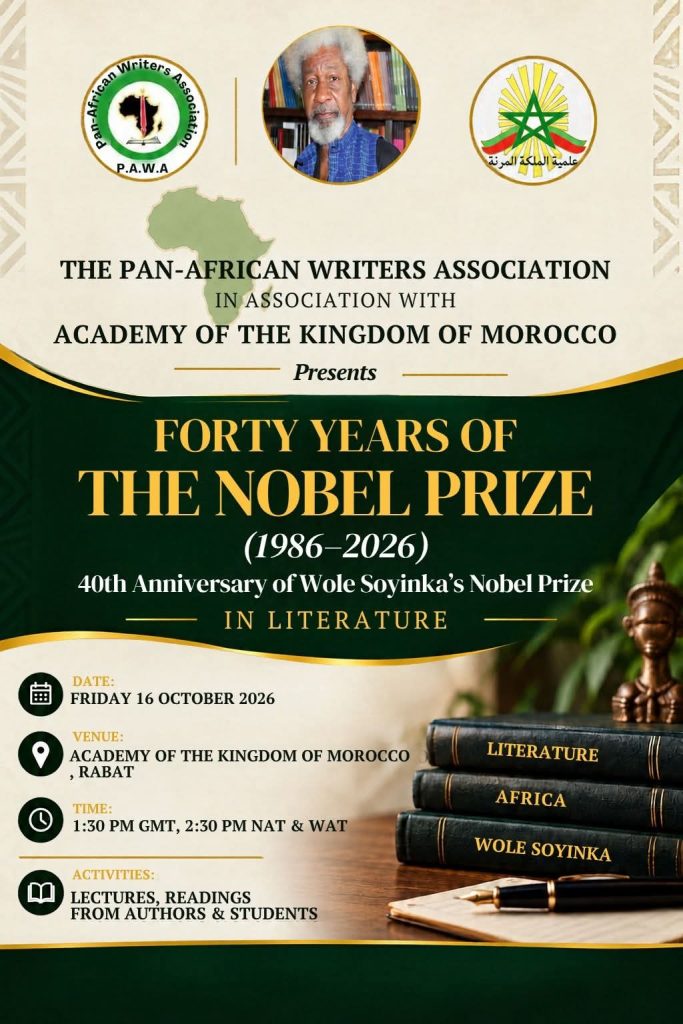
The programme will give special prominence to the fortieth anniversary of Wole Soyinka’s Nobel Prize in Literature, awarded in 1986.
Gbemisola Aderemi Adeoti of the University of Ile-Ife will deliver a contribution entitled “Celebrating Wole Soyinka and the Core of Existence: 40 Years.”
The celebration will continue with a special tribute ceremony organised by students of the Higher Institute of Dramatic Art and Cultural Animation (ISADAC) in Rabat. Entitled “The 40 Books You Should Have Read Before Turning 40…”, the event will commemorate the four decades since Soyinka received the Nobel Prize in Literature.
This initiative will connect the celebration of the Nigerian writer with broader questions concerning literary transmission, reading culture and the intellectual development of younger generations.
The concluding lecture will be delivered by Raphaël Liogier of Sciences Po Aix-en-Provence, director of the Chair of Transitions at UM6P-IAS in Benguerir. His lecture is entitled “Prolegomena to All Future Literature.”
Senator Jean-Marie Mama will deliver the closing address under the title “Towards a New Ecology of Knowledge,” highlighting the importance of renewing approaches to the production and circulation of knowledge and developing more balanced relationships between cultures and intellectual traditions.
An International Vision for the Literature of the World
By bringing these two initiatives together, the Royal Academy of Morocco connects an in-depth reflection on Mediterranean memory with the creation of a dedicated institutional space for books and their international circulation.
From literary correspondence to translation, from historical archives to contemporary voices, and from African classics to emerging generations of writers, these three days invite participants to consider literature as a meeting ground between peoples.
The House of the Worlds of Books embodies an essential ambition: to make the book a living space for dialogue, transmission, knowledge-sharing and cultural cooperation—a space where linguistic and cultural diversity becomes a shared human resource, helping us understand the past, illuminate the present and imagine the future.
For further information:
Royal Academy of Morocco
Official website: [Royal Academy of Morocco](https://www.alacademia.org.ma?utm_source=chatgpt.com)