 thesilkroadtoday
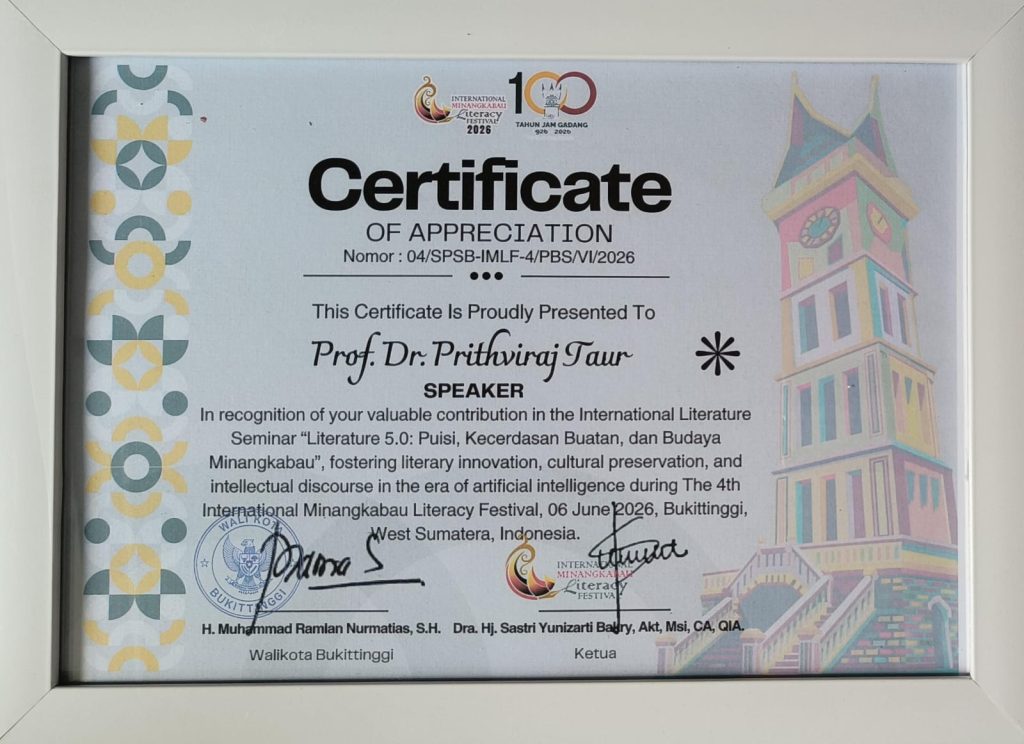
(*Speech by Prof. Dr. Prithviraj Taur, India*)
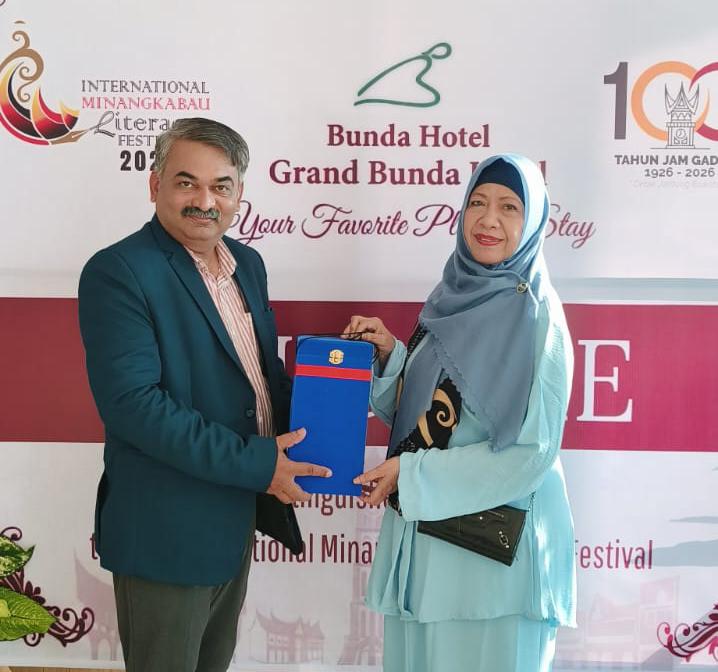
Respected organizer of IMLF 4 Mrs. Sastri Bakry, writers who have come from across the world to participate in this festival Aminur Rahman, Dikdik Sadikin, Rahmat S. Ag. M. Hum. Les Wicks, Laura di Corsia, Dr. Andria C. Teams in, Prof Indryuda, Fauzia Fauzan and my Minangkabau brothers and sisters,
This incident must have occurred about six or seven years ago. I was discussing about the Marathi language with my friend Dr. Mahesh Joshi. Our conversation revolved around how modern technology was entering the Marathi language and the various levels at which it would need to develop in the future. During the course of our discussion, the issue of detecting plagiarism in Ph.D. dissertations submitted to universities also came up. We both agreed that software capable of identifying such plagiarism would become available within the next decade. We also discussed how artificial intelligence could write stories and poems, and that sometimes these compositions might even be more beautiful than those written by human authors and poets.
To our surprise, within just six months, our university acquired software capable of detecting plagiarism in Marathi-language dissertations and even calculating the percentage of copied content.
What we had imagined would happen over the next decade actually happened within four to six months. It was then that I first realized that the pace of technological advancement is far greater than our imagination. Today, one only needs to think of an idea and search for whether software or a mobile application related to it exists. One soon discovers that countless such applications are already available in the market, and newer, more advanced ones are being developed every day. Search for ChatGPT, and you immediately encounter numerous AI applications, from Gemini to DeepSeek and many more.
All of this is truly astonishing. It is as though each of us now possesses Aladdin’s lamp and the genie within it.
In the blink of an eye, tasks are completed almost instantly. Human labor is being saved on a massive scale. The days of sitting beside a DTP operator for hours to design a WhatsApp poster are gone. With a single click, we create countless posters according to our preferences from the comfort of our homes and instantly share them with one another.
Whenever the world undergoes a transformation, whenever a field of knowledge takes a giant leap forward, its impact naturally extends to many other areas of life. About six months ago, I attended the “Conference on Classical Indian Languages” organized by the Department of Marathi Language, Government of Maharashtra. There, I witnessed the revolution AI has brought to the field of translation. I was already familiar with the rapid translation of foreign languages, but what amazed me was the real-time translation from one Indian language to another through the application Bhashini—a remarkable achievement of IIT Madras, IIT Bombay, and other experts.
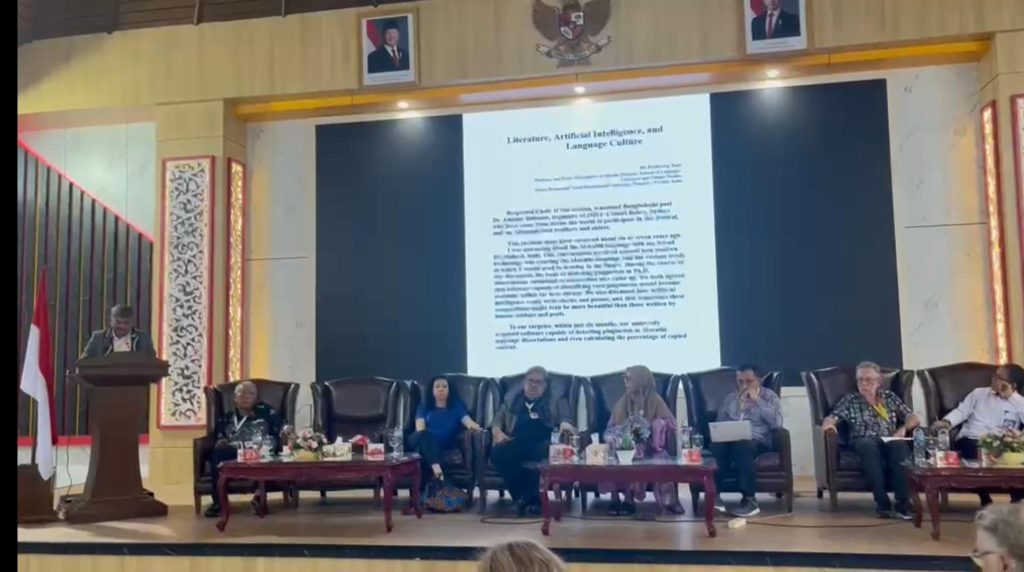
On the stage, scholars of various languages were speaking in Sanskrit, Pali, Tamil, Odia, and their respective mother tongues. Simultaneously, every word they uttered appeared on the screens before us in Marathi, Telugu, Malayalam, Bengali, and other languages. Events and innovations occurring in distant places are now reaching our homes within a matter of months. This is the success of the technological revolution.
One implication of this is that within the next five or six years, the role of the human translator may largely disappear. Precise and polished translations of practical, technical, informational, and standard-language texts are already being produced by AI. In the near future, we may also receive excellent translations of creative literature through AI.
In this context, let me mention an incident that I recently read about. The story The Serpent in the Grove by Trinidad and Tobago writer Jameer Nazir won the 2026 Caribbean Award for Best Short Story. Subsequently, allegations emerged that the story had been written with the assistance of artificial intelligence. A similar accusation was made about Mia Billard’s novel Shy Girl a month and a half ago, after which the novel was withdrawn by its publisher.
Whether these literary works were actually produced through AI or not is, for the moment, beside the point. What is important is that AI technology, which six or seven years ago could only generate rudimentary stories and poems, has now become highly sophisticated. It is beginning to demonstrate the capacity to create works of art that may rival—or even surpass—human creativity. The “death of the author” was proclaimed in the previous century; now, in an entirely different sense, we may witness the “death of the human author” before our very eyes.
This is indeed a troubling and unsettling time, and we will soon need to find answers to these challenges. Writers and poets have already become people on the margins. Writing is increasingly viewed as a non-commercial, seemingly impractical artistic activity. The media revolution and technological advancements have placed so many alternatives before us that deliberate efforts are now required to draw attention back to books.
I do not know what the situation is in your countries, but at least in Indian languages, we are experiencing a decline in readership for poetry. There is a growing need for books and literary works with new narratives, fresh sensibilities, and innovative language that can attract children, adolescents, and young readers.
Yet, I am not pessimistic. I also understand that every literary genre possesses its own unique strength. Poetry speaks through images; the short story is centered on a single focus, while the novel embraces multiple centers. The language of literature always suggests something beyond its literal meaning; it speaks through implication and resonance. Through imagery, symbols, myths, and unconventional uses of language, a literary work expands its power of appeal.
Poets and writers do not merely break language apart, nor do they simply bend it. They create language—and language itself is culture. Therefore, poets and writers are, in a sense, creators of culture.
The dreams poets envision are not theirs alone. These dreams are collective, and they are also primordial. Humanity has dreamt them for ages. Through the pursuit of those dreams, human beings have shaped this world. They created language, developed scripts, built cultures, and established civilizations.
In this journey, humanity has now discovered technology. Technology, too, is a human creation. This means that technology is merely one stage on the path toward the fulfillment of our dreams. It is not the destination. It is not the ultimate achievement. Technology is only a tool.
Our goal still lies far ahead, and it is unquestionably human. We shall reach it through human labor, through the beauty of intellect, through the sweat of hard work, through the sensitivity of the human heart, and through the fragrance of human relationships.
For the moment, these are my thoughts on literature, poetry, language, and the technology of artificial intelligence. I extend my best wishes to all of you on your journey toward the realization of your dreams.
(Dr. Prithviraj Taur
Professor and Head, Department of Marathi
Director, School of Language, Literature and Culture Studies
Swami Ramanand Teerth Marathwada University, Nanded – 431606, India)