 thesilkroadtoday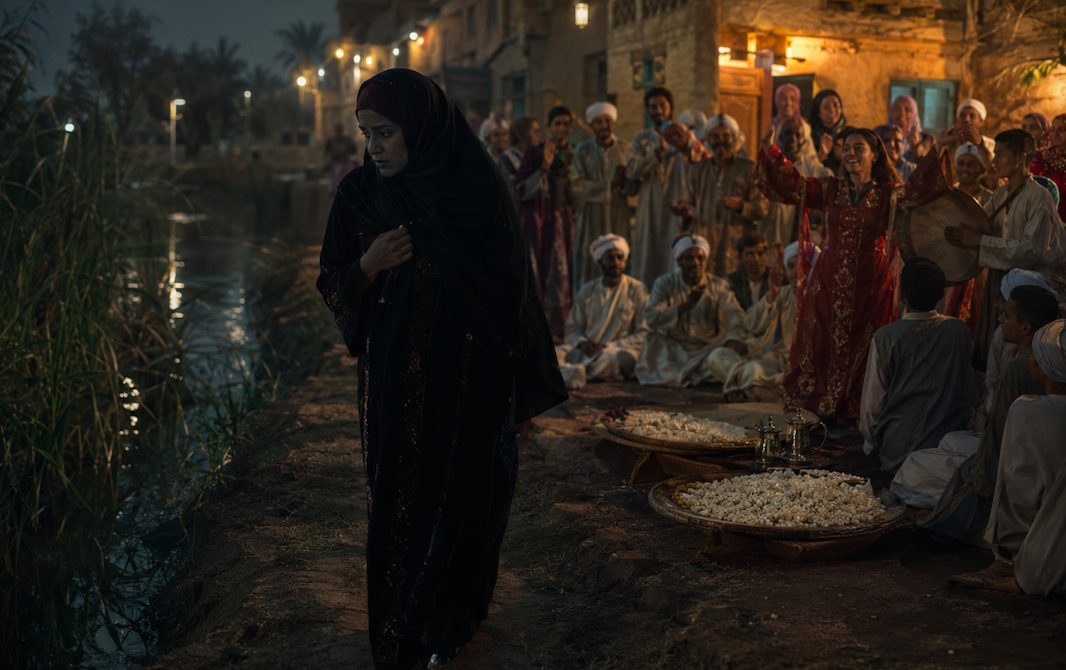
A Short Story By Sherif Abd ElMegid, Egypt

Her footsteps quickened, as steady and measured as the cadence of a military march. She kept turning her head, alert and terrified, while an entire symphony rose around her—its movements composed of the whispering palms, the hissing reeds, the croaking frogs, and the famous chirp of the cricket that belongs to the night of every village.
At times the echoes swelled; at others, they faded. They awakened in her a fear unknown to humankind, as though the whole world had somehow understood what she had just seen. She cast one last look around the place, stealing quick glances along the banks of the single canal leading to the entrance of Adendan, the Nubian village displaced from its original home. She chose the rougher path, far from the bus stop where vehicles carried people to and from the small village across the only bridge—the link between the village and the world.
At last, she reached her house. She changed her clothes and put on her beautiful red dress, covering it with the embroidered black gergar. She took one final look inside the house, then locked the door.
And now she was on Street Forty-Seven, walking alone beneath the dim light cast by a few streetlamps that still functioned, defying the passage of time and the absence of maintenance.
Asha Fakhri
The sound of the drums rose and swelled amid the joy of everyone, but the whole world could not contain the happiness of Asha Fakhri. How could it? It was the wedding of her firstborn son, Salem Gasho.
Asha had been widowed. Despite her beauty, she had never remarried. She had raised her four children, and now, at last, she was reaping the first harvest of her life.
The crowds surged into the dancing circle. Everyone wanted to take part in the aragid—the traditional wedding dance. The Mummer finally reached the wedding celebration, and when they asked her why she had been absent, she gestured with her hand to say that she had been asleep. When they signaled that they had knocked on her door, she indicated that she had heard nothing. They laughed.
The Mummer threw herself into the dance, and to the beat of the drums everyone sang Al-Qamar Buba, Kaduda, and other wedding songs. She danced with Asha Fakhri as no one else had, as though announcing her presence and the overwhelming joy within her.
The men immersed themselves in the familiar tradition of eating dinner outside the houses along the street of the groom’s home. The women went indoors to prepare the dishes, as well as the popcorn placed on the kurdaj. A tray was set before every house, filled with everything delicious and abundant.
Men and children sat on the ground in their white jalabiyas, forming endless circles. The women ululated:
“May the Prophet’s blessings be upon you, O Muhammad! The lover of the Prophet sends blessings upon him!”
The young men laughed and played, their voices filling the place as they offered Salem their final advice. He was about to become a fully grown man—a husband, a householder.
Batoul
The floating body of an eight-year-old girl became the sole subject of conversation throughout Adendan. Everyone soon confirmed that it was the body of Batoul, the daughter of Hamed Ali, who had disappeared on the night of the wedding.
Investigators and informants spread among the villagers. The shops closed their doors after dinner, and the cafés emptied. The girl’s family mourned for three days and three nights.
Salem wept the precious, bitter tears of a man, alone after locking himself inside his room. Tahira did not know what to do or what to say.
How would you reveal your secret, Tahira? Mountains of sorrow rested upon your shoulders. You were a respectable girl, and Salem was the pride of Adendan’s young men—perhaps the most handsome of them all. But what was the reason? Had he not loved her? What would you do, Tahira?
The news spread everywhere.
Salem, Asha’s son, had not yet revealed the truth. Misfortunes never come alone. Yesterday, Batoul had drowned; today, there was the story of Salem.
The Mummer moved from house to house, gesturing with her hands and reading the movements of people’s lips. The story passed through every home until Salem, sitting among a group of friends during a late-night gathering, tried to summon the courage to speak.
“The Mummer is a snake. You can never predict when she will strike. Thank God she cannot speak. If she could, she would have set off a conflict no one could have contained.”
They laughed. They helped him with stories, remedies, and herbs whose effectiveness had been tested by generations.
At the ancient temple of Kom Ombo, Asha learned what she had to do to bring Salem back to the man he had been. The news was kept from the Mummer, who had been absent for reasons beyond her control. The authorities questioned her because she had been the last person to see the girl before she drowned.
Four days later, the Mummer returned to the village.
By then, Salem had grown bolder. Sheikh Hassan, the man known for his piety and spiritual knowledge, had helped him. He advised Salem to enter gently and gave him the tested herbs. Yet Salem secretly went to a doctor in Kom Ombo.
His mother believed that her efforts had succeeded.
The Mummer wept when her secret was exposed during a government search of her house. There, the authorities found hundreds of amulets, each bearing the name of one of the village’s grooms.
The police car stood before the Mummer’s house, its familiar lights illuminating the night of Adendan. Children gathered around it, while old women circled nearby, repeating their customary cry:
“Biu—biu!”
The soldiers collected the talismans and amulets and placed them inside the car as evidence against the Mummer.
In his report, the officer wrote that the Mummer had not killed Batoul Hamed Ali. The girl had drowned without anyone strangling her, contrary to what everyone had suspected.
Meanwhile, the Mummer walked alone along the road leading to the canal. Tears flowed down her cheeks, but no audible sound came from her.
And Salem, Asha’s son, searched like a madman among the piles of amulets for the charm the Mummer had made for him.

Notes
1. The Mummer: The mute woman.
2. Asha Fakhri: Aisha Fakhri.
3. Aragid: A traditional dance performed at weddings.
4. Kurdaj: Special palm-frond trays used for serving popcorn and sweets.
5. “Biu—biu”: An expression uttered during calamities, similar in meaning to the Arabic expression “Oh, what a disaster!”