 thesilkroadtoday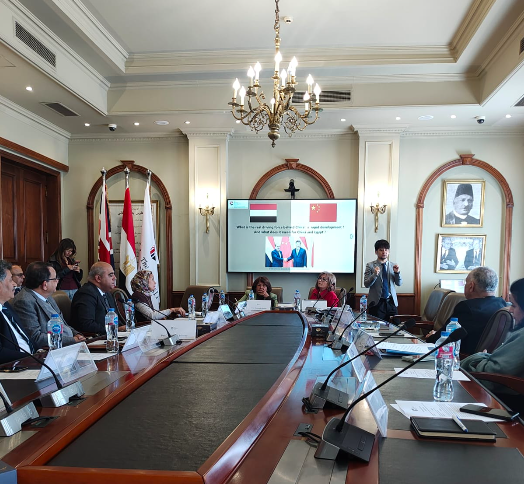
The British University in Egypt Hosts High-Level Symposium on Digital Education, Highlighting China’s Model as a Strategic Inspiration for Global Higher Education Transformation

The British University in Egypt convened a high-profile Social Sciences Cluster Symposium on Monday, March 30, titled “Recent Developments of Digital Education: China – a Model for Inspiration?” at the Boutrous Ghali Conference Room, bringing together leading academics, policymakers, and experts to examine the transformative impact of digitalization on higher education worldwide.
The symposium was co organized with the faculty of Business Administration,Economics and Political Science.
Moderated by Professor Dr. Shadia Fahim, Dean of the Faculty of Arts and Humanities, the symposium provided a comprehensive platform for discussing how digital transformation has evolved into a central strategic pillar shaping institutional competitiveness, redefining academic standards, and bridging geographic and socio-economic disparities in education. The event underscored that digitalization is no longer a reactive or supplementary tool, but rather a proactive, state-driven strategy, as exemplified by China’s model, which positions education at the core of national development and global leadership in the knowledge economy.
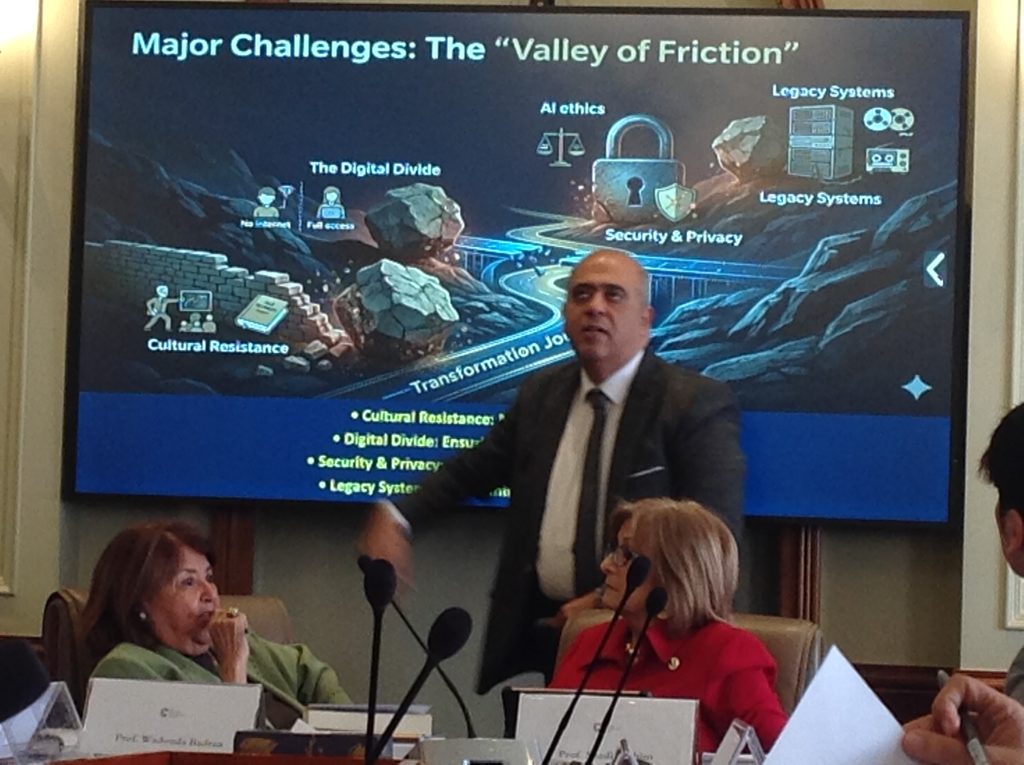
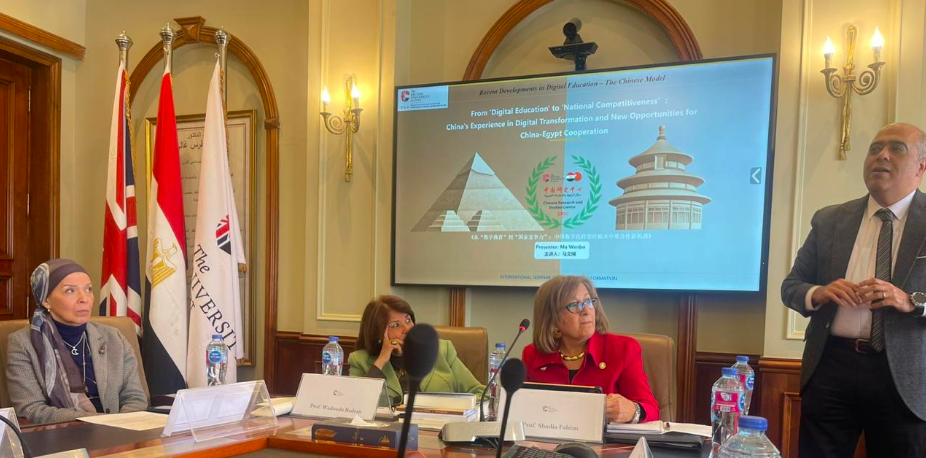 The symposium opened with an in-depth presentation by Dr. Mina Mounir Labib (above), Head of the Digital Transformation Component (Digitalization Fund Program) and Professor at Ontario Tech University, who articulated a paradigm shift from IT-led initiatives to strategy-led educational ecosystems. Through a rich set of data-driven examples and visual presentations, he introduced the concept of the “Intelligent University,” built upon four foundational pillars, and examined institutional challenges through the lens of the “Valley of Friction,” where digital ambitions often face operational resistance. He further outlined a strategic roadmap tailored for Egypt, emphasizing that data has become the most critical institutional asset in designing agile, student-centered learning environments and redefining the overall student value proposition in higher education.
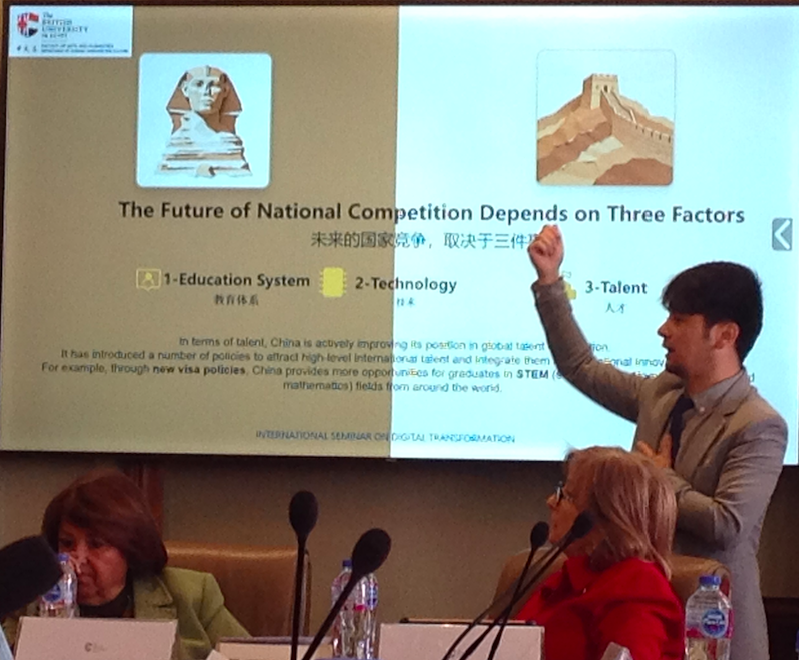
Building on this framework, Mr. Ma Wen Bo (Ismail), Assistant Director of the Confucius Institute at Suez Canal University, delivered a compelling analysis of China’s digital education transformation, highlighting its shift from fragmented, profit-driven educational models to a cohesive national vision aligned with long-term strategic goals such as the “Education 2035” modernization plan. His presentation showcased how China has successfully transitioned from ensuring “justice of access” to prioritizing “justice of quality,” thereby enhancing educational outcomes and strengthening its position in the global talent race. Through engaging video materials and comparative reflections drawn from his teaching experiences in both China and Egypt, he provided valuable insights into differences in student engagement, learning environments, and institutional priorities, as well as the emerging challenge of achieving “skill fit” in a rapidly evolving global labor market.
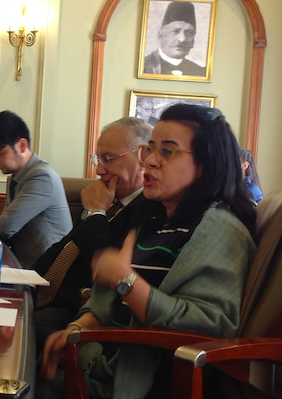
The third session, presented by Dr. Hoda ElHadary from the Department of English Language and Literature at the Faculty of Arts and Humanities, explored the profound implications of digital transformation for the Humanities. She demonstrated how the integration of computational tools and data analytics has reshaped disciplines such as literature, philosophy, and cultural studies, transforming them into dynamic, interdisciplinary fields that combine traditional scholarship with digital methodologies. Her presentation emphasized the rise of Digital Humanities as a key area of innovation, enabling broader access to knowledge, enhancing research capabilities, and modernizing curricula to better prepare graduates for the demands of a digital knowledge economy. She also drew connections to the strategic framework presented earlier, reinforcing the importance of aligning technological innovation with academic vision.
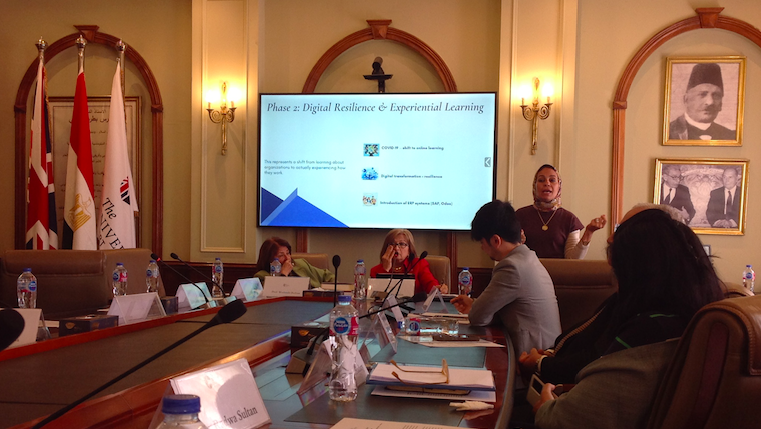
In the final session, Prof. Wafaa Salah from the Faculty of Business Administration, Economics, and Political Science, examined the evolution of teaching and learning in social sciences over the past decade. Her presentation highlighted key phases of digital transformation, focusing on the adoption of interactive learning platforms, the development of digital resilience through experiential learning using enterprise systems, and the increasing reliance on data-driven education models. She also stressed the importance of strengthening partnerships with industry to provide students with access to professional tools, certifications, and real-world applications, thereby enhancing employability and aligning academic outcomes with labor market needs.
The symposium concluded with thoughtful interventions from Ambassador Aly El-Hefny, Director of the Egypt Africa Center at the university and former Egyptian Ambassador to China (above, right), who called for the development of a forward-looking strategy to deepen Egypt-China cooperation in digital education, drawing on his extensive diplomatic experience. In addition, Dr. Diaa Helmy Al-Faki emphasized in his concluding remarks that successful digital transformation requires not only technological readiness but also effective cultural management to ensure institutional and societal adaptation.
The event ultimately reaffirmed the British University in Egypt’s commitment to fostering critical dialogue, advancing innovative educational models, and positioning itself at the forefront of digital transformation in higher education both regionally and globally.