 thesilkroadtoday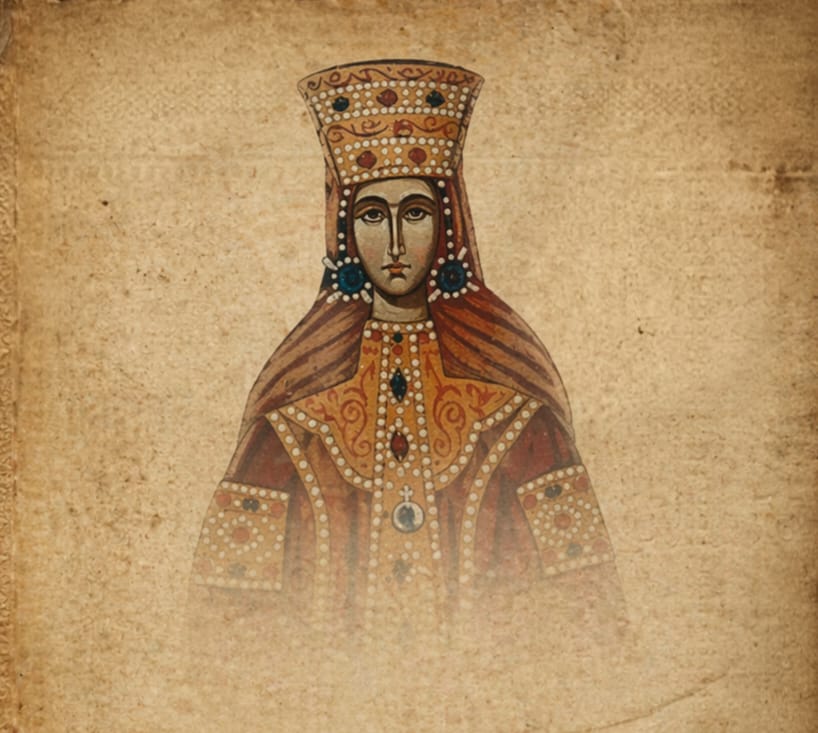
610 Years Since the Birth of Mara Branković (Mara Hatun)
By Dr. Ana S. Gad
Mara Branković was one of the most significant women of the Serbian Middle Ages — a princess, diplomat, benefactor, and mediator between the Christian and Ottoman worlds.
She was born in Vučitrn around 1416, as the daughter of Đurađ Branković and the Byzantine princess Irene Kantakouzene, at a time when the Serbian state was balancing between independence and the growing pressure of the Ottoman Empire.
A folk poem records that in childhood she suffered from a grave illness, and that her father, in gratitude to God and the elder Joanikije for her miraculous healing, built a monastery which was named Devič Monastery after the healed maiden. It was also recorded that Mara was exceptionally beautiful, “more beautiful than all in the seven Vlach kingdoms and the whole Turkish Empire.”
As part of a peace agreement, in 1435 she was married to Murad II. One of the conditions for concluding peace with the Ottomans was the marriage of Đurađ’s daughter Mara to the sultan and her departure to the harem. Đurađ and Jerina had to gather an enormous dowry of 600,000 ducats — more than ten years’ worth of tribute that Đurađ had been paying the Turks since 1428. Murad II and Mara Branković married in 1436, and she became a sultana, known as Mara Hatun. She was Murad’s second and last legal wife.
This dynastic marriage was not merely a political act, but the beginning of her historical role. Although she lived at the Ottoman court, Mara remained devoted to Eastern Orthodoxy and, according to historical testimony, never converted. In doing so, she preserved a strong bond with her origins and Serbian-Byzantine spiritual heritage.
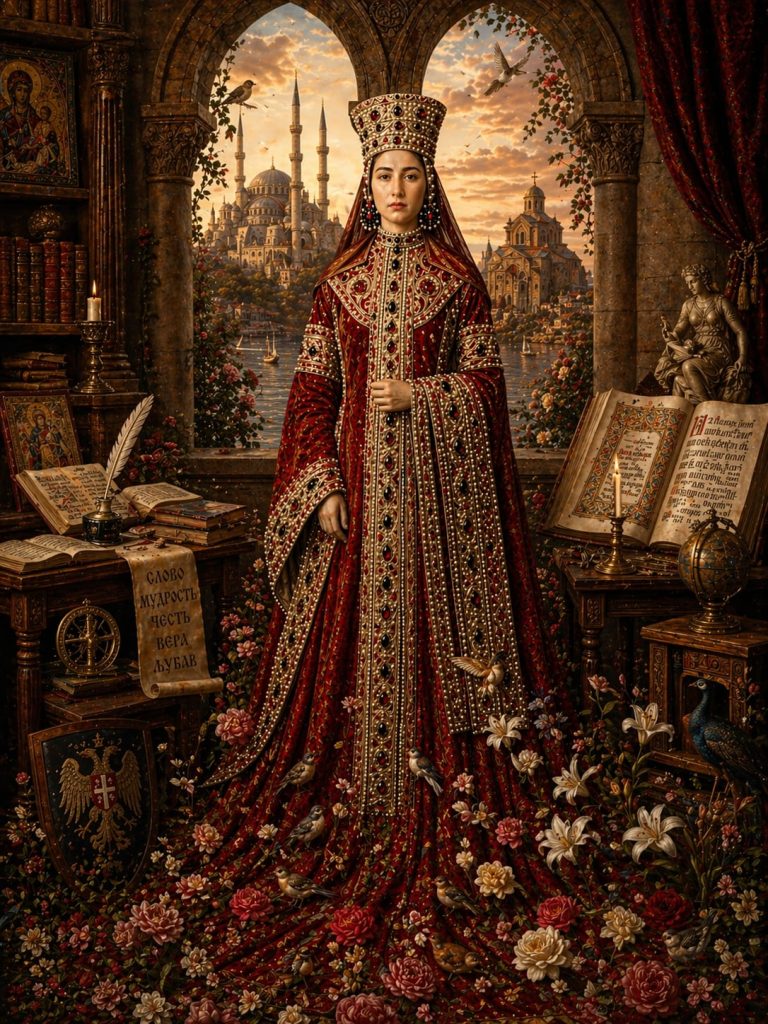
After the death of Murad II in 1451, Mara did not lose influence. On the contrary, she gained a special place at the court of his successor, Mehmed II. Historical sources indicate that Mehmed respected her and regarded her as a trusted figure, granting her a degree of political autonomy. During this period she often mediated diplomatic relations among the Ottoman Empire, Serbian nobles, Byzantine circles, and European rulers.
Her political role became especially prominent after the Fall of Constantinople in 1453. In the complex relations between East and West, Mara represented a bridge between civilizations. She took part in negotiations, protected certain Christian interests, and engaged in diplomatic contacts that transcended the boundaries of a single court or state. For this reason, many historians consider her one of the first great women diplomats of the Balkans.
A special chapter of her life is linked to her role as patron and protector of Orthodoxy. She was closely connected with Mount Athos, especially the monastery of Hilandar Monastery and other Athonite monasteries. She supported monastic communities through gifts, privileges, and political protection. Traditions and sources associate her name with preserving valuable relics and manuscripts, as well as interceding to protect Christian holy sites under Ottoman rule.
She spent the last years of her life on her estates in Ježevo near Serres, where she remained a respected figure with significant political and spiritual authority. There she died on September 14, 1487.
It is also recorded that after the death of Sultan Murad II she returned to Serbia, where she even refused a marriage proposal from the last Byzantine emperor, Constantine XI Palaiologos, a widower without children, because she had vowed never to marry again. Owing to the great respect and influence she held over her stepson Mehmed II, he granted her several estates, including Ježevo (today Dafni in Greece, southeast of Thessaloniki), from where she worked tirelessly until her death in 1487.
She was a great patron, though she never became a nun. She even stayed on Mount Athos, despite the well-known prohibition on women visiting, where she helped the monasteries of Hilandar, Saint Paul Monastery, and Vatopedi Monastery.
The historical significance of Mara Branković lies in the fact that she transcended the traditional role of a medieval princess. She was a woman of diplomacy in a male political world, a protector of faith in an age of conquest, and a symbol of cultural encounter. In Serbian history she is remembered not only as a despot’s daughter and a sultan’s wife, but as a figure whose influence shaped the political and spiritual currents of the 15th century.
For authors and researchers, Mara Branković represents fertile ground for studying women’s influence in the Middle Ages, Serbian-Ottoman relations, diplomacy, cultural mediation, and the history of Orthodox heritage. Her biography opens space for historical, literary, feminist, and cultural interpretations, which is why she remains an inspiring figure in contemporary scholarship.
Mara Branković, or Mara Hatun, also endures as a symbol of wisdom, perseverance, and quiet yet powerful female influence in history. In an age of wars, conquests, and divisions, she represented a bridge among peoples, religions, and cultures. Her life testifies that power lies not only in rule, but also in mediation, reconciliation, and the preservation of spiritual and cultural values. As a historical and almost legendary figure, Mara Branković remains a symbol of dignity, diplomatic wisdom, and the enduring strength of a woman who connected worlds.