 thesilkroadtoday
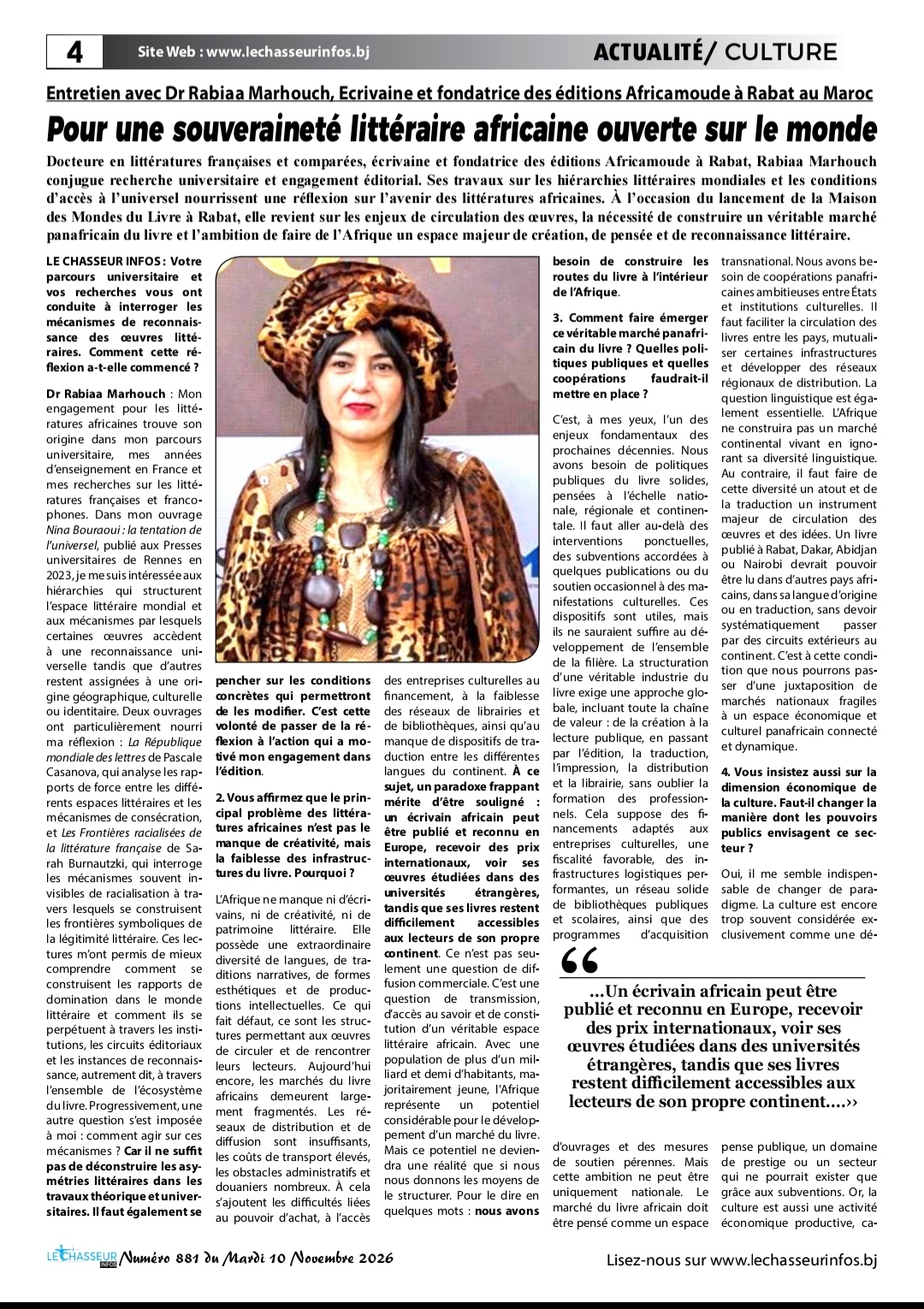
An interview with Dr. Rabiaa Marhouch, writer and founder of Africamoude Publishing House in Rabat, Le Chasseur Infos – Actualité / Culture, 10 November 2026
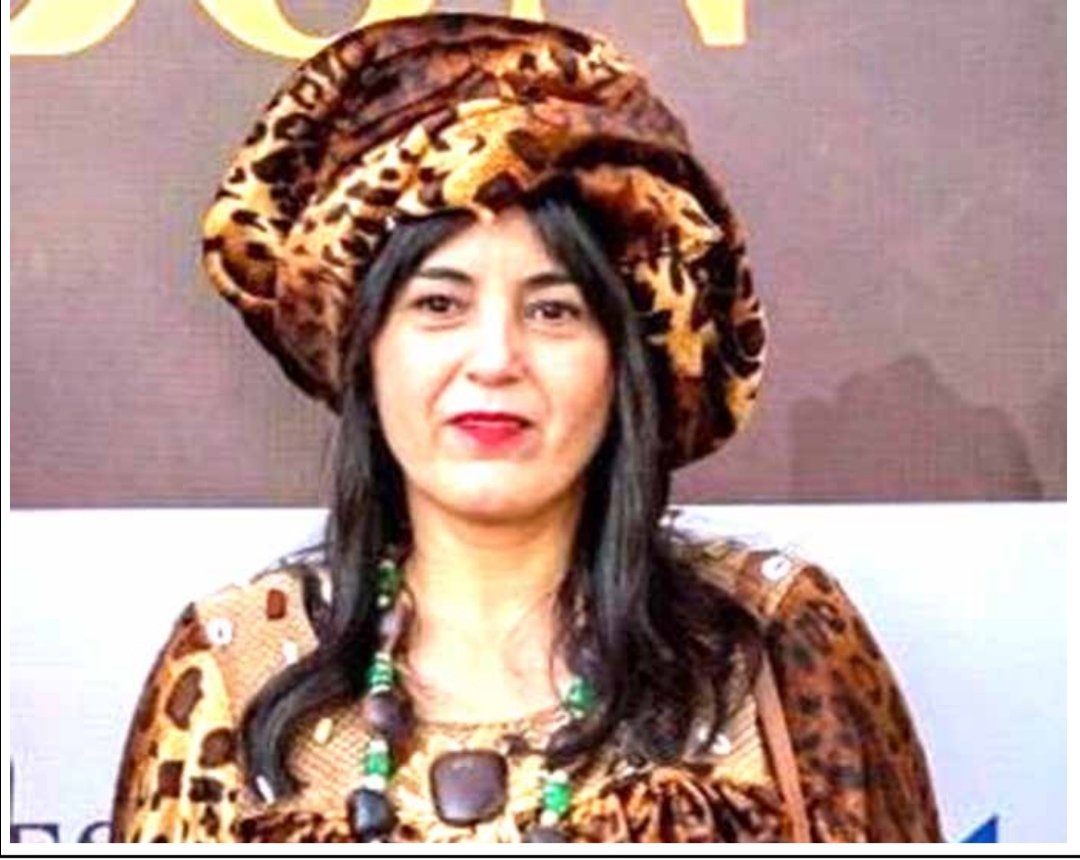
Dr. Rabiaa Marhouch, a scholar of French and Comparative Literature, a writer and the founder of Africamoude Publishing House in Rabat, combines academic research with editorial commitment. Her work on global literary hierarchies and the mechanisms through which literary works gain universal recognition has led her to reflect on the future of African literatures.
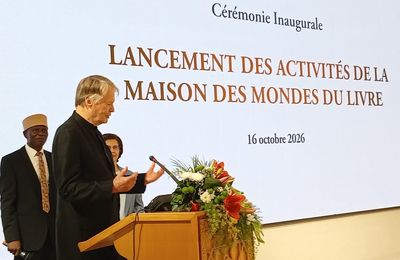
On the occasion of the launch of the House of Worlds of Books in Rabat, she reflects on the challenges surrounding the circulation of literary works, the need to build a genuine African book ecosystem, and the ambition to make Africa a major space for literary creation, intellectual thought and recognition.
LE CHASSEUR INFOS: Your university studies and research have led you to investigate the mechanisms through which literary works gain recognition. How did this reflection begin?
Dr. Rabiaa Marhouch: My academic journey and research gradually brought me to examine the mechanisms of literary recognition, particularly those governing the circulation of works between different cultural and linguistic spaces. My experience in France, together with my research into French-language and Francophone literature, enabled me to observe how literary value is constructed, disseminated and acknowledged.
My work has increasingly focused on understanding the relationship between literary creation, cultural identity and the institutions that determine which works become visible internationally. This has also led me to question the conditions under which African literatures can achieve the recognition they deserve.
LE CHASSEUR INFOS: Your work raises questions about the diversity of languages, literary traditions and cultural identities. How can this diversity become a source of strength rather than an obstacle?
Dr. Rabiaa Marhouch: Africa’s linguistic and cultural diversity is not a weakness; it is an extraordinary resource. The continent possesses a wealth of languages, traditions, memories and forms of expression. These constitute an immense intellectual and creative heritage.
The challenge is to develop the means through which this wealth can circulate, be translated and reach readers beyond its original environment. We must build bridges between languages and literary communities, while ensuring that our cultural particularities are not erased in the process.
This requires a collective effort involving writers, publishers, translators, researchers, cultural institutions and public authorities.
LE CHASSEUR INFOS: You argue that the principal problem facing African literature is not a lack of creativity, but rather the weakness of the continent’s book infrastructure. Why?
Dr. Rabiaa Marhouch: Africa certainly does not lack creativity, talent or intellectual genius. On the contrary, it possesses an extraordinary diversity of languages, traditions, artistic forms and literary expressions. What is lacking is the infrastructure that would allow this creative wealth to circulate effectively.
Our writers produce remarkable works, but the networks required to publish, distribute, promote and make these works accessible remain insufficient. The book market is fragmented, and the distribution channels are often inadequate. Consequently, many valuable works remain confined to limited geographical areas.
We must therefore develop publishing networks, strengthen libraries and reading institutions, improve distribution systems and remove the administrative and economic obstacles that prevent African books from reaching their readers.
LE CHASSEUR INFOS: How can a genuine pan-African book market emerge? What public policies and forms of cooperation should be put in place?
Dr. Rabiaa Marhouch: In my view, one of the fundamental challenges is to establish appropriate policies and mechanisms for the development of the book sector. We need public policies that support publishing, facilitate regional and continental distribution, and extend beyond the traditional boundaries of individual national markets.
This diversity must be accompanied by effective cooperation between publishers, writers, translators and cultural institutions. We must also encourage the translation of African works into other languages and create opportunities for them to reach international audiences.
The creation of a genuine African book industry requires a coordinated approach involving the entire literary chain: from creation and publishing to distribution, promotion and public access to books.
LE CHASSEUR INFOS: You also emphasise the economic dimension of culture. Should we change the way public authorities approach this sector?
Dr. Rabiaa Marhouch: Yes. It is essential to change the way culture is perceived. Culture should not be regarded merely as an expense or a secondary area of public intervention. It must be recognised as a strategic investment, capable of generating economic activity, employment and sustainable development.
The book industry, in particular, involves a wide range of professions and economic activities. Publishing, printing, distribution, bookselling, translation and cultural programming all contribute to the creation of wealth.
We must therefore recognise culture as an economic force and develop policies that enable its creative industries to flourish.
LE CHASSEUR INFOS: How do you assess the relationship between the economic power of the book market and the intellectual recognition of African literatures?
Dr. Rabiaa Marhouch: There is a direct relationship between the strength of the book market and the international visibility of literary works. A well-structured market provides writers with opportunities to publish, reach readers, participate in literary events and gain recognition.
Yet the economic dimension must not become the sole measure of literary value. African literature must be recognised for its intellectual, artistic and cultural contributions, rather than judged exclusively by its commercial performance.
We need a book economy that supports literary independence and allows our writers to participate fully in the global intellectual conversation.
LE CHASSEUR INFOS: Could this ambition be interpreted as a form of regionalism, or as an attempt to replace one form of domination with another?
Dr. Rabiaa Marhouch: This is a legitimate concern, but it is important to distinguish between cultural independence and cultural domination. The objective is not to replace an external form of domination with an African one. Rather, it is to create an independent literary space in which African voices can express themselves freely and participate in the international exchange of ideas.
Africa must be able to define its own literary priorities, recognise its own writers and establish its own systems of evaluation, without excluding international dialogue.
The ambition is to achieve a more equitable relationship between literary cultures, one in which African works are not simply judged according to criteria established elsewhere, but are also recognised through their own intellectual and aesthetic contributions.
.
As Dr. Rabiaa Marhouch emphasises:
> “We must move beyond this artificial opposition between culture and the economy. The two dimensions are complementary. An ambitious cultural policy is also an investment policy, an economic development policy and a means of creating wealth. It is precisely this recognition that can enable African cultural industries to operate on a much larger scale.”
LE CHASSEUR INFOS: Beyond publishing networks, the question of cultural imagination is also at stake. Who tells Africa’s story, and what are the consequences for future generations?
Stories are never neutral. They help shape our perceptions of the world, our collective memory, our relationship with history, and the way we envision the future. The power dynamics that structure the literary world therefore also influence our collective imagination.
When the dominant narratives about a continent are primarily produced, selected, or celebrated elsewhere, this can affect how its people perceive their own history and their place in the world.
This question is particularly important for young people. Through which stories do African children discover the world? In which languages do they read? What characters do they encounter? What representations of their societies, their past, and their future are presented to them?
Obviously, the aim is not to offer them exclusively African stories. Literature must open doors to the world and enable encounters with other human experiences. But it is equally essential that African children have access to works in which they can recognize their own languages, cultures, landscapes, ancestors, and contemporary realities.
They must know that they are heirs to a rich intellectual and cultural history, but also that they are the creators of new narratives, with the freedom to invent them themselves.
Today, Africa should no longer have to fight to insert a word into the world’s narrative; it must equip itself, at home, with the means to participate in creating that narrative.