 thesilkroadtoday
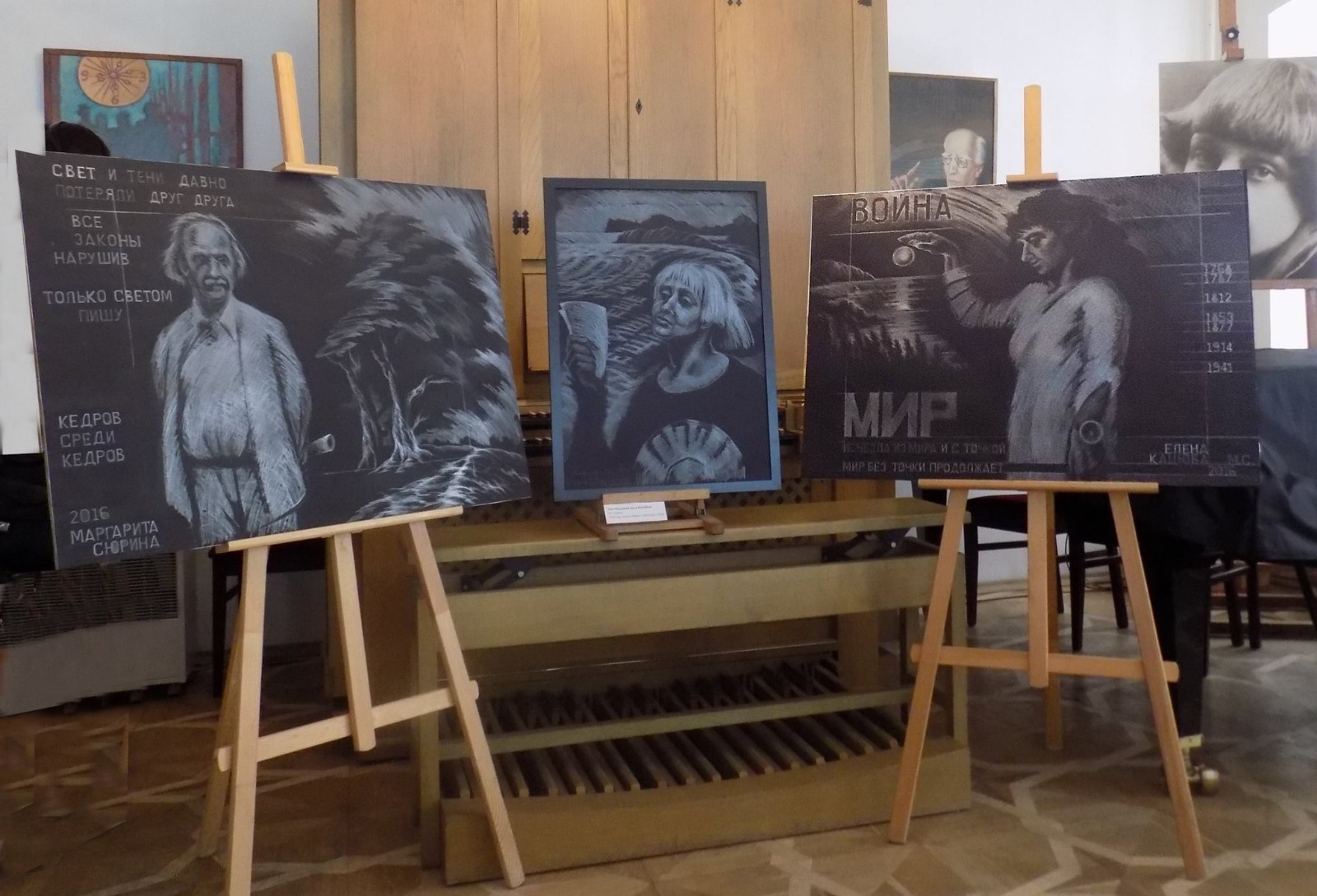
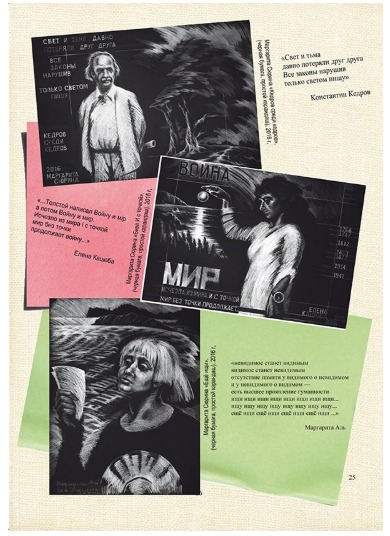
An exhibition featuring three paintings of the avant-garde poets Konstantin Kedrov, Elena Katsyuba, and Margarita Al was held at the Marina Tsvetaeva House-Museum in Moscow. Created by the artist Margarita Syurina, these works are part of the ongoing artistic project “Portraits of Russian Literature”, which brings together visual art and poetic expression.
The project seeks to capture the spiritual and intellectual essence of Russian literary figures — both classical and contemporary — by transforming their poetic voices into visual form. Through her distinctive monochrome technique and profound symbolic imagery, Margarita Syurina reveals the unity of word and image, reflecting the timeless dialogue between literature and art in Russian culture.
Margarita Syurina
Author of the idea and director of the project
Portrait
Art Project “Portrait of Russian Literature”
The art project “Portrait of Russian Literature” opens its third season. In 2016, we will present several new thematic exhibitions in the halls of Moscow’s literary museums, all dedicated to Russian literature.
According to a tradition established over the past two years, the season will open on July 30 at the Marina Tsvetaeva House-Museum in Moscow. We present the exhibition “Russian Literature and Crimea”, in which works by several generations of artists from our project reflect the theme of the profound cultural and spiritual connection between the Crimean Peninsula and Russian literary and artistic thought.
At the same time, and parallel to the exhibition at the Tsvetaeva Museum, we will showcase another exposition, “Russian Literature and Crimea”, at the Nikolai Ostrovsky Museum on Tverskaya Street, in a house historically associated with the name of Alexander Sergeyevich Pushkin.
At the project’s exhibitions dedicated to Crimea, the viewer will encounter Voloshin and Tsvetaeva, Chekhov and Tolstoy, Alexander Pushkin and Alexander Grin, Nabokov and Mandelstam, Paustovsky and Kuprin, Vasily Zhukovsky, and many, many others.
Yalta, Koktebel, Gurzuf, Balaklava, and Sevastopol — from ancient Chersonesus to the Kerch port, from the heights of Ai-Petri to Kara-Dag, from Bakhchisarai to Old Crimea, every Crimean landscape carries within it a fragment of Russian poetry, prose, painting, and music.
Since the days of Empress Catherine the Great and up to the present, the finest minds of the Russian intelligentsia have created, rested, and worked here. The estates and ancestral homes of the Vorontsovs, Naryshkins, Sheremetevs, and Goncharovs were built here. It was here that Prince Alexander Nikolaevich Golitsyn—called by his contemporaries in Crimea “a living fragment of the 18th century”—spent his final days. Each day, the best fruits and wines from Count M. S. Vorontsov’s Alupka Palace, the Governor-General of Tavria, were delivered to Golitsyn’s palace in Gaspra. In the evenings, Elizaveta Ksaverievna Vorontsova herself would read his favorite books aloud to the aging prince…
The very same Elizaveta Ksaverievna, who once gifted Alexander Sergeyevich Pushkin the ancient Karaite carnelian ring that accompanied the poet throughout his life and inspired his famous poem “The Talisman.”
Even in our complex times, Russian poets, writers, artists, composers, and our long-time friends from the DOOS Group continue to write poetry, articles, paintings, and music on the Crimean Peninsula.
It has become a cherished tradition that every new season of the art project “Portrait of Russian Literature” opens with poetic installations and readings organized by Poet’s Journal.
This season, we hope to delight our exhibition visitors not only with the opportunity to see and hear contemporary poets reading their own works live, but also to present a gallery of portraits of these living poets.
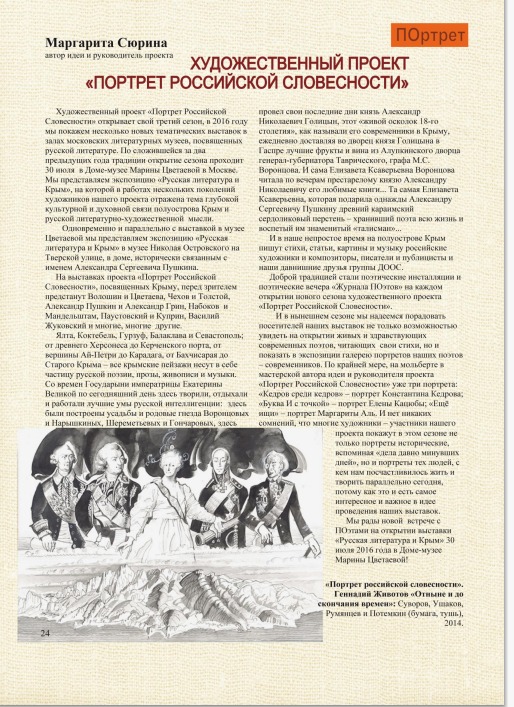
Суворов, Ушаков, Румянцев и Потемкин (бумага, тушь), 2014
Already, on the easel in the workshop of the project’s author and director, there are three completed portraits:
- “Kedrov Among the Cedars” — a portrait of Konstantin Kedrov
- “The Letter ‘I’ with a Dot” — a portrait of Elena Katsyuba
- “Keep Searching” — a portrait of Margarita Al
There is no doubt that many artists participating in our project will, this season, present not only historical portraits — recalling “deeds of days long past” — but also portraits of those contemporaries with whom we are fortunate to live and create today. This, indeed, is the most compelling and essential idea behind our exhibitions.
We look forward to meeting the poets again at the opening of the exhibition “Russian Literature and Crimea” on July 30, 2016, at the Marina Tsvetaeva House-Museum!
“Portrait of Russian Literature.”
Gennady Zhivotov, “From Now Until the End of Time”: Suvorov, Ushakov, Rumyantsev, and Potemki
Report on the Three Paintings from the Project “Portrait of Russian Literature”
Artist: Margarita Syurina
Poets Depicted: Konstantin Kedrov, Elena Katsyuba, Margarita Al
Project Director: Margarita Syurina
The three paintings presented in the visual art project “Portrait of Russian Literature” are dedicated to contemporary avant-garde poets whose creative work bridges the boundaries of poetry, philosophy, and visual expression. Created by the artist Margarita Syurina, the portraits combine literary text and artistic image, forming a synthesis of word and form that reflects the depth and individuality of each poet.
1. “Kedrov Among the Cedars” — Portrait of Konstantin Kedrov (2014)
The first portrait captures the spiritual energy of the poet and philosopher Konstantin Kedrov, one of the leading figures of Russian metaphysical poetry. The composition contrasts light and darkness, visually echoing Kedrov’s line:
“Light and darkness have long lost each other,
Only light can see the face of light.”
Kedrov’s image stands illuminated against a cosmic background, symbolizing his role as a thinker who unites the metaphysical and the earthly through poetic insight. The use of white and silver tones on a black surface creates an atmosphere of transcendence and intellectual luminosity.
2. “War and Peace” — Portrait of Elena Katsyuba (2014)
The second painting, portraying Elena Katsyuba, bears the striking words “War” and “Peace” (Война / Мир), emphasizing the poet’s exploration of conflict and harmony in modern existence. The image of Katsyuba holding a light source reflects the power of poetry to confront darkness and guide human consciousness. Her own words accompany the work:
“I have only begun my verse in the world,
and every line is a point of no return.”
The composition’s contrast of geometric structure and emotional gesture underscores the tension between logic and emotion — a hallmark of Katsyuba’s poetic style.
3. “Keep Searching” — Portrait of Margarita Al (2014)
The third work presents Margarita Al, a poet whose texts blend philosophical depth with a search for spiritual renewal. Her portrait, surrounded by swirling motion and organic patterns, evokes the fluidity of thought and the eternal quest for meaning. A quote by the poet reads:
“The universe becomes visible
only through the transparency of the soul.”
Syurina’s visual language mirrors this introspection — the delicate interplay of shadow and light expresses a meditative stillness, suggesting that creativity itself is an act of revelation.
Together, these three portraits form a unified poetic triptych within the “Portrait of Russian Literature” project. They not only depict faces but also embody the metaphysical essence of contemporary Russian poetry — where art and word merge to celebrate the inner light of creation.