
For thousands of years, humans have sought ways to preserve the bodies of those who departed from this world. The idea of death, of losing loved ones, has always stirred fear and sorrow, but it also inspired reflection on the meaning of life and the possibility of the soul’s survival beyond the grave. Across time and space, methods of mummification varied greatly depending on environment, knowledge, and religious beliefs.
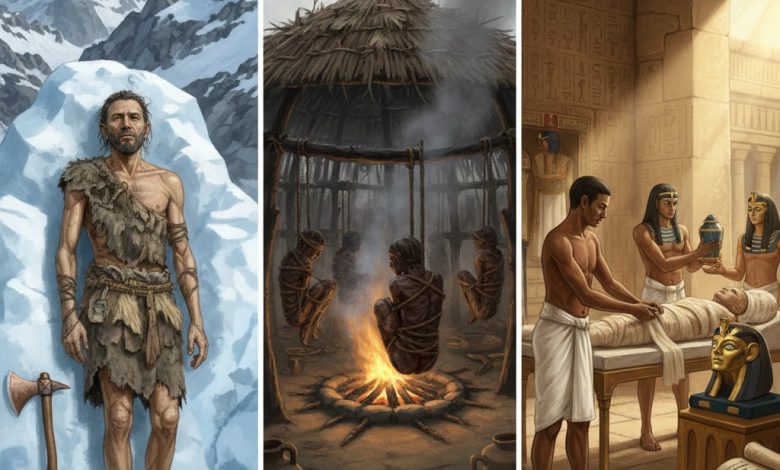
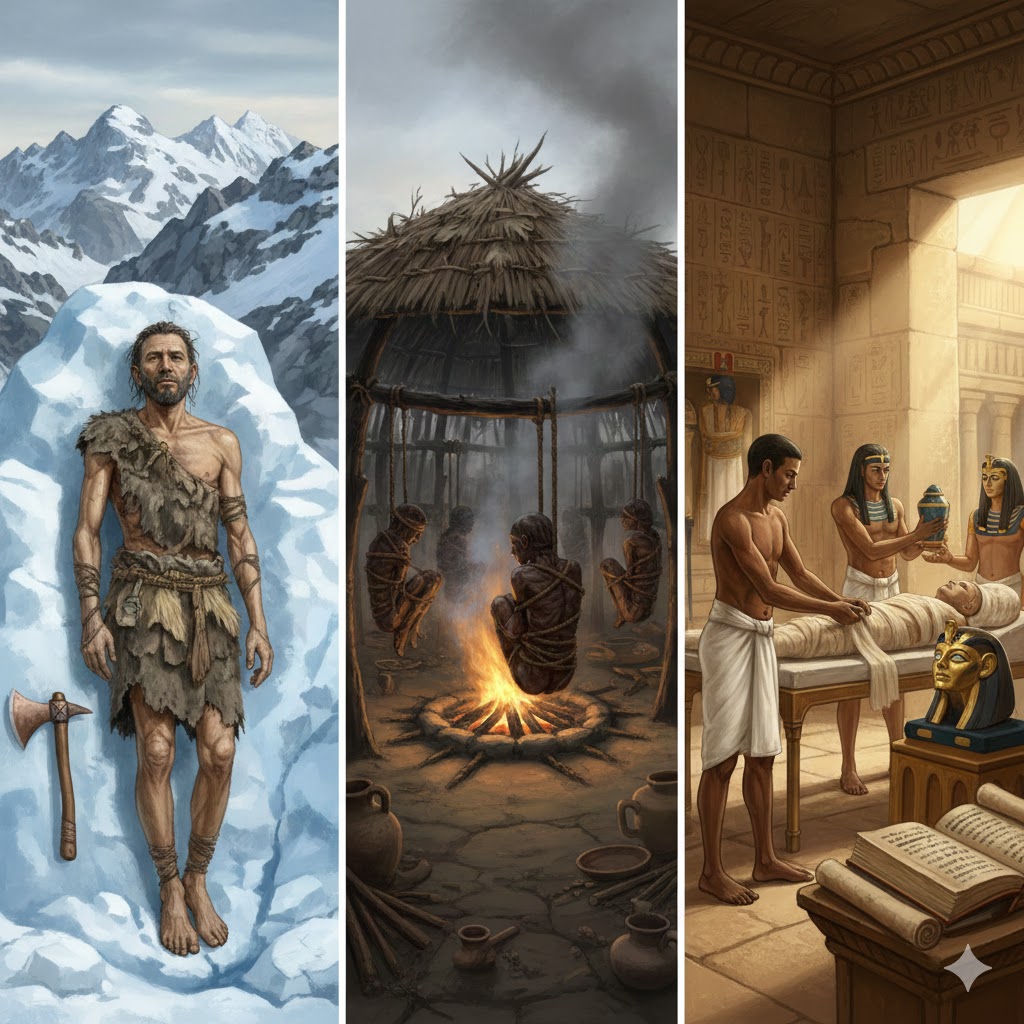
In the heart of the Alps, over five thousand years ago, Ötzi, the “Iceman,” lived a life that today offers a window into natural mummification. Ötzi was not mummified in the deliberate sense; no one at the time knew about the art of embalming. Yet the cold mountain air, dry winds, and absence of bacteria preserved his body in remarkable condition for millennia. Nature itself was the embalmer, and the result, while extraordinary, was purely accidental, with no human intent or ritual. Ötzi’s preservation teaches us that while the environment can protect the body, it does not reflect culture, knowledge, or spiritual intent.
Elsewhere, in Southeast Asia, humans practiced an early form of intentional mummification. Between 10,000 and 12,000 years ago, they preserved their dead by exposing bodies to smoke from low fires and binding them in a crouched position. This method slowed decay and allowed some soft tissue to remain, but it was rudimentary. Organs were not removed, chemicals were not used, and there were no religious rites guiding the process. Often, only skeletal remains survived, carrying traces of smoke and drying. While these early practices reveal a human understanding of preservation, they pale in comparison to the complexity achieved later in Egypt.
In ancient Egypt, mummification reached a unique and unparalleled level, combining science, art, and religious ritual into a comprehensive practice. Egyptians understood that the body was not merely flesh and bone, but the dwelling of the soul. To preserve the soul, the body had to remain intact. They developed precise and intricate procedures: removal of the brain through the nose, extraction of the internal organs prone to decay, drying the body with natron for extended periods, applying oils and aromatic resins, wrapping the body in tens of meters of linen, and adorning it with masks and symbolic amulets. Every step reflected a profound awareness of natural science and spirituality, interwoven seamlessly.
 The Egyptian environment greatly facilitated preservation. The dry air, scorching sands, and arid climate ensured that mummification could succeed where tropical climates would fail, as humidity accelerates decay. Yet environment alone was not enough. Egyptian mummification became a structured institution, involving specialized priests, dedicated workshops, unique chemical compounds, and sacred texts detailing every step. The Book of the Dead and Pyramid Texts were not merely literary works—they were instructions guiding the preservation of the body and preparation of the soul for eternity.
Royal mummies, such as Tutankhamun, Ramses II, Seqenenre, and Ahmose, were not just preserved bodies; they were artistic and spiritual masterpieces. Gold, ornaments, masks, and the careful application of resins transformed the mummy into a symbol of beauty, knowledge, and immortality. Each mummy tells a complete story: of medicine, craft, religion, society, and human ingenuity. These creations became globally renowned and ensured that Egyptian mummification would remain a benchmark for both preservation and artistry.
Why, then, did Egyptian mummies achieve such fame? The answer is simple: they combined science, art, and religion. Elsewhere, mummification was either accidental, as in Ötzi, or rudimentary, as in early Southeast Asia. In Egypt, it became a precise science, a religious ritual, and a profound philosophy of life and death. This synthesis produced mummies that were not only technically superior but also spiritually and aesthetically compelling.
For more than three thousand years—from the Predynastic period through the Old, Middle, and New Kingdoms, and into the Late and Roman periods—Egyptians refined mummification. No other civilization maintained such a sophisticated, long-lasting practice. As a result, Egyptian mummies have endured as eternal symbols of human culture, offering insight into the beliefs, science, and artistry of one of history’s greatest civilizations.
Ultimately, Egyptian mummies are more than preserved remains; they are complete narratives about humanity—about religion, knowledge, art, and society. Their enduring fascination lies in this ability to combine the scientific with the spiritual, to transform death into art, and mortality into a form of eternal life. They remind us that civilization is not merely about survival but about leaving a legacy that speaks across millennia