

The exhibition of works by the late Greek artist and architect Makis Varlamis at the Bibliotheca Alexandrina was not a mere artistic event or a conventional cultural activity. Rather, it represented a profound civilizational act, reaffirming that Alexandria still possesses the capacity to reclaim its historical position as a cosmopolitan city, a center of cultural radiance, and a crossroads between East and West, between past and future, and between memory and imagination.
The Bibliotheca Alexandrina, with all its exceptional symbolism, is not just a modern cultural institution; it is the spiritual and intellectual continuation of the greatest knowledge project the ancient world ever witnessed. For this reason, it proved to be the most harmonious setting for Varlamis’s work—a body of work that transcends art alone and intersects with history, philosophy, architecture, and the human essence. Within this space, the works were not presented merely to be viewed, but to be read, contemplated, and reconsidered as vehicles for reflecting on the meaning of human civilization.
 The Bibliotheca Alexandrina, with all its exceptional symbolism, is not just a modern cultural institution; it is the spiritual and intellectual continuation of the greatest knowledge project the ancient world ever witnessed. For this reason, it proved to be the most harmonious setting for Varlamis’s work—a body of work that transcends art alone and intersects with history, philosophy, architecture, and the human essence. Within this space, the works were not presented merely to be viewed, but to be read, contemplated, and reconsidered as vehicles for reflecting on the meaning of human civilization.
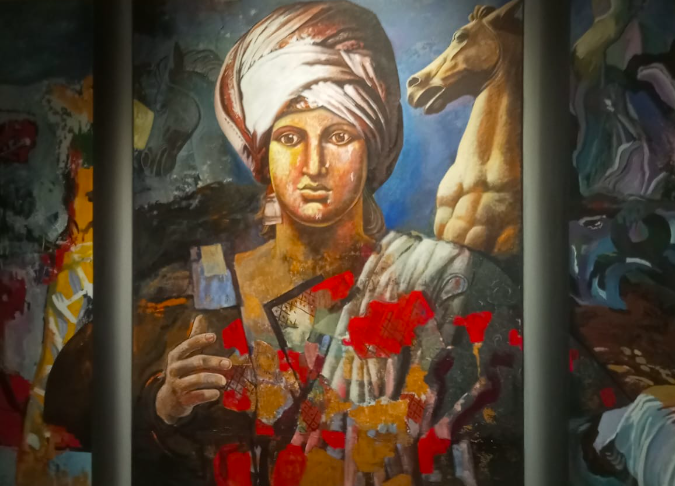
In this exhibition, Varlamis’s works were not offered as isolated paintings or visual compositions but as an integrated intellectual project that reinterprets the figure of Alexander the Great beyond stereotypical frameworks. Here, Alexander is not the conquering general or the legendary hero; he is a global human symbol, embodying the idea of cultural exchange, the pursuit of knowledge, and the aspiration to build a world based on interaction rather than exclusion. Within the library’s spaces, art intertwined with memory, architecture with philosophy, and history with the present, making the visitor an active participant in an open contemplative experience that questions identity, the limits of belonging, and the possibility of creative coexistence among peoples.

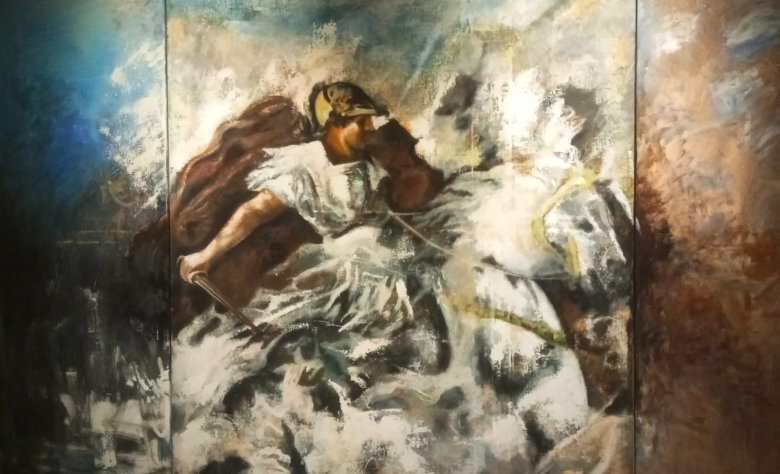
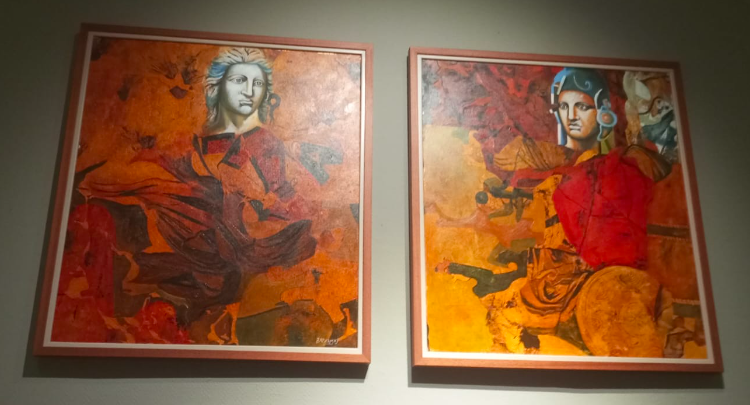
The significance of this exhibition is heightened by its location in Alexandria—the city founded by Alexander himself—not merely as a political capital but as a city of ideas, a city of dreams. A city created to serve as a meeting point for civilizations and a human laboratory for diversity and openness. Over the centuries, Alexandria became a global symbol of science, knowledge, and art, a unique model of a city that shaped its identity through plurality rather than uniformity. Here, as Varlamis envisioned it and as the library embraces it today, Alexandria is not merely a city of the past but also a city of the future, capable of generating a global cultural discourse that transcends geographical, political, and linguistic boundaries.
In this event, the Bibliotheca Alexandrina was not merely a venue for the exhibition but a true partner in shaping meaning. It is an institution that believes culture, art, and knowledge are not luxuries but essential tools for human dialogue and bridge-building between peoples. This belief is at the core of Varlamis’s artistic project, based on the idea that art can serve as a universal language, transcending differences and speaking to the human soul. Hence, the remarkable harmony between the library’s modern architecture, with its transparency and openness, and the Mediterranean spirit of Varlamis’s works, imbued with movement, history, and profound questions.

This event carries a clear and profound message: Egyptian–Greek relations are not limited to shared history alone, no matter how rich or long-lasting that history may be. They are constantly renewed through art, thought, creativity, and cultural dialogue. It also confirms that, despite all the transformations it has witnessed, Alexandria still possesses the capacity, through its major cultural institutions, to play its natural role as a global platform for intercivilizational dialogue and a free space for the convergence of ideas and human visions.
Thus, the exhibition of Makis Varlamis’s works at the Bibliotheca Alexandrina was not merely a revival of a great artist’s name or a celebration of an exceptional creative experience. It was a tribute to the very idea of Alexandria itself: a city belonging to the world, carrying its memory, and reshaping its future—a city to which the world returns through art, just as it once returned through knowledge.