

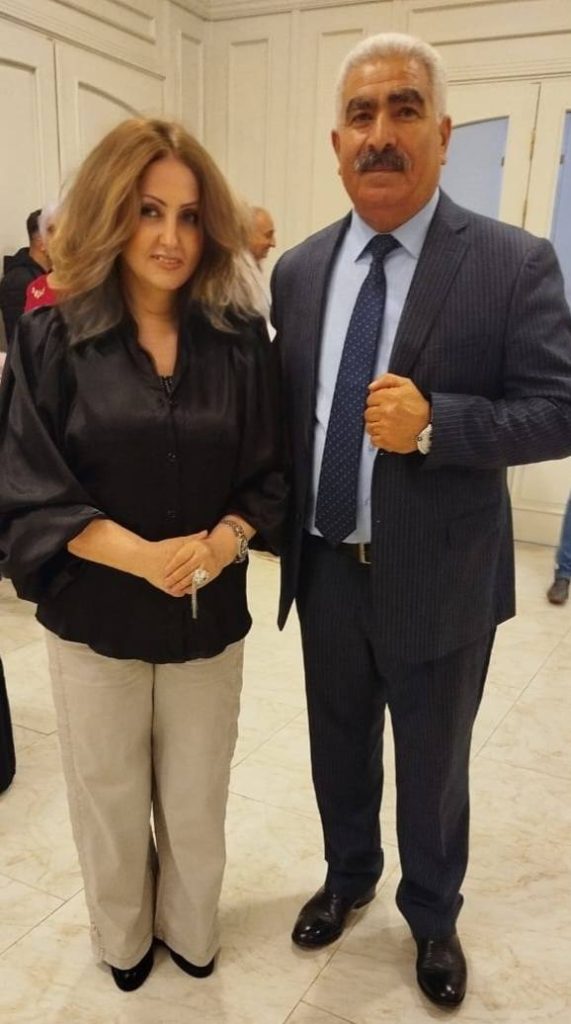
– Ms. Tarana, welcome. How are you?
– Thank you very much. I wish you well.
– Both for me and for our readers, it would be interesting if you could introduce yourself in a few sentences. How would you present yourself to your readers?
– I am an ordinary person who loves balance in everything, values composure in daily life, and treats herself and those who respect her with the utmost respect.
– For a person, the dearest and sweetest memories are those of childhood. How do you remember those years? Could you share with us one unforgettable incident from the days when both your parents were alive?
– A child’s memory is very strong. I even have a story about this. If I said that I remember every single day of those distant years and have forgotten nothing, you would probably believe me. My first day at school; my father holding my hand and teaching me how to write letters; my mother combing my hair and braiding it; my grandfather’s house in the village of Poladlı in Ağdam; relatives, my aunts on both sides. As I speak now, those beautiful days pass before my eyes like a film reel. Truly, every day of that period is a beautiful memory.
– Your father was a well-known person in an official position. Many people like myself grew up with parents who lived in poverty and hardship. Although we were happy, we lacked many things. I wonder, what did you lack in your childhood?
– In fact, the period when my father held an official position mostly belonged to my older brothers and sisters. I was the youngest child, and by the time I became aware of things, my father was already retired. However, the respect and authority my father earned during his many years of service in law enforcement always served as moral support for our family. My parents managed to build a family that could serve as an example to everyone—one in which children never lacked anything.
I should also mention that even in their most prosperous times, my parents always extended a helping hand to those in need. My mother used to say that during the harsh war years, when my father worked at the military commissariat, he would drive a car into the yard at night, open the trunk, and call the neighbors to take food so their children would not go hungry. I have heard similar stories from eyewitnesses. I also remember an elderly man we did not know coming from the district to offer condolences at my father’s funeral. Crying, he said: “If it weren’t for your father, my children would have died of hunger.” We learned about my father’s good deeds much later.
– Ms. Tarana Memmed, when did you feel that you would become someone important in the future? No, let’s not joke—I’m asking seriously. You are a poet, painter, well-known writer, translator, and a former lieutenant colonel of the Ministry of National Security. These are major titles, aren’t they?
– First of all, let me say that I do not consider myself a “great person,” because possessing the titles you listed does not necessarily make one great. Perhaps I am simply different. If you had said that, I would agree. If several responsibilities fall upon the shoulders of a delicate woman and she manages to fulfill them, this may be considered a form of difference.I sensed this difference from childhood. For example, I could foresee certain events, and I had the ability to understand people. I loved books from a young age. My father had a rich library, and I eagerly read those books. Now I think that much of what I have achieved is the result of foundations laid in childhood.
 – Ms. Tarana Memmed, when did you feel that you would become someone important in the future? No, let’s not joke—I’m asking seriously. You are a poet, painter, well-known writer, translator, and a former lieutenant colonel of the Ministry of National Security. These are major titles, aren’t they?
– I also knew your late husband, Mr. Etibar, very well. He was a wonderful person and contributed greatly to the translation of my work The Captive Woman. Please remember him with us and tell us a little about him. When did you meet, and when did you start a family? How has his loss affected you?
– My late husband did not like public exposure of our family, and I fully agreed with him. If you have noticed, I never speak about my family or family matters in interviews or posts. We always remained faithful to the saying, “Our home is our fortress.” I think that if I were to say something now or reveal anything, I would hurt his spirit.
Let me just say this: both of us did everything we could so that our only child would one day remember his parents with pride and honor.
– I have read your novel Secret. It is a magnificent work. In general, what is a secret, and why can good people not keep secrets? Even in your case, although you titled the novel Secret, all the secrets of the protagonist are revealed at the end.
– Thank you for your high appreciation of my work. A secret is the state of information or news before it is disclosed. You have probably heard the saying, “All secrets are eventually revealed.”
Dzerzhinsky once said that only a well-educated person can keep a secret. I do not agree with your statement that “good people cannot keep secrets.” In a novel, I may reveal my character’s secret to the reader, but I would never reveal a secret entrusted to me. If that were not the case, I would not have devoted much of my life to protecting state secrets and keeping them undisclosed until death.
— You used to write poetry from time to time, and you still do. They are truly beautiful poems. But why did you move to prose? You also have dramatic works that have been staged. In general, what is the difference between poetry and prose for you?
— I don’t remember ever taking a step like “moving to prose,” because I came to literature not through poetry, but through prose. My poems are simply emotions I want to express; like every Azerbaijani, sometimes I feel the urge to arrange them into rhyme. If I said that I could express the difference between poetry and prose with some new word of my own, that would be insincere. Poetry is poetry, prose is prose. Each has its own place and its own power of influence. I think that those who write poetry (I mean true poetry) possess very strong sensitivity and are therefore closer to God, and often what they write is dictated to them. The word “poet” comes from the Arabic root “sha‘ara,” which means “to feel.” In fact, perhaps I don’t write poetry precisely because I love poetry so much. I believe it is a very great responsibility. Let it not seem as if one can be irresponsible in prose—absolutely not! In general, if the Creator has given us writers the ability to touch the human heart and astonish it in a good way, then first and foremost we bear responsibility before Him.
— You have translated many works. Let us take my novel “The Captive Woman” as an example. The translation turned out very well; Russian-speaking readers also confirm this. For you, is it easier to write a work or to translate one? And whom have you translated?
— A certain part of my literary activity consists of translation. I believe that translating is more difficult than writing. A translator cannot help but remain within the framework created by the author and must translate the work as it is. The strength of a translator lies precisely in being able to convey both the author’s words and spirit to the reader as they are. Perhaps that is why I do not translate every work. If I do not like a work, if I cannot accept it as my own, or if I do not learn something new from it, I do not translate it. For example, recently, while translating physician-writer Hümbət Həsənoğlu’s “Selected Works” into Russian, I encountered many scientific innovations. I have translated into Azerbaijani a very interesting work titled “The Postman for Yeva” by our compatriot Alexandra Azima Reingardt, who lives in Germany. I should note that although the author has lived far from Azerbaijan for many years, she masterfully depicts in her work the traditions and beliefs preserved by our people. I also take special pleasure in translating the essays and poems of Tamilla Akhundova, another Russian-language representative of Azerbaijani literature, into Azerbaijani. Ms. Tamilla’s works are deep in meaning and very complex in terms of writing style. Such translations encourage the translator to learn and to apply knowledge correctly.
As you know, the Karabakh theme has been a long-standing wound for me, because as a Karabakh native I experienced longing for homeland, people, and land. Therefore, without applying the above criteria to the Karabakh theme, I translated two books from Azerbaijani into Russian without reading them in advance. These were your book “The Captive Woman” and Rahilə Soltanqızı’s “The Epic of Victory,” dedicated to the memory of her martyred brother. The feelings I experienced while translating these books will never be forgotten. I would very much like these books to be read and included in textbooks, because both reflect unforgettable pages of our history. It is said that both translations turned out well. How wonderful that after pain, longing, and suffering, works about our Victory were also created, and I was able to convey both states to a Russian-speaking audience.
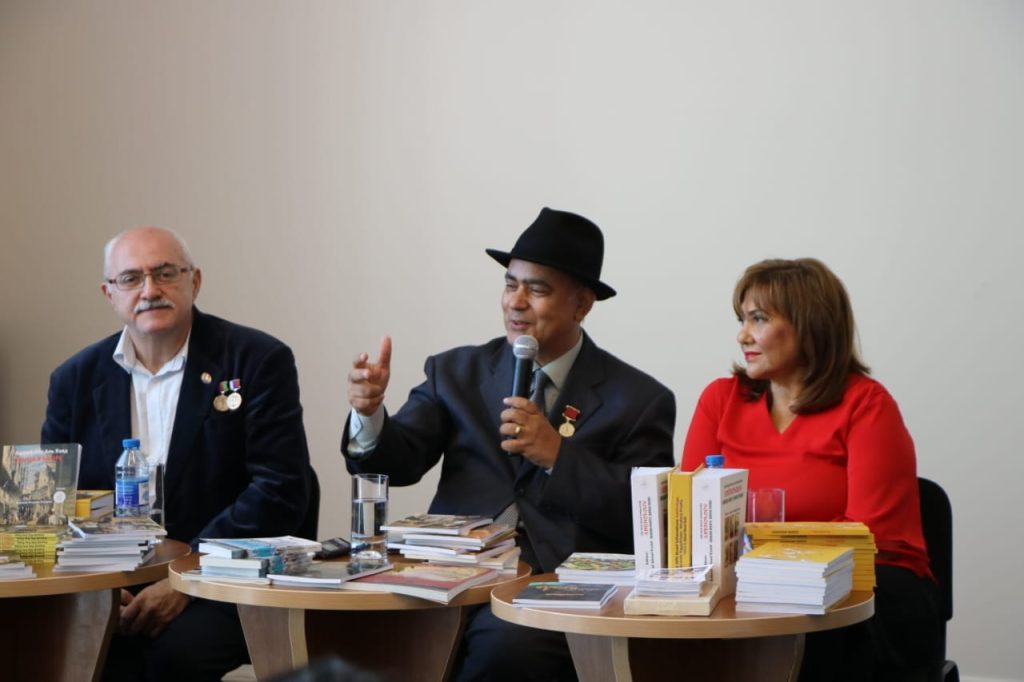
— Speaking of translation, you have also translated “A Street in Cairo” by the great Egyptian writer Ashraf Aboul-Yazid Ashraf-Dali into Azerbaijani. Mr. Ashraf is a great figure. What can you say about your acquaintance with him?
— Perhaps many do not know that I am a professional Arabic translator. Even as a student, I translated the famous poem “Habibati (My Beloved)” by the Arab poet Nizar Qabbani into Azerbaijani. The phrase I used in the translation—“oh my last, my first love”—was greatly appreciated by my Arabic language teacher. Later, I translated several fairy tales by the Egyptian children’s writer Samir Abdul-Baqi into our language. Two years ago, I dared to translate from Arabic into Azerbaijani a small but deeply meaningful book. It is “A Street in Cairo” by the world-renowned, peace-advocating Egyptian writer Ashraf Aboul-Yazid Ashraf-Dali. I note with great pride and gratitude to the author that this book was published in Egypt, and one copy was presented to me as a gift.
I met Ashraf Dali at a meeting with readers of the Russian writer—our compatriot—very talented and a laureate of many awards, a member of the Azerbaijan Writers’ Union, and the author of dozens of valuable books, Eldar Akhadov. The meeting was held mainly in Russian and English. I remember that my addressing Mr. Ashraf in his own language pleasantly surprised him. Later, I learned more about Ashraf Aboul-Yazid Ashraf-Dali, followed his writings on social media, and today I am proud of my personal acquaintance with such a person.

— Your voice resembles the murmur of water—are you aware of this? Even our late academician Ziya Bunyadov, if I’m not mistaken, spoke of the magic of your voice. Do you think this is true?
— That’s what they say. It was Ziya Bunyadov who first paid attention to my voice and, at a moment when I wanted to become a scholar, directed me completely toward a different path. After graduating from university, I intended to work at the Institute of Oriental Studies of the Academy headed by Ziya müəllim. However, my interesting meeting with Ziya Bunyadov, on his recommendation and instruction, brought me to the Foreign Broadcasting Department of Azerbaijan Radio (now called a Department).
During that meeting, we spoke at length in Russian, Azerbaijani, and sometimes Arabic. A question he asked—completely unrelated to our conversation—surprised me:
“Has anyone told you that you have a beautiful voice?”
“No, no one has particularly noted it,” I replied.
Then he picked up the phone, dialed somewhere, and said:
“I’m sending you a girl with a beautiful voice. Take her and let such a voice be broadcast from Azerbaijan to the Arab countries.”
I honestly say that I later learned he had spoken with Hafiz müəllim, the head of the Foreign Broadcasting Department of Azerbaijan Radio. After some time, alongside the powerful and majestic voice of the late Fakhraddin Gasimov (son of the famous poet Gasim Gasimzadeh), my voice also reached the world.
If I were to say something myself about my voice, it would seem immodest. Therefore, I simply thank Ziya müəllim first, and then the friends who appreciated and valued my voice.
— You love white flowers and sunny weather very much. These are all signs of spring. If you wouldn’t mind, I’d say you are on the threshold of life’s autumn. Where does this youthful spirit come from? Not to mention your beauty at this age, mashallah.
— I am not on the threshold of life’s autumn—I am right in the middle of it. I never hide this or my age. You know, I think that as a person grows older, they become more attached to life. I truly love white flowers and sunny weather. I have written so much about this that my readers already know this weakness of mine. I admit that in this autumn season of life my spirit is somewhat tired, but how can one ever have enough of beauty, nature, and the changing of seasons?
As for beauty, I believe there is no woman who is not beautiful—there are women who do not know how to present themselves sufficiently. I always say that I inherited strength and courage from my father, and delicacy and gentleness from my mother. May God have mercy on them.
 — What qualities do you like and dislike in people?
— I like honesty; I dislike hypocrisy.
— You have many friends and acquaintances. We all care for you very much. You are able to communicate with everyone, which is quite difficult. I’m very curious—how do you manage this?
— One does not have many friends; I have many acquaintances. Each person who cares for me has a special place in my heart. Communicating with everyone is not difficult. One simply needs to take into account people’s individual characteristics, their upbringing, the environment they grew up in, their education, not demand from them what you yourself possess, and accept everyone as they are.
— In recent years you have faced many hardships. You lost your beloved husband, had health problems, family and household concerns, and so on. But thank God you are standing, you are among us, and you continue to write and create. How did you manage this?
— I never talk about my personal problems. People need positive energy more now. But if you ask, I will say that I never wanted to be a strong woman. Even in my stories, female characters are delicate, gentle, somewhat submissive, capable of forgiving. But life issued its own decree, and I became precisely a strong woman. I even have a line in my poem: “I am amazed at the endurance within me.” Yes, I have lived through difficult days recently. There were even days when I collapsed, when it felt as if my breath stopped from helplessness. But my close relatives and loved ones surrounded me with care, held my arms, and lifted me up. My friends and companions supported me, saying, “You are strong!” If I am standing today, it is thanks to the sincere, dear people around me. I owe love to each of them.
— What worries you most today?
— As one understands life and grows older, the feeling of anxiety decreases. One day you realize that you cannot intervene in the events that worry and distress you. What happens, happens anyway. Yet one of the traits that distinguishes humans from other beings is the ability to think. If a person thinks, they inevitably feel concern. On a global scale, conflicts in many parts of the world, natural disasters, pandemics, the gradual destruction of humanity, and the loss of values worry me.
— What have you done so far, what have you been unable to do, and what would you like to do next?
— Most of what I have done so far is visible. What I have been unable to do are things not directly dependent on me. If His Majesty Life grants me time, there are still things I would like to do.
— And finally, a traditional question: if you were born again, which profession would you choose, and which mistake in life would you not repeat?
— First of all, I am sure that neither I nor anyone else has the possibility of being born again. So I would not want to dwell on that question and build dreams, although my desire to become a doctor still remains. Whatever I have done, whatever mistakes I have made, whatever I have done right or wrong—all of it is mine. As for what I would or would not do, most likely I would do the same things again.
— Thank you very much for your wonderful answers, Ms. Tarana Memmed!.
— I thank you as well for your thoughtful questions.