

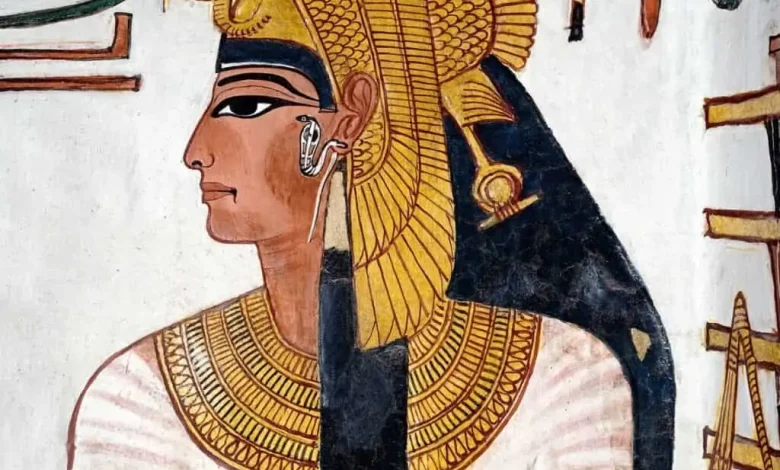
Queen Nefertari…
Beauty of Beauties and Queen of Eternity
Dr. Hend El-Sherbiny

Queen Nefertari was not merely the wife of a great king; she was, in herself, a complete civilizational phenomenon—an embodiment of the ideal queen in ancient Egypt, uniting beauty, intellect, status, and symbolism. When we speak of Nefertari, we do not recall only the image of a beautiful woman, but rather a deeper meaning of beauty as understood by the ancient Egyptians: the beauty of spirit and mind, and the ability to represent cosmic order, Ma’at.
Nefertari bore the title of Great Royal Wife of King Ramesses II, and her name, Nefertari Merit-Mut, means “the beautiful one, beloved of the goddess Mut.” This was no arbitrary name; it reflected her religious and symbolic status within the royal court. In reliefs and inscriptions, Nefertari appears participating in rituals and sacred ceremonies, presenting offerings, and addressing the gods with composure and dignity—scenes that confirm she was not merely the king’s shadow, but a symbolic partner in rule and sanctity.
Nefertari’s beauty also had a clear political and cultural dimension. She played an important role in Egypt’s diplomatic relations, especially with the Hittite state, exchanging letters and gifts with its queen—a rare scene that reflects the trust and international standing of the Egyptian queen. These correspondences reveal a woman fully aware of her role, conscious of Egypt’s value and prestige, and capable of representing her country through the language of civilization rather than power alone.
The pinnacle of Nefertari’s legacy is embodied in her famous tomb in the Valley of the Queens (QV66), considered one of the most beautiful tombs in ancient Egypt, indeed in the entire world. Its walls are not merely funerary texts, but a philosophical and spiritual journey, showing Nefertari as she traverses the afterlife, converses with the gods, and is warmly received as if she herself were among the immortals. The vibrant colors, artistic precision, and harmony between text and image all point to an exceptional status granted to only a very few queens of Egypt.
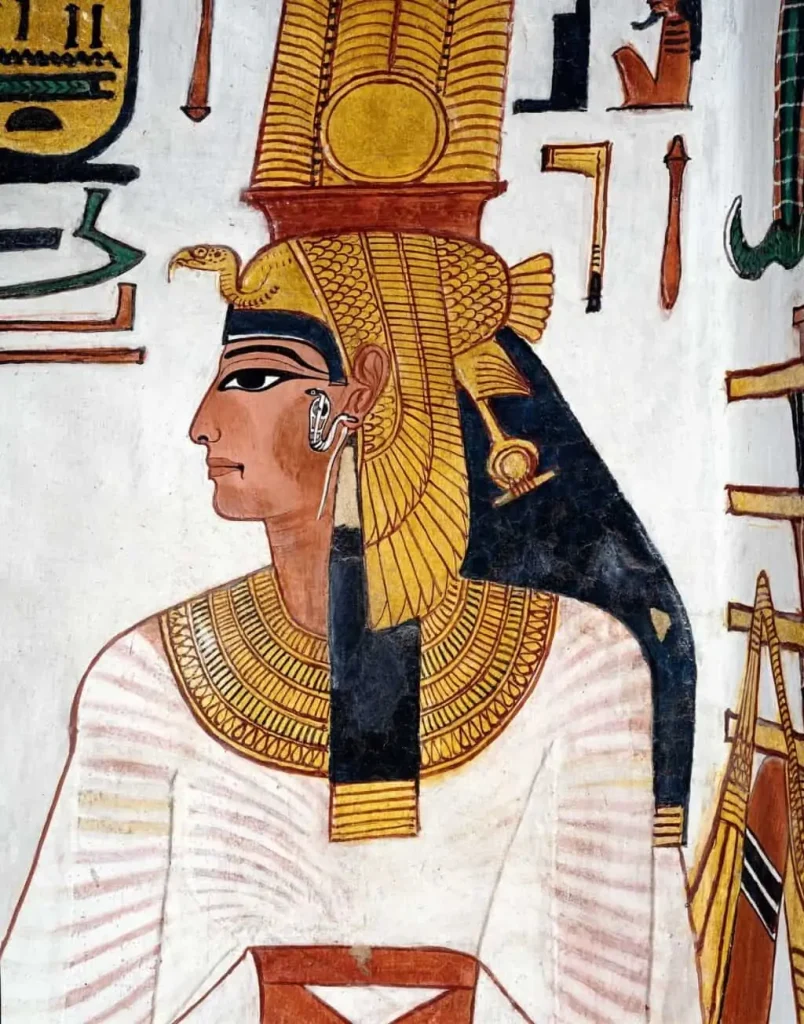
Ramesses II loved her deeply, and this love is clearly expressed in her small temple at Abu Simbel, where she is shown equal to him in size—an unmistakable break from artistic convention. Her figure was not reduced, as was customary, but placed on equal footing with the king, sending a powerful visual message: that beauty here is authority, and that status is measured not by gender, but by worth.
In essence, Nefertari was more an idea than a person—an idea of the queen who unites femininity and power, beauty and wisdom, earth and heaven. That is why her name has endured, and her beauty has remained alive—not because it was merely the beauty of a face, but because it was the beauty of a civilization that believed human beings could approach eternity through art and meaning.
Thus, Nefertari remains—
the beauty of beauties, and the queen of eternal immortality.