
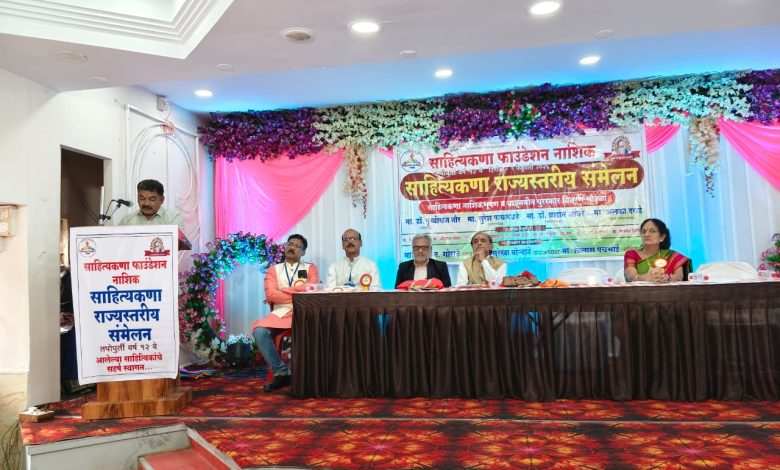
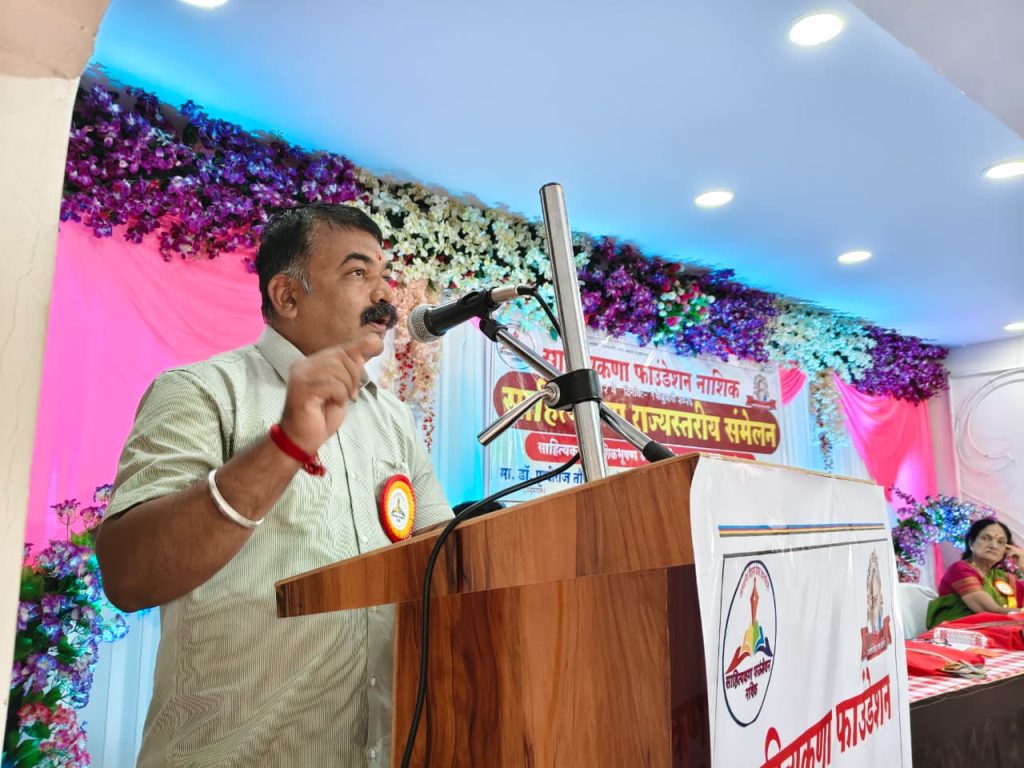
The President of this Marathi Literary Festival ( Sammelan) Respected Suresh Pachakwade; Dr. Prashant Ambre; the President of Sahityakana Foundation, noted writer Sanjay Gorade; the Secretary, my dear and kind-hearted writer friend Vilas Panchbhai; former presidents of this Festival Vijaykumar Mithe, Vivek Uglamugle; Sanjay Karajkar; Dr. Rajesh Gaikwad; Alaka Darade; Rakesh Wanakhede; Haridas Akhare; Ashwini Boraste; Bhaskarrao Shirode; Surekha Borhade; Rajendra Somvanshi; Pravin Jondhale; Nandkishor Thombare; poet friend Sagar Jadhav; Sureshrao Pawar; Ravikant Shardul; Kiran Sonar; Pratibha Jadhav; Umesh Gaydhani; Prof. Tushar Chandavdarkar; Dr. Dilip Dhondge, Jitendra Kunwar, Sayaji Shinde, Satish Malave, Gopalrao Patil, Kritika Marathe, Gurya Swami, Vasant Shahane, Ratnakar Shejwal, Rajendra Ugale, Prakash Holkar; writers, authors, poets, brothers and sisters,
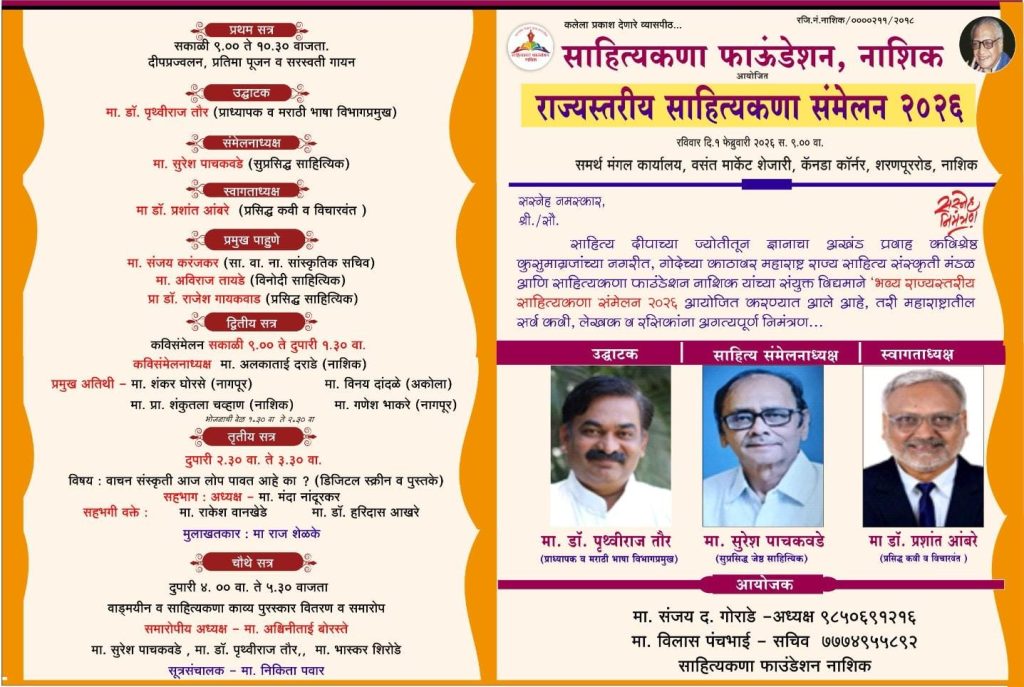
I declare the State-level Sahityakana Sammelan, organized by the Sahityakana Foundation Nashik, is open now.
Nashik is sacred land. It is land sanctified by the touch of Lord Ramachandra’s feet. The footsteps of great personalities from history, saints, kings, and brave warriors are marked upon this land. This is the land of sacrifice, restraint, struggle, and radiance.This is the land of the poet laureate Kusumagraj, freedom fighter Vinayak Damodar Savarkar, the poet Govind, Vasant Kanetkar, Vamandada Kardak, and Baburao Bagul. It is their literary contributions that have shaped my being, and I note this with gratitude at the very outset.
The term ‘Sahityakana’ reminds me of some other words. Words like communication, bodily posture, movement, sensation, dialogue, flexibility, endurance, protection. This term brings to mind the history of human evolution spanning the last forty lakh years. The development of humans from quadrupeds to bipeds, the language they acquired, the memory they gained, the script they discovered, their triumph over time – it reminds me of many such milestones. Every human has a backbone made from the spinal cord and vertebrae. It is crucial for establishing communication between the brain and the body, and when it is injured, there is a risk of losing sensation. In short, the backbone (Kanaa) is the most critical part of the human body. Because of it, our daily activities become easy.
About 30-32 years ago, I encountered the term ‘backbone’ (Kanaa) in the context of socio-cultural roles. I was a junior college student at the time. Awareness of contemporary issues was gradually developing within me. I was beginning to understand the complexities of problems, and it was then that a sentence I read in some article was etched deep into my heart. ‘People without a backbone ruin culture, and people with half a backbone cannot save it even if they wish to.’ For three decades, this sentence has come back to me on various occasions. Standing on this platform of ‘Sahityakana’, I remember it vividly.
Every era is difficult for writing and reading. Just as courage is needed to utter the word truth, so is courage needed to hear it. The present is miles away from both the words ‘truth’ and ‘courage’. This does not mean that people in the past were particularly fond of these words and respected them.
But in every era, some great souls have lived; in every age, some people were born who did not let the meaning of these words perish. Mahatma Gautam Buddha, the supreme saint Dnyaneshwar Mauli, Mahatma Basaveshwar, Jagadguru Saint Tukaram, Mahatma Phule, Mahatma Gandhi, and Dr. Babasaheb Ambedkar gave new meaning to both the words ‘truth’ and ‘courage’ in their respective times. They imparted a luminous essence not just to these words, but to the entire human epoch. Our lives, like ours, have been illuminated by this light of knowledge. Because of this light, we have begun to see the world around us anew. With this vision gained, some people in society became poets-writers, some became painters, some singers. The creation of art is the quest for truth. The melody of a song is the realization of having grasped the truth. And an inspired, excellent poem is the touch of truth, granted by the grace of the creator.
Therefore, when we see many religions around us in the world, writers and artists separate themselves from them and tread a new path of the religion of truth. The writer’s religion itself is that religion of truth. This is the religion of humanity. The entire human society stands on this very foundation.
Being a poet-writer is a responsibility. It is a responsibility we have voluntarily accepted, and hence, our literary and personal conduct must be pure and pristine. Who is free from the flaws of anger, greed, attachment, illusion, jealousy, envy, and malice? But we believe that it is important for the world to free itself from the trap of ‘they’ and ‘them’, and for this, we must examine ourselves repeatedly. If we are advising others, teaching others, guiding others, then why shouldn’t we, as advisors, guides, and illuminators, be accurate ourselves? Why shouldn’t we nurture the values we preach? We must walk on the path we show to others. A poet-writer must be moral even in dreams, let alone in real life. Every action of a poet-artist must be moral. To create the beautiful world, we paint through stories or poems, we ourselves must step forward; for this, ‘backbone’ (Kanaa) is important.
The household may have broken,
But the backbone didn’t break
Placing a hand on the back
Just say, fight on.
This is what Kusumagraj said in his poem; it must not be forgotten.
Even in the intense darkness around us, there are pillars of light, there are guides who give courage and support when we lose our way, there are rangolis drawn by sisters-in-law outside each of our doors, and in tired bodies and eyes about to fade, there are elders who say ‘Be victorious’ and their blessings. These blessings give the tenacity to fight. These good wishes make life’s journey pleasant; these are the ordinary people around us, who make our surroundings clean, innocent, and pure like a baby’s smile.
‘Sahityakana’ is a writers’ Festival organized by writers for writers. Different generations of the present are coming together and, on this occasion, speaking about their stance. This stance is about living with integrity; it is about embracing each other beyond the differences of color, religion, race, region, language, dialect, class, caste, gender. Our ancestors gave us the mantra ‘Vasudhaiva Kutumbakam’ (The world is one family) in the most ancient times. We are the inheritors of Saint Dnyaneshwar, who said, ‘This whole universe is my home’. We are the ‘people’ who believe in the collective power of the people and dream of festivals of joy for them.
As writers, we reside on a small piece of the earth, write in a specific language; but our residence is on a planet, which we call Vasundhara (the Earth). We care for every living and non-living being on this Vasundhara. As writers, we have repeatedly tried to establish our biological relationship with the universal animate and inanimate creation. As litterateurs, we have taken an oath to ourselves; we have taken an oath placing the waters of the Godavari River as witness, we have taken an oath placing the mountain ranges of the Sahyadri as witness, we have taken an oath placing the blood of the heroes who fought for freedom on this land as witness, we have taken an oath placing the moon, stars, sun, forests, winds, and conscience as witness. We have taken an oath to be writers. That is why we are not just talking about the physical backbone; we are also talking about the ‘Sahityakana’ (literary backbone). The dialogue that has begun on the occasion of the Sahityakana Sammelan seems important to me.
A year and a half ago, on the occasion of a poets’ festival among BRICS countries, I was invited by the Chinese government. For about a week and a half, we visited some cities in South and North China, various places. Hangzhou is a remarkable city in Zhejiang province in South China. It is said that the moon descends to earth to bathe in the West Lake of this city. In Haining near this city, the famous poet Xu Zhimo (1897-1931) lived in the last century. This poet lived a very short life of only thirty-four years in the worldly sense. He died in a plane crash. But this poet changed the face of modern Chinese literature. He conducted various experiments. Published periodicals. Created new forms of composition. At this poet’s house, which has now been turned into a memorial, I visited with writers from different countries. And there I got to see some photographs of Rabindranath Tagore. A hundred years ago, in 1924-25, Rabindranath Tagore visited this city in China on the invitation of Xu Zhimo. He attended the poet’s wedding. Tagore stayed in this city for a few months. The city of Haining has preserved his memories. When I went, the city of Haining was celebrating 100 years of Rabindranath Tagore’s visit.
Before that, I had gone to Egypt for the VI Open Eurasian Literary Festival “LIFT-2023” at the Cairo International Book Fair. On the streets of Cairo (there is a famous Arabic poem by the Egyptian poet Ashraf Aboul-Yazid Dali with this title) and while going into the Pyramid at Giza, I kept remembering the Ghats of ancient Varanasi. Varanasi is the village of Mahatma Kabir, as well as the great writer Premchand.
Just recently, I visited Red Square in Moscow, the capital of Russia. The second world congress of the World Organization of Writers WOW was organized under the leadership of Margarita Al. In the Foreign Languages Library of Moscow, a statue of Anna Bhau Sathe has been erected. Anna Bhau Sathe, who gave dignity to labour and toil, is a very great Indian writer.
Wherever we roam in the world, the personalities we repeatedly meet are from the court of literature, I felt this strongly. These are undoubtedly great luminaries. They went around the world and made a home in people’s hearts.
There is a story told about the German poet Goethe (1749-1832). It is said that before publishing any of his compositions, Goethe would read them out to the servants and maids in his house. If they liked the composition, it would be sent forward. Through this practice, a poet became a great poet. We must have read his Faust. The first condition for becoming great is how intimate your relationship is with ordinary people. If the common person, who does not know what literature is, likes your writing, applauds your stories heartily, or if your poem comes to his lips in his joys and sorrows, then you need no other award or certificate. Whether university critics write about you or not, whether your books are in the syllabus or not, whether government awards are tied to your waist or not, whether you have a following or not, whether you are a member of any camp or clique – all this is meaningless.
Does your writing have readers? Does your book elevate the standard of living of ordinary people? It is more necessary to ask ourselves these questions. Your writing itself should be your high, the intoxication of creation should be entwined around your daily existence. If we are living deceitfully, betraying the writer’s dharma, straying from the path of truth, then sleep doesn’t come. And then the artist’s lot becomes a life subject to all sorts of addictions and vices. A true artist does not need any external intoxication, any other substance that gives a high.
It also feels appropriate to mention here that great things are not very complex. Very simple words make human life meaningful. Love, peace, harmony, dialogue, sensitivity, friendship, relationship, smile – these are very beautiful words. When these words enter our lives, our living changes.
You might remember, our ancestors have also told us that the path to peace of mind, the path to self-elevation, is not outside, but inside.
‘If you dig the soil to reach the root,
You will get nothing.
The path to the root
Goes through the flower.’
This is what the poet Uttam Kolgaonkar said. This analogy is worth considering as important advice for writers.
Excellent works can blossom from within our own lives. The more we observe ourselves, our family, and society microscopically, the more universal we become. The universal values around the world are the same. They do not change according to country or time. The appeal of the Ramayana and Mahabharata, and the appeal of the Odyssey and Iliad, are the same all over the world. Everyone in the world sees their own reflection in these epics. And that is why these stories have been told from generation to generation across the world for ages.
Standing on this platform, as a representative of our generation, I want to remind you of this very thing. Write in a language that the ordinary people around you will understand, write for the common people, and face life boldly. Write fearlessly. Let there be anger, let there be fire, let there be the language of revolution, but it must have the touch of humanity, the warmth of emotion, the thread of intimacy towards humans – take care of this.
Mrinalini Gadkari (1949-2018) was an excellent translator in Marathi. I met her while pursuing post-graduation on the occasion of taking an interview. She has translated many books from Bengali into Marathi.
During the interview, there were questions and answers about various Bengali writers from Bankimchandra Chattopadhyay, Saratchandra Chattopadhyay, Tarashankar Bandopadhyay to the recent Ashapurna Devi, Mahasweta Devi, Sunil Gangopadhyay, Taslima Nasreen. During this interview, Mrinalini Gadkari noted an observation that in Bengali, a writer is not recognized as a writer until he writes for children.
In Marathi, the situation is quite the opposite. Those whom we acclaim as eminent writers do not seem to have written much for children. There is no attitude of taking children’s literature seriously in the Marathi literary sphere. Thus, we have missed out on very important things. I humbly appeal to the writers present at this conference, that with the same strength with which you write for adults, take out some time to write for young readers as well. Understand the world of the children around you. Marathi has a rich tradition of children’s writers like Na. Dho. Tamhankar, Sane Guruji, Bha. Ra. Bhagwat, Sudhakar Prabhu, Vinda Karandikar, Anant Bhave, Madhuri Purandare, Rajiv Tambe, L. M. Kadu, Madhuri Mate, Baba Bhand, Farukh Kazi, Swati Raje, Aaba Mahajan. Even so, there are still no books for children who have come of age, for adolescents; there are no books that children in Remand Homes will relate to and that will instill a love for reading; there are no books that will preserve the emotional world of children from the nomadic, de-notified communities; there are no books that children living in tribal hamlets in the jungle will relate to. Who will write for the thousands of such children around us? I appeal that we should come forward for this.
Language was a major barrier until recently, which is why I consciously turned to translation. Over the last twenty-twenty-five years, I have brought thousands of stories from around the world into Marathi for young children. Along with Prof. Swati Kate, I visited schools in Wadi Tanda and interacted with school students from various communities whose mother tongue is not Marathi. I wrote for these children. Took steps to facilitate intercommunication between language and dialect.
Today, from this platform, I want to make you aware that due to the revolution in the field of AI (Artificial Intelligence), the existence of human translators will cease in the next two-three years. The barrier of languages will be removed, and with one click, writing from around the world will be easily readable in one’s own language. Of course, this has already begun. Meaning, henceforth, there will be no need for human translators. Before our very eyes, interpreters and translators will become extinct.
I view this reality differently. When, due to artificial intelligence, writing from around the world is easily available in one’s own language, then new content will be the stronghold. Readers worldwide will be eager to read works that have new content, works that will give a new interpretation of life, that will touch untouched aspects of existence, experiences that have not been presented before. In the future, such writing will be read worldwide, transcending the boundaries of language, country, and time. In the coming era, a writer will not compete with writers from his own village or language, but with writers from all over the world.
The great saint Tukaram gave advice through his abhanga (Poetry) in the seventeenth century: ‘Let the critic’s house be next door.’ This advice is very important in the present. If someone writes something good or bad about us, we get hurt, our resolve wavers. Because of all this, we stray from the path onto a byway. We start walking on a path that is not ours. Our path is that of love, not hatred. Our path is that of friendship, not envy. Our path is that of compassion, not violence. We must call for peace. Therefore, ignore people who criticize or comment on you uselessly. Keep moving forward, singing your song in your own ecstasy. Like-minded people may or may not come with you; don’t worry about that. Remember, your joy lies in the song that blooms on your lips.
Someone might think that all my discussion has become preachy; however, it is not so. I have very humbly placed before you the observations that have occurred to me while writing and reading. I just said that our competition is with writers and poets from all over the world; however, a writer’s competition is never with other writers, it is with oneself.
Your second book should be more advanced and richer than your first book. Reading a book should take the reader from the step they are on to a higher step. And if merely by reading, the reader can elevate their level, then the height of the writer who wrote that book should indeed be very great. Shouldn’t it?
As a human, as an individual, as a component of the animate-inanimate creation, as an offspring of this earth – what is our height? Do I practice human values in real life? Let us ask ourselves this question today. When we get the answer, we will realize whether our backbone is straight or not.
If our backbone as a human is straight, then surely our ‘Sahityakana’ (literary backbone) as a writer will also be straight; this is my belief.
Here, I extend my best wishes to all the writers present for their future journey, for a healthy life, for a happy, prosperous, and healthy life.
Thank you.
Jai Hind! Jai Maharashtra!
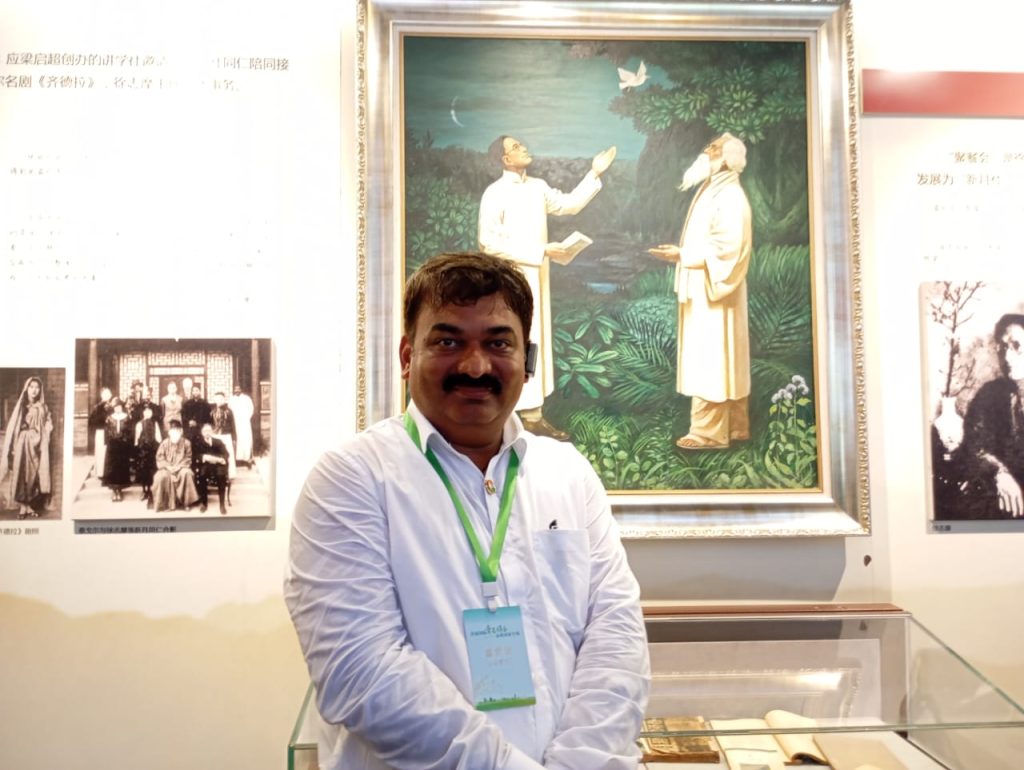
(Dr. Prithviraj Taur is Professor and Head, of Marathi Department at Swami Ramanand Teerth Marathwada University, Nanded 431606, Maharashtra, INDIA. Contact – 9890515815 drprithvirajtaur@gmail.com)