 thesilkroadtoday
 By Bill F. Ndi,
President, Pan African Writers Association and Professor at Tuskegee University, Tuskegee, Alabama
I spent time reflecting on how we are often conditioned to view the map of the world as a static plane—a cold, geometric grid where “Great Powers” move across the board with the detached logic of grandmasters. They feel free to move into sovereign states and capture their leaders with impunity and will often cook up stories of national security, fight against terrorism, excuses that in and of themselves are inexhaustible. In this prevailing geopolitical imaginary, smaller, weaker,and often marginalized nations are cast as “idle chessmen,” inert objects defined only by their utility to the powerful state, i.e. player. In short, the world is turned into a chessboard on which we assume that because a piece is stationary, it is passive. We assume that because it is small, it is silent.
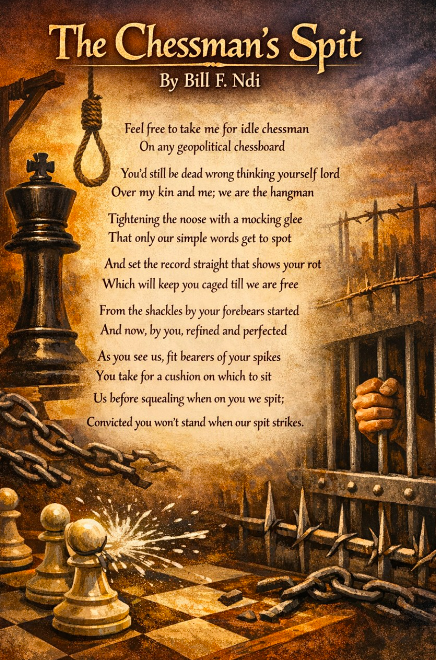 In “The Chessman’s Spit” the speaker co-opts the reader to psychologically shatter this illusion. This short 14-line poem does not merely critique power; it effectively de-centers the “lord” entirely, shifting the ontological weight of the world from the hand that moves the piece to the “kin” who endure the movement. Like in his collaborative seminal work with Hassan Yosimbom, Centers and Peripheries in Literature: Interrogating Hegemonic Canonism, Ndi offers a revolutionary manual for 21st-century resistance, suggesting that the most dangerous element on any board is not the queen or the knight, but the piece that has begun to witness the “rot” of the player viz. the hegemon.
1. The Hangman’s Glee and the Hegemon’s Illusion of Control
The ultimate vulnerability of the hegemon lies in his own arrogance—the belief that he is playing one game while his subjects are playing another. The poem invites the oppressor to “feel free to take me for idle chessman,” a line that functions as a tactical maneuver. This is the first lesson of resistance: the power of invisibility. While the “lord” is focused on the horizontal strategy of the board—the acquisition of territory and resources—the “kin” are operating on a vertical, lethal plane.
The oppressor operates under a delusion of sovereignty, yet “The Chessman’s Spit” reveals that the “lord” is actually the one being measured for a suit of rope. The “mocking glee” of the marginalized is a psychological weapon; it signals a transition from the status of a colonial object to a revolutionary subject. As Frantz Fanon argued, the moment the oppressed realizes their humanity, the colonizer’s world begins to dissolve. In Ndi’s vision, the “idle” piece on the geopolitical chessboard is not waiting to be moved; it is preparing a ceremony of justice.
“You’d still be dead wrong thinking yourself lord / Over my kin and me; we are the hangman / Tightening the noose with a mocking glee”
2. Waking up to Refined Shackles: How Oppression Evolves
Power is never static; it is a shapeshifter. Ndi’s line “shackles by your forebears started” recognizes the historical continuity of oppression, but it is his focus on how these chains are now “refined and perfected” that speaks most urgently to our 21st-century reality. We have moved from the era of overt, physical chains to the Foucauldian nightmare of “refined” systems—algorithmic surveillance, debt traps, and the subtle “normalization” of geopolitical hierarchiesand bullying from those who believe might is right.
This “perfection” of power is designed to make the shackles invisible, transforming the Hegelian master-slave dialectic into a cleaner, more corporate “diplomacy.” However, this refinement is also a form of fragility. By moving power into the realm of the systemic and the cerebral, the “lord” has distanced himself from the basic reality on the ground. The “rot” is still there; it has simply been polished. Resistance in the modern age, therefore, requires a sophisticated “setting of the record” to expose the old colonial bones beneath the new neoliberal flesh.
3. Ndi’s Spiky Cushion: The Elite’s Discomfort
One of the poem’s most arresting metaphors is the “spiky cushion.” The global elite often view the masses as a human buffer—a soft, compliant foundation upon which they can rest their weight and maintain their “lordship.” They seek a “cushion” of cheap labor, silent compliance, and strategic depth.
Yet, Ndi identifies a profound “social angst” that haunts this arrangement. The elite are never truly at ease; they sit upon a foundation of “spikes.” This is the inherent instability of the “gilded cage” of power. The “kin” are not a passive surface; they are sentient, hostile, and sharp. The “spikes” represent the ever-present threat of agency—the reality that the marginalized can, at any moment, pierce the comfort of the powerful. Haven’t we witnessed this in some quarters in Africa? This creates a state of constant, underlying anxiety for the hegemon, who realizes his “throne” is actually a site of potential impalement. The comfort of the elite is not a sign of peace, but a precarious hold on a foundation that despises them.
 4. The Venomous “Spit”: The Power of Rejection
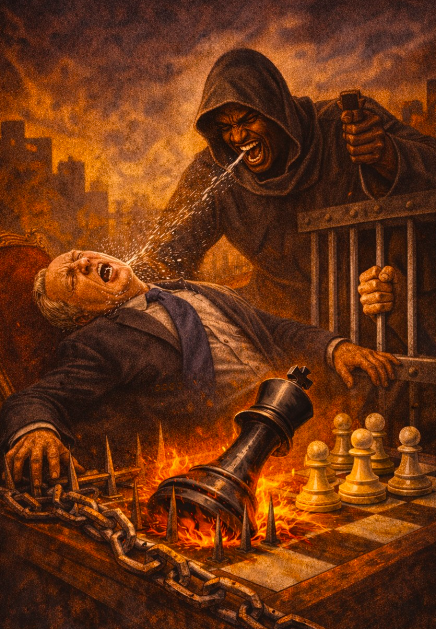
The poem reaches its peak with an act of radical de-legitimization: the “spit.” In the high-stakes world of “refined” diplomacy and complex treaties, “spit” is a primal, instinctual rejection. It is the ultimate “No.” It represents the moment the “kin” withdraw their consent to participate in the lord’s game entirely.
Ndi suggests that “simple words” are the catalyst for this strike. These words are not just speech; they are acts of narrative reclamation that “set the record straight” and expose the moral decay—the “rot”—of the powerful. When the “kin” spit, they are not merely expressing anger; they are stripping the “lord” of his dignity and his standing as do the Beggars in Sembène Ousmane’s Xala. The poem concludes with the absolute conviction that the “lord” cannot stand when the “spit strikes.” This is because the lord’s power is a performance that requires an audience; the spit is the moment the audience walks out and leaves the theater to the actor alone on stage and in the dark.
“Us before squealing when on you we spit; / Convicted you won’t stand when our spit strikes.”
Conclusion: Setting the Record Straight
“The Chessman’s Spit” is far more than a literary exercise; it is a post-colonial manifesto to helprecalibrate the reader’s understanding of the “geopolitics of resistance.” It reminds us that the “refined shackles” of the 21st century are only as strong as the silence of those who wear them. By exposing the “rot” behind the veneer of modern power, Bill F. Ndi provides a roadmap for a world where the “kin” no longer squeal, but strike to have the hegemon in their place “squeal”.
As we witness the shifting tides of global influence and the cracks appearing in once-impenetrable hegemonies, we are forced to confront a final, unsettling question: In the modern geopolitical game, who is truly in danger—the piece being moved, or the “lord” who has forgotten that his entire world rests on a cushion of spikes?