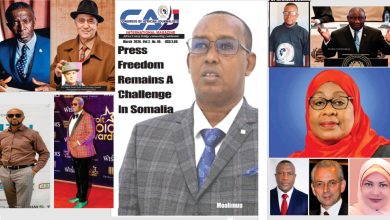

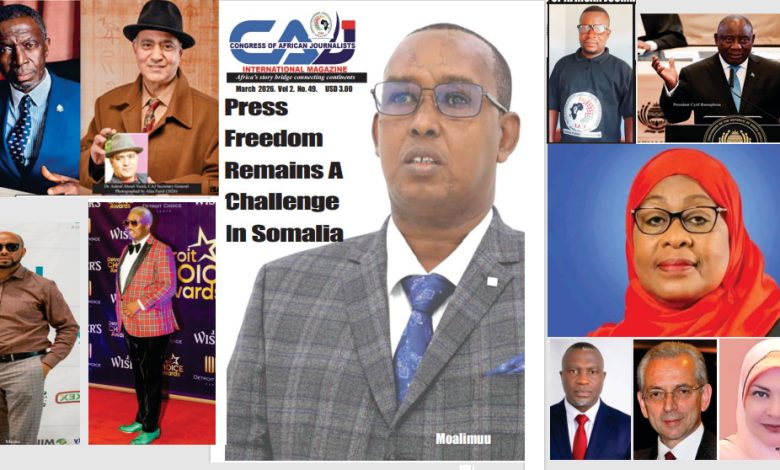
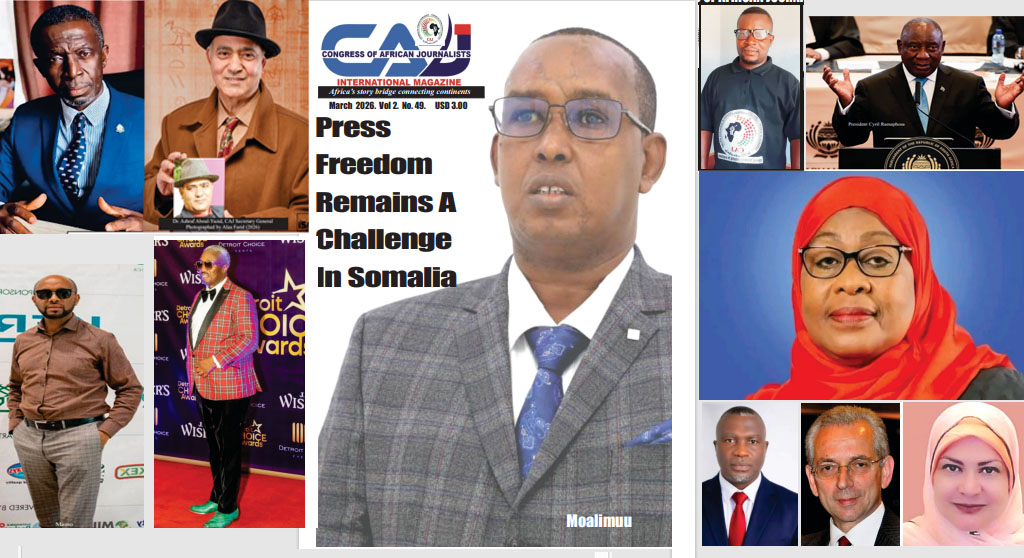
The March 2026 Edition of CAJ International Magazine arrives at a defining hour for African journalism, leadership, and cultural expression. Across fourteen themes—spanning politics, literature, education, philosophy, reproductive health, theatre, and global geopolitics—one message resonates clearly: Africa is no longer content to be narrated by others. Africa is writing its own story.
At the heart of this edition stands Hon. Mohamed Ibrahim Moalimuu, recipient of the CAJ Eminent African Leaders and Achievers Award 2026. His journey from journalism to national leadership in Somalia embodies the very bridge our continent must strengthen—the bridge between truth-telling and policymaking. When journalists become legislators without abandoning their commitment to transparency and accountability, democracy deepens. Moalimuu’s career reminds us that journalism is not a spectator’s craft; it is a nation-building vocation.
That vision echoes powerfully in our interview with Dr. Ashraf Aboul-Yazid, Secretary General of CAJ, who calls for Africa to transform from being influenced into being influential. Journalism, he reminds us, is not merely documentation—it is justice in motion. It is the shaping of collective memory and the safeguarding of freedom. If Africa is to reclaim its intellectual sovereignty, the newsroom must become as strategic as any parliament.
 Chairman Michael Adeboboye reinforces this urgency. The Congress of African Journalists was born from the need for a unified African media voice—ethical, professional, and unapologetically continental. In an era of algorithmic manipulation and information warfare, unity among African journalists is not symbolic; it is essential.
But leadership is not confined to politics and media. In Ethiopia, Gezahagn Mamo demonstrates how sustainability can redefine Africa’s economic value chains. Coffee, long exported as raw commodity, becomes under his stewardship a narrative of wildlife preservation, innovation, and dignity. Brewing impact beyond the cup, indeed.
Across borders, philosophy, law, and governance intersect. Yannis Fikas reminds us that leadership without philosophy is directionless. In Liberia, Cllr. Tiawan Saye Gongloe challenges us to reflect on contempt of court and freedom of speech—not as opposing forces but as pillars of democratic maturity. Meanwhile, in South Africa, the critique of SONA 2026 underscores a continental demand: citizens no longer seek speeches; they seek measurable transformation.
Nigeria’s reproductive crossroads presents a different but equally urgent story. While parts of the world confront demographic decline, Nigeria navigates high fertility, social pressure, and expanding assisted reproductive technologies. The African future will not be shaped by numbers alone, but by how societies manage dignity, health, and opportunity.
In Tanzania, bold investment in foundational literacy signals long-term vision. Early reading, writing, and arithmetic are not technical details; they are the architecture of development. Without literacy, democracy falters; without education, economic growth remains fragile.
This edition also affirms the indispensable role of literature. Bill F. Ndi’s analysis of geopolitical hypocrisy reminds us that poetry can dissect deception more precisely than policy papers. Literature is not escape—it is exposure. It reveals tyranny masked as diplomacy and hypocrisy disguised as righteousness.
We read a story that embodies a social conflict that does not concern the homeland of the writer Azza Abouelezz alone, but the whole of human society.
Travel writing transports us to Moscow’s Church of the Assumption “Slovushchee,” where memory and architecture converse. Fiction immerses us in psychological struggle through “Jihad’s Battle.” Biography introduces us to Professor Machasin, whose disciplined life embodies intellectual devotion. Theatre brings us to Carthage, where puppet art becomes moral allegory—a garden of white hearts calling humanity back to innocence.
Taken together, these fourteen themes form a mosaic of continental consciousness. They speak of governance and grassroots, of heritage and innovation, of critique and celebration. They demonstrate that African journalism must not merely report events—it must connect disciplines, cultures, and generations.
Africa’s story is complex, but it is coherent. It is a story of resilience, redefinition, and responsibility. From Mogadishu to Addis Ababa, from Lagos to Dar es Salaam, from Monrovia to Tunis, the narrative is shifting.
The question is no longer whether Africa will be heard. The question is how powerfully, ethically, and creatively we will choose to speak.
With this edition, CAJ affirms its commitment: to amplify African voices, defend press freedom, nurture intellectual exchange, and insist that journalism remains the conscience of our continent.
Africa writes. Africa leads. Africa rises.