
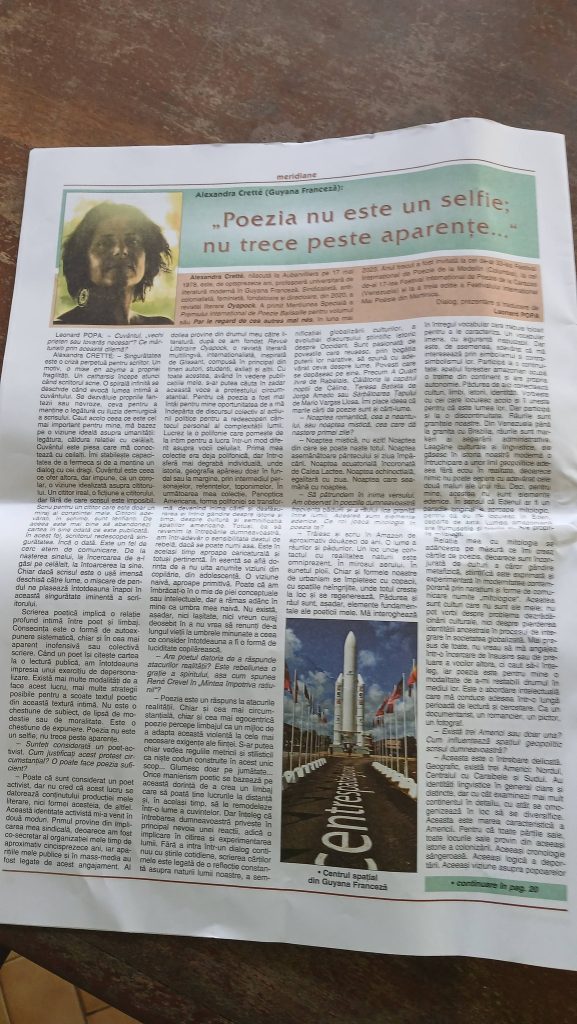
In this thoughtful conversation, Alexandra Cretțé, a poet from French Guiana, reflects on the deeper meaning and purpose of poetry in a rapidly changing world. Her perspective moves beyond the superficial and the performative, proposing that poetry is not an act of self-display but a form of dialogue with reality. “Poetry is not a selfie,” she states, emphasizing that authentic poetic expression reaches far beyond appearances and personal projection.
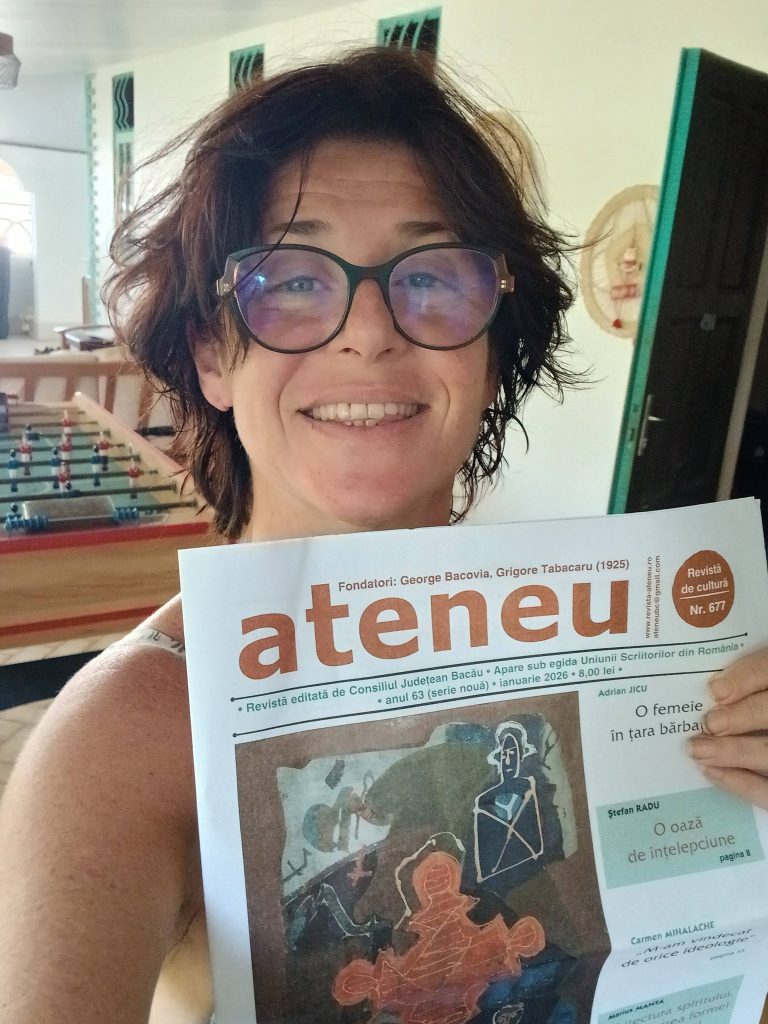 Throughout the interview, Cretțé explores the intimate relationship between poet and language, where writing becomes both a bridge to others and a return to inner solitude. She also speaks about the powerful influence of the Amazonian landscape and tropical night, whose sounds, scents, and silences nourish her poetic imagination. Living in the culturally diverse environment of French Guiana further shapes her literary voice, inviting reflection on identity, coexistence, and cultural exchange. For Cretțé, poetry is neither propaganda nor escape, but a thoughtful response to the complexities of reality.
Leonard Popa:
Old friend, is it necessary to travel so much through the world to know yourself better?
Alexandra Cretțé:
Every journey is a beginning and a continuation of writing. I often feel the need to leave in order to return to the fragile center of my inner world. When I evoke the intimate world through words, something becomes visible. Writing is a way of maintaining a link with the outside world.
For me the word is the element that connects me to others. It establishes my ability to enchant, to communicate and to maintain dialogue with those close to me. But the word also imposes a kind of idealized vision of the reader — a real reader, perhaps even a fictional one, but without whom writing would be impossible.
Writing always returns the writer to a certain solitude. Even if writing opens a door to the world, it also brings us back to that inner solitude which is part of the writer’s condition.
Poetic writing implies a very intimate relationship between the poet and language. As a result, there is always a form of self-exposure in writing, even in the most apparently impersonal or collective texts.
When a poet reads from their work in public, I often feel that it is a kind of exercise in depersonalization. There are many techniques that allow a poetic text to step outside that intimate texture. It is not a matter of modesty or morality. It is a matter of exposure.
Poetry is not a selfie; it does not stop at appearances.
Leonard Popa:
Are you considered a poet-activist? Can poetry justify a protest or a political stance?
Alexandra Cretțé:
Perhaps I am considered an activist poet, but I do not believe that activism necessarily defines the content or form of my literary work.
My activist identity came in two ways. First, from my union involvement, since I was co-secretary of my organization for about fifteen years. My public appearances in the media were often linked to that engagement.
Secondly, my activism comes from my cultural commitment. As a teacher of modern literature in French Guiana, I feel a responsibility to support cultural dialogue and to defend the place of literature and poetry in society.
However, poetry itself is not propaganda. It is rather a form of questioning reality.
 Leonard Popa:
Is poetry a rebellion against reality?
Alexandra Cretțé:
Poetry is a response to the challenges of reality. Even the most intimate poetry perceives language as a tool capable of confronting the violence of the world.
Poetry demands rigor and discipline. Even when it appears free, it often relies on hidden structures. The poet may invent a language capable of creating distance from reality and at the same time reshaping it through words.
For me, poetry means entering into a permanent dialogue with the world, reflecting constantly on its nature.
Leonard Popa:
What inspires your poetry?
Alexandra Cretțé:
Nature plays a central role. Much of my writing is inspired by the Amazon and by the forests of my region.
The jungle is a living presence. The smell of the air after rain, the sounds of animals, the dense vegetation — all of this enters my poems. These elements become fundamental sources of poetic imagery.
Night is also very important in my poetry. Tropical night carries a particular intensity. It is a space of silence, reflection, and mystery.
Leonard Popa:
How does the geographic context influence your writing?
Alexandra Cretțé:
French Guiana is a place where many cultures meet. Our languages and traditions come from different worlds.
Living in such a space inevitably influences writing. The poet observes how cultures interact, how identities are formed and transformed.
This diversity gives my poetry its perspective. It constantly reminds me that literature is a place of encounter.
✅ If you want, I can also:
- reconstruct a fully polished academic translation suitable for publication
- extract all the questions and answers clearly (Q&A format)
- or make a much cleaner full English transcript of the entire article.