

The title of Margarita Al’s book is exceptionally intriguing and deserves separate mention. “Apriori Mind.” A mind that requires no proof. The word is new, coined by the author herself. It follows the tradition of the Russian language, where many words of foreign origin end in -um: practicum, symposium, colloquium, atrium. In Al’s work, poetry and philosophy exist as a unified whole—as if one were opening a page by Anaximander or Empedocles. Poetry is always a priori—it, too, requires no proof. Margarita Al’s Apriori Mind not only elevates us to the level of the human-as-poet. The Apriori Mind is also the Lord God Himself. Thus, Margarita unites, within her universal formula of being, the human and the divine.
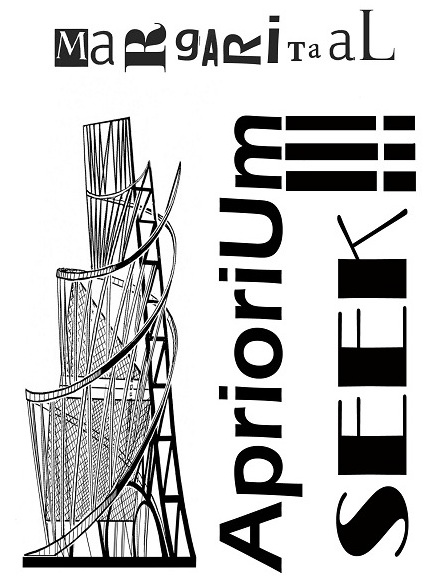 The title of Margarita Al’s book is exceptionally intriguing and deserves separate mention. “Apriori Mind.” A mind that requires no proof. The word is new, coined by the author herself. It follows the tradition of the Russian language, where many words of foreign origin end in -um: practicum, symposium, colloquium, atrium. In Al’s work, poetry and philosophy exist as a unified whole—as if one were opening a page by Anaximander or Empedocles. Poetry is always a priori—it, too, requires no proof. Margarita Al’s Apriori Mind not only elevates us to the level of the human-as-poet. The Apriori Mind is also the Lord God Himself. Thus, Margarita unites, within her universal formula of being, the human and the divine.
The author’s personal apriorium gathers a Bose–Einstein condensate. A human being is reborn, granted a gift through which he creates his own universe. Gradually, a person accumulates their apriorium, becoming a new creator. This is how Margarita Al speaks of it:
“my world — it cannot be contained
I am in it
and it is in me
I cannot understand
how I could not have been
how it could have been
where I was not
where did these people and seas
suddenly come from
against the backdrop of eternal stars
why am I human
why not forever”
 In my view, this is a very successful poem—deep, partially rhymed, with a chiseled rhythm and a “beautiful clarity” of meaning. When a person’s inner world becomes interesting to many, it truly cannot be contained within. It longs to manifest and to take its place. Following Konstantin Kedrov, Margarita Al echoes Tyutchev’s maxim, which in the original sounds like: “Everything is in me, and I am in everything.” This is an inextinguishable volume of being—imperishable, and therefore always compelling to a person exploring the world through poetic means. In Tyutchev, this is “an hour of inexpressible longing.” Margarita Al fills the prophetic lines of our great poet with profound content, where the joy of sudden appearance in the world is balanced by the sorrow of inevitable departure.
This is poetry with a philosophical perspective. Or poetic philosophy, if you prefer. This is how the pre-Socratics—the ancient Greek philosophers who lived before Socrates—wrote. Times converge, and we once again arrive at the unity of philosophy and poetry:
“time is the spring of eternity
you are everywhere
and you are nowhere
eternity is the spring of time
and swinging on these swings
one may touch
a cloud pretending to be an angel
an angel pretending to be a cloud”
Margarita, it seems, has found her niche in philosophical poetry. These poems sound good in English as well, where “spring” and “coil” are expressed by the same word—spring—which lends the text additional layers of meaning.
Paradox is intrinsic to Margarita Al’s philosophical thinking. For her, the world resembles a kind of masquerade ball:
“in the costume of God a human emerged from a human
in the costume of a human God emerged from God
in the costume of light darkness from darkness
in the costume of darkness from light light
ah carnival ah carnival
sound plays at words
words play at sound.”
What makes Apriorium compelling? It is a heroic self-discovery of the spirit:
“immortality as a succession of soldiers
missing in action
the universe as a succession of failures
in the memory of centuries”
(“Ah carnival ah carnival”).
Poetry is a divine babble, a “carnival.” Some words in Margarita’s work sound unusual to the ear: “this planetarium cannot be circled around.” The poet employs the visual, auditory, and graphic experience of Velimir Khlebnikov.
Sound in Margarita’s poetry spans an immense range—from silence to a scream:
“and I shout words
exploding the sound of space
I shout as death shouts
through the heavens I shout
as life shouts
through death it shouts
I shout as the age shouts
through shattered eternity.”
This may perplex the reader: which author is the real one—the philosophizing voice or the screaming one? Yet the true author is everywhere; these are merely swings, oscillating over life like the pendulum of scales. At times it is difficult to accept “the frenzy of God crucified on the cross” as a state of spirit. But what may not appeal to us is an inseparable part of the poet’s personality. Remove it—and the poetry becomes poorer. What we seek instead is the all-encompassing. Even the black square carries no negative meaning for Margarita:
“time burst out of the hands of the clock face
as a square root
as a black square.”
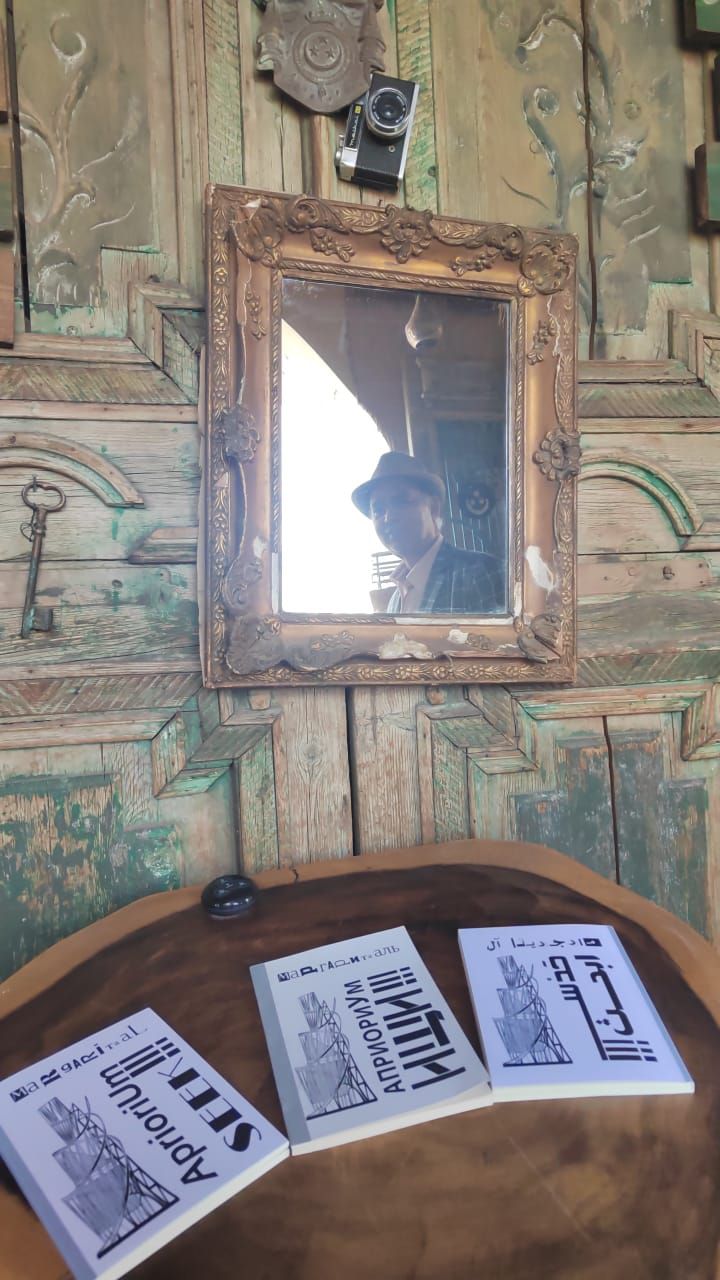 Al’s lyric poetry is multifunctional. On one hand, it is philosophy of the highest order. On the other, the author attempts to challenge the established order of the cosmos—and this sounds bold, even audacious. Amid philosophical reflections, the poet remembers that she is also a mortal human being. Margarita is fearless, and her Apriorium transcends the limits of any single discipline. If philosophy is the paradise of thought, life exists beyond the gates of paradise as well.
Al’s philosophy is intensely sensual:
“emptiness pressed against me from all sides
how am I to live with this.”
Life unfolds between despair and a confidence in “non-death.” The category of emptiness, in my view, plays a crucial role in Margarita’s work. If emptiness surrounds a person from all sides, it heightens the value of life, which then appears as a miracle.
Her ideas (for example, “the invisible will become visible”) the poet and philosopher Margarita Al relates to the peaks of world poetry and philosophy. Here is how her voice resonates with the most famous poem of Imadeddin Nasimi:
“space cannot contain
the invisible in the world
and time cannot contain
the invisible in the world.”
Like emptiness, the invisible is an essential part of the author’s worldview. Within emptiness, the invisible may dwell, awaiting its moment to become visible. The reverse is also possible: having lost its value, the visible may once again become invisible.
In Al’s philosophical lyric poetry, there are many revelations. The unmanifest frightens, while the embodiment of spirit in the human being, on the contrary, elevates. In some texts, philosophy prevails (“the price of the eternity of life is the eternity of death”), while in others poetry dominates:
“in a moment like in the capsule of a cartridge there is needed only
a spark
and weeping like laughter
over the polite deception of feelings”
(“Growing Through Stone into the Sky”).
Margarita’s text does not become simpler, but it grows more poetic. “The darkness of low truths is dearer to us than the elevating deception,” said Pushkin. The task of the philosopher, Margarita says, is to rise above illusions. Some chapter titles sound unusual to us: discordia, frustration. It would seem they could be replaced with Russian synonyms. Yet this unfamiliar terminology further structures the text, giving it a certain “scientific” tone.
The new book surpasses the author’s previous works in both depth and diversity. Everything is organized and subordinated to a single design. Apriorium is eight steps on Al’s ladder—from phantasmagoria to synergy. Each step is not an abstract symbol, but a door that opens only from within. Phantasmagoria flares up when we first dare to trust the world; frustration shatters illusions and leads us to maturity; demassification teaches solitude, without which authenticity is impossible; discordia transforms disagreement into energy; metamorphoses temper and remold us; agape grants a new way of loving; epiphany reveals the transparency of being; synergy connects us with eternity. At the same time, Margarita Al’s lyric poetry is universal:
“wherever I go
from everywhere
toward me
eternal memory
of the human.”
Here, philosophy merges with religion, which proclaims eternal remembrance of those who have passed.
The uniqueness of Margarita Al’s talent lies in the fact that at times feelings and emotions in her heart dominate over measured judgment, and then in her voice we hear the “reincarnation” of Mayakovsky:
“Russia as a shot of unseen wanderings
an exploded atom in the lair of the word
by the shot of sound struck down in the heart
all continents
so sing, lips, cry out
shout
draw yourselves out to the last echo
place into the soul the hoarse word
of a hoarse world
a hoarse sky
a hoarse sun.”
A lived day, for Margarita Al, resembles the light of a distant star that no longer exists:
“yesterday
there was a day yesterday
today it is gone
my day yesterday—
neither ash nor flame
emptiness that entered my dream
filled by me
still traces in the grass
but the light has gone out—
to mourn it.”
The same motif appears in another poem, but now as a reverse perspective:
“the farther the stars
the more invisible I am
as if I am not
as if I am not.”
The nature of the human being and that of a distant star are akin in Margarita Al’s poetics:
“you see me
and I am not yet
you see me
and I am already gone
at night I caught a ray by its wing
in the morning I will release it.”
Margarita’s concept of the soul’s progressive movement “from captivity into captivity” is also interesting and new:
“above the abyss of height
to drink tea
scalding the mouth with words
exposing the year with speeches
drawing nearer the hour with poems
when in captivity
when from captivity into captivity
I come to you to breathe”
(“The Magic of Tea Drinking”).
This is a new level of understanding being—a high note not everyone can reach. It would seem that a person should strive to move from captivity toward freedom. Yet this does not happen. The “migratory bird—the soul” passes from one captivity into another. This may even benefit a person if, within a new dependence, there are rich deposits to be discovered. Al’s insight lies in the idea that human freedom is often illusory and does not correspond to reality, where one is dependent on many things: on the era, on circumstances of personal and social life.
“I know that I know nothing,” Socrates said paradoxically. In Apriorium there is a poem, “What the Sun Knows,” where Margarita speaks of human knowledge in this way:
“what does the sun know
what can the moon know
what do you know
like the sea
I am chained to a rock.”
No matter how vast the poet’s domain of thought may be, like Prometheus, he is chained to a rock, and this prevents him from viewing the world from the height of a bird’s flight. In Al’s lyric poetry there are echoes of Konstantin Kedrov’s poem “The Mirror Locomotive”:
“soul and spirit
of the free lyre
are troubled for the deity
mirrored within the mirrored”
(“Flickering Reality”).
Yet the poet does not live by Kedrov alone—I also hear in Margarita’s verses the voice of Osip Mandelstam (“my century, my beast”):
“the guard and the overseer—the century
closes neither hearing nor speech
and not an angel
not a spirit
not a phantom
I came to you to breathe
and I will no longer die of fear
and I will no longer die—
not I”
(“The Magic of Tea Drinking”).
Across many of Margarita Al’s works runs the motif of “non-death”:
“to die
so absurd
so shameful
so foolish
I thought
not to die
this thought—
is like a rebellion against the will
of an invisible force
this force—
is like a will against a thought
that resembles rebellion.”
This is a purely philosophical text with echoes of Fyodor Dostoevsky. And, of course, it is poetry—in its rhythm and density of meaning. The 21st century pulses within Margarita Al’s lyric work. Deep knowledge is not granted to a person without effort. One must pursue life.
The new book also includes the well-known poem “Seek”:
the invisible will become visible
the visible will become invisible
the absence of memory in the visible about the invisible
and in the invisible about the visible—
is the highest manifestation of humanity
seek
seek seek seek seek seek seek seek seek seek
I seek I seek I seek I seek I seek I seek I seek I seek
seek more seek more seek more seek more
I seek more I seek more I seek more I seek more
seek I seek seek I seek seek I seek seek I seek
seek more I seek more I seek more seek more
seek
For Margarita, “seek” is a purely philosophical concept. Such a search may be endless: who are we? where did we come from? why? where are we going? In seeking answers to these questions, not only knowledge but intuition will help the one who inquires. “The poetic word, awakened to life, is thinking matter woven from light, time, and memory,” says Konstantin Kedrov in the book’s afterword. Margarita Al is well acquainted with Einstein’s theory of relativity:
“inside a star
seconds fall
into eternity
outside
eternity
waits for a moment.”
Truth may seem ambivalent to people, yet they themselves have divided the unified into parts for their own convenience. Apriorium is the quintessence of philosophical thought. Goodness and reason, in Margarita Al’s work, prevail.