

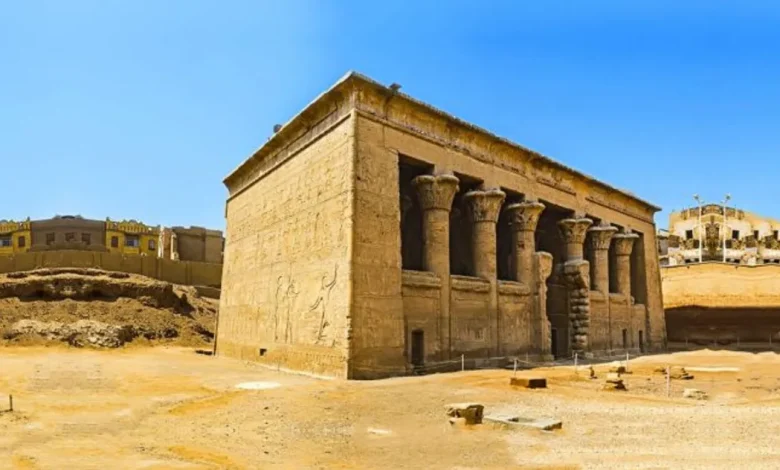
Astronomy in ancient Egypt stands as one of the most remarkable expressions of the creative interaction between human beings and the cosmos in Egyptian civilization. The ancient Egyptian interest in the sky was never abstract or detached from daily life; rather, it was practical, religious, and symbolic at the same time. For the ancient Egyptian, the sky was not merely a distant expanse filled with shining stars, but a living order connected to time, agriculture, religious festivals, the renewal of life, and the very idea of creation itself. This is why the sun, the moon, and the stars occupied such an important place in ancient Egyptian thought, and why the observation of celestial phenomena became a means of understanding the order of the universe and regulating the rhythm of life on earth. Archaeological studies, texts, and astronomical scenes in temples and tombs indicate that the ancient Egyptians possessed an important body of practical observational knowledge, which enabled them to develop a calendar, use instruments for measuring time, and connect certain celestial phenomena with the seasons and with religious rituals.
Astronomical knowledge in ancient Egypt was closely tied to agricultural life, which formed the backbone of the Egyptian state. The regularity of the seasons, the timing of sowing and harvest, and the annual inundation required a precise awareness of time, and for this reason observing the sky became part of the management of everyday life. It is well known that the heliacal rising of Sirius was associated in ancient Egyptian consciousness with the cycle of the Nile flood and with the beginning of the year. This demonstrates that observing the heavens was not a secondary activity, but a tool for understanding nature and organizing society. The Egyptians also knew different methods of timekeeping, including sundials and water clocks, and they relied on stellar observation to divide the night and determine its hours, reflecting a notable development in temporal and observational knowledge in relation to their age.
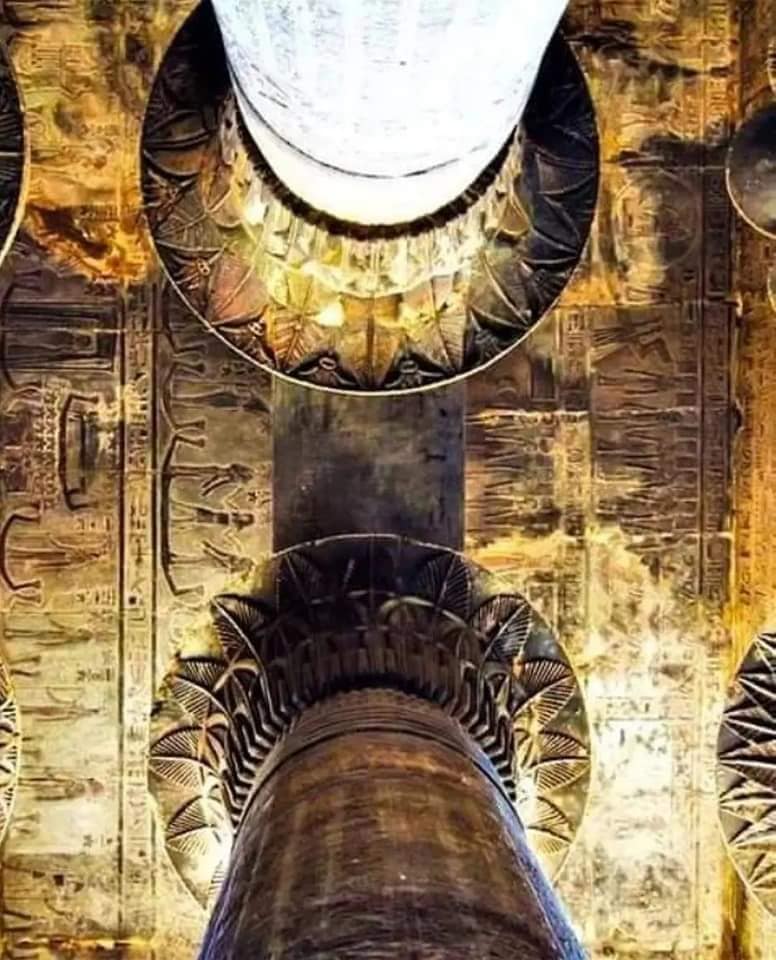 The importance of astronomy in ancient Egypt, however, was not limited to the practical sphere. It also extended into the religious and symbolic dimensions of life. In Egyptian thought, the universe was founded upon order and balance, and the movement of celestial bodies formed part of that cosmic order. For this reason, the sky appeared in texts and images as a sacred realm. The sun, in its daily and nightly journey, became associated with the ideas of birth, death, and renewal, while certain stars, planets, and celestial phenomena were linked with deities and with the afterlife. Consequently, the astronomical scenes that appear on the ceilings of temples and tombs should not be understood merely as beautiful decoration. They are visual expressions of a complete cosmic conception that connects time, creation, ritual, and human destiny.
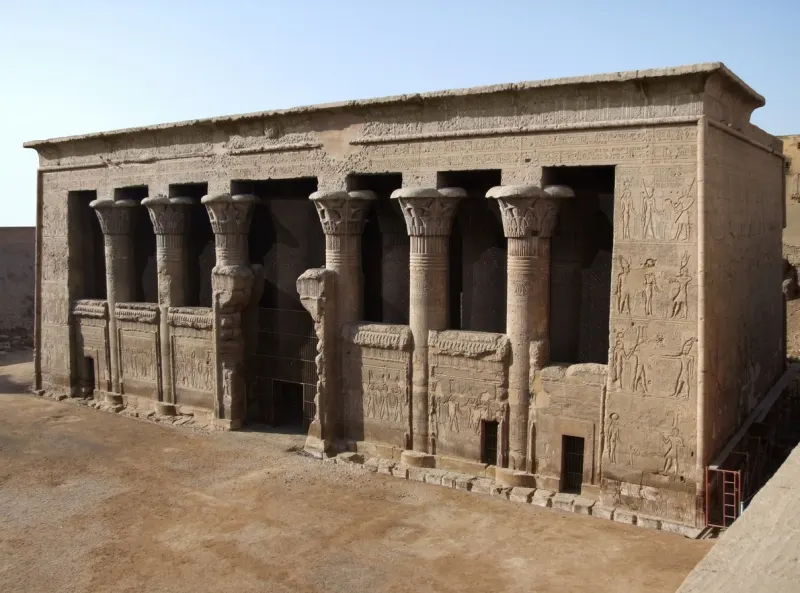
Within this broader framework, the Temple of Khnum at Esna emerges as one of the most important archaeological monuments for understanding the depth of astronomical knowledge among the ancient Egyptians in the later periods, particularly during the Ptolemaic and Roman eras. This temple, famous for its relatively well-preserved ceiling and its rich inscriptions, offers unique material for understanding the relationship between belief, art, and astronomical observation. In recent years, the temple has acquired even greater importance because cleaning, conservation, and documentation work has revealed astonishing details on its ceiling, including astronomical scenes and zodiacal images that had long been obscured beneath thick layers of soot and dirt. These discoveries have highlighted the temple’s great scientific and artistic value and have shown that it is not simply a major architectural monument, but also an important visual document in the history of ancient astronomical knowledge.
The significance of the Temple of Khnum at Esna also lies in the fact that it reflects a historical phase marked by broad cultural interaction between the ancient Egyptian tradition and certain astronomical elements coming from the Babylonian and Greek worlds, elements that the Egyptians then reformulated within their own religious and artistic framework. This is clearly visible in the representations of the twelve zodiac signs on the temple ceiling. Although the zodiac became well known throughout the ancient Mediterranean world, at Esna it appears within a distinctly Egyptian religious program. These zodiacal images therefore do not represent a break with Egyptian tradition; rather, they offer an important example of the Egyptian civilization’s capacity for absorption, reinterpretation, and integration within its own cultural system. For this reason, Esna provides scholars with an excellent model for studying the transmission and transformation of astronomical knowledge across cultures, a subject that also harmonizes with the concept of the Berlin exhibition, which examines the history of the zodiac from Babylonia to Egypt and the Greco-Roman world.
 The significance of the Temple of Khnum at Esna also lies in the fact that it reflects a historical phase marked by broad cultural interaction between the ancient Egyptian tradition and certain astronomical elements coming from the Babylonian and Greek worlds, elements that the Egyptians then reformulated within their own religious and artistic framework. This is clearly visible in the representations of the twelve zodiac signs on the temple ceiling. Although the zodiac became well known throughout the ancient Mediterranean world, at Esna it appears within a distinctly Egyptian religious program. These zodiacal images therefore do not represent a break with Egyptian tradition; rather, they offer an important example of the Egyptian civilization’s capacity for absorption, reinterpretation, and integration within its own cultural system. For this reason, Esna provides scholars with an excellent model for studying the transmission and transformation of astronomical knowledge across cultures, a subject that also harmonizes with the concept of the Berlin exhibition, which examines the history of the zodiac from Babylonia to Egypt and the Greco-Roman world.
 One of the most striking features of Esna is that its astronomical scenes go beyond the mere depiction of zodiac signs and form part of a wider symbolic structure that includes planets, stars, and other celestial entities associated with cosmic order. The Egyptian Ministry of Tourism and Antiquities has indicated that the exhibition in Berlin presents the zodiac scene recently revealed on the ceiling of the Temple of Khnum at Esna, depicting the twelve zodiac signs from Aries to Pisces, together with representations of planets such as Jupiter, Saturn, and Mars, as well as other astronomical elements used by the ancient Egyptians in measuring time. This official statement is of great importance because it confirms that the temple offers direct evidence for understanding how the sky was represented in late ancient Egypt and how astronomical observation was integrated into a religious and artistic program within the sacred space of the temple.
The importance of Esna is also connected with the religious role of the temple itself. Khnum was the god of creation and formation, the deity who shaped the human being on the potter’s wheel in ancient Egyptian belief. The presence of a celestial program on the temple ceiling therefore accords with the idea of the totality of creation and cosmic order, in which earth and sky cannot be separated, nor divine action from the order of the universe. At Esna, the sky is not a decorative background, but an essential part of the temple’s theological meaning. It is the realm of order, time, and cosmic cycles, all of which contribute to a profoundly Egyptian vision of the world as an organized and constantly renewed structure. This is what gives the astronomical scenes at Esna an intellectual dimension no less important than their artistic and aesthetic one.
From a scientific point of view, it is necessary to emphasize that discussion of astronomy among the ancient Egyptians must remain within its proper historical framework. The ancient Egyptians did not practice astronomy in the modern sense based on mathematical physics and contemporary optical instruments. Yet they did possess a practical and symbolic body of observational knowledge that was advanced for its time. This knowledge was expressed in the monitoring of celestial cycles, the use of certain phenomena to regulate time and the calendar, and the employment of the sky in religious and artistic expression. Such a precise understanding protects us from exaggeration on the one hand and from underestimating the ancient Egyptian achievement on the other. The real value lies in the fact that the ancient Egyptian, within the limits of the tools available in his age and his worldview, succeeded in constructing a coherent system of knowledge linking the heavens with life, religion, and authority.
From this perspective, the importance of the exhibition Destiny in the Stars: The Beginnings of the Zodiac in Berlin becomes especially clear. According to the organizing institution, the exhibition is dedicated to the history of the zodiac and its significance from Babylonia to Egypt and the Greco-Roman world, presenting this history through a modern scholarly lens. The official Egyptian announcement further explained that the exhibition comes within the framework of cooperation with the Egyptian-German mission working on the documentation, recording, and restoration project of the Temple of Khnum at Esna, and that it includes a distinguished display of the zodiac scene recently discovered on the temple ceiling, along with images of the celestial zodiacs of Dendera and instruments for measuring time. These elements make the exhibition an important occasion for highlighting the Egyptian contribution to the history of ancient astronomical knowledge, especially in light of the discoveries brought to light by the recent restoration work at Esna.
Today, after the revelation of so many of its astronomical details, the Temple of Khnum at Esna stands as an exceptionally important witness to the ancient Egyptians’ fascination with the sky and to their ability to transform that fascination into a refined artistic and religious language. The temple also reminds us that ancient Egyptian civilization was not merely a civilization of architecture and statuary, but also one of time, order, and cosmic vision. Through the study of Esna, together with Dendera and other monuments, we realize that the ancient Egyptian looked at the sky with the eye of an observer, the mind of an organizer, the imagination of an artist, and the spirit of a believer. This fusion of observation, belief, and beauty is what gives ancient Egyptian astronomy its true distinctiveness, and it is what makes its presentation in a major international venue such as the Berlin exhibition both deserved and significant from scientific and cultural perspectives.