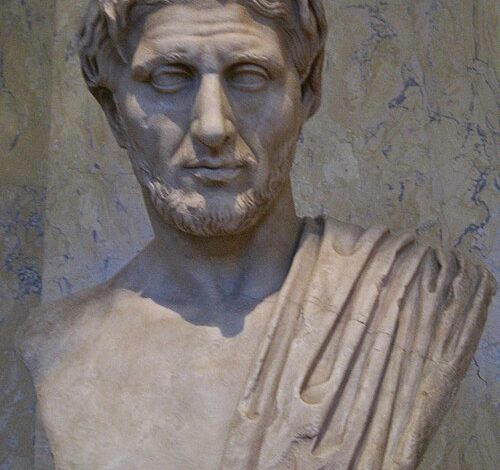
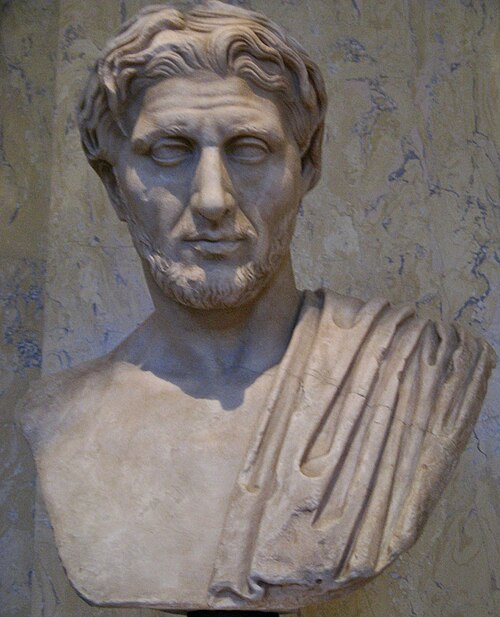
At the main entrance of the Bibliotheca Alexandrina stands the statue of Demetrius of Phalerum, not merely as a decorative artistic element adorning a grand architectural space, but as a profound symbolic marker that evokes the memory of humanity at one of its most luminous intellectual moments. This statue, in its silent presence, encapsulates the story of a man who played a pivotal role in shaping one of the greatest cultural projects in history: the Ancient Library of Alexandria. It was not simply a repository of books, but a living embodiment of the idea of universal knowledge.
Demetrius of Phalerum emerged from the rich intellectual traditions of the Greek world. In Athens, he distinguished himself as both a ruler and a thinker, governing the city for ten years with an ambition to harmonize power and reason, politics and philosophy. Yet the volatile tides of political life in ancient Greece forced him into exile when democracy was restored. He fled first to Thebes and eventually found refuge in Egypt, a land that was on the threshold of an unprecedented cultural transformation.
In Egypt, particularly in Alexandria, Demetrius encountered Ptolemy I Soter. This meeting was far from incidental; it marked a turning point in the history of knowledge. Ptolemy, a ruler of vision and ambition, recognized the value of intellectual power alongside political authority. It was within this context that Demetrius proposed his grand idea: the establishment of a great institution dedicated to learning and research, bringing together scholars from across the known world. Thus emerged the concept of the Mouseion, often regarded as a prototype of the modern university, accompanied by a vast library that would soon become a global symbol of scholarship. At his core, Demetrius was a man of ideas before he was a man of power. Historical evidence suggests that he played a decisive role in the formation of the Library’s early collections, overseeing the acquisition of books from across the ancient world. His vision extended far beyond mere accumulation; he sought to create a dynamic intellectual space where civilizations could meet, cultures could interact, and knowledge could be pursued without boundaries. Although there remains scholarly debate over whether Demetrius served as the first official head of the Library, there is no doubt that he was one of its principal architects. He provided the intellectual framework and organizational vision that defined its identity. He believed deeply that knowledge transcends borders and that the prosperity of nations depends fundamentally on their commitment to learning and scholarship. Today, the statue of Demetrius of Phalerum at the entrance of the Bibliotheca Alexandrina does more than recall the past; it rearticulates a timeless civilizational question: how can humanity build a more enlightened and conscious world? How can a city transform itself into a beacon of intellectual radiance that guides others? In this sense, the modern Library of Alexandria represents not a mere revival of the past, but a continuation of its spirit in a contemporary form. It is an attempt to rekindle the Alexandrian dream—one that affirms knowledge as power and culture as a bridge between peoples. Thus, Demetrius of Phalerum remains, through his statue, a witness to a foundational moment and a guardian of a human legacy that continues to seek itself in books, in libraries, and in the minds of thinkers. He reminds us that civilization begins with an idea—and that great ideas never die; they simply reshape the world across time.