 thesilkroadtoday

Abstract
This article examines linguistic diversity as evidence of the unity of human nature through the example of Russian-Arabic cultural dialogue. Analysis of folklore, literature, and paremiology of both traditions demonstrates the similarity of emotional experiences, moral principles, and didactic goals. The study reveals historical and contemporary cultural bridges—translation practice, academic exchanges, educational programs—that promote mutual understanding between peoples. Special attention is given to the relevance of preserving linguistic diversity for sustainable intercultural dialogue in the 21st century in the context of the Decade of Languages of the Peoples of the World, declared by the World Organization of Writers.
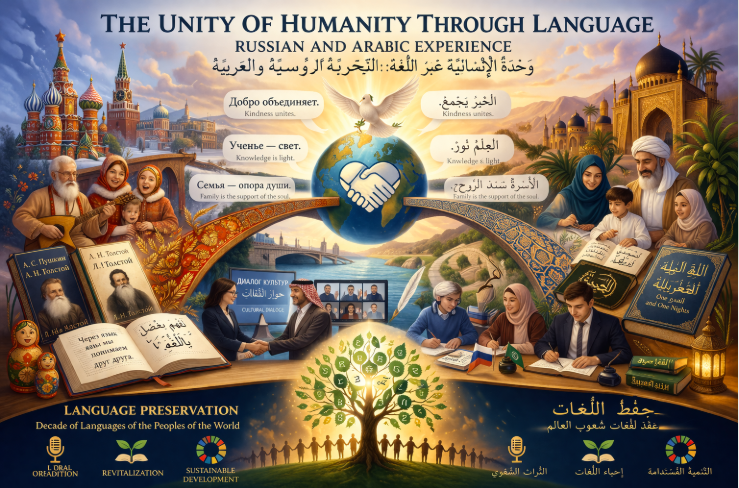
Table of Contents
- Introduction
- Theoretical Foundations: Linguistic Diversity as Cultural Wealth
- The Commonality of Human Emotions in Russian and Arabic Traditions
- Cultural Bridges between the Russian and Arabic Worlds
- Language Preservation as a Condition for Intercultural Dialogue in the 21st Century
- Conclusion
- References
1. Introduction
In the era of globalization and intensification of intercultural contacts, the question of the unity of humanity acquires special relevance. Paradoxically, it is linguistic diversity—the existence of more than seven thousand languages on the planet—that serves as convincing proof of the commonality of human nature. Each language represents a unique system of categorizing experience; however, comparative analysis of various linguocultural traditions invariably reveals universal patterns of emotional experiences, moral judgments, and social relations.
The Decade of Languages of the Peoples of the World, declared by the World Organization of Writers, creates an institutional framework for understanding the role of linguistic diversity in the modern world. In this context, the Russian-Arabic cultural dialogue is of particular interest—the interaction of two major linguocultural areas possessing rich literary traditions, developed folklore, and a long history of contacts.
The purpose of this article is to demonstrate how the folklore, literature, and poetry of the Russian and Arabic peoples express similar emotions, ideas, and moral principles, thereby confirming the thesis of the unity of human nature despite all the diversity of its cultural manifestations. Special attention will be paid to the cultural bridges connecting the two worlds and the relevance of preserving linguistic diversity to ensure genuine mutual understanding between peoples in the 21st century.
2. Theoretical Foundations: Linguistic Diversity as Cultural Wealth
Contemporary linguistic anthropology views linguistic diversity not as an obstacle to communication, but as a fundamental cultural wealth of humanity. Each language embodies a unique “worldview”—a system of conceptualizing reality that reflects the historical experience, geographical conditions, social organization, and spiritual values of the people who speak it. At the same time, comparative studies demonstrate that despite all the diversity of linguistic structures and cultural practices, there exist deep universals of human experience.
Cognitive and corpus-based studies show that linguistic worldviews vary; however, common semantic fields and contextual disambiguation allow for the expression of similar emotional and moral content in texts in Russian and Arabic [6]. This means that differences in linguistic structure do not prevent the transmission of universal human meanings, but only color them in specific cultural tones.
Paremiology—the science of proverbs and sayings—provides particularly rich material for studying cultural universals. Proverbs represent a concentrated expression of folk wisdom, moral norms, and life experience. Comparative analysis of the paremiological funds of various peoples allows us to identify both universal themes (good and evil, family, labor, justice) and culturally specific ways of understanding them.
Literature and poetry, being the highest forms of verbal art, also serve as powerful instruments of intercultural dialogue. Great literary works possess the ability to overcome linguistic and cultural barriers by addressing universal aspects of human existence—love, suffering, the search for meaning, moral choice. The reception of Russian classical literature in the Arab world and the interest of Russian writers and poets in Arab-Islamic culture create strong cultural bridges between the two civilizations.
3. The Commonality of Human Emotions in Russian and Arabic Traditions
3.1. Moral Proverbs and Paremiological Parallels
Comparative analysis of Russian and Arabic proverbs reveals striking similarities in the understanding of fundamental moral categories. Many Russian proverbs about good and evil have close Arabic equivalents, and both traditions use proverbial warnings and instructions to encourage benevolence and warn against envy and malice [1]. This testifies to the fact that basic ethical intuitions of humanity are transcultural and find expression in the paremiological formulas of various peoples.
Corpus-based studies and equivalence analysis show that when translating Russian proverbs into Arabic, functional and cultural analogues are found, indicating semantic convergence even in cases where imagery differs [2]. For example, the Russian proverb “One in the field is not a warrior” and Arabic paremias about the necessity of collective action express a similar idea, although they use different metaphors. Systematic comparisons of numerical and moral paremiological codes reveal overlapping thematic groups that function as ready-made cultural bridges in interlingual pedagogy and lexicography [9].
Such paremiological similarity is not accidental. It reflects the commonality of social experience of agricultural and pastoral societies, similar forms of family organization, universal psychological mechanisms of moral judgment. Proverbs of both traditions warn against pride, praise industriousness, emphasize the value of friendship and loyalty, condemn lies and betrayal. These moral constants constitute a universal ethical foundation on which it is possible to build mutual understanding between cultures.
3.2. Family Values and Social Relations
The family as a basic social institution occupies a central place in the value systems of both Russian and Arabic cultures. A comparative study of family set expressions shows that Russian and Yemeni (Arabic) paremias reflect similar conceptualizations of kinship, obligations, and affective relations [3]. Both traditions emphasize the importance of honoring parents, caring for children, maintaining kinship ties, and mutual assistance within the family circle.
In Russian proverbs, the family appears as a source of strength and support: “The whole family together, and the soul is at peace,” “Warm by the sun, good by the mother.” Arabic paremiology also abounds with statements about the value of family ties and maternal love. This parallelism reflects the universality of family attachments and their central role in the formation of personality and social identity.
The similarity extends to broader social relations. Both cultures value hospitality, condemn greed and stinginess, praise generosity and magnanimity. The concepts of honor, dignity, and reputation play an important role in both traditions, although they may have culturally specific nuances. This commonality of social values creates a solid foundation for mutual understanding and empathy between representatives of Russian and Arabic cultures.
3.3. Literary Themes and Ethical Motifs
Literature represents a more complex and reflective form of cultural expression compared to folklore, but here too a striking commonality of themes and ethical motifs is found. The work of major Russian writers whose ethical and spiritual themes resonated in Arab intellectual circles—for example, Leo Tolstoy and Maxim Gorky—illustrates how narrative and poetic elaboration of problems of conscience, social justice, and moral criticism transcends linguistic and cultural boundaries [4], [5].
Tolstoy, with his preaching of nonviolence, criticism of social inequality, and search for the spiritual meaning of life, had a significant influence on Arab intellectual thought in the early 20th century. His works were translated into Arabic and actively discussed in the context of the modernization of Arab society and the search for paths of social renewal. Gorky, with his attention to the fates of the dispossessed and faith in human dignity, also resonated with Arab readers experiencing a period of national awakening and social transformations.
This reception of Russian literature in the Arab world demonstrates that great literary works address universal aspects of human experience—suffering, the search for justice, moral choice, the striving for a better life. The literary heroes of Tolstoy and Dostoevsky, Chekhov and Turgenev, experience moral dilemmas that are understandable and significant to readers of any culture. This confirms the thesis that despite all cultural diversity, humanity is united in its fundamental emotional and ethical experiences.
4. Cultural Bridges between the Russian and Arabic Worlds
4.1. Historical Networks of Interaction
Russian-Arabic cultural ties have a long history, rooted in the Middle Ages and significantly intensified during the imperial and Soviet periods. Long-term political, educational, and cultural ties that existed from tsarist and Soviet times created archives of exchanges, migration, and translations that ensured sustained Russian-Arabic interaction [7]. These historical networks included diplomatic contacts, trade relations, pilgrimage, scientific expeditions, and educational exchanges.
During the Soviet period, Russian-Arabic interaction acquired new forms and scales. Thousands of Arab students received education in Soviet universities, studying not only technical and natural science disciplines, but also Russian language, literature, and culture. Soviet specialists worked in Arab countries, facilitating the transfer of knowledge and technology. These contacts created an entire generation of Arab intellectuals fluent in Russian and familiar with Russian culture, which significantly facilitated cultural dialogue.
The post-Soviet period is characterized by diversification of forms of interaction. Along with state programs of cultural exchange, non-governmental initiatives, academic partnerships, and joint research projects are developing. Russian cultural centers in Arab countries and Arab cultural organizations in Russia serve as platforms for exhibitions, concerts, and lectures, promoting mutual acquaintance with cultural heritage and contemporary achievements.
4.2. Translation Practice as a Channel of Cultural Exchange
Translation of literature and folklore—including canonical Russian translations of Arabic texts and Arabic translations of Russian works—is repeatedly identified as the main channel for transmitting themes, styles, and social ideas between the two cultures [7], [8]. Translation activity represents not simply a linguistic operation, but a complex process of cultural mediation requiring deep understanding of both traditions.
The history of Russian translations of Arabic literature is rich and diverse. “One Thousand and One Nights,” translated into Russian in the 19th century, had a significant influence on Russian literature and culture, inspiring writers and poets to create works with Eastern themes. Translations of classical Arabic poetry introduced Russian readers to the refined aesthetics of the ghazal, qasida, and rubai. During the Soviet period, modern Arabic literature was actively translated, reflecting the processes of national liberation and social transformations.
Arabic translations of Russian literature also play a key role in cultural dialogue. The works of Pushkin, Lermontov, Gogol, Tolstoy, Dostoevsky, and Chekhov have been translated into Arabic and are part of the cultural baggage of the educated Arab reader. These translations not only introduce the Arab audience to the Russian literary tradition, but also contribute to understanding universal human problems through the prism of Russian cultural experience.
The teaching of Russian language in Arab countries and Arabic language in Russia is emphasized as a practical path to deepening dialogue and mutual understanding in contemporary discussions of cultural policy [8]. Proficiency in the partner’s language opens access not only to literary texts, but also to everyday culture, media, and scientific discourse, creating conditions for deeper and more nuanced mutual understanding.
4.3. Academic and Poetic Exchanges
Translingual and postcolonial poetic practices in Russian academic and poetic communities demonstrate conscious crossing of linguistic boundaries with the aim of making foreign cultural elements “friendly and familiar,” strengthening intercultural literacy [10]. This is especially noticeable in the work of St. Petersburg poets who turn to Eastern, including Arabic, themes and use elements of the Arabic poetic tradition in their works.
Academic Oriental studies play an important role in building cultural bridges. The Russian school of Arabic studies, which has long traditions, has made a significant contribution to the study of the Arabic language, literature, history, and culture. The works of Russian Arabists are translated into Arabic and used in Arab universities. Similarly, Arab researchers of Russian culture contribute to a deeper understanding of Russia in the Arab world.
Joint scientific conferences, symposia, and publishing projects create platforms for the exchange of ideas and methodologies. Comparative literary studies, contrastive linguistics, comparative folklore studies—all these disciplines contribute to identifying both common features and specific characteristics of Russian and Arabic cultures. Such knowledge is necessary to overcome stereotypes and build relationships based on mutual respect and understanding.
5. Language Preservation as a Condition for Intercultural Dialogue in the 21st Century
5.1. Oral Tradition as a Bearer of Cultural Values
Oral storytelling, songs, and ritual speech are central means of transmitting cultural knowledge, identity, and moral frameworks; the loss of these forms destroys the embodied knowledge necessary for deep mutual understanding [11]. Folklore represents not simply entertainment or an archaic survival, but a living tradition in which the collective experience of a people, its values, worldview, and ways of understanding reality are encoded.
In the context of Russian-Arabic dialogue, the preservation of the oral tradition of both cultures is of particular importance. Russian bylinas, fairy tales, songs, chastushkas; Arabic qasidas, folk tales, Bedouin poetry—all this is the richest material reflecting the soul of the people. The loss of these traditions would mean not simply the disappearance of texts, but the destruction of an entire layer of cultural memory, the impoverishment of emotional and aesthetic experience.
Modern technologies open new possibilities for documenting and preserving oral tradition. Audio and video recordings, digital archives, multimedia databases allow us to record not only the verbal text, but also intonation, gesticulation, and performance context. This creates conditions for transmitting folklore heritage to future generations in the most complete and authentic form.
5.2. Language Revitalization and Global Development Goals
Recent international surveys document hundreds of language revitalization initiatives around the world and link language maintenance to the Sustainable Development Goals, noting that many efforts need institutional support, training, and resources to succeed [14]. The preservation of linguistic diversity is recognized not only as a cultural, but also as a socio-economic task related to ensuring human rights, social justice, and sustainable development.
Empirical assessments of the state of indigenous languages of Russia reveal intergenerational transmission, use in education, and availability of educational materials as key factors for survival, emphasizing the urgency of policy and public action [13]. Many languages of the peoples of Russia are endangered, which requires comprehensive measures to support them—from creating textbooks and dictionaries to organizing language nests and immersion programs.
Translation of indigenous folklore into dominant regional languages—for example, Nenets into Russian—has been used as an active tool for documenting and revitalizing endangered languages while maintaining the accessibility of their cultural content [12]. Such practice allows, on the one hand, to record linguistic material, and on the other hand, to make it accessible to a wider audience, contributing to raising the prestige of the minority language.
5.3. Preservation of Conceptual Diversity
Comparative linguistic studies show that language-specific polysemy and contextual meanings shape how communities understand emotions and ethics; preserving languages thus preserves alternative worldviews necessary for nuanced intercultural dialogue [6]. Each language represents a unique cognitive system, a special way of categorizing experience that cannot be fully reduced to another language.
This means that the loss of a language is not simply the disappearance of a means of communication, but the loss of an entire way of thinking, a unique perspective on the world. The multilingualism of humanity represents a colossal cognitive resource, a kind of “library” of different ways of understanding reality. Preserving this diversity is critically important for solving complex problems of modernity that require multiple perspectives and creative approaches.
In the context of Russian-Arabic dialogue, this means that genuine mutual understanding requires not simply translation of texts, but deep penetration into the conceptual systems of both languages. Understanding how Russian and Arabic languages differently categorize time, space, social relations, and emotional states opens the way to richer and more nuanced cultural exchange, free from simplifications and stereotypes.
6. Conclusion
The analysis of Russian-Arabic cultural dialogue convincingly demonstrates that linguistic diversity, far from dividing humanity, serves as proof of its fundamental unity. The folklore, literature, and poetry of the Russian and Arabic peoples, despite all the originality of forms and images, express similar emotions, moral principles, and life values. Paremiological parallels, the commonality of family and social concepts, the universality of literary themes—all this testifies to the fact that different cultures represent variations on universal human themes, not mutually impenetrable worlds.
Cultural bridges between the Russian and Arabic worlds—historical networks of interaction, translation practice, academic and poetic exchanges—create a solid foundation for mutual understanding and cooperation. These bridges do not arise spontaneously; they are the result of purposeful efforts of translators, scholars, writers, educators, diplomats, and cultural figures. Their work deserves recognition and support, since it is precisely this work that makes dialogue between civilizations possible in an era of global challenges.
The preservation of linguistic diversity in the 21st century acquires special relevance. Oral tradition as a bearer of cultural values, revitalization of endangered languages, maintenance of conceptual diversity—all this is not archaic tasks, but urgent requirements of sustainable development and genuine intercultural dialogue. The loss of a language means the loss of a unique way of thinking, the impoverishment of the cognitive and cultural potential of humanity.
The Decade of Languages of the Peoples of the World, declared by the World Organization of Writers, provides a unique opportunity to mobilize efforts to preserve and develop linguistic diversity. The Russian-Arabic experience of cultural dialogue can serve as a model for other linguocultural pairs, demonstrating that with mutual respect, openness, and purposeful efforts, it is possible to build strong bridges between the most diverse cultures.
In conclusion, it should be emphasized that the unity of humanity does not mean cultural unification. On the contrary, it is realized through recognition and respect for diversity, through the ability to see in the other not a stranger, but a bearer of a different but equally valuable experience. Language is not a barrier, but a bridge; not a wall, but a window into another world. Preserving and studying languages, developing translation practice, supporting cultural exchanges—all this is an investment in the future of humanity, in a world where differences enrich rather than divide, where dialogue between cultures serves as the foundation of peace and mutual understanding.
References
[1] “Русские пословицы о добре и зле с эквивалентом в арабском языке,” Al-ādāb, 2023. https://doi.org/10.31973/aj.v1i145.3888
[2] “Russian Proverbs in Arab Heritage: An Extensive Study of Equivalence and Translation,” 2025. https://doi.org/10.5281/zenodo.17522679
[3] Y. Alavi et al., “Linguistic Representation of Family Relations in Russian and Yemeni Set Expressions,” Journal of Sustainable Development, vol. 8, no. 4, p. 268, 2015. https://doi.org/10.5539/JSD.V8N4P268
[4] M. Parpiyev et al., “Arap yazarlari tarafindan lev tolstoy’un algilanmasi,” Akra kültür sanat ve edebiyat dergisi, 2022. https://doi.org/10.31126/akrajournal.1078513
[5] S. Gintsburg, “Maksim Gorky and Arabic Literature,” 2024. https://doi.org/10.11647/obp.0340.20
[6] A. Dawood et al., “Моделирование вариативности языковой картины мира русского и арабского языков на основе параллельных корпусных данных (на примере сказок «Тысяча и одна ночь»),” Oriental Studies, vol. 78, no. 2, pp. 483–498, 2025. https://doi.org/10.22162/2619-0990-2025-78-2-483-498
[7] “Russian-Arab Worlds,” 2023. https://doi.org/10.1093/oso/9780197605769.001.0001
[8] “Россия и арабский мир – межъязыковые контакты и культурное взаимодействие,” 2022. https://doi.org/10.48612/govor/bbvb-x4vk-7tvt
[9] Н. Борисовна et al., “Нумеративный код культур: лексика со значением числа в русских и арабских паремиях,” 2023. https://doi.org/10.24412/2713-0231-2023-11
[10] M. Rodionov, “Post-Orientalism in the Poetry of Modern St. Petersburg Scholars,” 2015.
[11] M. Zwettler, “Classical Arabic Poetry between Folk and Oral Tradition,” Journal of the American Oriental Society, vol. 96, no. 2, pp. 198–212, 1976. https://doi.org/10.2307/599823
[12] A. Polikarpov et al., “Translation of Folklore Texts as a Means of Preserving the Nenets Language: An Integrative Approach,” Vestnik Volgogradskogo Gosudarstvennogo Universiteta. Seriâ 2. Âzykoznanie, vol. 22, no. 3, pp. 130–143, 2023. https://doi.org/10.15688/jvolsu2.2023.3.11
[13] V. Kozhemyakina et al., “Indigenous Languages of the North, Siberia and the Far East: Current Status and Development Prospects,” Vestnik Volgogradskogo Gosudarstvennogo Universiteta. Seriâ 2. Âzykoznanie, vol. 21, no. 6, pp. 165–179, 2022. https://doi.org/10.15688/jvolsu2.2022.6.13
[14] S. Báez et al., “Encuesta internacional de esfuerzos de revitalización: enfoque regional para Latinoamérica,” Cuadernos de lingüística de el colegio de México, vol. 9, 2022. https://doi.org/10.24201/clecm.v9i0.231