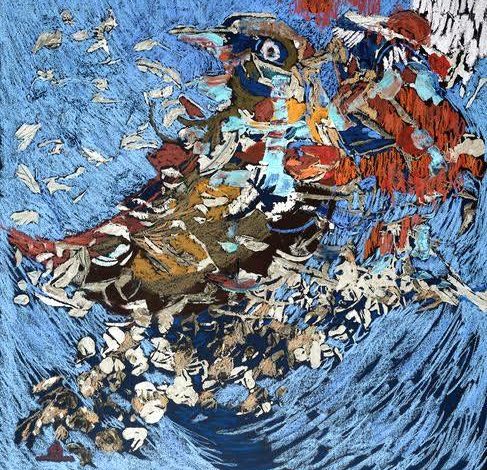
Watching Birds (soft pastel and acrylic, 80 × 80),
Egyptian Halla Shafey
In Watching Birds (soft pastel and acrylic, 80 × 80), Egyptian Halla Shafey does not merely depict a bird; she reconstructs it from the scattered residues of motion, memory, and belief. The image resists stillness. It is a field of turbulence—shards of color, broken contours, and tactile strokes—yet from within this apparent dissonance emerges a form both fragile and assured: a bird suspended between disintegration and transcendence.
Shafey’s accompanying text becomes essential to reading the painting. Her words speak of a quiet certainty—of a bird that trusts the temporality of clouds and the inevitable passing of storms.We need to know, understand and believe in this, in this certain times of wars. This metaphysical assurance is not illustrated literally but translated into visual tension. The bird’s body appears almost fractured, assembled from a mosaic of vivid reds, blues, ochres, and whites, as if it has endured the storm it philosophically transcends. Yet it does not collapse. Instead, it holds—precariously, beautifully—within a swirling blue expanse that suggests both sky and sea, both freedom and engulfment.
This duality situates the work within a long lineage of birds in art and literature. Birds have always functioned as intermediaries—between earth and heaven, body and spirit, the ephemeral and the eternal. From ancient mythologies where birds carried divine messages, to poetic traditions where they embodied the soul’s longing, the bird is never merely an animal. In Shafey’s work, this symbolic weight is renewed but also complicated. Her bird is not idealized into smooth flight; it is textured, burdened, almost wounded by its own materiality.
Once, more than three decades ago, I wrote a poem— it halted me in the unsanctioned void, and whispered: rise, take flight. I was startled to find that if I dared to soar, my wings would open of their own accord. Yet I turned away, refusing— I would not fly, nor would I yield.
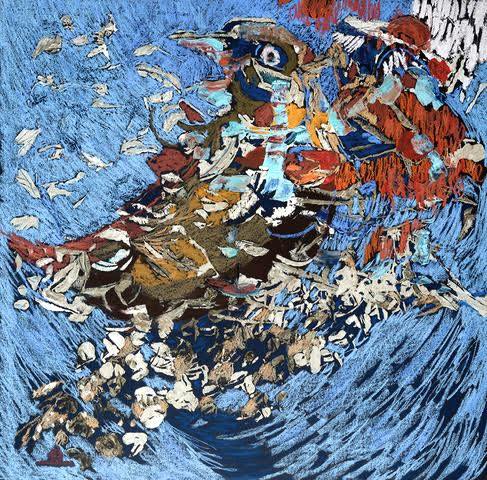
Watching Birds (soft pastel and acrylic, 80 × 80),
And such a state longs for the faith of that bird— the one who believes, with quiet certainty, in its own strength… and in its steadfast endurance. Back to the painting, the medium itself reinforces this reading. Soft pastel allows for immediacy and fragility, while acrylic asserts permanence and structure. Their coexistence mirrors the conceptual core of the piece: the coexistence of vulnerability and faith. The bird seems to be in the process of becoming—its edges dissolving into the background, its form resisting closure. It is less a fixed subject than an event: the act of holding together under pressure.
What distinguishes Shafey’s vision is her refusal to separate spiritual certainty from existential struggle. The bird’s “calm certainty,” as she writes, is not depicted as serenity but as persistence. The storm is present in every stroke, every rupture of color. And yet, the bird remains faithful to its song—an idea that resonates deeply with literary traditions where birds continue to sing in the face of chaos, not because the world is stable, but because faith renders instability bearable.
In this sense, Watching Birds becomes less about observation and more about recognition. We are not simply watching a bird; we are witnessing a condition of being. The fragmented surface invites the viewer to reconstruct meaning, just as the bird reconstructs itself in flight. It asks: what does it mean to trust in continuity when everything appears broken?
Shafey’s bird does not deny gravity; it transcends fear of it. Held—“by the Merciful,” as she writes—it neither fears falling nor hesitates before height. This theological undercurrent subtly transforms the painting into a visual meditation on surrender, where faith is not passive but dynamic, an ongoing movement forward.
Thus, the painting reclaims the bird as a central figure in contemporary artistic discourse—not as a decorative motif, as we used to admire many of her previous works, but as a profound symbol of resilience. In Shafey’s hands, the bird is both ancient and immediate, literary and visceral, fragmented yet whole. It moves—and in its movement, it teaches us how to endure, how to believe, and how to continue.