 thesilkroadtoday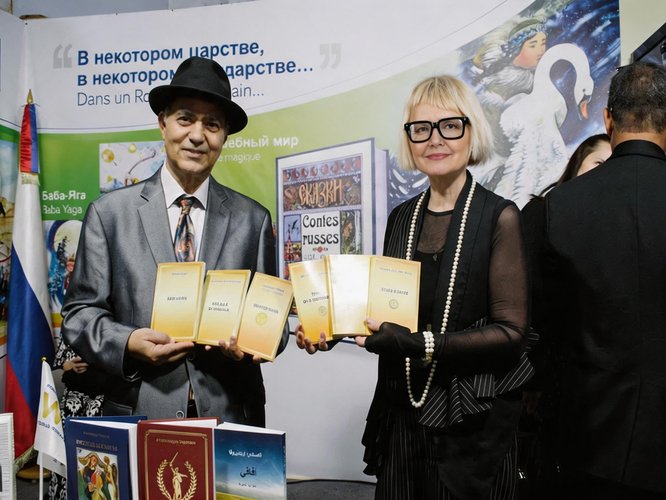
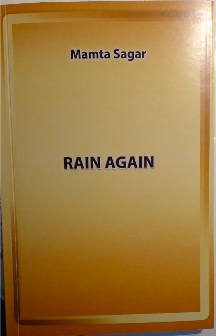
This review explores the poetry of Indian writer Mamta Sagar, a distinguished recipient of the World Organization of Writers (WOW) Award. Her acclaimed collection gained international visibility during the World Peoples Assembly in Tunisia, where it was presented by WOW President Margarita Al. The book was showcased both at the Tunis International Book Fair and at the Russian House in Tunis, situating Sagar’s work within a vibrant global literary dialogue.
Mamta Sagar’s Rain Again emerges as a luminous and intellectually charged contribution to contemporary world poetry, carrying with it the depth of Kannada literary traditions while engaging a global readership through translation. As one of the distinguished laureates of the World Organization of Writers (WOW) Awards, her work arrives already framed by international recognition—yet the true measure of its value lies within the poems themselves, where language becomes both a site of resistance and a medium of intimate reflection.
The volume is thoughtfully introduced by the publisher, poet Margarita Al, whose preface situates Mamta Sagar’s voice within a broader cultural and historical continuum. She describes the poems as scattering “like pollen from a flowering Kannada tree,” an image that proves strikingly apt. Sagar’s poetry indeed carries an organic, dispersive quality—rooted in a specific linguistic and cultural soil, yet capable of germinating across diverse intellectual landscapes. The reference to “Dravidian memory” underscores a key dimension of her work: an insistence on continuity, identity, and resilience in the face of historical and cultural pressures.
Mamta Sagar herself, a poet, academic, translator, and feminist thinker, brings a rich interdisciplinary background into her writing. Her scholarly engagement with gender, patriarchy, and resistance informs the thematic undercurrents of the collection. Yet the poems never feel didactic. Instead, they operate through subtle imagery, emotional resonance, and linguistic precision. Her dual engagement with Kannada and English—along with multiple other languages through translation—positions her poetry at a unique intersection between the local and the global. Translation, as she notes in her own preface, is not merely a technical exercise but a creative reassembly, a “reshuffling” that produces new poetic forms while preserving the original’s essence.
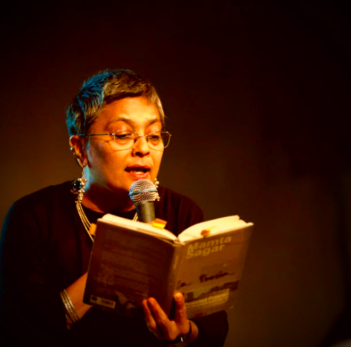
The inclusion of selected poems such as “For My Mother,” “Hide and Seek,” and “Words” offers a revealing glimpse into the range and depth of her poetic voice.
“For My Mother” is perhaps the most emotionally evocative among them. The poem begins with delicate imagery—a rose, its petals, its color—only to gradually transform into a meditation on memory, loss, and unspoken pain. The metaphor of the rose dissolving into a “transparent petal” mirrors the quiet erasure of presence, while the final lines reconnect this natural imagery to the poet’s mother, whose “hidden drops of pain” are internalized by the speaker. The poem’s strength lies in its restraint; it avoids overt sentimentality while achieving a profound emotional impact.
In contrast, “Hide and Seek” adopts a more fluid, almost playful structure, yet beneath its simplicity lies a philosophical reflection on existence and perception. The movement of a leaf, the flow of water, the fleeting presence of fish—all contribute to a sense of transience. The repeated notion that “water doesn’t know / air doesn’t know / tree doesn’t know” suggests a universe operating beyond conscious awareness, where human attempts to assign meaning may be inherently limited. The poem captures the elusive nature of reality itself, framed as a quiet, ongoing game.
“Words,” though brief, is strikingly conceptual. By describing words as “black drizzly drops / on a form of white space,” Sagar foregrounds the visual and material aspects of language. The paradox she introduces—“Visible, but mute; the invisible, heard”—encapsulates the tension at the heart of poetry: the struggle to articulate what often lies beyond expression. It is a fitting reflection for a poet deeply engaged in translation, where meaning constantly shifts between presence and absence.
The exhibition of Rain Again during the World Peoples Assembly in Tunisia, both at the international book fair and the Russian House, further underscores its global significance. The book does not merely represent an individual achievement but participates in a broader dialogue between cultures, languages, and literary traditions.
Ultimately, Mamta Sagar’s Rain Again is a work of quiet power. It does not seek to overwhelm but to resonate—through memory, language, and the subtle interplay of images. It is a testament to poetry’s enduring ability to cross boundaries, carrying with it both the specificity of its origin and the universality of its themes.
POEMS by MAMTA SAGAR
- FOR MY MOTHER
To the touch of a finger, soft, the rose;
its petals, all tender
The rosy hue
flows from petal to petal;
Over the lips, the spread of a rosy smile;
between the pages, the single petal
is a trapped pink butterfly;
opened many days after, the pages show the vanishing
of both pink and rose;
in its place, a transparent petal.
Without a trace disappeared the rose;
has it gone away, just like that, no word, no question, no sound or ado, gone?
Didn’t know at all.
and merged with the breeze.
! The pink of the rose erased the rose itself
I remember my mother;
her hidden drops of pain, I hold within me.
HIDE AND SEEK
A leaf from the tree gliding sliding swinging a kite caressing the wind a boat on the river
with colourful fish yellow and green flash on the shining water moves quickly
disappearing with the flow
water doesn’t know air doesn’t know tree doesn’t know fish doesn’t know this game of hide and seek.
WORDS
Why are words like this?
Black drizzly drops
on a form of white space! Why are words lik Visible, but mute; the invisible, heard.