 thesilkroadtoday
 By Professor Bill F. Ndi,
Professor of Modern Languages, Communications, and Philosophy, Tuskegee University, Alabama USA; President of the Pan African Writers (PAWA) and First Vice President of The Alabama Council of University Faculty Senate Presidents (ACUFP) as well as Interim Director of International Programs at Tuskegee University, Alabama USA.
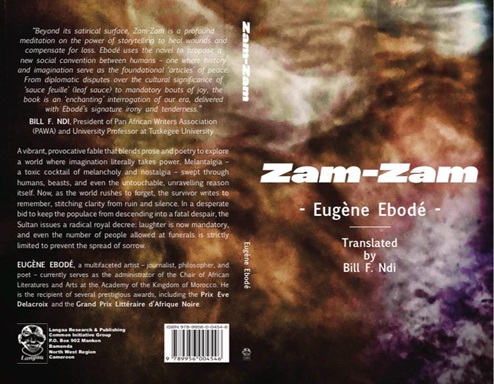
In anticipation of the publication of Eugene Ebodé’s Zam-Zam in the English language and under the Langaa RPCIG imprint, I would like to seize this as a moment of personal privilege as a critic and the translator, to whet the readers’ appetite before they delve into Ebodé’s ocean of memory lit by fiction from a master footballer—international soccer star and goalkeeper with the junior Indomitable Lions—turned literary maestro with a pen that spews “enchanting” interrogations of our era and delivered with a signature irony and tenderness à l’Eugène Ebodé.

The Weight of Memory and the Light of Fiction
Eugène Ebodé does not merely write; he conjures liminal realms where the boundaries of the real and the imagined dissolve into a vibrant provocation. Born in Cameroon and now serving as a cultural diplomat at the Academy of the Kingdom of Morocco, Ebodé is a multi-faceted artist—journalist, philosopher, and poet—whose ensnaring prose seeks to expose the “African genius” to a world in need of its light.
In his latest masterpiece, Zam-Zam (2025), the narrative pulse is driven by the arrival of a Tikar princess named Onisha in a kingdom where certainties have begun to vacillate. Ebodé transports us to a society besieged by a mysterious spiritual pandemic: “mélanthalgia.” Through this fable, he explores a world where imagination literally takes power, offering a poetic breath to a humanity gasping under the weight of its own history.
“Mélanthalgia”, The Deadly Cocktail
The central ailment of the kingdom, “mélanthalgia,” is a masterful blend of melancholy and nostalgia. Ebodé defines this condition as a “toxic cocktail”—a mortal sadness that threatens to tip the scales of existence from life toward an emotional abyss. It is a state of being “mad with emotion,” where the past becomes a trap rather than a foundation.
In Ebodé’s vision, the written word serves as the primary defense against this lethal despondency. He views literature not as an escape, but as a restorative force:
“The central idea is that stories are a force, and that this force is a modality that comes to compensate for wounds and misfortunes.”
Joy as a Political Weapon: Laughter by Royal Decree
To combat the spread of “mélanthalgia,” the Sultan issues a series of startling decrees, the most radical of which makes laughter mandatory. This is not the “sardonic laughter” of the cynic, but a survival mechanism—a “joyous detour” designed to place necessary distance between the human spirit and the misfortunes that seek to crush it.
The Sultan’s logic is profoundly counter-intuitive yet survivalist. Recognizing that sadness has become a contagion, he limits funerals to only a few attendees. This decree is a calculated effort to “limit the breakage” of public morale; by restricting the collective weight of mourning, the Sultan prevents a single death from triggering a fatal wave of grief that could consume the living. In this kingdom, joy is a mandated form of resistance.
The Linguistic Alchemy: What “Zam-Zam” Really Means
The title Zam-Zam represents a profound linguistic and spiritual alchemy, bridging Ebodé’s ancestral Beti roots with the sacred traditions of the Islamic world:
- The Beti Root: In the author’s mother tongue, Zam signifies supreme joy or ecstasy. Doubling the term into Zam-Zam creates “ecstasy squared”—a state of overflowing energy so intense it borders on madness, or being zinzin.
- The Sacred Source: The title simultaneously invokes the miraculous Zamzam well of Islamic tradition. In the fable, this reference becomes literal as the character Zamzam discovers a miraculous source, providing the water necessary to save the kingdom’s sacred forest from a ravaging, apocalyptic fire.
The Cassava Scepter: From Nourishment to Punishment
One of the novel’s most profound ironies is revealed by the Kingdom’s Historian regarding the royal mace, or scepter. While it is currently feared as a “scepter of terror”—a blunt instrument of power used to crush the heads of the recalcitrant—its origins were humble and life-giving. Originally, this heavy tool was used for pounding Cassava to feed the people.
Ebodé uses this transformation as a visionary metaphor for the evolution of human “tools.” He warns that our modern tools—Artificial Intelligence, metadata, and the machines of the digital age—often begin as aids to human progress. Yet, like the cassava scepter, they risk becoming instruments of “enslavement” or “depletion” if we forget their nourishing origins and allow them to be turned against the spirits they were meant to serve.
The “Night of Hard Knocks”: Wit Over Muscle
The futility of brute force is laid bare during the “Night of Hard Knocks,” a pivotal verbal joust between the colossus Zamzam and Princess Onisha. Though Zamzam is a physical giant capable of shattering the royal mace with his own head, he is utterly humiliated in this poetic duel.
The princess delivers a series of “punches” to the giant, not as acts of violence, but as a stinging rebuke for his lack of spirit and wit. In this space of “verbal ecstasy,” Zamzam’s muscles are irrelevant. Ebodé uses this encounter to argue that true virility is found not in the “exposure of muscle” or “brute force,” but in the “non-brutal elucidation of available horizons.”
A New Social Contract Based on Stories
Ebodé proposes a “new human convention” that challenges the foundations of modern society. He contrasts Jean-Jacques Rousseau’s traditional social contract—which Ebodé notes was founded by an “imposter” who claimed land as his own—with a new, “intimate contract” inspired by Scheherazade. Where Rousseau’s contract was built on property and the exclusion of others, Ebodé’s convention asserts that “the fruits belong to everyone” and that the primary article of human engagement must be the story.
In this magical laboratory of a kingdom, the exchange of narratives is a life-saving necessity. As the Sultan realizes through the presence of Onisha:
“Your story will save human lives.”
Beyond the African Continent
Through his leadership at the Academy of the Kingdom of Morocco, Eugène Ebodé continues to champion the idea that literature is a “magical laboratory” capable of elevating the spirit and neutralizing the toxic cocktails of our era. He invites us to look beyond the “sands of the desert” and into the sacred forests of our own imagination to find a “human-human convention” that transcends borders.
Ebodé’s fable leaves us with an urgent invitation to use our stories as the only force capable of healing our historical wounds and neutralizing the “mélanthalgia” of the modern age. We must tell our stories if we intend to ensure our own survival.