 thesilkroadtoday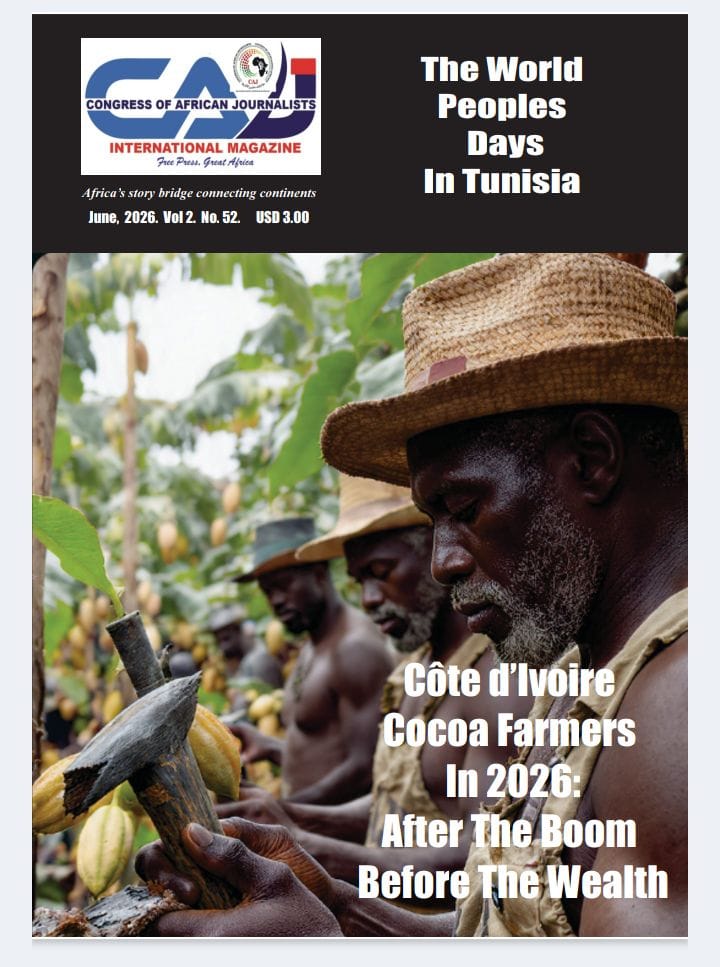
As this June 2026 edition of CAJ International Magazine reaches our readers across Africa and beyond, a common thread emerges from every report, feature, and commentary contained in these pages: the struggle to transform survival into dignity.
From the cocoa farms of Côte d’Ivoire to the classrooms of Somalia, from the markets of Angola and Tunisia to the forests of Liberia, Africans continue to navigate a world shaped by economic uncertainty, political transitions, climate pressures, technological change, and the enduring demand for accountable governance. Yet amid these challenges, the continent is not standing still. It is adapting, negotiating, rebuilding, and imagining new futures.
Our cover story takes us to Côte d’Ivoire, the world’s largest cocoa producer. For decades, the fortunes of cocoa farmers rose and fell with global commodity markets over which they had little control. Today, new policies seek to replace volatility with stability. Price guarantees, direct support payments, farm modernization, and sustainability measures represent more than agricultural reforms; they are an attempt to answer a fundamental question confronting many African economies: how can natural wealth be transformed into human prosperity?
The same question echoes throughout this edition.
In Somalia, innovative educational models are bringing learning to children whose lives have long been disrupted by conflict, displacement, and climate shocks. The story is not merely about schools. It is about the determination of a nation to invest in its future despite extraordinary constraints. Across the continent, education remains the most powerful bridge between hardship and opportunity.
In Liberia, debates over carbon credits and forest governance reveal another challenge facing modern Africa: ensuring that global environmental solutions do not reproduce old patterns of exclusion. As governments negotiate carbon finance agreements, citizens rightly ask who benefits, who decides, and who bears the costs. These questions are increasingly central to the continent’s relationship with the global economy.
Economic realities dominate many of our reports this month. Angola’s currency crisis, Tunisia’s austerity measures, Morocco’s uneven recovery, and Nigeria’s approaching electoral contest all illustrate a growing tension between macroeconomic indicators and lived experience. Governments may point to reforms, infrastructure projects, or improved fiscal balances. Citizens often judge success by different measures: food prices, transport costs, employment opportunities, and the ability to support a family with dignity.
Nowhere is this gap more visible than in our examination of survival economies. Whether it is women in Kenya entering sex work due to a lack of employment opportunities, or households across North and Sub-Saharan Africa relying on informal networks to compensate for failing systems, the stories remind us that economic statistics acquire meaning only when viewed through human lives.
The issue also shines a spotlight on governance, rights, and freedom. Reports from Eritrea, Eswatini, Mozambique, and the Sahel examine the difficult relationship between state power and citizen participation. They raise important questions about the rule of law, freedom of expression, democratic accountability, and the role of institutions in maintaining social trust. These are not abstract concerns. They shape everyday realities and influence whether citizens feel protected, heard, and represented.
As journalists, we understand that accountability begins with information. The challenges facing reporters in Mozambique, the lessons revisited in our analysis of the Pentagon Papers, and the broader concerns about media freedom across Africa remind us that independent journalism remains one of democracy’s essential pillars. Where information is restricted, public trust erodes. Where journalists can work freely and responsibly, societies are better equipped to confront their problems honestly.
Yet this edition is not defined solely by struggle. It is equally a celebration of culture, creativity, and shared humanity. From the World Peoples Days in Tunisia to Morocco’s visionary House of Book Worlds, from reflections on creativity and identity to opera, literature, and visual arts, these pages remind us that development is not measured only in economic growth. It is also measured in the vitality of ideas, the preservation of memory, and the capacity of cultures to inspire dialogue across borders.
Africa’s story in 2026 is neither one of unqualified optimism nor unrelenting crisis. It is a story of societies navigating complexity. It is a story of citizens demanding dignity, governments seeking solutions, and communities adapting to rapid change. Most importantly, it is a story of people whose daily resilience often exceeds the capacity of institutions designed to serve them.
At CAJ International Magazine, we remain committed to telling these stories with accuracy, fairness, and depth. The continent deserves reporting that goes beyond headlines and statistics to illuminate the realities behind them.
In these pages, readers will encounter farmers, teachers, traders, journalists, artists, policymakers, elders, and young people. Together, they form the living portrait of an Africa that continues to confront its challenges while refusing to surrender its aspirations.
That portrait, ultimately, is the true story of our continent.