 thesilkroadtoday
— An In-Depth Interview with Chinese Poet Cao Shui at the 6th Silk Road International Poetry Festival
Al-Tariq Al-Arabi Newspaper (The Arab Road), Culture Section, Page 07, September 1, 2026
By Turkia Lucif
I. Reporter: As a Chinese poet, what special significance does it hold for you to receive this honor at the “Silk Road” International Poetry Festival held in Kazakhstan, the historical hub of the Silk Road?
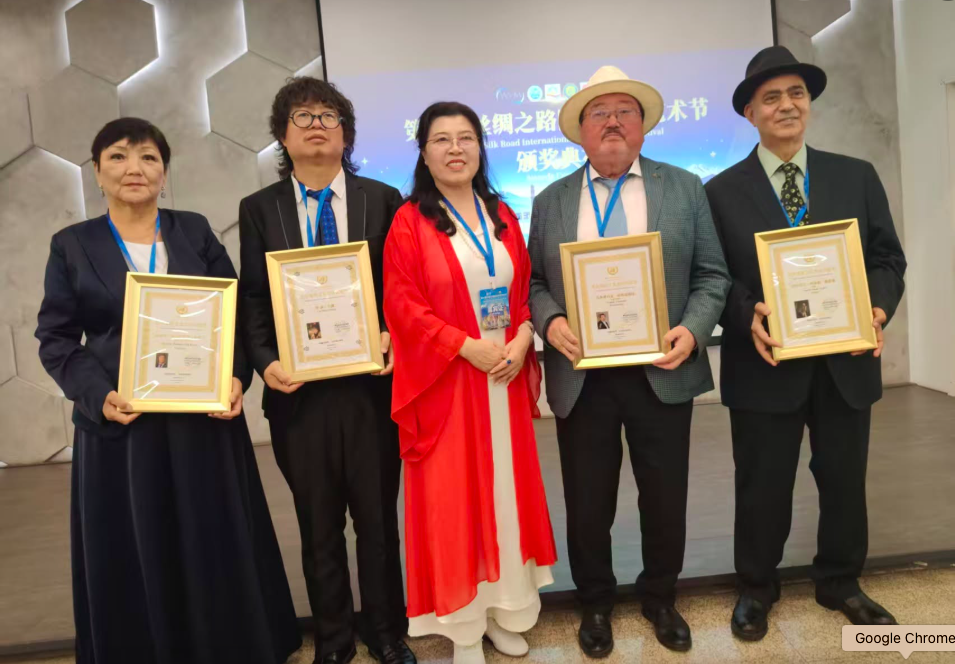
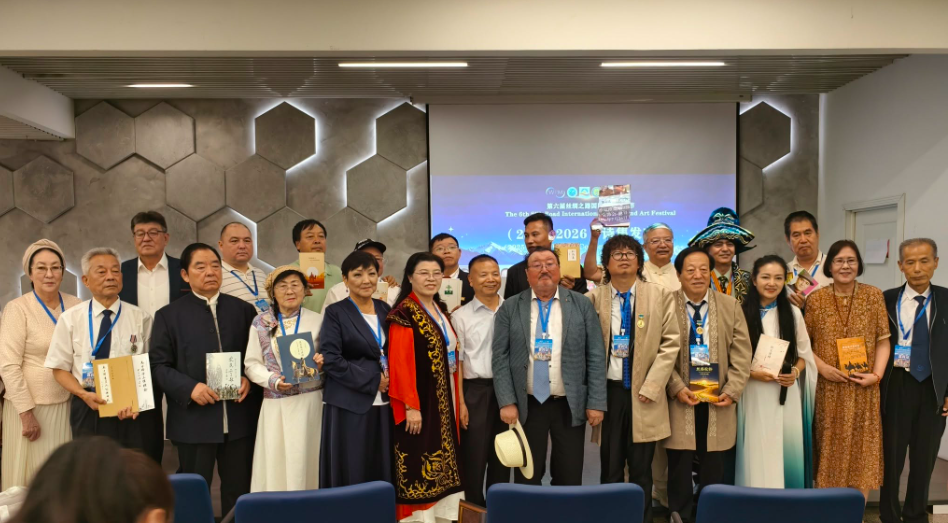
Cao Shui: This is an extremely important moment in my poetic career. At this festival, I received three awards simultaneously — the “Outstanding Cultural Contribution Award of the World Silk Road” presented by the UN World Silk Road Forum, the “Abai International Poetry Award” of Kazakhstan, and the “Golden Papyrus Award” of Egypt. These three awards come respectively from an international organization, Central Asia, and the Arab world, carrying special symbolic meaning for me.
China is the starting point of the Silk Road. The camel bells of Chang’an have traversed two thousand years of sandstorms and still echo across the grasslands of Central Asia today. It is also from here that Chinese literature goes out into the world. In my view, these three awards are not only an affirmation of my personal creation, but also a confirmation of the poetics I advocated in the Manifesto of Grand Poetry — “to integrate Eastern and Western civilizations, to integrate ancient and modern civilizations, to integrate secular and sacred civilizations.” These three integrations are precisely the direction of the common values pursued by human civilization in poetry.
I have always believed that Chinese literature belongs not only to China but also to the world. From The Book of Songs and Songs of Chu to Tang and Song poetry, Chinese poetry has always been a radiant pearl in the treasury of human civilization. Today, as China embraces the world with a more open posture, Chinese literature should also find its rightful place in the landscape of world literature. These three awards represent the world’s recognition of Chinese literature’s contributions, recognition of the Grand Poetry movement, and an impetus for my future creation.
II. Reporter: How do you understand the inner connection between classical Chinese poetry and the “Silk Road” spirit that this festival is committed to reviving?
Cao Shui: Classical Chinese poetry contains a profound Silk Road spirit. Chinese poetry has a great number of works pursuing “universal harmony” (tianxia datong). In The Book of Rites · Li Yun, it is said that “when the Great Way prevails, the world belongs to all.” This ideal echoes repeatedly in poetry. Tao Yuanming depicted an ideal world without strife and with equality for all in The Peach Blossom Spring; Du Fu cried out in My Cottage Unroofed by the Autumn Wind: “Could I get mansions covering ten thousand miles, to house all poor scholars and make them smile?”; Zhang Zai’s “to establish heart for heaven and earth, to establish life for the people, to continue the lost teachings for past sages, to open eternal peace for all generations” further pushed this universal sentiment to its extreme. What these poetry pursue is precisely the core of the Silk Road spirit — peaceful coexistence and common prosperity among different civilizations.
Classical Chinese poetry contains a great deal of writing and imagination about the Western Regions. From the Kunlun mythology in The Classic of Mountains and Seas to the desert smoke and long river sunset in the frontier poetry of the Han and Tang dynasties, the Western Regions have always been an important space in Chinese poets’ imagination. Cen Shen’s “Suddenly, like a night of spring breeze, ten thousand trees and pear trees bloom” describes the snow scenery of the Western Regions; Wang Zhihuan’s “Why should the Qiang flute complain about the willows? The spring wind never crosses the Jade Gate” depicts the vastness of the frontier; Wang Wei’s “I urge you to drink one more cup of wine; west of the Yang Pass there are no old friends” writes of the parting on the road to the Western Regions. These poems themselves are literary testimonies of the Silk Road, recording the exchanges and collisions between Chinese civilization and Central and West Asian civilizations.
Since modern times, the West has led the world through the Industrial Revolution and technological innovation, and the balance of the world has tilted toward the West like a seesaw. But the development of human civilization has never been one-directional, and now is the time to contribute Chinese cultural strength. The Grand Poetry poetics I advocate, and the Silk Road poetics advocated by Ms. Wang Fangwen, are precisely dedicated to this — letting Chinese poetry once again become a bond connecting Eastern and Western civilizations, and letting the spirit of the Silk Road gain new life in contemporary poetry.
III.Reporter: In your view, which Chinese poem best embodies the bridging role connecting East and West, as the Kazakh poet Olzhas Suleimenov said, “there is no East, no West”?
Cao Shui: If I had to choose one Chinese poem that best embodies the bridging role connecting East and West, I would choose Great Dance of Sorrow, a poem excerpted from my epic Epic of Eurasia. This poem has been acclaimed by many critics as a work that connects Eastern and Western civilizations, breaking through the barriers between East and West at the level of poetic cultural geography.
In Great Dance of Sorrow, I created two core images — the Asian and the European. They are the embodied representatives of Eastern and Western civilizations respectively. The Asian represents the mystery, restraint, and profundity of the East, while the European represents the rationality, extroversion, and expansion of the West. But in the poem, they are not opposing poles; rather, they are partners dancing together on the great stage of the world. They face the common human predicament — loneliness. This loneliness is not unique to any one civilization, but the common existential condition of all humanity. Whether you come from the East or the West, whatever religion you believe in or language you speak, before the vast universe, human beings are all lonely existences.
The core theme of Great Dance of Sorrow is: to dance in loneliness, to transcend in suffering. The Asian and the European meet, collide, and embrace on the world stage. Their dance is sorrowful because they are deeply aware of human finitude; but their dance is also great because they pursue infinity within finitude and seek connection within loneliness. This is precisely the realm of “there is no East, no West” as the Kazakh poet Olzhas Suleimenov put it — when we confront the common destiny of humanity, the boundaries of civilizations dissolve, and what remains is only the common heartbeat of humanity.
This poem has been translated and reviewed in many countries. Some critics have said that Great Dance of Sorrow shows them the possibility of a world poetry that transcends nationalism. I think this is precisely the power of poetry — it enables people of different civilizations to dance in the same rhythm and meet in the same sorrow.
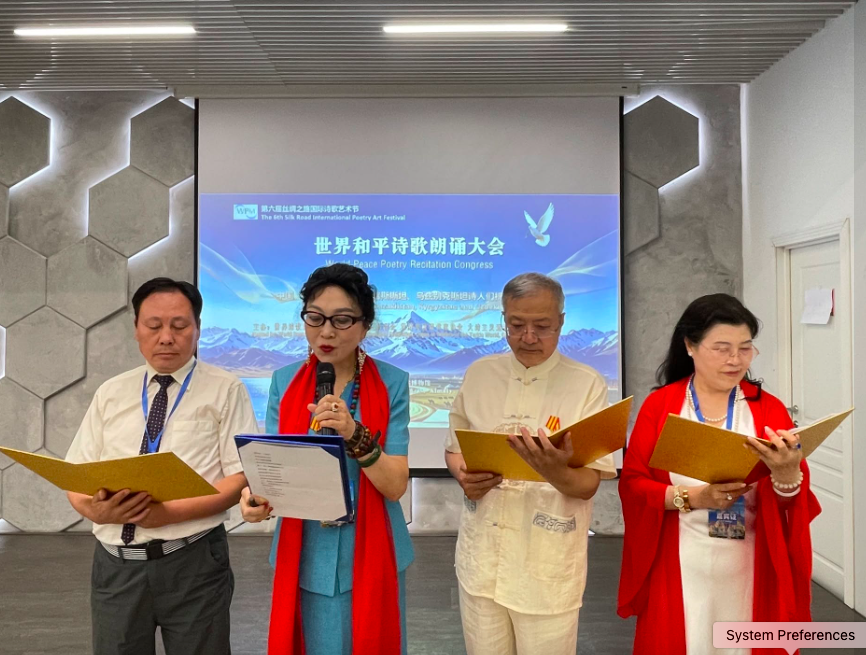
IV. Reporter: When you first arrived in Kazakhstan and participated in this poetry festival, what was your first impression of Kazakhstan’s poetic tradition and cultural atmosphere?
Cao Shui: My connection with Kazakhstan began in 2023. That year, I first arrived in Almaty, and the great Kazakh poet Ulugbek Yesdauletov personally took me to visit the Central State Museum. There, we saw a complete set of gold horse ornaments — those golden artifacts from before the Common Era, with their exquisite craftsmanship and magnificent shapes, were breathtaking. I stood before those gold horse ornaments, speechless for a long time. It was a shock that traversed time and space; you could almost hear the hoofbeats on the steppe two thousand years ago and see the figures of nomadic peoples galloping on horseback in the golden sunset.
This is also the “Golden Steppe” zone that I have written about repeatedly in my long poem Epic of Eurasia. From the Eastern European Plain to the Mongolian Plateau, this steppe belt traversing Eurasia is an important channel for human civilizational exchange. The Scythians, the Huns, the Turks, the Mongols… one nomadic people after another rose, migrated, and merged on this steppe. They were not only spreaders of war but also transmitters of civilization. Those gold horse ornaments are precisely the material testimony of the highly developed steppe civilization.
Through translating Ulugbek’s poetry, I gained a deeper understanding of Kazakhstan’s poetic tradition. His poetry possesses a particular vastness and melancholy characteristic of steppe peoples, and a deep reverence for nature and life. In the process of translation, I deeply realized that human beings share 99.99% of their emotions, just as human genes are 99.99% identical. Love and hate, joy and sorrow, hope and despair — these emotions know no ethnicity or language. This made me believe even more firmly in the theme of my book — “humanity shares the same origin, the world seeks universal harmony.”
By participating in the 6th Silk Road International Poetry Festival this time, I have gained a deeper understanding of the cultures of Kazakhstan, as well as Uzbekistan and Kyrgyzstan. Although these Central Asian countries each have unique ethnic traditions, they all share the cultural genes of the Silk Road. Recently, I have written a series of poems, attempting to deeply integrate the civilizations of the Silk Road and incorporate the grasslands, deserts, ancient cities, and legends of Central Asia into my poetic world.
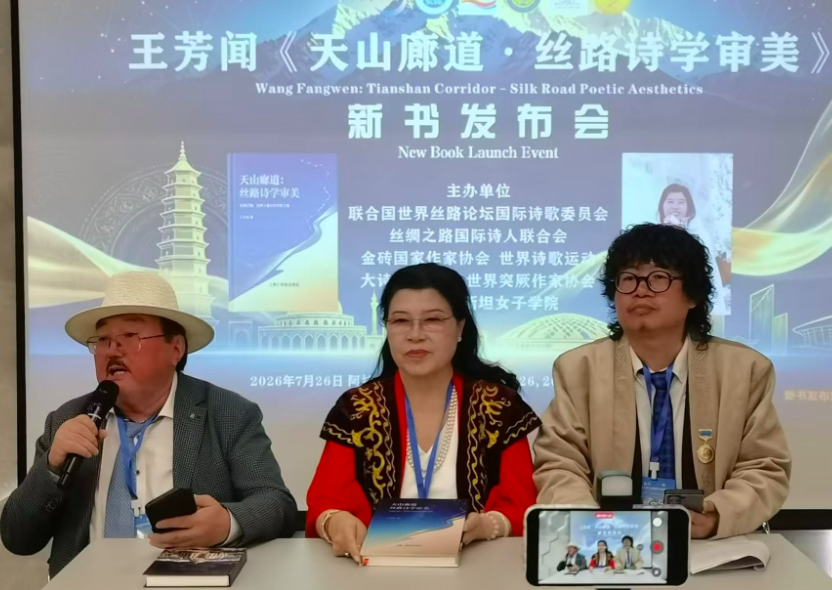
V. Reporter: Against the backdrop of today’s turbulent international situation and the rise of war discourse, how should Chinese poetry undertake the contemporary mission of conveying peace and friendship?
Cao Shui: This is a heavy but unavoidable question. The process of human integration has always been accompanied by war. From World War I to World War II, humanity paid the price of tens of millions of lives and briefly learned its lesson. The establishment of the United Nations, the building of the international legal system, and the development of regional cooperation organizations are all humanity’s efforts to avoid war. But heartbreakingly, regional wars have now resurfaced, and war discourse is once again rampant in some countries.
I am deeply concerned about this. I worry about the outbreak of World War III — in the nuclear age, World War III would have no victors; it would destroy entire human civilization. Human history has proven countless times that war is never the ultimate way to solve problems; it only brings cycles of hatred and civilizational regression.
But at the same time, I am an optimist. I firmly believe that humanity will inevitably move toward great unity, because we are originally one family. From the perspective of genetics, all humanity descends from a common ancestor in Africa; from the perspective of cultural studies, major civilizations have always exchanged with and nourished one another. The Silk Road itself is a great testimony to peaceful human exchange — along this long road, caravans brought not swords, but silk, tea, porcelain, and spices; monks transmitted not conquest, but Buddhist teachings, scriptures, and faith.
I do not wish for human unity to be achieved through war, but rather through poetry and culture. This is precisely the core pursuit of the Chinese Grand Poetry school. Grand Poetry advocates “integrating Eastern and Western civilizations, integrating ancient and modern civilizations, integrating secular and sacred civilizations.” This integration is not achieved through force, but through understanding, dialogue, and resonance. Poetry is humanity’s oldest language and the language that can most transcend civilizational boundaries. When a Chinese poet’s poetry moves Arab readers, when a Kazakh poet’s verses are recited by Chinese readers, the barriers between civilizations dissolve, and the seeds of peace are sown.
Chinese poetry should undertake the mission of conveying peace and friendship in this era. We must write poetry that can move all humanity, and let the world hear Chinese poets’ call for peace and reflection on humanity’s common destiny. This is not an empty slogan, but a creative principle that every Chinese poet should practice.
VI. Reporter: In the exchanges at this festival, what commonalities have you discovered between the traditions and aesthetics of Arab poetry, Kazakh poetry, and Chinese poetry?
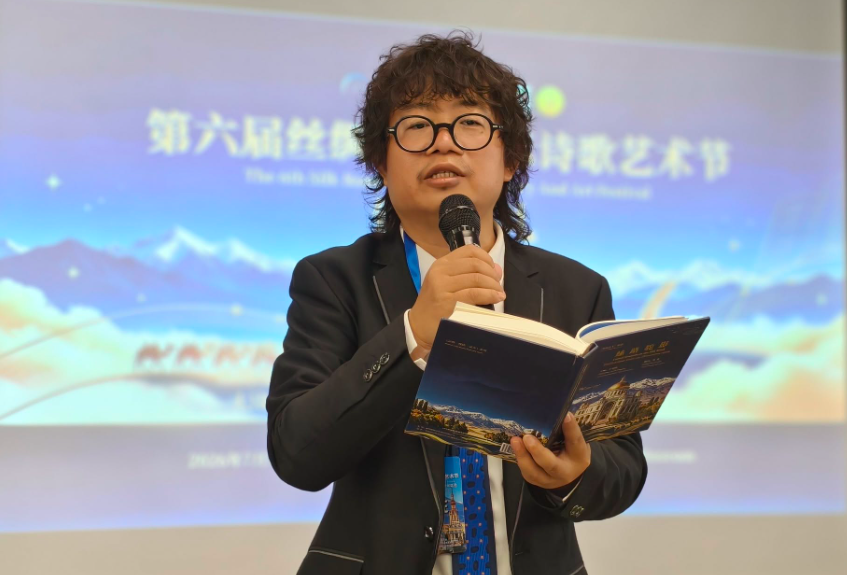
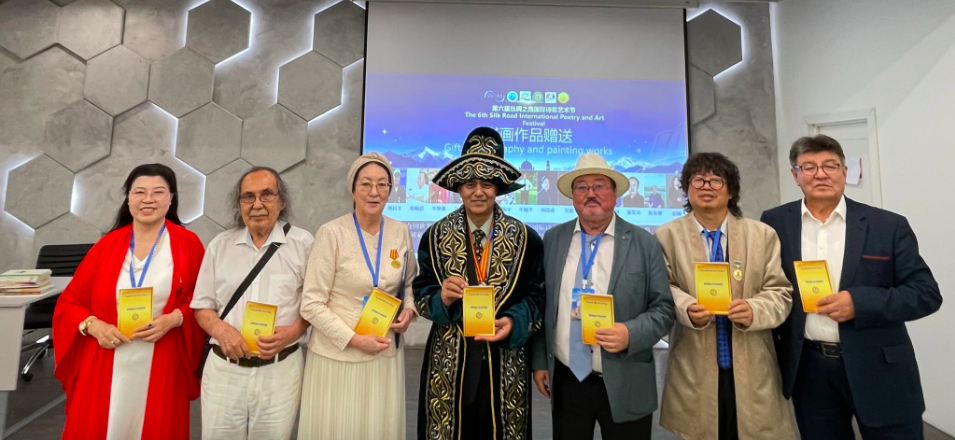
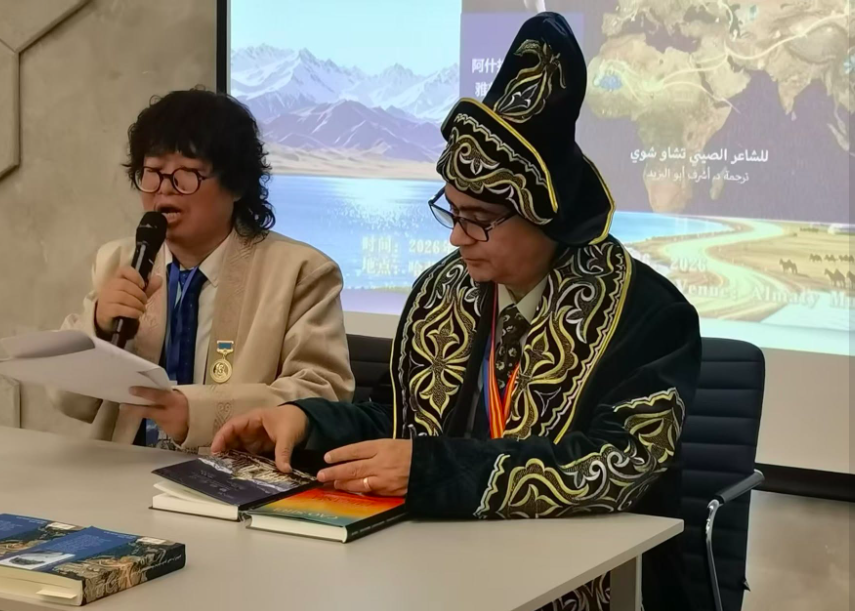
Cao Shui: An important achievement of this festival is the publication of the book Silk Road Camel Shadows. Edited by Wang Fangwen and translated by me, this book collects works by poets from China, Kazakhstan, Uzbekistan, Kyrgyzstan, Egypt, and other countries. In the process of translating these poems, I deeply felt the commonalities among different poetic traditions.
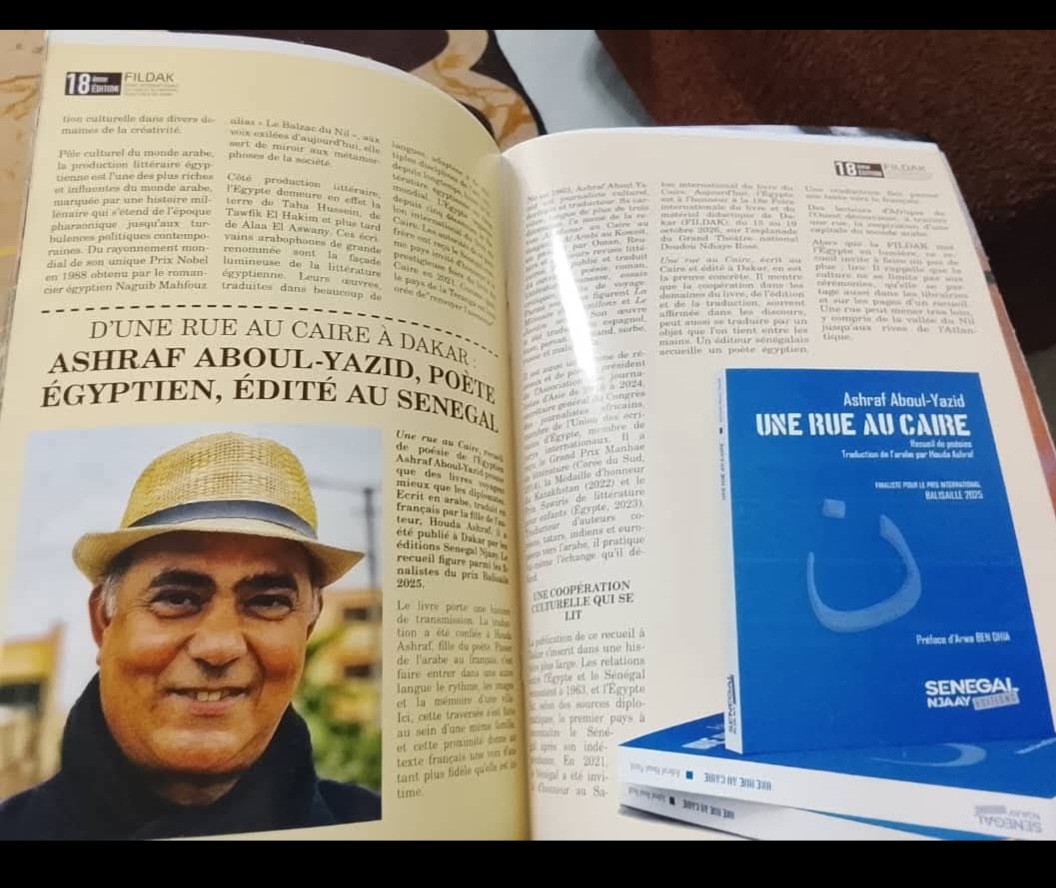
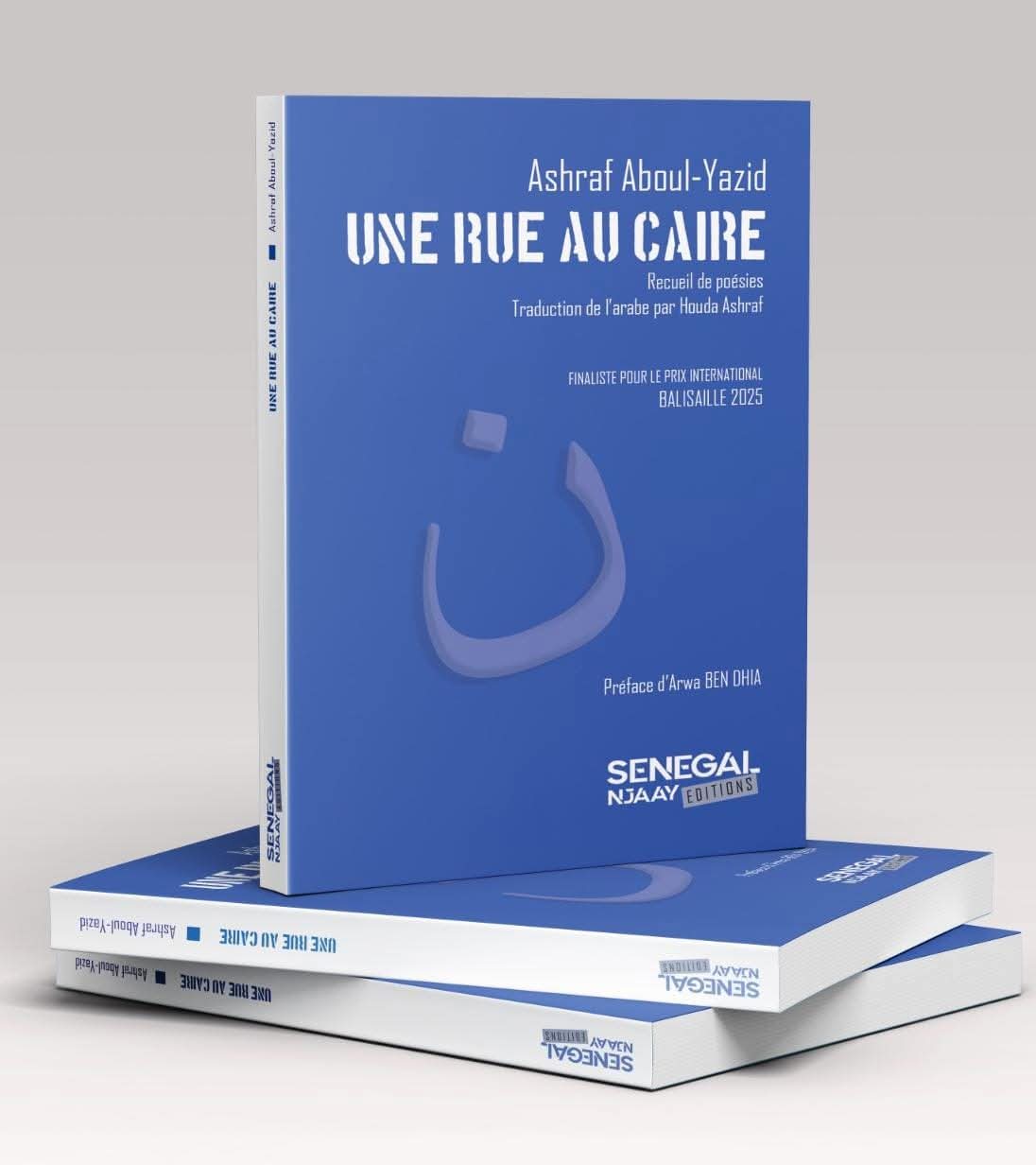
At the same time, the Egyptian poet Ashraf also translated and published the Arabic version of my long poem Epic of Eurasia. We held a launch ceremony together at the festival, and afterward traveled, wrote, and discussed together. In this process, I gained a deeper understanding of the Arab poetic tradition.
I have found at least three important commonalities among Chinese poetry, Central Asian poetry, and Arab poetry. First, they all have profound classical traditions. China has The Book of Songs, Songs of Chu, and Tang and Song poetry; Arabia has the Mu’allaqat (Suspended Odes) and the golden age poetry of the Abbasid dynasty; Kazakhstan has a long-standing oral epic tradition and the art of akyn (itinerant bard) singing. These classical traditions are not only cultural treasures of their respective peoples but also inexhaustible sources for contemporary poetic creation.
Second, they all pursue the order of the world. Whether it is the “Dao” in Chinese poetry, “Islam” (meaning submission and peace) in Arab poetry, or “Asa” (harmony and balance) in Kazakh poetry, they are essentially explorations of cosmic order and human social order. This pursuit of order gives all three poetic traditions a transcendent dimension — they do not merely write about personal emotions, but rather write about humanity’s understanding of the world and its aspiration for an ideal life.
Third, a brand-new world poetic aesthetics is taking shape through Silk Road poetic aesthetics. At this festival, I saw poets from different countries writing in their respective languages about common themes — remembrance of the Silk Road, desire for civilizational exchange, and hope for human peace. Although these poems differ in language and form, their inner aesthetic pursuit is the same. I believe that with the continuous promotion of platforms such as the Silk Road International Poetry Festival, a new poetic aesthetics integrating East and West, tradition and modernity is being born, and Chinese, Central Asian, and Arab poetry will play vital roles in it.
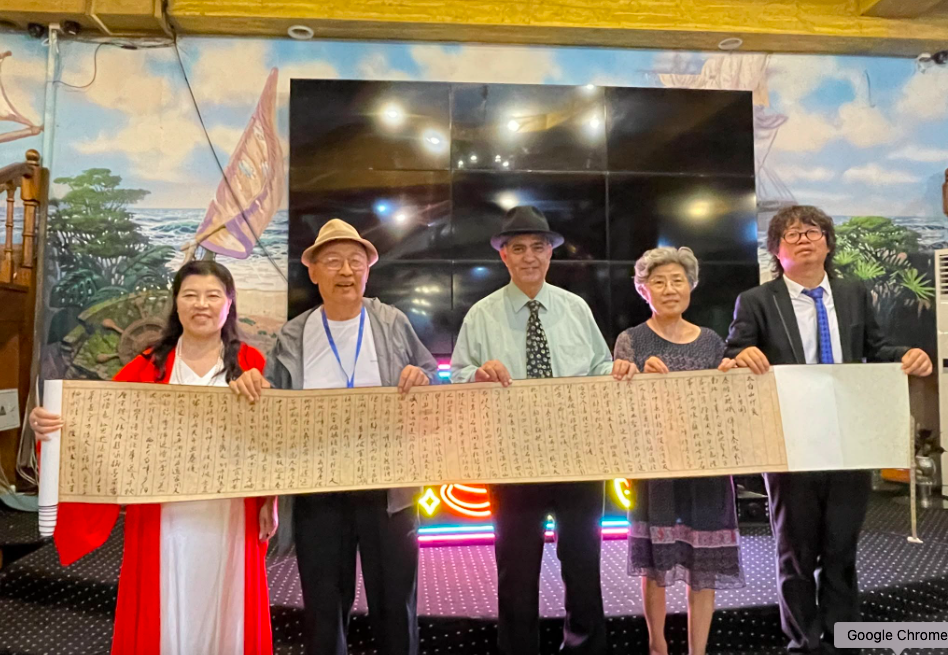
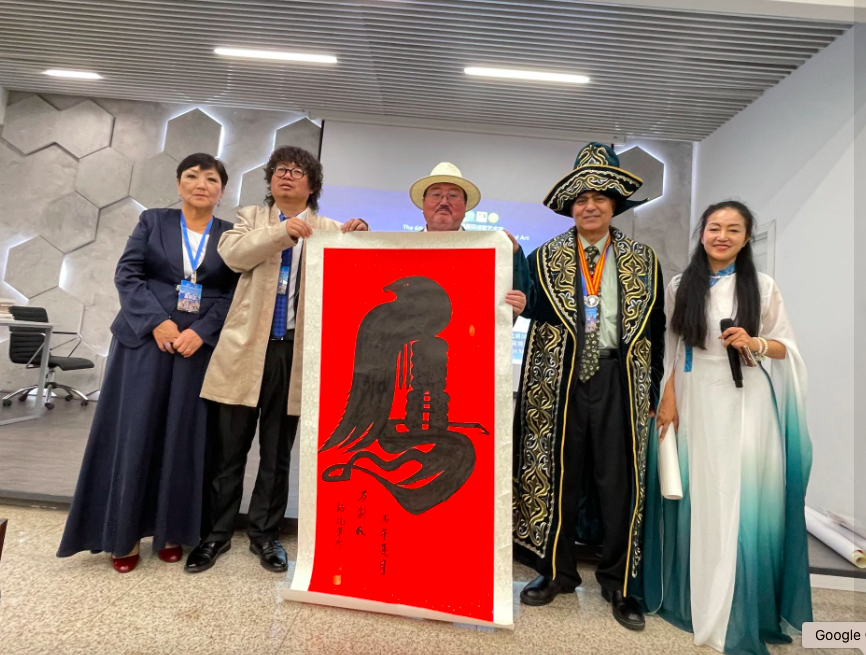
VII. Reporter: The organizers awarded you the “Gilded Papyrus” as the highest honor. What are your feelings about this? What cultural meaning does this symbolic gift convey to you?
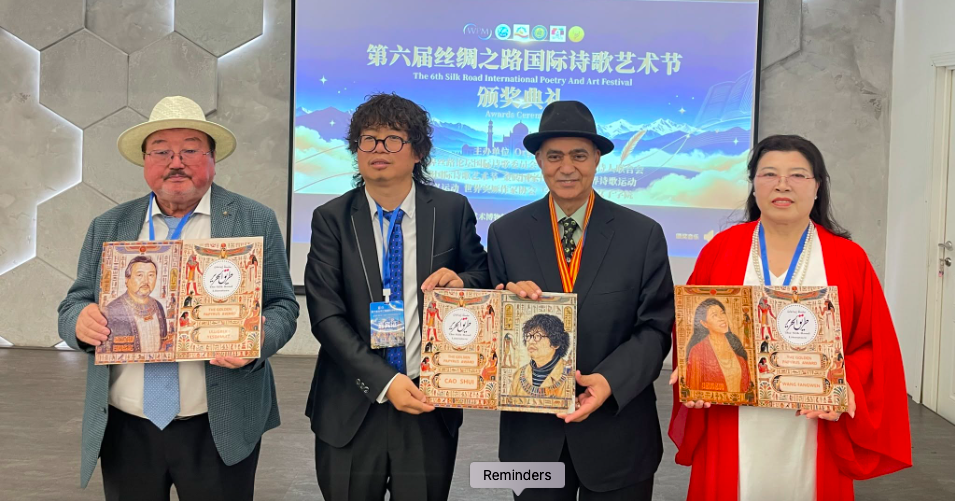
Cao Shui: Receiving Egypt’s “Golden Papyrus Award” is the highest honor for me. This award is not only an affirmation of my personal creation, but also a recognition of the Arabic version of my long poem Epic of Eurasia and the Grand Poetry movement I advocate. When I received that gilded papyrus, what I felt was an embrace across time and space between two ancient civilizations.
China and Egypt are the two oldest civilizations in human history. The pyramids of the Nile and the Great Wall of the Yellow River stand respectively at the two ends of Eurasia, witnessing the dawn of human civilization. Although these two civilizations are separated by thousands of miles, both share a pursuit of eternity, reflection on order, and reverence for life. Papyrus is a symbol of ancient Egyptian civilization, just as silk is a symbol of Chinese civilization — both are great contributions their respective civilizations made to human cultural transmission. Through this award, two ancient civilizations have merged in poetry.
After receiving this award, I have delved deeper into Egyptian civilization, as well as the Babylonian, Canaanite, Greek, Persian, Indian, and Chinese civilizations closely related to Egyptian civilization. These civilizations constitute the core matrix of ancient human civilization, and their exchange and integration are precisely the most profound historical significance of the Silk Road. I wrote a poem for the Egyptian god Horus —
In this poem, I attempted to integrate figures from Egyptian mythology such as Horus, Osiris, Set, and Ma’at with my own Grand Poetry philosophy. The golden papyrus is not only an award but also a vow — I will continue to use poetry to connect different civilizations and let humanity’s shared memory be revived in poetry.
VIII. Reporter: Do you understand the development trajectory of paper and papyrus in the history of Chinese civilization? How do you view their historical connection with the “Silk Road” in cultural transmission?
Cao Shui: I have conducted specialized research on this question. In my theoretical work Grand Poetics, there is a chapter specifically discussing the media of literary transmission. I believe that Chinese paper and Egyptian papyrus both have revolutionary significance in the history of human civilization.
I divide the development of human literature into four revolutions. The first revolution was the birth of language — language enabled human literature to emerge from nothing, from instinctive cries to conscious expression, and oral literature was born. The second revolution was the emergence of writing media — paper and papyrus enabled humanity to move from oral literature to written literature; literature no longer relied on memory and oral transmission but could be recorded, preserved, and disseminated. The third revolution was the invention of printing — printing enabled literature to move from short works to long ones, and the large-scale reproduction of books made knowledge and literature no longer the privilege of a small elite but accessible to a broader population. The fourth revolution was the rise of electronic media — the move from written literature to electronic literature brought the speed and scope of literary transmission to unprecedented levels.
In these four revolutions, papyrus and paper played extremely critical roles. The ancient Egyptians used papyrus, which grew abundantly in the Nile Delta, to produce one of the earliest writing media in human history. The emergence of papyrus enabled the literary, religious, and scientific documents of ancient Egypt to be preserved and transmitted, exerting a profound influence on the entire Mediterranean civilization circle. Chinese papermaking, on the other hand, was invented in the Western Han Dynasty and gradually matured after improvements by Cai Lun in the Eastern Han Dynasty. Compared with writing materials such as bamboo slips, wooden tablets, and silk, paper was lighter, cheaper, and easier to write on, and its emergencecompletely changed the way Chinese culture was transmitted.
Papyrus and paper are inextricably linked with the Silk Road. It can be said that the Silk Road itself was a road of media transmission. Chinese papermaking technology was precisely transmitted through the Silk Road to Central Asia, West Asia, and ultimately to Europe. After the Battle of Talas in 751 CE, Tang Dynasty papermaking craftsmen were captured by the Arabs, and papermaking technology thus entered the Arab world, later spreading to Europe through the Arabs. This transmission processcompletely changed the course of human civilization — without paper, there would have been no subsequent printing, no Renaissance, and no rise of modern science.
Therefore, when I learned that this award was named after the “Golden Papyrus,” I deeply felt its far-reaching significance. This is not only a reward for me personally, but also a recognition of the Silk Road’s key role in human cultural transmission. Egyptian civilization and Arab civilization are vital links in human civilization, and papyrus is the most vivid symbol of that link.
IX. Reporter: What role do you think contemporary Chinese poets should play in promoting literary dialogue and mutual understanding among different civilizations?
Cao Shui: I have pondered this question for a long time. Qatar’s Al Jazeera website once asked me a very sharp question: China is already an economic superpower, but Chinese literature’s influence in the world does not match this — why? I believe this is caused by many factors, but the core can be reduced to four levels of barriers.
The first barrier is language. Chinese is the most spoken language in the world, but in international literary exchange, English, French, Spanish and other languages dominate. The uniqueness of Chinese — pictographic characters, tonal system, grammatical structure — makes translation a huge challenge. Many excellent Chinese poems lose their original charm and power once translated into other languages. The second barrier is ways of thinking. Chinese culture is deeply influenced by Confucian, Buddhist, and Taoist traditions, and the Chinese way of thinking emphasizes holism, intuition, and dialectics, while Western thinking emphasizes analysis, logic, and empiricism. This difference in thinking makes many images and metaphors in Chinese poetry difficult for readers from other cultural backgrounds to understand directly. The third barrier is national boundaries. Under the modern nation-state system, literature is often placed within the framework of national culture, and classifications such as “Chinese literature,” “French literature,” and “Egyptian literature” themselves constitute a form of segregation. The fourth barrier is internet restrictions. In the digital age, the internet should be the most convenient channel for literary exchange, but for various reasons, there are overt or covert barriers between the cyberspaces of different countries, which to some extent hinders the free dissemination of literature.
These four barriers are not only problems faced by China but also common problems faced by many countries. But I believe that the existence of barriers precisely demonstrates the necessity of dialogue. Contemporary Chinese poets should play a more active role in promoting civilizational dialogue. First, we must go global through excellent works. Works are the best calling card; when a poem truly touches the common emotions and destiny of humanity, language barriers can be broken through. Second, we must actively participate in international poetry exchanges. Platforms such as the Silk Road International Poetry Festival are important venues for civilizational dialogue. We must go out and also invite in,enhancing understanding through face-to-face exchanges. Third, we must tell the earth-shaking changes taking place in China. Contemporary China is undergoing the largest-scale modernization process in human history, and this process contains countless moving stories and profound reflections. Chinese poets have a responsibility to write these stories and reflections, letting the world hear the authentic voice of China.
Ultimately, I hope that through the exchange of poetry and culture, the world will realize the “human utopia” spoken of by Plato and Confucius. In The Republic, Plato depicted a just city-state ruled by philosopher-kings; in The Book of Rites, Confucius depicted a world of “great harmony” where “the world belongs to all.” These two ideals from different civilizations are essentially the same — they both pursue human peace, justice, and common happiness. Poetry is precisely the bridge to this utopia.
X. Reporter: Will this trip to Kazakhstan and the spiritual inspiration of the “Silk Road” inspire you to create new poems?
Cao Shui: Of course. Every in-depth trip along the Silk Road is a source of creative inspiration. My connection with Central Asia can be traced back to 2019, when I visited Kyrgyzstan and was deeply moved by its snow mountains, grasslands, and ancient legends. Upon my return, I wrote the long poem Kyrgyzstan Rhapsody. In that poem, I attempted to integrate the Kyrgyz epic tradition Manas with my Grand Poetry philosophy, writing of the vastness and expanse of the Central Asian land.
This time, I have traveled more deeply through Uzbekistan and Kazakhstan, gaining a deeper understanding of the history and geography of this region. In Samarkand, I stood before the three madrasas of Registan Square, feeling the glory of the Timurid Empire and the profundity of Islamic civilization; in Bukhara, I walked through the ancient domed bazaars, as if hearing the camel bells of caravans from a thousand years ago; in Almaty, I once again entered the Central State Museum and reunited with those gold horse ornaments. Every place inspires my creative inspiration, and every exchange with local poets enriches my poetic world.
Along the way, I have already written a series of poems. Some are responses to specific historical scenes, some are meditations on civilizational exchange, and some are tributes to natural landscapes. They will become the beginning of Volume II of my long poem Epic of Eurasia, titled Song of the Earth.
Epic of Eurasia is one of my most important works. Volume I uses the history and geography of Eurasia as its thread, writing of the rise, fall, and integration of human civilizations across the vast land from the Mediterranean to the Pacific. For Volume II, Song of the Earth, I plan to expand my vision from Eurasia to the entire planet, writing of humanity as a whole and its common destiny on this planet. The Central Asia trip has made me even more convinced that the spirit of the Silk Road belongs not only to Eurasia but to all humanity — it is a symbol of peaceful exchange and common development for humanity.
I plan to complete the poetry collection Song of the Earth this year. It will be my poetic response to the spirit of the Silk Road and my literary reflection on humanity’s common future. I hope this collection can be translated into more languages, allowing readers around the world to hear the echoes from the depths of Eurasia and feel the power of human civilizational exchange.
XI. Reporter: After the conclusion of this festival, which word or image from Kazakhstan would you most like to bring back to China and share with readers?
Cao Shui: If I had to choose one Kazakh image that I most want to bring back to China, I would choose the “Islimi carpet.” During my time in the three Central Asian countries, I gained a deep understanding of the local history and geography and encountered many unique cultural symbols. Recently, a photo I posted of Chen Hong, Secretary-General of the Silk Road International Poetry Festival, standing before a Central Asian-style carpet attracted wide attention online, and many people were drawn to the exquisite Central Asian patterns. This made me realize that Islimi-style carpets are not only handicrafts but also an expression of cosmology.
The first time I viewed an Islimi-style carpet at such close range was in a handicraft workshop in Almaty. When the artisan unfolded that enormous carpet, I was stunned by its exquisite beauty — on the red background, pink flowers bloomed in layers, and green leaves wound and extended, the entire pattern resembling a miniature cosmic garden. I wrote a poem on the spot —
In this poem, I attempted to interpret the deep meaning of the Islimi carpet. The core of the Islimi style is “infinitely growing flowers and leaves” — flowers and leaves extend infinitely in the pattern, with no beginning or end, symbolizing the eternity of life and the infinity of the universe. “Encircling a circular paradise between two rivers” is both a portrayal of Central Asian oasis civilization — the oasis between two rivers is the home of life — and a metaphor for humanity’s ideal homeland. And “weaving into the rotation of the galaxy” and “scattering into the flight of Laniakea” elevate the carpet’s pattern from an earthly garden to a cosmic scale — in the cosmology of Central Asian nomadic peoples, the patterns of the earth correspond to the stars of the sky, and the garden of humanity is a microcosm of the universe.
I hope to bring the image of the Islimi carpet back to China, letting Chinese readers know that on the steppes of Kazakhstan, there are artisans who weave the vision of the universe with wool and silk thread. This is not only an aesthetic enjoyment but also a civilizational revelation — humanity’s pursuit of perfection and eternity knows no East or West, and has remained the same through all ages.
XII. Reporter: In the process of building a community with a shared future for mankind and improving relations among nations, why does the value of poetry surpass that of silk, paper, gunpowder, and the compass?
Cao Shui: This is a fundamental question. The Four Great Inventions — papermaking, printing, gunpowder, and the compass — are China’s great contributions to human civilization. They spread to all parts of the world through the Silk Road and profoundly changed the course of human history. Papermaking and printing promoted the popularization of knowledge and the dissemination of culture; the compass facilitated the Age of Discovery and the beginning of globalization; gunpowder changed the form of warfare. These are all transmissions at the technological level, which greatly promoted the development of human material civilization.
But I believe that in the age of globalization, in the process of building a community with a shared future for mankind, the value of poetry and art will surpass that of technology. Why? Because technology solves the question of “what can be done,” while poetry solves the questions of “why do it” and “what is good to do.” Technology can enable humanity to land on the moon, transmit information around the globe in an instant, and create unprecedented material wealth, but technology itself cannot answer the fundamental questions of how humanity should coexist, how to face differences, and how to pursue happiness. Poetry, precisely, is the exploration and answer to these questions.
The concept of a community with a shared future for mankind proposed by China provides a Chinese solution for relations among nations. This solution did not arise out of thin air; it is a contemporary summary and sublimation of the ancient Chinese thought of “universal harmony” and the ideal of world peace. From “when the Great Way prevails, the world belongs to all” in The Book of Rites, to Kang Youwei’s Book of Great Unity, to today’s community with a shared future for mankind, there has always been a main thread running through Chinese thought — humanity is an integral whole, and all nations should coexist peacefully and develop together.
Grand Poetry is precisely the embodiment of this thought in poetry. The Grand Poetry I advocate pursues “integrating Eastern and Western civilizations, integrating ancient and modern civilizations, integrating secular and sacred civilizations.” These three integrations encompass all eight ancient civilizations from Babylon to Persia, India, China, Canaan, Egypt, Greece, and the Maya, and also encompass approximately 200 countries in today’s world. I believe that poetry and art will play the most vanguard role in the integration of human civilization — they are softer than politics, more enduring than economics, and more deeply rooted in people’s hearts than technology.
This power will surely surpass guns and cannons. Because guns and cannons can conquer land but cannot conquer hearts; they can destroy bodies but cannot destroy spirits. Poetry, however, can evoke common emotions in the hearts of people from different civilizations, can turn enemies into friends, and can turn strangers into brothers. In the history of the Silk Road, silk and paper transmitted not only commodities and technology but also the warmth of civilization and the connection of hearts. Today, poetry will continue to undertake this mission — it will become the spiritual bond for building a community with a shared future for mankind, and the eternal bridge connecting Eastern and Western civilizations.