 thesilkroadtoday
In the spring of 2002, while Ramallah was living under siege and military checkpoints were severing roads between Palestinian cities and towns, an international literary delegation arrived in the Palestinian territories. Its members brought with them more than their fame and literary awards: they came with a desire to see for themselves what was happening on the ground, and to convey to the world a testimony that went beyond what television news bulletins could report.
Among the delegation’s members were Nigerian writer Wole Soyinka, winner of the 1986 Nobel Prize in Literature, and Portuguese novelist José Saramago, who received the same prize in 1998. The visit was part of a mission organized by the International Parliament of Writers, chaired by American novelist Russell Banks, in response to an invitation from Palestinian poet Mahmoud Darwish to visit Palestine and witness its reality firsthand.
This was not a sightseeing tour by writers seeking fresh material for their work. It was an attempt to get closer to the lives of a people whose cities were under siege, whose homes were being destroyed, and whose most basic rights were being tested every day: the freedom to move, to reach work, university, or hospital. The international press documented the journey, while Soyinka himself wrote a literary account of his experience in Ramallah. The visit thus remains one of those moments when world literature encountered Palestinian history at an exceptionally painful juncture.
I. From Mahmoud Darwish’s Invitation to Ramallah
On March 24, 2002, a delegation from the International Parliament of Writers arrived in the West Bank. In addition to Soyinka and Saramago, its members included American novelist Russell Banks, South African poet and writer Breyten Breytenbach, Chinese poet Bei Dao, Spanish novelist Juan Goytisolo, Italian writer Vincenzo Consolo, and French writer Christian Salmon.
The delegation was received by Al-Karmel magazine, with its editor-in-chief, Mahmoud Darwish, among those welcoming the visitors. According to a report published by the French newspaper Le Monde on March 28, 2002, the writers travelled through the West Bank and Gaza Strip before planning to proceed to Tel Aviv to meet writers there.
Darwish’s intention in extending the invitation was to allow the writers to witness what reports alone could not convey: how Palestinian geography was being fragmented by checkpoints and settlements, and how people’s lives changed when even a short distance became a journey fraught with waiting and danger.
In a later testimony reported by Arab News in June 2002, Darwish explained that he had taken the delegation to a hill overlooking Jerusalem so that its members could see how settlements dominated the landscape and severed connections between Palestinian cities and towns. He did not want to deliver a propaganda speech; he wanted the landscape itself to speak.
That was the essence of the initiative: the writer was to see, and then write; observation was to become testimony, and words were to travel beyond the place where they were spoken.
II. Soyinka Writes About Palestine: The Myth of the One-Eyed Giant
After returning from the journey, Soyinka published an article in the British newspaper The Guardian on April 5, 2002, entitled “Beware the Cyclops.” In it, he revisited scenes from his visit to Ramallah, drawing on Greek mythology to offer a literary and moral interpretation of what he had witnessed.
Soyinka did not begin his testimony with an official political scene or a speech by a leader. Instead, he opened with an image from everyday life at a checkpoint.
He saw people getting out of vehicles, crossing the interrupted road on foot, and then looking for other means of transport on the opposite side. Amid this confusion, a young Palestinian offered him a drink free of charge after realizing that he had no local currency with which to buy one.
Soyinka paused over this small act of human kindness, seeing in it another dimension of his experience: the warmth and generosity of the people, their desire to connect with the outside world, and their concern that the world should not forget their land, which was living under the weight of conflict. Yet this was not the only image that remained in his memory.
A Flock of Sheep Beside the Interrupted Road
On his way back from Birzeit University, Soyinka saw a flock of sheep being unloaded from a truck near a crossing point. The shepherd began leading the animals through a rocky valley, while the road remained closed to the movement of people and vehicles.
At first glance, it seemed no more than an ordinary incident. But it brought to the writer’s mind another, harsher image: a people being forced to seek alternative routes through life, in a land where freedom of movement was shrinking and reaching one’s destination had become a journey of detours and waiting.
From this observation, Soyinka moved to the image of the one-eyed giant, drawing inspiration from Polyphemus in Greek mythology. His choice of myth was not merely a rhetorical ornament. He wanted to express the danger that arises when a person or authority sees the world from only one perspective, and when such one-sided vision prevents the recognition of the humanity of others.
In his article, he wrote about the humiliation he had witnessed among Palestinians, the destroyed homes, the blocked roads, and settlement policies. He also referred to accounts of births taking place at checkpoints and deaths occurring when ambulances were prevented from arriving in time.
Soyinka did not write as a distant observer. He understood that what he had seen imposed a moral responsibility upon him, and that literature which merely watches suffering from the sidelines loses an essential part of its human purpose.
Nevertheless, the writer did not overlook the violence involved in the killing of civilians. He condemned the targeting of innocent people, emphasizing that justifying their deaths in the name of any cause destroys the very human meaning that such a cause is supposed to defend.
Here lies the significance of his testimony: it does not merely describe the Palestinian scene; it seeks to place it within a broader moral framework, in which the suffering of one people must never be used to erase the humanity of another, and ancient myths must not become instruments for justifying contemporary violence.
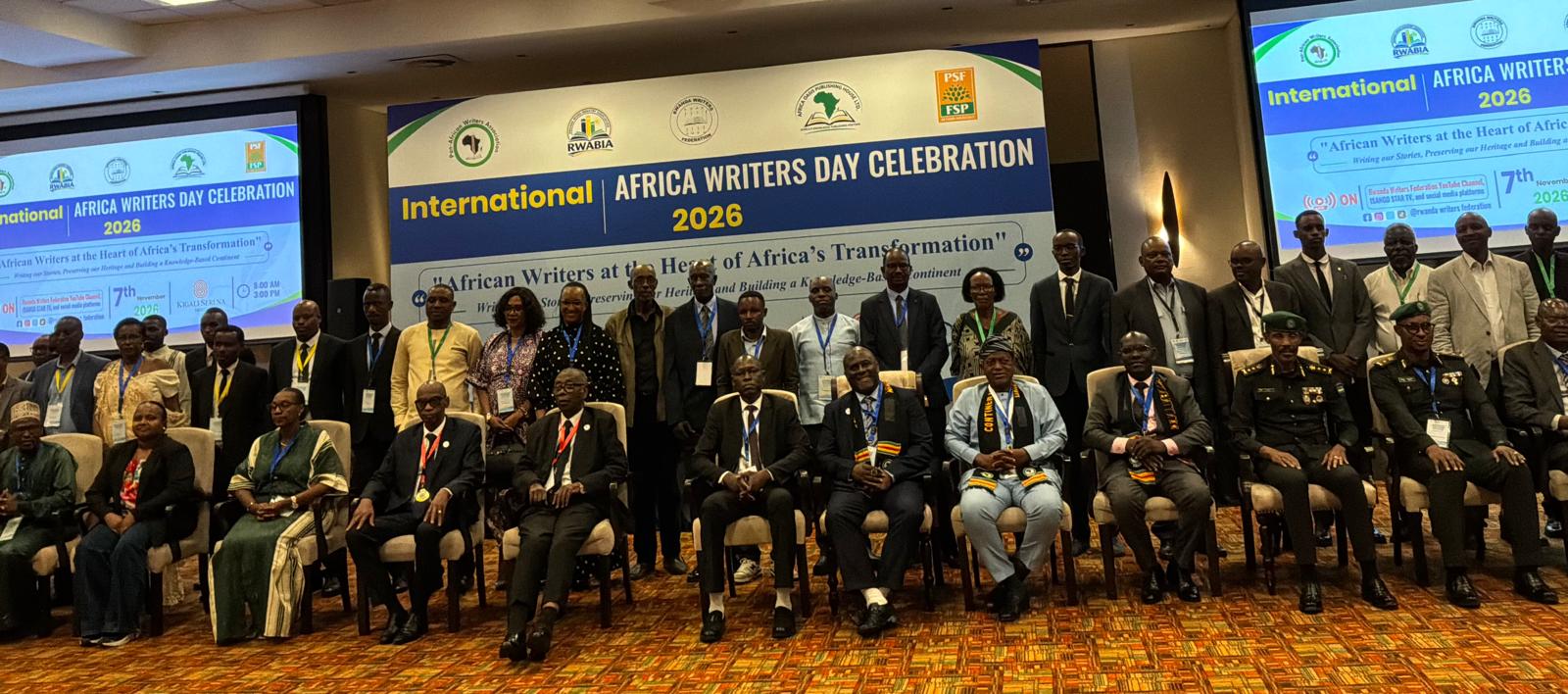
I was reminded of this important event when I met two distinguished literary figures: the great Nigerian writer in Rabat in October 2026, and the eminent Palestinian writer Dr. Hanan Awwad in Amman in November 2026. The link between these encounters was not merely the memory of that historic visit. Both figures were also honored with the Gold Medal of the World Organization of Writers (WOW), in recognition of their contributions to world literature. The announcement of these honors had been made in Moscow in September 2026, during the Literary Council proceedings held on the sidelines of the Second Congress organized by the World Peoples Assembly in the Russian capital.
Poet Margarita Al presented the Gold Medal to Wole Soyinka during the opening of the Dar Awalim Al-Kuttab at the Royal Academy of Morocco in Rabat. Margarita Al also presented the Gold Medal to Hanan Awwad during the Arab World Summit organized by the World Peoples Assembly and the Arab Peace Group in Amman.
III. How Did the International Press View the Visit?
The literary visit to Palestine did not pass without attracting media attention. European and Arab newspapers followed the delegation’s movements and reported its members’ accounts of checkpoints, destruction, and everyday life under military restrictions.
Le Monde: Writers in the Crucible of the Middle East
The French newspaper Le Monde published a report entitled “Des écrivains dans le brasier du Proche-Orient” (“Writers in the Crucible of the Middle East”), covering the delegation’s journey through the West Bank and the Gaza Strip.
The report described the destruction inflicted on homes and facilities in Al-Amari refugee camp near Ramallah. The writers visited a cultural center for young people that had been vandalized, and witnessed the damage to its buildings, furniture, musical instruments, and computers.
The report also described the difficulties the delegation encountered in reaching Birzeit University. Its members had to leave their vehicles and cross the checkpoint on foot before continuing their journey by other means of transport.
In the Gaza Strip, the delegation listened to testimonies from residents who had lost their homes, as well as explanations of the difficulties faced by ambulances trying to reach the wounded and sick.
The report quoted Italian writer Vincenzo Consolo as saying that what the delegation had witnessed was far more distressing than he had expected. It also recorded Juan Goytisolo’s observations: as he viewed the traces of bombardment and destruction in Gaza, he was reminded of what he had previously seen in Sarajevo.
These encounters confronted the writers with a question that went beyond immediate politics: How can literature help convey the voices of people whose suffering is not reaching the world sufficiently?
Christian Salmon, Secretary-General of the International Parliament of Writers, proposed practical solidarity with Palestinian writers through translating and publishing their work internationally. In his view, Palestinian words themselves were suffering under siege.
El País: Two Nobel Laureates at Arafat’s Headquarters
On March 25, 2002, the Spanish newspaper El País published a report entitled “Dos Nobel de Literatura en el refugio de Arafat” (“Two Nobel Laureates in Arafat’s Refuge”), covering the delegation’s arrival in Ramallah and its meeting with Palestinian President Yasser Arafat.
The report emphasized that the delegation had not come merely to seek political meetings. Its members also wanted to listen to Palestinian and Israeli intellectuals and explore possibilities for dialogue and peace.
Yet the checkpoints, inspections, and military presence that the writers encountered on their way to Ramallah made the journey itself part of the testimony they would carry back with them.
The Palestinian Centre for Human Rights: From Observation to Taking a Stand
On March 27, 2002, the Palestinian Centre for Human Rights issued a statement on the outcome of the delegation’s visit to Gaza.
The statement noted that the delegation members had expressed their shock at the humanitarian and human rights conditions they had witnessed and affirmed their solidarity with the Palestinian people.
It also recorded their meetings with representatives of Palestinian civil society, artists, and writers, including poet Ahmad Dahbour, poet Bassem Al-Nibras, and writer Abdullah Tayeh, alongside other human rights and cultural figures.
These names are important to the documentation of the visit because they show that the delegation did not limit itself to meeting the political leadership or viewing the destruction. It also engaged with Palestinian voices working in culture, the arts, human rights, and the media.
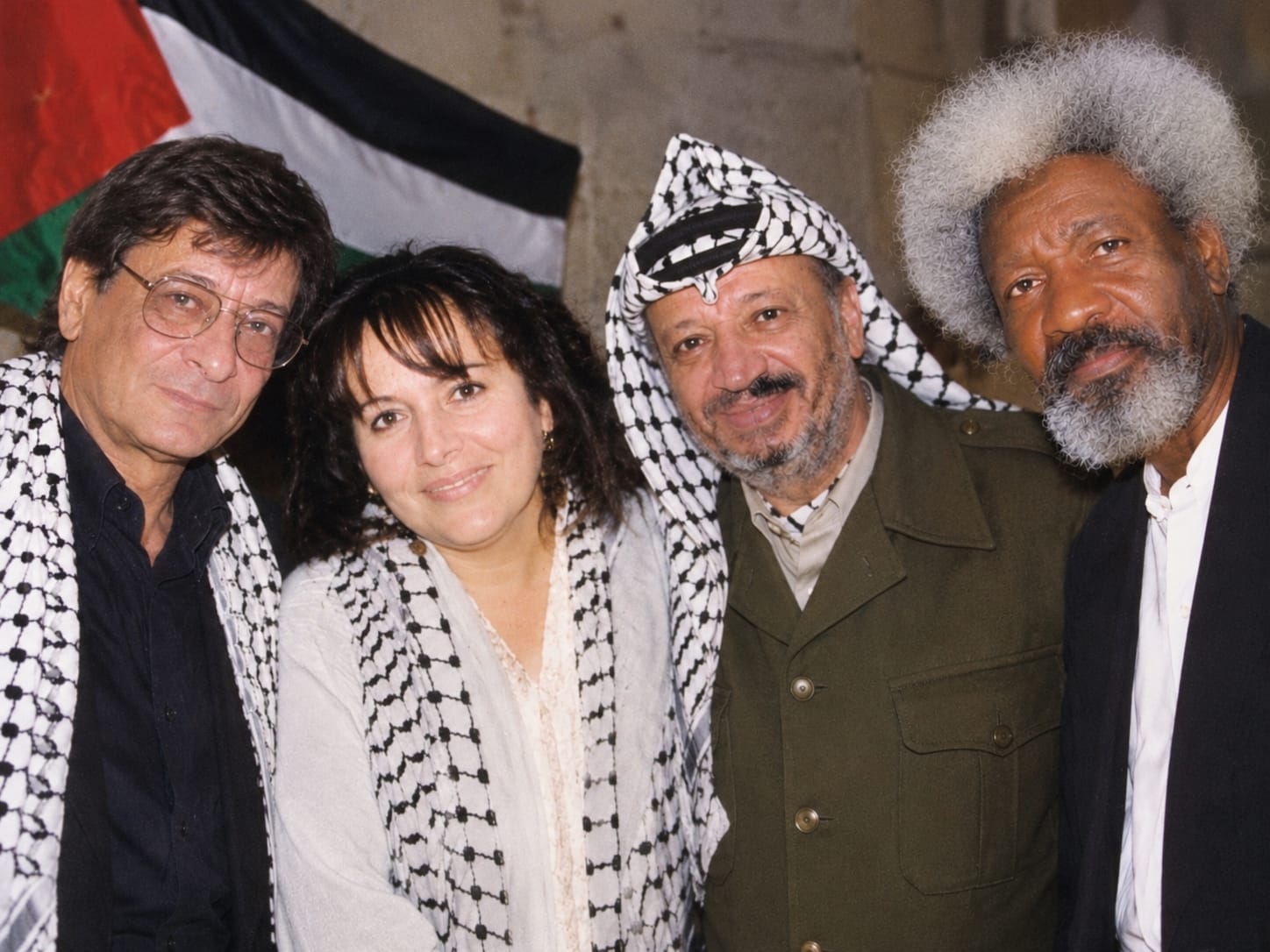
IV. A Historic Photograph Bringing Together Darwish, Hanan Awwad, Arafat, and Soyinka
While newspaper reports documented the visit in words, the photograph before us gives it a direct human face.
The photograph brings together four people from different worlds whose paths converged at a deeply significant moment in Palestinian history:
Yasser Arafat, the Palestinian president, whose headquarters in Ramallah became one of the symbols of the siege during that period.
Wole Soyinka, the Nigerian Nobel Prize-winning writer, who came to Palestine as part of an international literary delegation and later wrote about his experience in Ramallah.
Mahmoud Darwish, the poet whose work carried the Palestinian cause into the languages of the world, and who was among the leading figures behind the initiative to invite international writers to witness the Palestinian reality.
Dr. Hanan Awwad, the Palestinian poet and writer whose work was closely connected to Palestinian cultural and political affairs, and who served as cultural adviser to President Yasser Arafat.
The significance of this photograph does not lie merely in the gathering of four well-known figures. Rather, it captures a network of relationships connecting poetry, politics, and world culture.
Darwish represents the Palestinian voice seeking to be heard beyond its own borders. Hanan Awwad represents the presence of the Palestinian intellectual at the heart of cultural and political life. Arafat represents the Palestinian leadership at a moment of siege. Soyinka, meanwhile, represents the international writer who moved from following the Palestinian cause through news reports to witnessing it personally.
It is a photograph in which four paths converge: poetry, cultural testimony, political history, and world literature.
V. Hanan Awwad and the Place of the Palestinian Intellectual in International Memory
Dr. Hanan Awwad’s presence in the photograph deserves particular attention, not simply because she appears alongside well-known figures, but because she is a writer and poet who worked in the Palestinian cultural sphere and was connected to the Office of the Presidency at a time when culture was part of the struggle over memory and representation.
Her presence in this photograph opens an important avenue for examining the role of Palestinian intellectuals who combined writing with public service and helped build bridges between the Palestinian cause and international cultural circles.
VI. From Ramallah to the World
The March 2002 visit was not an isolated event. It took place just days before the large-scale Israeli military operation in the West Bank, which began on March 29 and included Ramallah and other Palestinian cities.
Before that operation began, the delegation members had already witnessed some of the consequences of military incursions, destruction, and siege. After returning home, their writings and interviews helped convey their observations to readers in Europe, the Americas, and other parts of the world.
In Soyinka’s article, the small details remained particularly powerful: the young man who offered a free drink, the flock of sheep crossing the valley, and the road cut off at the checkpoint. These images conveyed everyday life more effectively than many political slogans.
The power of these details lies in the fact that they do not reduce Palestinians to an image of victimhood. Instead, they reveal human beings who continue to live, preserve their dignity, and welcome a stranger with generosity even in the darkest circumstances.
Reading Soyinka’s testimony today, therefore, is not merely an opportunity to recall an international writer’s position on the conflict. It also allows us to reflect on how observation becomes literature, how literature becomes memory, and how memory becomes a document that outlives the moment in which it was written.
Thus, Wole Soyinka’s visit to Palestine in March 2002 remains one of those moments when world literature stepped out of books and into the streets, moving from conference halls to checkpoints, refugee camps, and destroyed homes.
Soyinka came as part of a delegation that wanted to see and listen. He then wrote his own testimony about Ramallah, while the international press recorded the details of the journey and the positions expressed by its participants. In the background of this testimony, Mahmoud Darwish stands out as the person who initiated the invitation to witness and bear witness. The photograph bringing him together with Hanan Awwad, Yasser Arafat, and Soyinka gives that moment a human face.
For when a poet visits a besieged land and then writes about it, what he has seen no longer belongs to his memory alone; it becomes part of the memory of the world.
Essential Sources for Further Reading and Documentation
1. Wole Soyinka, “Beware the Cyclops,” The Guardian, April 5, 2002.
Read Soyinka’s original article
2. Catherine Bedarida, “Des écrivains dans le brasier du Proche-Orient,” Le Monde, March 2002.
Read Le Monde’s report on the delegation’s visit
3. El País, “Dos Nobel de Literatura en el refugio de Arafat,” March 25, 2002.
Read El País’s report on the meeting with Arafat
4. Palestinian Centre for Human Rights, statement on the writers’ delegation visit to Gaza, March 27, 2002.
Read the Palestinian Centre for Human Rights statement
5. Agence France-Presse via Getty Images, archival photograph of the delegation at Arafat’s office in Ramallah, March 25, 2002.