 thesilkroadtoday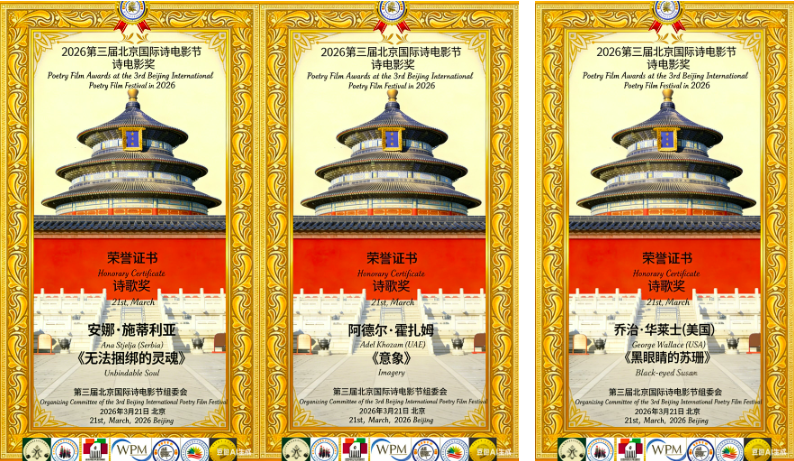
On the occasion of World Poetry Day, established by UNESCO, the 3rd Beijing International Poetry Film Awards have been officially announced and presented. The 3rd Beijing International Poetry Film Awards attracted the participation of poets and literary professionals from 28 countries including Colombia, Russia, Australia, China, Tajikistan, the United States, Algeria, Greece, Italy, Serbia, Egypt, Ecuador, Lesotho, the United Arab Emirates, Kazakhstan, the Republic of Korea, Saudi Arabia, Switzerland, Belgium, Chile, France, Kyrgyzstan, Nepal, Lebanon, Pakistan, India, Armenia and Finland.
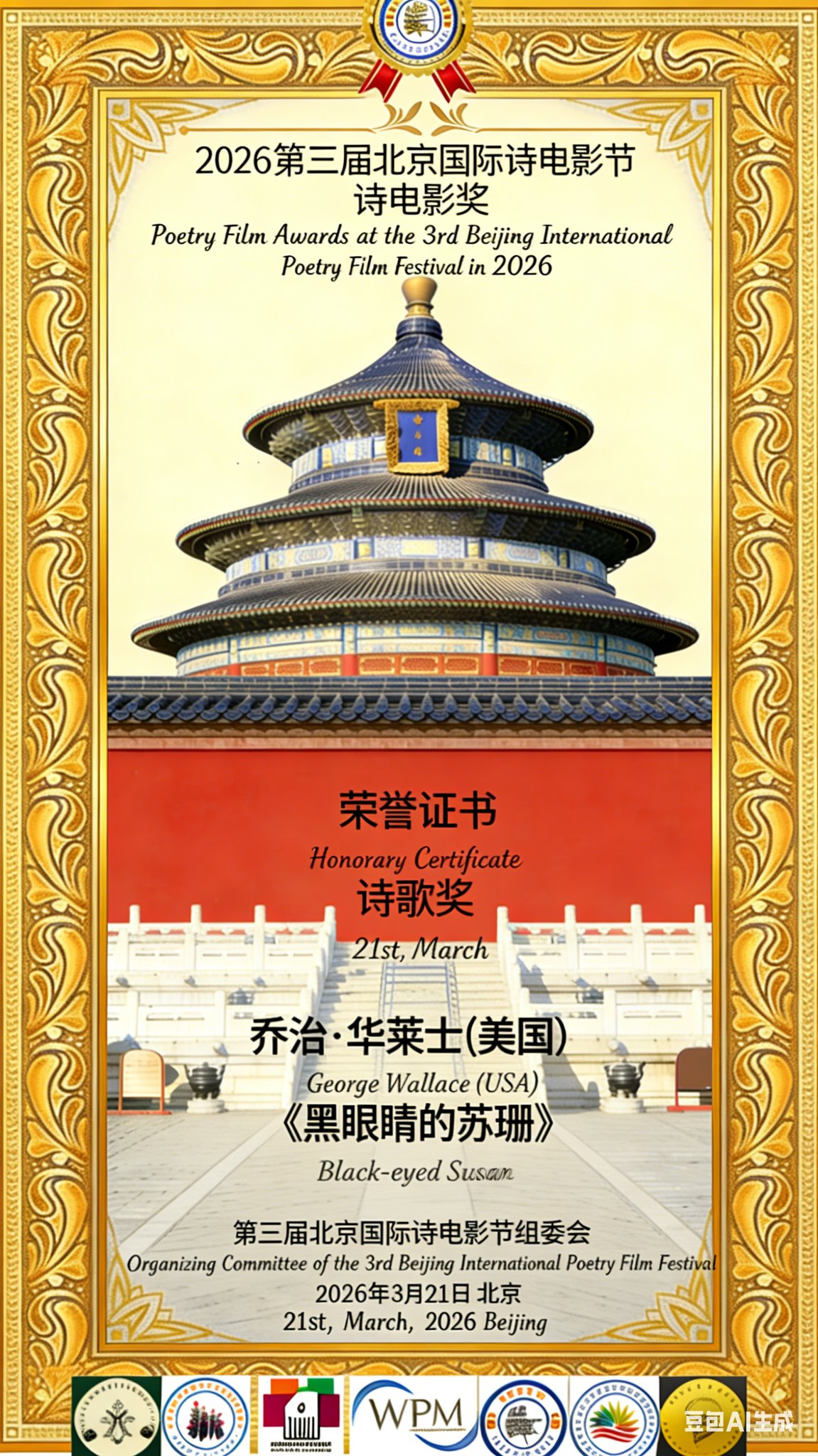
Creators and guests from all countries took poetry film as a link to build a cross-cultural bridge for poetry exchange.Launched in six seasons, this year’s awards have selected 33 outstanding poetry film works, gathering the creative wisdom of poets from around the world, and inviting numerous renowned literary figures from home and abroad as special guests. With poetry film as the carrier, the event practices the integrated innovation of poetry and film art, echoing the core purpose of World Poetry Day: to promote cross-art dialogue of poetry and advance the global spread of poetry. The poster design is set against the backdrop of the Forbidden City in Beijing, and the certificate design is based on the Hall of Prayer for Good Harvests at the Temple of Heaven in Beijing. It represents the grandeur of Chinese aesthetics internationally and has received widespread praise from poets both domestically and internationally.
The poetry film movement advocated by Cao Shui has become the core spiritual core of this event, opening up a brand-new path for the development of contemporary poetry.
A total of30 countries and regions of poets and literary professionals participated in this event, making it an important practice of cross-cultural exchange in the field of world poetry. The awards were unveiled in six consecutive seasons.
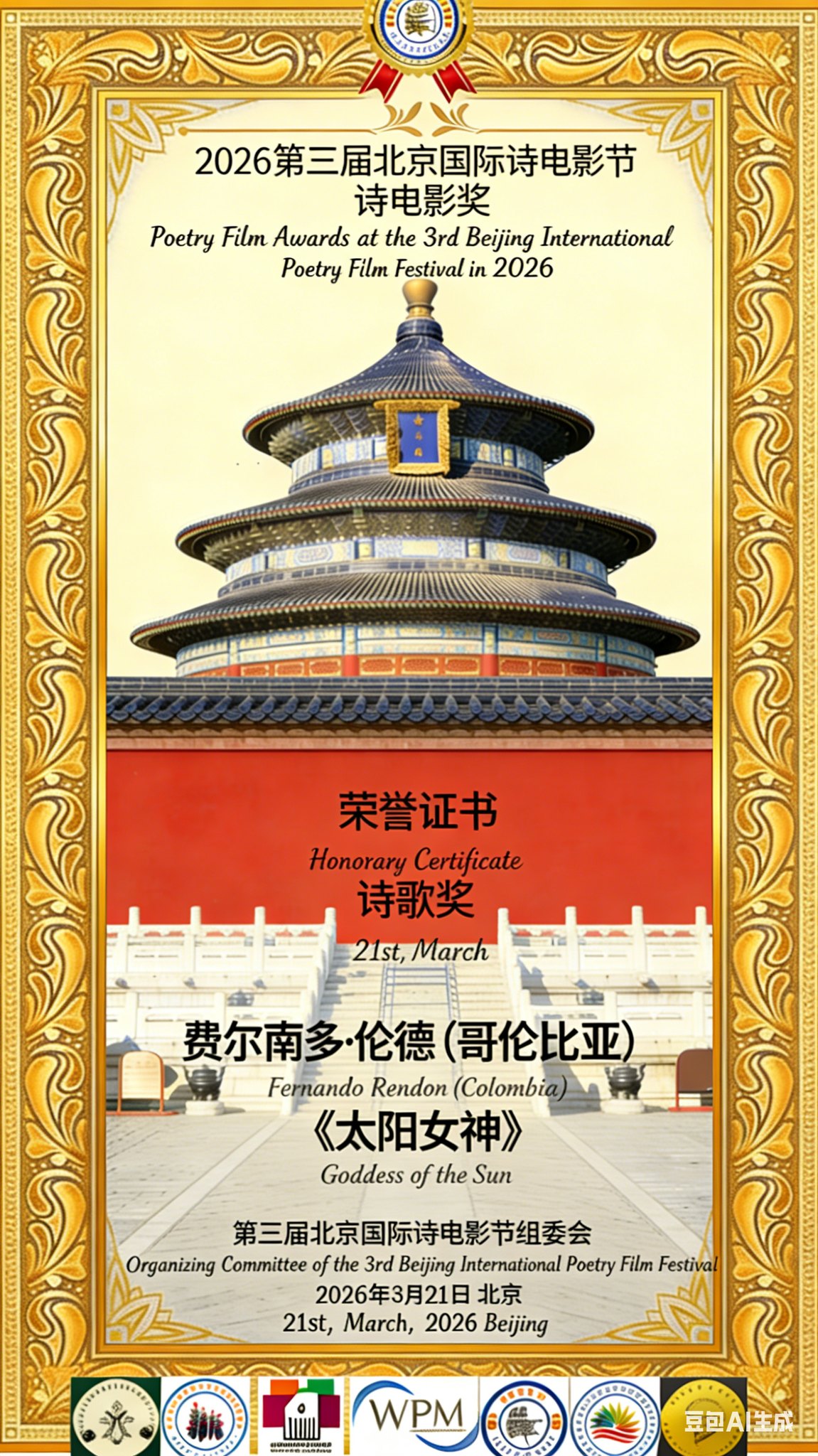 The winning works of Season 1 include “Goddess of the Sun” by Fernando Rendon (Colombia), translated by Cao Shui and dubbed by Jiaming; “Astronaut” by Vadim Terekhin (Russia), translated by Cao Shui and dubbed by Qiang Chaohui; “In the World, in Such a Good World” by Ying Xia (Australia), dubbed by Jiang Yunlin; “Testimony” by Tan Wuchang (China), dubbed by Li Jun; “God’s Window” by Wang Tong (China), dubbed by Aijia; “Ginkgo Leaf” by Li Ziguo (China), dubbed by Qingshan; “At Guandi Tower Wharf” by Cao Wenjun (China), dubbed by Zhang Jun; and “Romance of Love Waltz” by Abdukakhor Sattorovich Kosimov (Tajikistan), dubbed by Tianmahua.
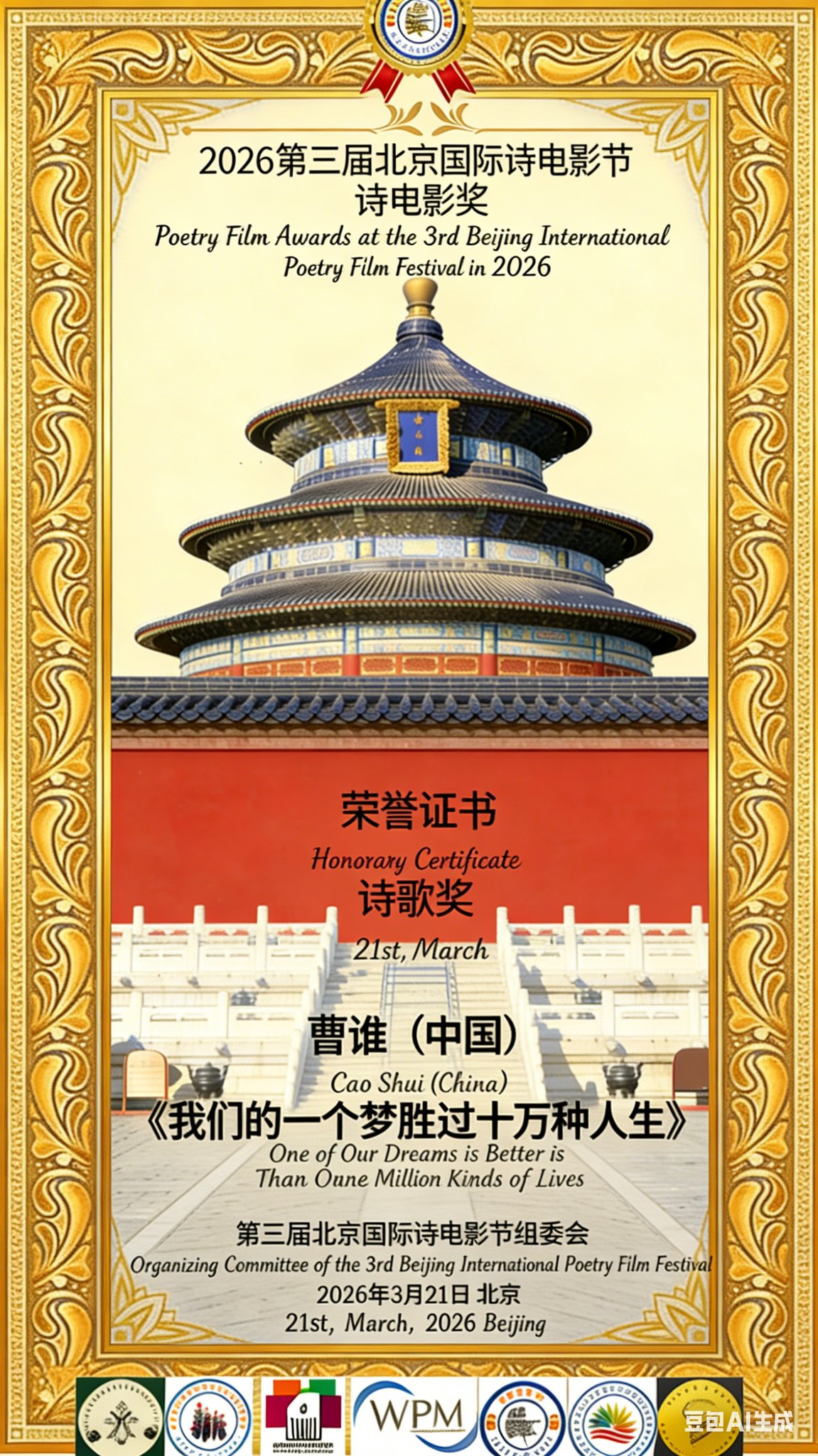 The winning works of Season 2 cover “One of Our Dreams is Better Than 100,000 Kinds of Lives” by Cao Shui (China), dubbed by Song Changjun; “Black-eyed Susan” by George Wallace (USA), translated by Cao Shui and Chen Bing; “A Great Love Poem” by Mohammed Rahal (Algeria), translated by Cao Shui and dubbed by Laoyin; “Charm of Chunling River” by Lei Xiaoming (China), dubbed by Song Weidong; “At Every Station, There is You Who Gets Off” by Yan Xi (China), dubbed by Wang Qingyun; “Gulangyu Island” by Yue Jian (China), dubbed by Lan Xin; “Janus With Two Heads” by Dimitris P. Kraniotis (Greece); and “The Prince is at Home” by Alessio Arena (Italy).
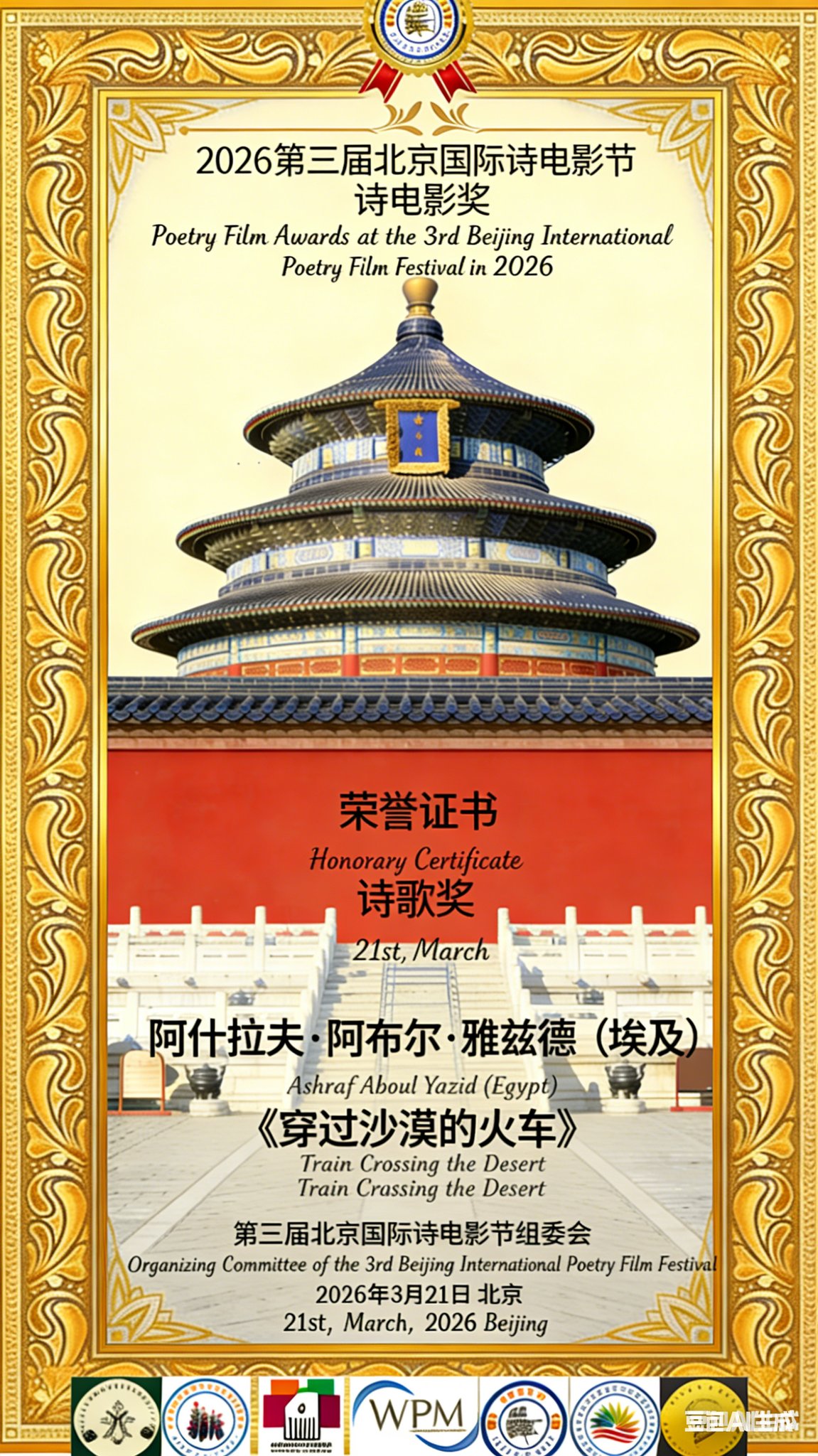 The winning works of Season 3 include “Skeleton Stylist” by Fan Qun (China), dubbed by Yuan Fan; “Unbindable Soul” by Ana Stjelja (Serbia), translated by Cao Shui and dubbed by Li Wei; “Train Crossing the Desert” by Ashraf Aboul Yazid (Egypt), translated by Cao Shui and dubbed by Chen Jun; “Song of Hope” by Edwin Antonio Gaona Salinas (Ecuador), translated by Cao Shui and dubbed by Zhen Li; “I Am African” by Siphiwe Nzima Ntšekhe (Lesotho), translated by Cao Shui and dubbed by Wang Qingyun; “The Silk Road” by Liang Zhihong (China), dubbed by Cui Zhiling; “Fading Childhood” by Wang Zhengyang (China), dubbed by Hong Bin; “Fox” by Lv Dao (China), dubbed by Chen Bing; and “Imagery” by Adel Khozam (UAE), translated by Cao Shui and dubbed by Aijia.
 The winning works of Season 4 include “Cotton Fluff in February” by Dong Lai (China), dubbed by Li Hua; “Wolf Nature” by Ulugbek Yesdolet (Kazakhstan), translated by Cao Shui; “Sydney Harbour on Notes” by Liao Shijing (Australia), dubbed by Chujian Hanmei; “Tonight, in Delingha” by Wang Fangwen (China), dubbed by Chen Bing; “Ordinary Meaning” by Lu Jian (China), dubbed by Wang Xiaoping; “Ancestors” by Lamberto Garcia (Italy), translated by Cao Shui and dubbed by Zhang Jianjun; “Remember Homesickness” by Han Geyou (USA), dubbed by Luo Songhuai and Song Lin; “A Tear of Acacia Fills the Room with Grass Fragrance” by Dong Faliang (China), dubbed by Qingshan; “Flying Sea” by Tian Jiguang (China), dubbed by Sun Kai; and “Companionship” by Han Dani (China), dubbed by Chen Bing. To highlight the internationality and professionalism of the event, the 5th and 6th seasons of the awards announced the lineups of international and Chinese special guests respectively. The international special guests include Oscar Saavedra Villarroel, Americas Coordinator of the World Poetry Movement; Kang Byeong-Cheol, renowned Korean poet; Raed Al-jishi, renowned Saudi Arabian poet; Laura Di Corcia, renowned Swiss poet; Sylvie Marie, renowned Belgian poet; Vo Thi Nhu Mai, renowned Australian poet; Roberto Aedo, renowned Chilean poet; Nikolay Vasiliev, renowned Russian poet; Lily Baylon Escritora, President of the International Association of Writers and Artists; Dra Hc Maria Elena Ramirez, Editor-in-Chief ofGlobal Humanitiesmagazine; Miguel Leonardo Gamarra Quiroz, President of the World Federation of Art, Literature, Education and Peace Culture of the United Nations; Alexandra Crette, renowned French poet; Xanthi Hondrou-Hill, renowned Greek poet; Dr. Salwa Ali Ahmed Abo Ali, renowned Egyptian poet; Altynai Temirova, renowned Kyrgyzstani poet; Til Kumari Sharma, renowned Nepalese poet; Franca Colozo, renowned Italian writer; George Onsy, renowned Egyptian poet; Turkia Loucif, renowned Algerian journalist; Bilal Al Masri, renowned Lebanese poet; Alessio Arena, renowned Italian poet; Marin Angel, renowned Finnish poet; Ahmed Al-Sheikh, renowned Egyptian poet; Fadwa Attia, renowned Egyptian poet; Shahid Abbas, renowned Pakistani poet; Ezhil Vendhan, renowned Indian poet; Achyot Kumar Borah, renowned Indian poet; Narek Paponts Arakelyan, renowned Armenian poet; and Diana Wu, President of the North American International Film Festival. The lineup of Chinese special guests is equally impressive, covering well-known poets, literary critics, cutting-edge creators and more, including renowned Chinese poets Yu Xiuhua, Cao Tian, Tan Yantong, Wu Shunzhen, Huang Yongjian, Lu Qing, Meng Yang, Zhai Yongli, Guan Dangsheng, Lu Zhong, Tie Wu, Xia Mingzhi, Xian Ya, Da Yueliang; emerging Chinese poets Ying Zi, Bei Shan, Mu Ziwen, Zhao Kangli, Han Lanna, Xing Shun; Yang Qingyun, renowned Chinese literary critic; and Wang Shenghua, emerging Chinese director. They are mostly poets who participated in the “Cao Shui-Tang Xiaoling Debate” and are the most active Chinese poets of contemporary times. The core soul of this event is the poetry film movement initiated by Cao Shui. His Manifesto of Poetry Film Movement gives modern significance to contemporary poetry and cross-cultural communication, becoming a spiritual bond for global poets. First, the movement integrates poetry with film and audio to revitalize traditional written poetry, making it visual and accessible. It revives the oral tradition of poetry and brings literary works to the public, solving the problem of difficult promotion and communication for contemporary poetry. Second, guided by the world poetics concept of integrating East and West, past and present, Cao Shui builds an exchange bridge between Chinese and foreign poetry. As a creator, translator and promoter, he translates multilingual poems and introduces global poetic works to China while spreading Chinese poetry abroad. Third, the movement reconstructs the creative ecology of poetry, combining lyrical expression with visual narration and providing new ideas for global poets. The 3rd Beijing International Poetry Film Awards practices this concept, gathering poets worldwide to promote the integration and symbiosis of the global poetry movement. Finally, the movement uses poetry film to convey universal human emotions such as love, hope and peace, echoing the mission of World Poetry Day and making poetry a shared language of mankind. The Poetry Film Movement originated from the *Manifesto of the Poetry Film Movement* written by Cao Shui on December 24, 2017. On May 19, 2023, Cao Shui, together with Zhang Jianjun and Fan Qun, jointly signed the revised version of the *Manifesto of the Poetry Film Movement* at Zhengyang Gate in Beijing, near the birthplace of Chinese cinema, officially launching the Poetry Film Movement in China. They successfully held the first Beijing International Poetry Film Spring Festival Gala during the 2024 Spring Festival. Poetry film originated from French avant-garde cinema. According to Irish poet Gabriel Rosenstock, who introduced relevant information to Cao Shui, *Moving Poems Magazine* has listed six internationally influential poetry film festivals: Cadence Poetry Film Festival in Seattle, USA; REELpoetry Festival in Houston, USA; Weimar Poetry Film Award in Weimar, Germany; International Video Poetry Festival in Athens, Greece; Les Instants Video in Marseille, France; and Midwest Video Poetry Fest in Madison, Wisconsin, USA. In China, there is also the “Huiyu Film Island Poetry Film Spring Festival Gala” founded in 2024. Together with the “Beijing International Poetry Film Spring Festival Gala”, there are a total of 8 poetry film festivals. As a pioneering international art movement, poetry film is growing vigorously around the world. After the successful holding of the Beijing International Poetry Film Spring Festival Gala, numerous media outlets at home and abroad covered the event, praising poetry film as “a creative art”, “the greatest contribution of Chinese literature to world literature”, and “a perfect integration of poetry and film”. As stated in the *Manifesto of the Poetry Film Movement*: “Every era has its own ‘dominant discipline’. In agrarian society, it was lyric literature characterized by poetry; in industrial society, it was narrative literature characterized by novels; in the information society, it is dramatic literature characterized by film literature. From now on, we will vigorously promote the Poetry Film Movement, commit to cinematizing poetry, let the ancient lyric literature from the agrarian era embrace the modern narrative literature from the information age, enable films to gain deeper poetic essence, and allow poetry to find better expression.” At present, the Chinese Poetry Film Movement is jointly promoted by the Great Poetry Movement, the World Poetry Movement, the Dramatized Novel Movement, the BRICS Writers Association. It has produced poetry films for more than 200 poets from over 50 countries, and plans to hold the Beijing International Poetry Film Festival annually to further advance the development of poetry film. It is reported that recently, Tian Yu (James) impersonated Cao Shui on Facebook and WeChat, provoking debates in the poetry circle both domestically and internationally. Tang Xiaolin criticized Cao Shui based on the false information from Tian Yu, and Cao Shui organized the “19th Army of Poetry War” to launch a justified counterattack both at home and abroad. This debate is thus known as the “Cao-Tang Debate” in China. Up to now, Cao Shui has secured a complete victory in both domestic and international literary circles. Domestically, Tang Xiaolin no longer dares to attack Cao Shui and is facing legal action, and the vast majority of poets in the Chinese poetry circle have recognized the harm of Tang Xiaolin’s reckless slandering. In the international poetry circle, after revelations from poets of multiple countries, the fact that James Tian and Eva Lianou Petropoulou defrauded domestic poets of money has been made known to international poets, and Tian Yu has been removed from his posts in multiple international organizations. The recent change of his position in the International Writers Association also marks Cao Shui’s victory in the Cao-Tang Debate. This is also the first debate in the history of poetry that has unfolded simultaneously in domestic and international literary circles. In the final stage of the Cao-Tang Debate, Yang Lian, a representative Misty Poet, viciously attacked Cao Shui on WeChat Moments. In response, Cao Shui published *Open Letter from Cao Shui to Yang Lian: The True Face of the “Old Poetry Tycoon” from the “Misty Poetry” Era*. In the article, he demanded Yang Lian to clarify the facts and make an apology: “I hope you can make a public clarification or apology. If you refuse to do so, I will clarify the facts for you by writing *How Anti-China Figure Yang Lian Was Forged*, and share my personal experiences with the public. I will talk about how you stole the spotlight at the launch event of my poetry collection *Listening to the World’s Heartbeat in Istanbul*, disregarding the feelings of the author and the organizers, and sought attention and fawned on the West by making anti-China remarks. I will talk about how you took the initiative to provoke a debate at the forum on Bozcaada Island, debated with me in English, and viciously attacked China’s mode of production using Western narratives. Let Chinese poets judge who is the villain that makes a ‘poetry business’ in the West by constantly making remarks that ‘attack China’.” Their debate has prompted the poetry circle to re-evaluate the significance of Misty Poetry and reflect on it based on the foundation of Chinese new poetry. Numerous critics are preparing to publish articles in response in the near future, pushing the “Cao-Tang Debate” into the “deep water zone” of the debate. The presentation of the 3rd Beijing International Poetry Film Awards is not only a concentrated recognition of the world’s outstanding poetry film creation, but also a global implementation of Cao Shui’s Poetry Film Movement concept. Poets and literary professionals from 30 countries and regions gathered together for poetry film, which not only witnessed the innovative achievements of the integration of poetry and film art, but also demonstrated the infinite possibility of cross-cultural communication of contemporary poetry. Under the guidance of Cao Shui’sManifesto of the Poetry Film Movement, poetry film is becoming a new trend in the development of world poetry, making poetry glow with new vitality in the era of media integration, and making the beauty of poetry from different civilizations bloom more dazzlingly in exchange and integration.