 thesilkroadtoday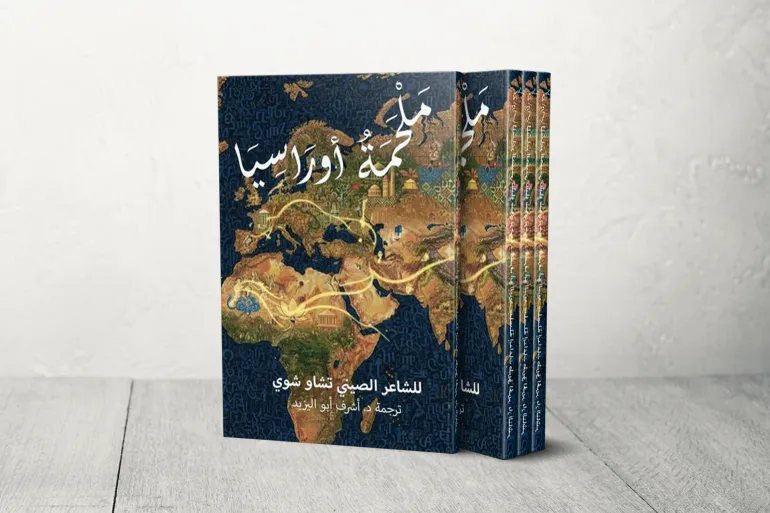
Conducted by: Mutasim Al-Shaer, Al Jareera Network
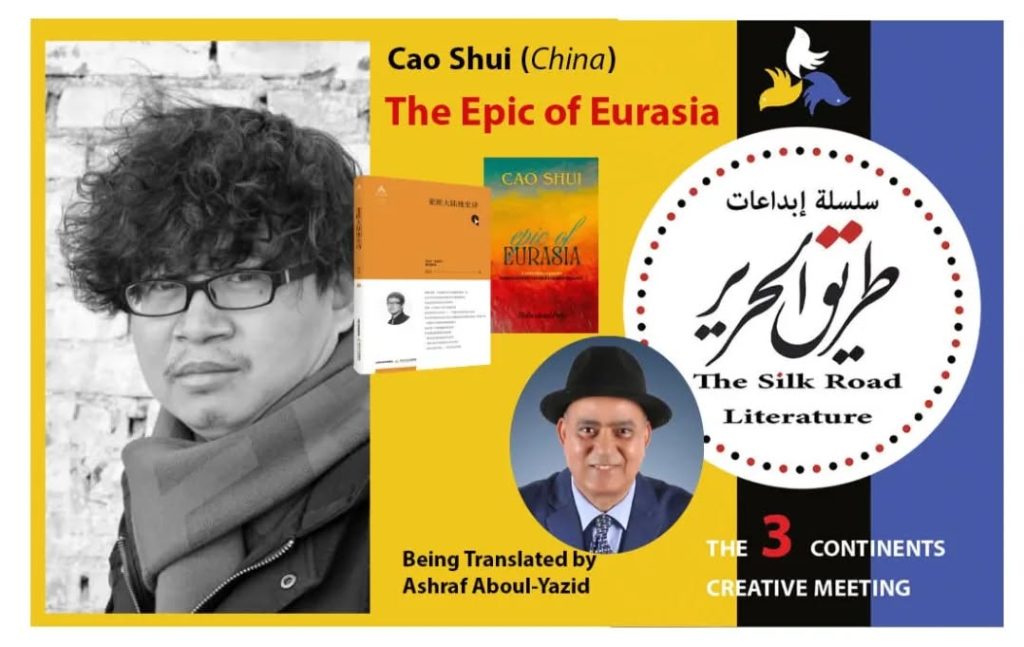
- 1.At the beginning of this conversation, let us celebrate the Arabic translation of Epic of Eurasia, accomplished by Ashraf Aboul-Yazid within the framework of the New Silk Road project. What does it mean to you to reach the Arab reader? And how do you view the cultural dialogue inspired by the New Silk Road initiative?
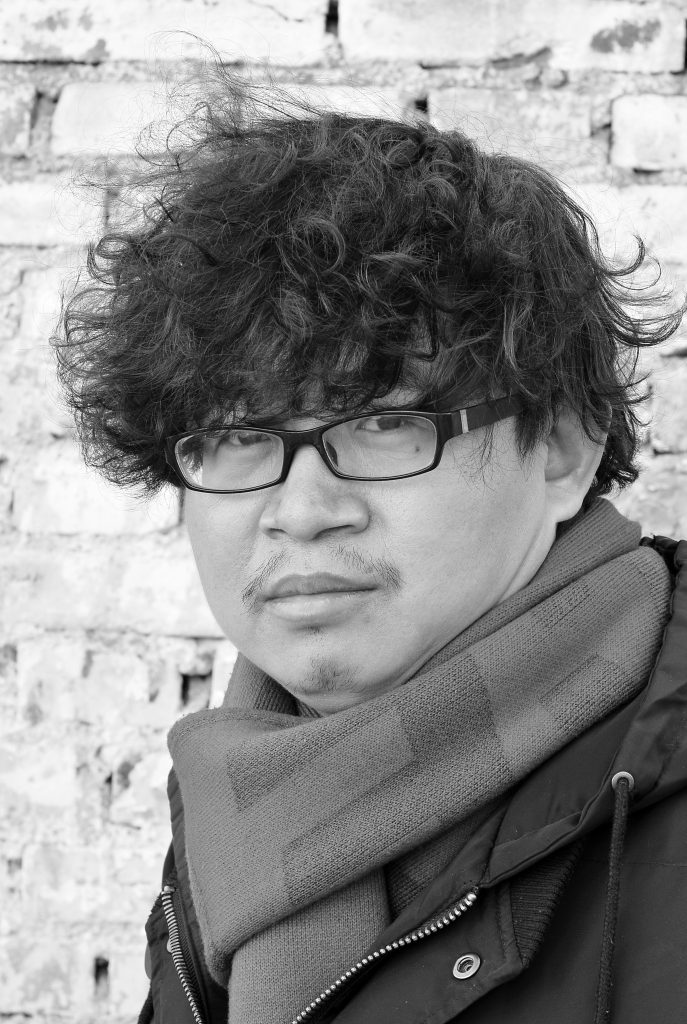
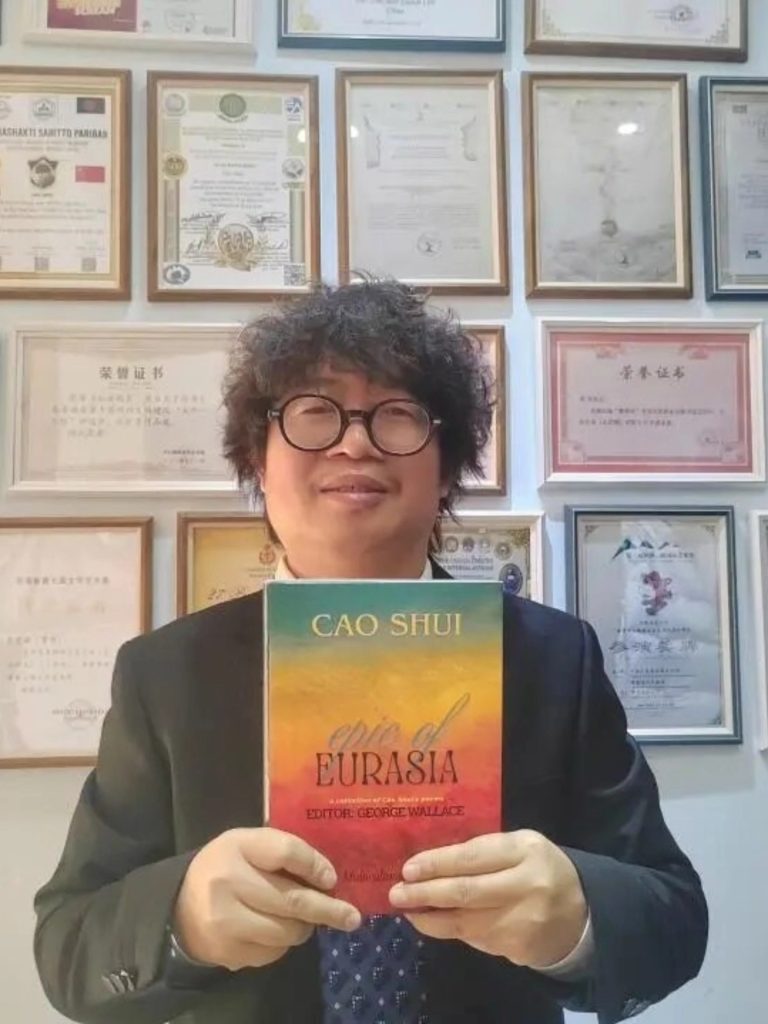
- Cao Shui:The publication of ‘The Epic of Eurasia’ is of great significance to me, as it is my first complete book to enter the Arab world, so our interview was very good starting from this book. This book is also the one that I have translated the most, with translations available in English, Italian, Russian, Swedish, Finnish, French, Spanish, and Arabic version is the most complete. The book also includes a list of all my works and awards, and I would like to thank the outstanding poet, translator, and friend Ashraf Aboul Yazid for his excellent translations, and thanks to Al Nashir Publishing House in Egypt for their foresight.
This book is written for all humanity, including Arab readers. Traditionally, our epics have been national epics, including the famous Gilgamesh, Greek epics, and Indian epics. In today’s globalized world, I want to create an epic for all mankind. The cradle of human civilization, the Eurasian continent, was the common ideal country of humanity. Starting from Mesopotamia, heading west to Canaan, Egypt, Greece, and east to Persia, India, and China, these seven civilizations were the core of the classical era. The Arab civilization certainly inherited and developed the Mesopotamian civilization and surrounding civilizations. In my book, Mesopotamia and the Arab world are the centers of the world. Ashraf included this book in the “New Silk Road” series, which is the most concrete manifestation of the New Silk Road Initiative. From Beijing, China to Cairo, Egypt, they were the two centers of the Silk Road in ancient times. Now, through literature, we have revived the Silk Road as the strongest link.
- 2.In an age of short texts and fractured attention—an age perhaps more desolate than the Waste Land envisioned by Eliot, where humanity has become a dim being circling meaninglessly around nothing—what led you to choose the epic form as your mode of expression in this era of fragmentation and radical individualism?
- Cao Shui:You described our era very accurately, we are in a fragmented era. Traditionally, no matter which of the seven civilizations we are in, they have a central system. When I look at the classics of various countries, almost everyone considers themselves the center of the world, similar to the overall narrative of the epic era. Under the impact of modern technology, people have lost the overall grasp of civilization, which is the overall source of confusion for modern people. Of course, the two World Wars destroyed people’s confidence in a better world, and the art of modernism and postmodernism is a response to this reality. T. S. Eliot’s’ The Waste Land ‘has inspired me greatly. Essentially, it is a modern epic that I call the’ Third Epic ‘. The first epic is a national epic similar to’ Gilmecash ‘, and the second epic is a literary epic similar to Virgil’s’ Aeneid’. Today, we are facing an era of the Third Epic without mysterious stories or intricate rhythms. It is in this fragmented era that I first choose epic or epic novels to write. Up to now, the 50 books I have created are generally epic pursuits that can awaken humanity’s shared past and future.
- 3.You have made Eurasia the stage for the “Dance of Great Sorrow” and the launching ground for your poetic manifesto.
Do you believe that reviving the civilizational concept of Eurasia might help restore the broken Tower of Babel? And can poetry reunite what politics has torn apart?
Cao Shui:In my creation, the Eurasian continent is the cradle of human civilization in the past, because all seven important civilizations in the past roughly spanned across the Eurasian continent, starting from Mesopotamia, heading west to Canaan, Egypt, Greece, and east to Persia, India, and China. They were all regional centers of civilization. This is a retrospective of the entire human civilization, as seen in Spencer Wells’ “The Journey of Man: A Genetic Odyssey”. Humans emerged from Africa, first gathered in Mesopotamia, and then migrated to the West and East respectively. The record of the Tower of Babel in the Bible is also a portrayal of this earliest state of humanity. So these seven civilizations, the seven brothers, we know that the Native Americans were yellow skinned people who migrated from Asia to America from the Pacific 15 thousand years ago, and since the Age of Discovery, white Europeans arrived in America from the Atlantic, where they eventually embraced each other. The Western civilization that developed from the Greek civilization is dominant today, while other civilizations are in a weak position. Of course, the global influence of the Chinese civilization is expanding along with China’s national strength; The concept of the Eurasian continent is to trace these ancient civilizations back to the roots of human civilization. At that time, these brotherly civilizations were all glorious. In the future, we need to extract elements from all these ancient civilizations and create a common civilization for humanity, not the East or the West, but the civilization of Asia and Europe, or the civilization of all mankind. This is a way to integrate all ancient civilizations into the world, which is a common problem faced by Arabia, Israel, Egypt, Iran, India, and China. This is also the original intention of my creation of the epic of the Eurasian continent. This is like a seed, my trilogy of “Kunlun Secret History”, essay collection “Kunlun Tour”, and film script “Peacock King” all aim to express the same theme: humanity is of the same origin, the world will be united as one!
- 4.What do Eurasia and Babel represent to you? What is the essential truth within them that you wish the world to see?
- Cao Shui:When I was very young, my younger brother Cao Chunbo brought me a painted Bible from a church, and I was attracted to the story of the Tower of Babel. This has also become a theme in my works. I have written the novel ‘The Spire of the Tower of Babel’, the poetry collection ‘Song of the Tower of Babel’, and the script ‘The Golden Empire’. Humans originally spoke the same language and built the Tower of Babel to the Heaven together, but God was afraid of affecting his authority and blocking people’s behavior, so he disrupted their language. People scattered to different places due to the inability to communicate, becoming the current two hundred countries and two thousand ethnic groups. The Tower of Babel is said to be the Hanging Gardens of Babylon. In my heart, the Tower of Babel is a concrete symbol of the Eurasian continent. 99.9% of human genes are the same, we are the same species, and we were completely brothers 100000 years ago. So is our current war meaningful? Through the Eurasian continent and the Tower of Babel, I hope that people will not forget their common ancestors. As long as we communicate through language, we can build a common Tower of Babel, which is the common ideal country of humanity.
- 5.A clear current in your creative work is a return to the past—to the civilizations of the ancient world, East and West alike.
What is it that we have lost in our age, that you seek among the treasures of antiquity? - Cao Shui:My Epic of Eurasia aims to integrate ancient and modern, Western and Eastern civilizations. The 50 books I have currently created are roughly divided into four series: Kunlun Secret History Series, Tower of Babel Series, Kekexili Animal Series, and Local History Series. The Epic of Eurasia is metaphorical and can be included in the Kunlun Secret History series, so I will introduce my more popular trilogy called” Kunlun Secret History “. Here, Eurasia and the Tower of Babel are transformed into the Kunlun Mountains, which are sacred mountains in central Asia, similar to the Olympus Mountains in Greece. I want to search for the common elements of Eastern and Western civilizations through the protagonist Long Hao, who is the secret master of the disappearing religion Manichaeism. In “Kunlun Secret History 1: Time and Earth Axis”, he is caught up in a mysterious Chinese gossip murder case. Through a series of stories, he eventually finds himself in the Kunlun Mountains and discovers the time and earth axis that controls time. In Kunlun Secret History 2: The Imperial Seal and Roman Crown, Long Hao continues to search for key information from the seven major civilizations of humanity. In Babylon, Persia, India, China, Canaan, Egypt, and Greece, each place has a story, and ultimately finds the Imperial Seal symbolizing the inheritance of Eastern power and the Roman Crown symbolizing the inheritance of Western power. In Kunlun Secret History 3: The Tower of Babel, Long Hao set out from the Arab world, heading east and west respectively, and finally found the Tower of Babel on the American continent. In the era of visualization, if these three books were made into movies, the dissemination effect would be even better. Our era has lost a holistic understanding of the world, forgotten the common memory of humanity, and forgotten the pursuit of common ideals. Therefore, I hope to awaken people through my poetry, novels, and dramas.
- 6.In your poem The Temptation of the Tower of Babel, in George Wallace’s English translation, we encounter a yearning toward light. Our world today seems immersed in darkness, despite its countless glittering surfaces. How can you wield the power of language to lead humanity to the summit of Babel, where darkness dissolves?
- Cao Shui:George Wallace is the translator of my English version of ‘The Epic of Eurasia’, and ‘The Temptation of the Tower of Babel’ is one of them. This book was recently published by Multicultural Press in Australia, and its editor Vo Thi Nhu Mai is currently promoting it. Our world is indeed shining brightly on the surface, but deep in darkness. The top of the Tower of Babel represents humanity’s pursuit of an ideal world of light, where we need to overcome the darkness around us. Just like the war between light and darkness in Manichaeism. I think there are five levels of darkness around us that need to be overcome. Human nature is to pursue what we want, but as soon as we enter this world, we will face various limitations, and darkness is a metaphor. The first darkness is personal morality, which we cannot break through. The third darkness is the limitation of national borders, and we still cannot travel completely freely. The fourth darkness is the barrier of language. We have thousands of languages, which is the source of human disputes now, and also the reason why humans cannot communicate, as the story of Tower of Babel said. The fifth darkness is the true darkness, which is tyranny. The first four shades of darkness are the darkness we have to accept at present. The fifth darkness is the abuse of the first four shades of darkness, hypocritical morality, government tyranny, national borders obstruction, malicious misreading. These are what we need to openly fight against. What I envision as human misunderstanding begins with language. Although all ethnic groups consider their own languages to be excellent, the laws of history tell us that they will eventually merge into a larger language, and eventually humans will speak the same language. What I need to do now is to extract elements from various ancient civilizations, and ultimately hope that humanity will move towards the same world, which may take five hundred or a thousand years.
- 7.You are preparing to publish The Dance of Great Sorrow at the Tower of Babel, which will present the poem in 108 languages. The poem feels like a requiem played for the world from a stage in the heart of Eurasia. Is it an elegy for the global conscience?
- Cao Shui:I once published a book called ‘The Lyric of the Tower of Babel’ in 2018, which was published in 13 languages, symbolizing the transformation of the sound of the Tower of Heaven into a sound. Now I plan to present this’ The Dance of Great Sorrow at the Tower of Babel ‘in 108 main languages. The Great Compassion Dance is my most translated poem, breaking through geographical limitations for the first time and bringing Eastern and Western people together to play a requiem for the world. It is also a symbol of our individual lonely existence in the world. This kind of elegy is not only a personal sadness, but also a lament for our current chaotic world. If we examine the history of various countries in the past, Greece’s thousands of city states were unified into one empire by the Macedonian Empire; China once had eight hundred feudal states, which were eventually unified into the Chinese Empire by Emperor Qin Shi Huang; There used to be many kingdoms in the Middle East, which were once unified by the Arab Empire. Today, although the Arab world is divided into 22 countries, it may be temporary. History has always been moving towards unity. Nevertheless, I firmly believe that humanity can ultimately speak the same language and build the original Tower of Babel.
- 8.You have engaged in translation yourself, including Footsteps of Istanbul and works by poets from America, Russia, and elsewhere.
What does translation mean to you? Is it an act of fidelity to your fellow writers, or an attempt to dissolve the world into your own language? - Cao Shui:I have always believed that we are currently in the stage of world literature. The general process of human literature has gone through, from the lyrical literature era dominated by poetry in the agricultural era, to the narrative literature era dominated by long novels in the industrial era, to the dramatic literature era dominated by film in the information age, and the future is the world literature era of great poetry. In this era, there are two most important behaviors: translation and great poetry. Translation is a means of physical meaning that enables civilizations to understand each other. The method of great poetry is to integrate elements of various civilizations to create a completely new world literature. For me, translation is not only a way to have in-depth communication with fellow writers, but also a way to integrate my creativity, which is not contradictory. All translations are a way for me to advance the world literature of Great Poetry. So I translated Nurduran Duman’s “The Footsteps of Istanbul,” Fernando Rendon’s “The Song of the Dream Land,” Vadim Terekhin’s “The Golden Bird in the Sun,” Lamberto Garzia’s “The Knight’s Song,” Ulugbek Yesdaulet’s “Pastoral in the Tent,” Sheikha Mohammed bin Rashid Al Maktoum’s “The Golden Shadow in the Desert,” Adel Khozam’s “The Epic of Humanity,” and so on. I remember Eliot expressed the idea that in contemporary times, one must be proficient in a foreign language. This is also my profound understanding that only by understanding more than one foreign language can one construct a complete view of the world, otherwise it is all localism. You will find that the major languages nowadays are themselves the fusion of regional civilizations. Arabic has integrated many civilizations from the past, such as Akkadian, Aramaic, Egyptian, and Hebrew. English is a fusion of French and German. Chinese also incorporates the languages of surrounding civilizations, such as Xianbei, Khitan, Mongolian, and Manchu, which were once popular ethnic languages in northern China. In the future, humans will definitely speak the same language.
- 9.Tell us about your encounter with Arab culture. How extensive is the translation of Arabic literature into Chinese? And which Arab writers are most widely known in China?
-
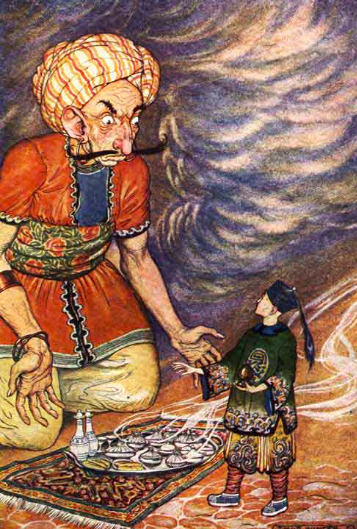
Aladdin’s Magic Lamp - Cao Shui:When I was a child, I studied “Aladdin’s Magic Lamp”, “Ali Baba and the Forty Thieves”, “Fisherman and the Devil” and other works from “One Thousand and One Dreams”. I also watched the movie “Aladdin’s Magic Lamp” on TV, and I have never forgotten it since. This is my impression of Arabia, which shaped my psychological structure in childhood. That is, I must look outward, there must be magical civilizations worth learning from, which is the original driving force behind my later proposal of Great Poetry Movement. I can only give my general impression of Arabic literature translated into Chinese. Besides the One Thousand and One Dreams, I have also read many quotations from the Quran. In my teenage years, I was familiar with three writers: Gibran Kahlil Gibran’s prose poetry was full of philosophy, Adonis’ poetry was full of mystery, and Naguib Mahfouz’s panoramic realism, all of which I had studied a lot earlier. In 2013, I joyfully met Adonis at the third Qinghai Lake International Poetry Festival and listened to him recite his own poetry. Guiseppe Conte, the great Italian poet and founder of Mythomodernism, grouped my and Adonis’ works together in his commentary, indicating that we share many common pursuits, which is an honorable thing for me. As I entered the literary world and read more Arabic works, some writers even became friends in real life. The first Arabic poet I directly interacted with was Adel Khozam from the United Arab Emirates, and we created “The Epic of Humanity” together. He wrote the beginning, I wrote the ending, and of course, there were also eighty poets from around the world who participated. In 2024, we held our debut ceremony together in Beijing, and in 2025, we hosted the 5th Silk Road International Poetry Festival together in Dubai. Recently, I have also been translating this great work. I am still translating “The Golden Shadow in the Desert” by Sheikh Mohammed bin Rashid Al Maktoum, a famous poet and ruler of Dubai, and I am also translating poetry by Ashraf Aboul Yazid, a famous Egyptian poet who is also the translator of my “Epic of Eurasia”. In addition, I have translated dozens of poets, including Algerian poet Achour Fenni, Muhammad Rahal, Saudi poet Raed Anis Al JISHI, Lebanese poet Bilal Al Masri, Palestinian poet Murad Sudani, and Iraqi poet Ali Al Shalah. Because Arabic is the native language of 22 countries, a great language that can be traced back to Akkadian, I am constantly exploring its cultural elements. I recently participated in the Golden Thinker’s Forum for Poetry and Literature in Egypt, where I won the Golden Thinker’s Ramadan Nights Riddles Award. I answer a riddle every day and also write a poem every day. This poetry award is the most unique, with a prize set up every day for 30 days and certificates awarded. I write a poem every day, approaching 30 poems, and finally compile it into a poetry collection called ‘The Arabian Starry Sky of Ramadan’. During this process, I completely followed the Arabs to spend this most noble month and learned a lot about Arabic knowledge, such as the 16 rhythms in classical Arabic poetry. Undoubtedly, if the temple of future world literature has eight sacred pillars of ancient civilizations, then Arab civilization must be at the center.
- 10.In the Arab world, there is a popular sense of comfort in engaging with China, as it does not—unlike America—seek to impose forced cultural change. Yet at the same time, Chinese culture does not appear in the global marketplace with the force one might expect from a great power. If we borrow Stephen Covey’s language, what is the “third alternative” between cultural dominance and national withdrawal?
- Cao Shui:I have been to the United Arab Emirates before and felt the friendliness of the Arabs, including the poet friends in the Arab world that I mentioned to me, which is probably related to the characteristics of Chinese culture. In fact, all eight ancient civilizations have their own personalities, but all civilizations are eager to be accepted by more people. Chinese civilization is an inward assimilation ideology, so it has expanded outward from the Central Plains region in the Yellow River Basin, gradually assimilating the surrounding “barbarians”. This is mainly through the attraction of peace, which makes these civilizations actively accept and become the current China. People from other civilizations call us China, but in fact, China calls itself the “central country”, so the Chinese call the process of superpower “peaceful rise”. Western civilization is a spiral of colonialism, starting from the earliest Greece, all the way to the Roman Empire, Frankish Empire, Spanish Empire, British Empire, and today’s United States, it has always been this way. By comparison, it can be found that China and the United States share the difference of cultural dissemination methods as the Arab world feel. While the United States is promoting cultural colonialism, China prefers to encourage other civilizations to actively accept Chinese culture. Here, I want to criticize the mediocrity of Chinese writers, which is a concrete manifestation of the “evil of mediocrity”. Confucius called such people “Mr. Good Good”. Currently, there is a widespread state of self isolation, and there is an idiom in China called “frog in the well”, including many famous writers in China who have not yet seen the arrival of the global era and are unable to express themselves, resulting in a “mismatch between Chinese culture and the status of a great power” in global culture. Therefore, I propose Great Poetry Movement to break this state. Later, I will talk about the biggest “Cao Shui-Yi Sha Dispute” in the Chinese literary world. Of course, every civilization hopes to expand its influence. Arab civilization or Islamic civilization may possess characteristics of both Chinese and Greek civilizations. Many people view China as an imminent “superpower” that will rival the United States, and the first confrontation between Eastern civilization and the powerful Western civilization. I believe this is the beginning of true integration of civilizations. Stephen Covey’s’ The Third Choice ‘is very good. The core of British and American culture is empiricism and pragmatism, and this world is not a zero-sum game. There must be a third approach. Borrowing the thinking methods of the four paradigms proposed in “The 3rd Alternative: Solving Life’s Most Difficult Problems,” namely “I See Myself,” “I See You,” “I Find You,” “I Seek You Out,” and “I Synergize With You,” the development of civilization follows the same pattern, with the first stage being “self-development,” such as Babylon, Persia, India, China, Canaan, Egypt, Greece, and Maya. The second stage is’ civilization contact ‘, where adjacent civilizations recognize each other and come into contact with each other. The third stage is “civilization collision”, where civilizations begin to merge with each other through contact. Through peace or force, we know that Greek civilization and Hebrew civilization merge into Western civilization; The Arab civilization integrated Babylonian civilization, Hebrew civilization, Egyptian civilization, and Persian civilization. Of course, Hebrew civilization and Persian civilization are still developing in new ways, while Chinese civilization merged with Indian Buddhist civilization to form Eastern civilization. This stage roughly merged into today’s appearance, which is the eight major civilizations proposed by Samuel Huntington: Chinese civilization, Japanese civilization, Indian civilization, Islamic civilization, Eastern Orthodox civilization, Latin American civilization, and African civilization. Of course, in my opinion, Japanese civilization belongs to Chinese civilization, Latin American civilization and African civilization belong to Western civilization, and Eastern Orthodox civilization should be called Eurasian civilization. Therefore, it is mainly composed of five major civilizations: Chinese civilization, Indian civilization, Islamic civilization, Western civilization, and Eurasian civilization. Recently, the conflicting Hebrew civilization and Persian civilization may be classified as Western civilization and Islamic civilization respectively. The future is the process of the fusion of these five civilizations, just like the fusion of a huge galaxy. It may be a peaceful attraction like the Chinese civilization, a strong colonization like the Greek civilization, or a third way of “synergized development”. This is also the theme of my creation, “Great Poetry”. Like the Tower of Babel, the pillars of the five civilizations work together to develop into a new “world civilization”.
- 11.In your poem The Shape of the Palestinian Son, the duality of human being and geography—so present in much of your poetry—becomes luminous. The Palestinian child acquires mythic features: his head the Sea of Galilee, his heart Jerusalem, his feet the Gulf of Aqaba. How do you view the sacrifices of the Palestinian people, who have become a poetic condition working upon the conscience of the world? And will this mythic struggle against brutality shape humanity’s future?
- Cao Shui:My book ‘The Shape of the Palestinian Son’ was inspired by the image of a 5-year-old child in a shroud. Despite being of the same age as my son, he created the image of the shroud, which is so similar to the map of Palestine. It is a tragic story. We are discussing the conflict and integration of civilizations. The most intense civilization conflict in the world is currently reflected in Palestine, which is also the focus of my poetry theme. This is because it is the “Central Plains” of human civilization, a concept in Chinese history. For four thousand years, many dynasties have been competing for the “Central Plains” in the Yellow River Basin. Whoever obtains the Central Plains will rule China, and now whoever controls the Middle East may control the world. Among the four major civilizations we mentioned earlier, this is the place where Islamic civilization and Western civilization fiercely compete. The conflict and integration of civilizations is a huge process. From the perspective of a “global citizen”, conscientious poets will sympathize with the victims. In fact, from a macro perspective, all empires and civilizations have gone through countless wars in their development, and at the individual level, countless tragedies have occurred. 15 million people died in World War I and 85 million in World War II, and behind them are 100 million tragic families. When I visited the United Arab Emirates, I visited the “House of Abraham” in Abu Dhabi. The three major religions that are now fiercely contested are actually brothers, and from a global perspective, humans also come from a common ancestor 100000 years ago. So we must see that all grand nationalism and narrow religiosity are manipulated by a few politicians. We originally came from the same place, but we will also move towards the same place. I hope that the sacrifice and suffering of the Palestinians can awaken human conscience, and let humanity choose peaceful methods to “develop together” in Stephen Covey’s way.
- 12.We live in one of the most dynamic ages in history—an age that should be reflected in our philosophical and aesthetic mirrors. Yet we see relatively few new critical schools or literary movements emerging from it. What compelled you to found the movement of Great Poeticism? And what are its central ideas?
- Cao Shui:Our world is indeed in the most dynamic ages, so dynamic that all civilizations collide directly together, in fact, finding a way to integrate the world. It is precisely based on the current predicament of their respective civilizations, including Chinese civilization, Indian civilization, Islamic civilization, Western civilization, Eurasian civilization, or even more ancient civilizations such as Babylon, Persia, India, China, Canaan, Egypt, Greece, and Maya, that we must extract common elements from culture to shape a common human civilization. Therefore, the “Great Poetry Movement” was proposed. The concept of epic poetry comes from India, and it was first proposed by Haizi in China. I have given it a new meaning. I wrote “The Manifesto of Great Poeticism” in 2007, “The Great Poetics” in 2010, and “The Great Aesthetic of Literature”, “The Manifesto of the Poetry and Film Movement”, and “The Manifesto of the Dramalized Novel Movement” in 2017. Their core concepts are “integrating Eastern and Western civilizations”, “integrating ancient and modern civilizations”, “integrating sacred and secular civilizations”, and of course, “integrating male and female cultures” and “integrating sound, form, and meaning in language”. Before 2017, my vision was still limited to the group of young Chinese poets. 2017 was an important turning point for me. I organized the “International Writer Writing Program” at Beijing Normal University and the China Writers Association, inviting 10 foreign writers to exchange ideas each time. We lived together at the Lu Xun Academy of Literature, where we could communicate comprehensively every day. I participated twice because of my good English, so it was almost like a Chinese writer communicating with 20 foreign writers. It was my first time encountering this exotic civilization from around me, and I found that fundamentally we had more in common. At that time, I published “The Lyric of the Tower of Babel” in 13 languages, which was a symbol and a belief. Nurduran Duman, a Türkiye poet, introduced me to the World Poetry Movement (WPM), met the founder Fernando Rendon, and entered a group of poets with common ideals through him. Many of my early important poets were known through the World Poetry Movement. We created, translated, published, received awards, and communicated together, so that I could see the dawn of the human community and form a school of world poets. Of course, later on, I joined or participated in the creation of a series of international organizations, such as the BRICS Writers Association and the International Writers and Artists Alliance. My works have been translated into 36 languages during this process, including 12 whole book translations, and have won over 50 international literary awards. This also led me to find a way to internationalize the ‘Great Poetry Movement’, because the essence of this movement is to provide a common literary creation method or ideology for 8 civilizations, 200 countries, and 2000 ethnic groups in the world.
- 13.There has been a well-known debate between you and the poet Yi Sha. What are your reservations regarding his poetic vision?
- Cao Shui:This debate is known as the “Cao Shui-Yi Sha Debate” in the Chinese literary world. On August 25, 2018, many poets in the middle poetry circle participated from my criticism of Yisha until March 28, 2020. This debate is known as the “debate on the path of Chinese modern poetry over the past century”, “the most modern debate of the 21st century”, and “the biggest debate since the Panfeng debate (the debate between Chinese Intellectual Schools and Folk Oral Poetry Schools)”. This debate is essentially a debate between the “Great Poetry Movement” advocated by me and the “Post-Oral Poetry School” advocated by Yi Sha. The concept of great poetry is to “integrate Eastern and Western civilizations,” “integrate ancient and modern civilizations,” “integrate sacred and secular civilizations,” and “writing according to different things”. The theory of the “Post-Oral Poetry School” was mainly expounded by Han Jingyuan, a disciple of Yi Sha, and summarized into three principles: “Oral writing”, “The presence of the body”, and “Poetic reality of facts”. These principles may have good intentions, but “oral writing” has led to the poetry world being filled with “Drooling writing” that lacks aesthetic appeal, such as Yisha’s “Poop pee fart poetry”; “The presence of the body”has caused the poetry world to be filled with vulgar and vulgar writing, such as Shen Haobo’s”Breasts-touching poetry”;The” poetic reality of facts “, which has led to the poetry world being filled with clever and witty comedians. Objectively speaking, Yi Sha’s’poetic reality of facts ‘actually has some similarities with my advocacy of ‘writing according to different things’, but no one has distinguished it in the process of debate. On the surface, the core propositions of the two schools of thought are respectively that I advocate the integration of elements from various civilizations to create great poetry; Yi Sha advocates pursuing Post-Oral Writing from daily life. But fundamentally, I advocate for the integration of various civilizations in the era of globalization, which is to face the world; Yi Sha advocates sticking to old ways in daily life and is oriented towards daily life. In the Cao Shui-Yi Sha Debate, our school emerged victorious, and the vast majority of readers recognized the crudeness of spoken poetry. Later on, their school greatly weakened. However, this kind of debate still exists. During the Chinese New Year in 2026, there was a fierce “Cao Shui-Tang Xiaoling Dispute”, which was caused by a person named James Tian impersonating me to register an account on Facebook and WeChat, and sending false attack messages to domestic and foreign critics. A famous Chinese critic Tang Xiaolin wrote four articles attacking me with these false messages. Of course, with the counterattack of our poetry school, the truth was revealed, and I replaced James Tian as the president of CIESART(International Chamber of Writers and Artists) China. Although this matter has temporarily subsided, looking back, it is also a question of the path of Chinese poetry, whether to choose the “Great Poetry Movement” or to “remain stagnant” domestically. Of course, writing is free, but I believe that we are now in the era of “Great Poetry” that integrates various civilizations. Therefore, various local centered poetry schools often criticize the “Great Poetry Movement”, which is probably what a new literary trend will face when it rises. After each debate, “Great Poetry” is understood by more people. I always believe that the future ideal country can only be achieved by integrating elements from the eight ancient civilizations.
-
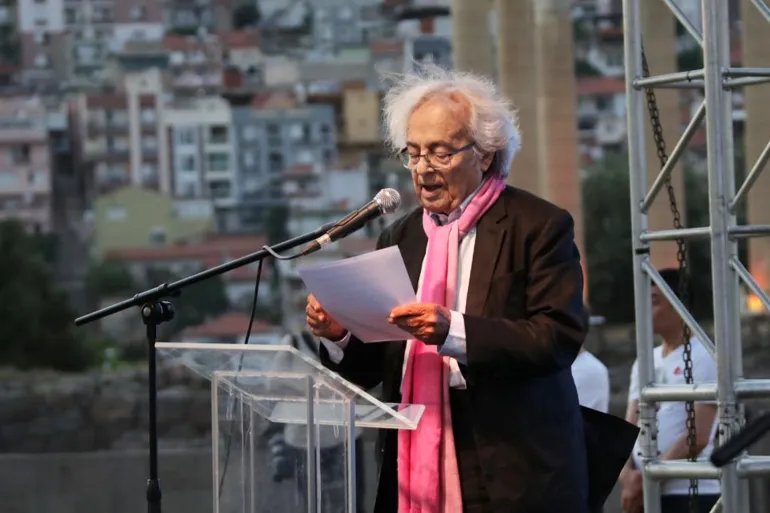
Adonis - 14.The Arab poet Adonis believes that poetry weakens when it shares a common ground with the public, and shines most brightly when it distances itself from that commonality—an idea that seems nearly the opposite of your own. How would you respond to this view through the lens of your manifesto of Great Poeticism?
- Cao Shui:In 2013, at the 3rd Qinghai Lake International Poetry Festival, I met Adonis and listened to his recitation by the Qinghai Lake. Our creations also have similarities, being evaluated in the same dimension by Giuseppe Conte, the founder of modern mythology. However, I cannot agree with his viewpoint. He has an elitist mindset, while I am the opposite, believing that one must empathize with the masses in order to write great works. The core of great poetry is to “integrate Eastern and Western civilization”, “integrate ancient and modern civilization”, “integrate sacred and secular civilization”. From the perspective of “integrating sacred and secular civilization”, it means to appreciate both the refined and the popular, and to integrate the feelings of ordinary people with the desire for sacred knowledge. Of course, Adonis is a poet whom I admire, and he may have said these words in the context of the time.
- 15.Social media has turned us into unsocial beings—isolated from real life, hidden within algorithm-governed virtual worlds, distant from two essential elements of human existence: the people around us and the places we inhabit. What philosophical impulse lay behind your decision to resign from journalism and travel across China—perhaps in search of real life—in Tibet and Xinjiang?
- Cao Shui:I used to work at Xihai Metropolis Daily with a stable job, but I feel that my mission is to create ‘Great Poetry’, which includes poetry, novels, and dramas. Social media virtualizes our lives, divided from a sociological perspective into the “X generation” (born 1965-1980), “Y generation” (born 1980-1995), and “Z generation” (born 1995-2010). Our level of virtualization is increasing. I belong to Generation Y and started surfing the internet in high school. This is a force that alienates us, so we need to use our feet to truly measure the earth. Of course, this is just one way for me to combat alienation. In fact, I am not against the internet. On the contrary, I believe it is a very good tool that creates conditions for free human communication. Therefore, I actively integrate into the literary exchange constructed by the internet. My biggest philosophical motivation at that time was to write a dedicated chapter in my essay collection ‘Journey to Kunlun’, which was to seek human freedom. My understanding of myself probably comes from the pen name “Cao Shui” in 2005. “Cao” is a surname with a history of five thousand years, representing Eastern tradition; Shui means Who which represents the questioning “Who am I” and is the core of Western philosophy; So this pen name means a fusion of Eastern and Western civilizations. So my biggest motivation for leaving my job and traveling far away was to find myself, to seek common ground among different civilizations, to create Great Poetry, and to realize my dream of Great Poetry. Everyone has a mission, and I have never left this goal, whether it is the peak or the trough of life, which is to establish an ideal country through literature.
- 16.I believe that what most distinguishes us as human beings is our capacity to astonish one another—this is the source of our reverence for creativity, which compels us to redefine ourselves and the world. In the age of artificial intelligence, can such astonishment be summoned at the press of a button? And do you fear that creativity may lose its sacred aura—that the creator will no longer be an exceptional figure?
- Cao Shui:The reason why people are human is to have magical creativity, which is what I call the ability to integrate the sacred and the secular. Artificial intelligence (AI) is indeed full of adjustments, as it enables us to obtain optimal solutions through computing power. Sometimes, I also use AI to do some programmatic work, such as writing essays based on my theory. However, I still believe that artificial intelligence is just a tool for humans. They still have to follow human instructions to do things, and creators are still the most unique. This may allow creators to focus more on the creative aspect, allowing artificial intelligence to do programmatic work. When computers appeared, humans were worried that these clever machines would replace humans because their computing power was too powerful. However, in the end, we realized that computers were just our job. We have actually had it in reality for a long time. In human society, leaders often sign and publish works, but many of them are completed by secretaries. So it’s good to use artificial intelligence as a secretary or assistant. In the face of such new things, I always believe that humans can control them, and the most terrifying thing is that humans use them to attack their opponents.
- 17.There is an explosion in cultural production: thousands of writers enter the open arena of authorship, and books multiply like short video clips. Readers face infinite choices—and abundance often leads to paralysis. How can we preserve a reading public in the age of image and speed?
- Cao Shui:From the initial definition of literature, in fact, the number of authors is increasing, and even everyone can write. Books have become monotonous, no longer as sacred as classics. This is probably a trend in the development of human civilization. Humans should have been equal, and everyone could do anything. This is also a source of my name Shui which means ‘Who’ in Chinese. I hope that I cannot be limited by work and can do everything I want to do. The more daunting challenge now is the proliferation of short videos, as images are more easily accepted by people, resulting in fewer readers. The spread of e-books has also led to fewer readers of physical books. This may be the biggest challenge that writers face. But what I want to say is that the progress of the times is never wrong, it just requires us to respond intelligently. The original intention of a writer is to be a creator, so we are always at the source, like an engine. The invention of writing enabled poetry to spread rapidly; The invention of printing technology led to the widespread sale of long novels; The emergence of imaging technology has turned drama into film; The emergence of the internet and digital technology has enabled the rapid dissemination of text. So we need to adapt to the changes of the times, create the most unique works that can be spread and expanded through the internet, and become easily accepted through film adaptations. We cannot harshly criticize readers, we must read physical books. We should adapt to the changes in communication media, and the essence of our creation is to inspire them spiritually, as long as they are inspired, no matter what path they take. Our ultimate goal is to establish a common home for humanity, through imaging and networking, to bring this goal closer.
- 18.And how might we restore the audience of poetry in an age of superficiality—what Alain Deneault has called the “mediocracy”?
- Cao Shui:Alain Deneault’s’ Mediocracy: The Politics of the Extreme Centre ‘has always been treated as a political book, and its application in the literary world is also very impressive. Whether in the East or the West, under any political system, there is now a widespread existence of mediocre rule. I made a statement during the ‘Cao Shui-Yi Sha Dabate’ that ‘99% of Chinese new poetry is garbage’, which plunged the entire poetry world into a debate. The “Oral Poetry School” and “Academic Poetry School” that I criticize are still within the scope of poetry. More poetry is not poetry at all, but they are still published in journals, which is the secularization of universal publishing rights. In the literary world, we also need to consider the issue of power. Many mediocre works are presented, while some truly revolutionary and good folk poetry is not published. This is also one of the reasons why the poetry industry has lost readers. Of course, the reason for losing readers now is due to changes in the times, the diversification of human entertainment methods, and the ease of accepting videos, which have diverted a large number of readers to movies. For this reason, I proposed the “Great Poetry Movement” to bring poetry back to the epic era of integrating everything. At the same time, in 2017, I proposed the “Poetry Film Movement” and the “Dramatizing Novel Movement”, and later the “Poetry Music Movement” and the “Poetry Calligraphy Movement”, hoping that poetry can cross boundaries and achieve diversity in poetry dissemination media. Mediocre rule has the evil of mediocrity, and the evil of mediocrity in literature is unforgivable.
- 19. In a troubled world driven more by politics than by the arts—where architects of evil resemble dragons breathing fire without regard for humanity, and where the roar of flames drowns out poetry and song—how can poetry survive in such an environment? And how can it help make this planet a better place?
Cao Shui:Recently, there has been a resurgence of war in the Middle East, with wars erupting between the United States, Israel, and Iran. The Middle East is the center of world civilization, making it a battleground for powerful nations. I was very surprised to find that the name of the American operation is’ Operation Epic Fury ‘, and war is certainly a classic scene often described in epics, but it reminds me of the origin of poetry. All art, including poetry, is a way for humans to express themselves outward, and true artists and politicians are the same type of people who want to reshape the world. People don’t want Hitler to be a painter, he wants to be the initiator of war. The wars commanded by Napoleon are considered an art form by people. Poetry and art both have the power to influence people, but compared to military and politics, the influence of poetry is subtle and imperceptible. The five major civilizations, namely Chinese civilization, Indian civilization, Islamic civilization, Western civilization, Eurasian civilization, and their internal secondary civilizations, all want to expand their influence. This war is a conflict between the Hebrew civilization under Western civilization and the Persian civilization under Islamic civilization, essentially a clash of civilizations. In terms of the pursuit of grand poetry, if we extract elements from various civilizations and create a great poem for all mankind, allowing humanity to rediscover that we come from the same place and will inevitably reach the same place, perhaps we can avoid many wars. Although the road ahead is arduous, we may also face the Third World War. 500 years later, humanity will either be unified or destroyed, and moving towards the ideal country of humanity is the mission of all poets and artists.
(End)
Biography of Cao Shui
Dr. H.C. Cao Shui(Chinese: 曹谁;pinyin: Cáo Shuí), also Shawn Cao (born in Jun 5, 1982), is a Chinese poet, novelist, screenwriter and translator. He is a representative figure of Chinese Contemporary Literature. He leads the Great Poetry Movement, Poetry Film Movement and Dramatizing Fiction Movement. In his “Manifesto of Great Poetry”, he aims to integrate sacred and secular cultures, oriental and occidental cultures, ancient and modern cultures in Chinese literature. In 2008, he resigned from a newspaper and traveled around Tibet and Xinjiang, which is the center of Eurasia or the World in his view. His novels Secret of Heaven trilogy tells the whole developing history of human civilization. His most notable works includes Epic of Eurasia, the already mentioned trilogy and King Peacock (TV series). In his works, he extracts elements of various ancient human civilizations, from Babylon to the west to Judea, Egypt, Greece, to the east to Persia, India, China, and uses these elements to reconstruct a new Utopian human homeland, which always described as Eurasia, the Top of the Tower of Babel or Kunlun Mountains (Heaven Mountains). So far 51 books of Cao Shui have been published, including ten poem collections, four essay collections, ten novels, twenty fairy tales, four translations and one hundred episodes TV series and films. He has won more than 100 literary awards worldwide, including the 1st Chinese Young Poet Award, the 4th Cao Yu Cup Drama Award, the Apollo Dionysus Award of the 8th Italian Rome International Academy of Contemporary Poetry and Art Award, the 12th Russian Golden Knight Award, and the Top Ten Public Figures of the 5th Chinese Poetry Spring Festival Gala, etc. His works have been translated into 38 languages, including English, Italian, Spanish, French, Russian, Arabic, Swedish, Finnish, Dutch, Turkish, German, Portuguese, Danish, Polish, Hungarian, Croatian, Slovenian, Japanese, Korean, Hindi, Nepali, Vietnamese, Greek, Bengali, Kazakh, Irish, Serbian, Kyrgyz, Albanian, Persian, Tamil, Armenian, Yakutian, Uyghur, Tibetan, Azerbaijani, Macedonian, Mongolian, etc. He has been invited to participate in the 30th Medellin International Poetry Festival, the 26th Havana International Poetry Festival, the 14th Kritya International Poetry Festival in India and the 4th Qinghai Lake International Poetry Festival. He is a member of China Writers Association, China Film Association and China Poetry Society. He is also chief editor of Great Poetry, deputy editor in chief of World Poetry, member of China Writers’ Association, Asian Coordinator of World Poetry Movement, Chinese Representative of BRICS Writers Association, secretary general of Boao International Poetry Festival, executive president of the Silk Road International Poetry Festival and Chairman of Beijing International Poetry Film Festival. Currently he lives in Beijing, and works as a professional poet, writer, translator and screenwriter.