 thesilkroadtoday
August 2026- Il Verso che Tace (The Verse That Remains Silent), the ambitious poetic work by Italian poet Gioia Lomasti, has developed into a wide-ranging cultural project that brings poetry, music, visual art, video, interpretation, and international literary dialogue into a single creative journey.
Created as a contemporary homage to Dante Alighieri, the project explores the enduring power of poetic language and its ability to cross centuries, languages, artistic forms, and cultural boundaries. At its heart lies a reflection on silence—not as the absence of words, but as the space from which the poetic voice emerges.
Since its presentation, Il Verso che Tace has generated an extensive body of critical and creative responses. Articles, interviews, reviews, reader reflections, musical interpretations, video readings, and artistic collaborations have appeared across Italian and international cultural platforms, documenting the work’s evolving public journey.
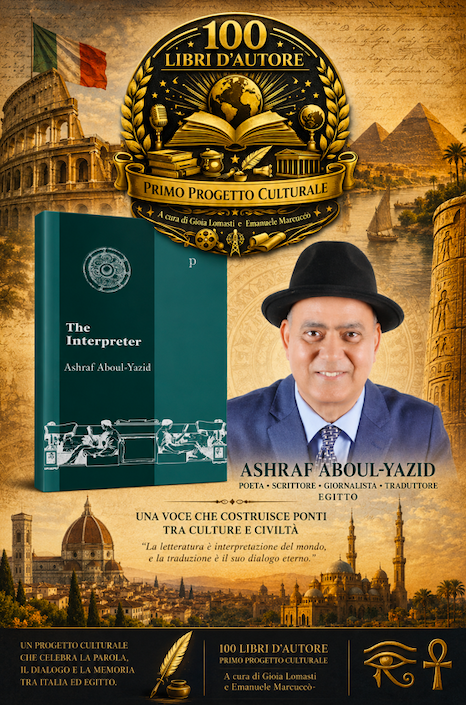
Among the international voices engaging with the project is Egyptian poet, writer, journalist, and cultural critic Dr. Ashraf Aboul-Yazid, whose review published by The Silk Road Today examined the work from an international literary and intercultural perspective. The review was subsequently translated into Italian, further extending the dialogue surrounding Lomasti’s work.
The project has also developed through collaborations with artists and cultural initiatives. Renato Garbin has created visual interpretations and video material, while Marco Nuzzo has contributed musical compositions and recitations, including interpretations of Canto I — Versi al Velo del Tempio. Poet and writer Norman Zoia has also contributed readings, musical tributes, and critical reflections, adding further dimensions to the work’s poetic voice.
A significant milestone came on Dantedì, March 25, 2026, when Il Verso che Tace was presented as a contemporary poetic response to Dante’s legacy. The project subsequently received moral patronage from the Società Dante Alighieri, beginning in June 2026, further recognizing its connection with the Italian poet’s enduring cultural heritage. The work has also attracted attention from WikiPoesia and numerous literary and cultural publications.
The project is characterized by continuous evolution. Its poetry has expanded into music, video, visual interpretation, multilingual presentation, interviews, critical writing, and new forms of digital storytelling. Sections such as “Tracce Visive” demonstrate how the project seeks to transform images into another form of listening, while I Canti explores the musical and sonic dimension of the poetic text.

The viewing page will remain permanently available online.
The international dimension of Il Verso che Tace is particularly significant. Through publications and collaborations beyond Italy, the project is becoming part of a broader cultural conversation about Dante, contemporary poetry, memory, and the relationship between silence and expression.
The work has also inspired reflections on the connections between Dante and contemporary artistic voices, between ancient literary memory and modern imagination, and between poetry and music. Articles exploring themes such as Dante and De André, Dante and Marilyn, and the relationship between poetry, light, and silence demonstrate the project’s capacity to generate new interpretive paths.
 Rather than remaining a closed literary work, Il Verso che Tace has become an expanding cultural ecosystem—one in which every new reading, review, translation, musical interpretation, video, or artistic response becomes part of its continuing life.
As the project moves toward the completion and presentation of its first volume, its creators and collaborators are preparing further international communication and English-language materials to make the work accessible to readers, writers, publishers, cultural institutions, and literary organizations worldwide.
For the international literary and cultural dimension of the project, English-language communication, international press materials, and potential collaborations, interested authors, publishers, cultural organizations, and media outlets may contact Dr. Ashraf Aboul-Yazid.
Il Verso che Tace continues to demonstrate that poetry can become an echo, a dialogue, a musical voice, and a shared journey—crossing borders while preserving the mystery and power of the word.
The verse may be silent, but its journey continues.