 thesilkroadtoday

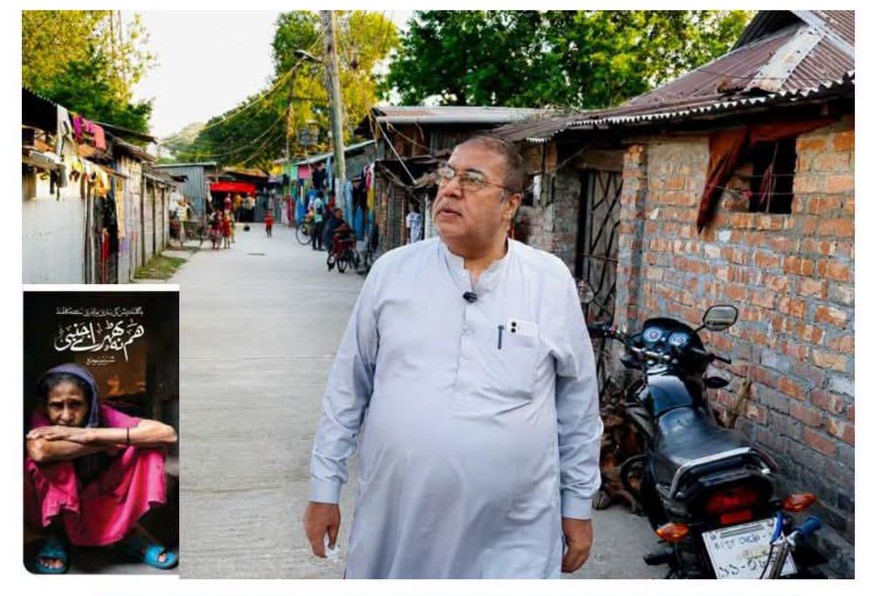
Hussein Abdel RahimHussein Abdel Rahim (1967) is an Egyptian journalist, essayist, novelist and short story writer with many published stories and novels.

- The Circle of the Journey
I walk under the rubble of clouds moving slowly beneath a neutral sky. Below, above, on God’s earth, you rotate alone with the kingdom, the seasons, and the dryness of a wind that comes only with hot gusts of dust that slightly block the pores of the soul to open the nostrils for breathing to infinity. Rain has become pointless; despite the repeated downpour that lasted for five hours.
Two decades ago, our barracks would flood after midnight, and I would laugh at my father’s distress and my mother’s anxious laughter over the laundry lines and the wool cloak that fluttered, brushing against the ashes of the smoke above my father’s lips as he smoked a hashish cigarette, intoxicated by the cold.
Now I laugh in my solitude and existence, changing my direction from the coast to Mariout, to the park, to Cyprus, to Athens, searching for meaning in the five decades.
Yesterday, I was tempting forty with the end of days; the color of twilight hasn’t changed much except in my country, today I violently strike my fifties, without bitterness, without decrease, and without anguish, I strike my hand to disperse a colossal sky pregnant with lies, perhaps it will overflow with my secret, and my relationship with the Lord of the blue, nothingness, and the senses. I strike the ground beneath me with a boot, a slipper, and a wool shoe, and another heel kept by a friend in the old cupboard above one of the roofs of the neighboring houses to our old home, suspended between heaven and earth. In the climate of Marshal Ismail and the echoing strike in my head and a memory that does not extinguish near the Jalā School, I walk with three hundred years and more behind me, and the lightness manifests in God’s land, God’s creation. I remember my pauses; here, Kristina presents the Salison in the amphitheater lobby, and the laughter translates the heart of the mysterious sea, overflowing with anger and might in my Alexandria in autumn.
I got lost and found myself close to a choking sensation accumulated by the vigor of childhood in my neck and throat. I walk slowly, with vigor and sometimes running, engulfed by the ecstasy of deserts and sands, and the voices of strangers sharing my journey on the other side of the map. A graceful leap from a guide of camels raving above the yellow sands of gold, as the sunset has lingered despite the lantern of the horizon with the donkey glow of the last page of the waning sun in lethargy and allure. This evening is mine alone and the night. How many years have passed, how many days have hidden since the season of the disappointing spring laden with the dust of deception and filth in my country? The companion of my distant shadow says:
“Tell me, companion, when will the caravan arrive at a known port?!”
_”When will the journey end and the path be of worth!!”
I say: “When creation is exchanged until the last pessimist’s laughter mingles with tears without any notable concern except for the mockery of the girls in the deaf house, except for the antennas that connect us with the harshness of the storm of lies. I walk slowly, after I grew tired of begging.
I am the beggar, the son of calamities, revolutions, hope, and the disappointment of certainty. I no longer care about shocks; I flirt with boredom very close to death, I play in the circle of thresholds titled with the abyss or the basement, threads of hope dangle in haste and anxiety and playfulness. I gasp in deceptive joy, I extend my hand, I open my arms trying to win a vastness and hope, opening my chest stormy with the buttons of my puffed-up shirt, I feel layers of deceptive sponge under my feet as I tread in the sand. I butt heads with the clouds at the moment of their collision and the roar of thunder without fear. I wonder, having missed the map of the ascension in the deserts of prophecy, perhaps I may win the pearl of impossibility to be swept away by the new, elusive certainty. I scream without restriction or condition in a life I thought was real, causing the resolutions to scatter on the sandy surface that still longs for a drop of water to complete the circle of my fifty years .
Translated from Arabic by Dr.Salwa Gouda
Salwa Gouda is an Egyptian literary translator, critic, and academic at the English Language and Literature Department at Ain-Shams University. She holds a PhD in English literature and criticism. She received her education at Ain-Shams University and California State University in San Bernardino. Furthermore, she has published several academic books, including “Lectures in English Poetry, and “Introduction to Modern Literary Criticism,” and others. She has also contributed to the translation of “The Arab Encyclopedia for Pioneers,” which includes poets and their poetry, philosophers, historians, and men of letters, under the supervision of UNESCO. A poetry anthology is published recently through Alien Buddha press in Arizona, USA. Additionally, her poetry translations have been published in various international magazines.