 thesilkroadtoday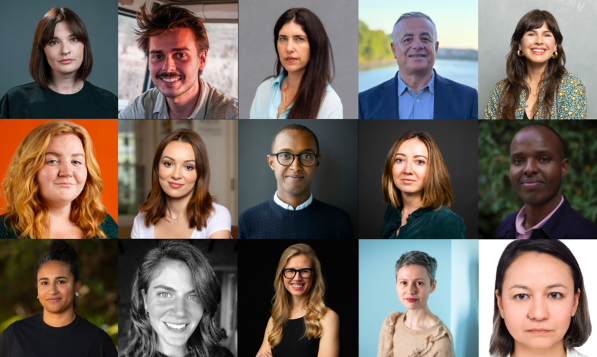
The Global Center for Journalism and Trauma has announced the recipients of the 2026 Ochberg Fellowship, a program that deepens journalists’ reporting of violence, conflict and tragedy. This year’s Fellows include outstanding senior and mid-career journalists in all media, representing six continents.
Established in 1999 for journalists seeking to deepen their knowledge of trauma science and improve their reporting of traumatic events and their aftermath, the Ochberg Fellowships are awarded to outstanding senior and mid-career journalists working in all media who specialize in covering violence, conflict and tragedy on every scale, from local beats to disasters, war climate change and genocide. The program has grown into a community of more than 250 Ochberg Fellows worldwide, and continues its long-standing mission to support rigorous, ethics-driven reporting on trauma.
“This year’s Ochberg Fellows embody the deep ethical and professional commitment that trauma reporting demands, whether in local newsrooms or on the international stage,” said Bruce Shapiro, executive director of the Global Center for Journalism and Trauma. “Reporting from more than a dozen countries across six continents, they are leading voices in journalism who have probed the human impact of violence and upheaval. Gathering in Paris for the first time under the Global Center’s banner, they join the Ochberg Fellowship at a moment when their work could not be more essential.”
Through seminars with leading experts and journalism practitioners, the week-long program provides journalists an unparalleled opportunity to explore the many dimensions of psychological trauma; to discuss ethical and craft challenges raised by their work; and to forge relationships with colleagues from around the world who share their interests and commitment.
Middle, L to R: Jessica Gallagher, Jesselyn Cook, Abdi Latif Dahir, Hannah Furfaro, Abdi Cadani
Bottom, L to R: Desirée Yépez, Iliana Papangeli, Emily Baumgaertner Nunn, Angelique Chrisafis, Glenda Kwek
The 2026 Ochberg Fellowship is made possible by generous support from the Trust for Trauma Journalism.
The 2026 Ochberg Fellows are
Emily Baumgaertner Nunn is the national health correspondent at The New York Times, where she covers public health issues affecting children and vulnerable communities. Before joining The Times in 2022, she reported on science and medicine for the Los Angeles Times, investigating issues ranging from bioterror defense systems and gene-editing technology to surrogacy scams and the teenage vaping crisis. Her reporting on the Covid pandemic and other health topics has received a National Headliner Award, recognition on the Forbes 30 Under 30 List, and she was named a finalist for the Livingston Award.
Baumgaertner Nunn earned a master’s degree in public health from The George Washington University. She started her journalism career at the Pulitzer Center on Crisis Reporting by flying to Sierra Leone and the Democratic Republic of Congo to cover infectious disease outbreaks. She is based in Los Angeles.
Abdi Cadani is a senior lighting cameraman for CBS News with 20 years of experience in international newsgathering. He has worked across the world in some of the most challenging environments, bearing witness to stories of war, political upheaval and survival. His work has been recognized with four Emmy Awards.
Cadani’s visual language is shaped by emotional sensitivity, lived experience and deep respect for the people he films. Drawing on a strong sense of composition and lighting, he strives to bring intimacy and emotional truth to difficult subjects. His images have contributed to CBS News’ coverage of major global events, including the Ebola crisis and the wars in Ukraine, Syria, Libya and Iraq. He holds a foundation degree from Ravensbourne College in Broadcasting Operations and Production, an MA in Applied Storytelling from Loughborough University, and is currently completing a part-time MA in Journalism at the University of Portsmouth.
Angelique Chrisafis is the Paris correspondent for The Guardian, where she reports on politics, society and the justice system. Her work has included sexual violence cases as well as major terrorist attacks, including the 2015 attacks in Paris and those in Brussels and Nice in 2016.
She has worked for the Guardian for more than 20 years, reporting across the United Kingdom and Europe. She has also reported from Ireland, covering the political and psychological aftermath of the Northern Ireland conflict.
Jesselyn Cook is a senior editor at Noema Magazine. She previously covered the intersection of technology and democracy as an investigative reporter at NBC News and a senior reporter at HuffPost. In 2025, she was a Nieman Fellow at Harvard University, where she taught a course in narrative nonfiction writing.
Cook has also taught newswriting and reporting as an adjunct journalism professor. She received a Berlin Capital Fulbright while completing her master’s degree in journalism and international relations at New York University. Her 2024 book “The Quiet Damage,” which investigates the human toll of conspiracy theories and disinformation, won a J. Anthony Lukas Work-In-Progress Award.
Mohammed Daraghmeh is bureau chief of Asharq News, a pan-Arab news organization based in Dubai and Riyadh. He is a Palestinian journalist based in Ramallah and covers Palestinian politics and regional affairs.
Prior to joining Asharq, Daraghmeh worked as a correspondent for the Associated Press in the West Bank and Gaza Strip, and served as a media lecturer at Bir Zeit University. He is a frequent speaker at international forums addressing media coverage of Palestinian politics and the Palestinian-Israeli conflict.
Hannah Furfaro is a mental health reporter at The Seattle Times, where she has covered teen opioid addiction, the psychiatric boarding crisis, and restraint practices inside mental health facilities. Her reporting in Washington helped inspire a new state law protecting youth experiencing serious mental illness and led King County to fund a full-time opioid use disorder prescriber.
Her stories have been published by The Atlantic, Science, Scientific American, The Wall Street Journal, The Scientist, The Guardian and Audubon Magazine. Her work has been supported by the Association of Health Care Journalists (AHCJ), the Rosalynn Carter Center Fellowship for Mental Health Journalism, the USC Data Journalism Fellowship and the Council for the Advancement of Science Writing. In 2023, she was named AHCJ’s beat reporter of the year. Her work has also been honored with the Sharon Begley Award for Science Reporting, the Anthony Shadid Award for Journalism Ethics and The National Press Foundation’s Carolyn C. Mattingly Award for Mental Health Journalism.
Ninna Gaensler-Debs is the co-director of Uncuffed, the award-winning radio training program and podcast produced by incarcerated people in California prisons in collaboration with KALW Public Media. Uncuffed provides professional audio training to people inside the carceral system, empowering participants to tell their own stories. Through the program, participants share their lived experiences to foster dialogue, challenge stereotypes, develop job skills, and inspire change. In her role, Gaensler-Debs helps guide the program’s editorial vision and leads its core work, from developing and teaching audio workshops inside prisons to supporting the growth of Uncuffed’s programming.
Gaensler-Debs has spent the past 15 years in radio as a reporter, editor, producer, and educator, with work featured on NPR, WIRED, 99% Invisible, Snap Judgment, and other national outlets. She has taught audio production in classrooms and at conferences worldwide, and is dedicated to creating opportunities for storytellers who have historically been excluded from mainstream media.
Jessica Gallagher is a staff photojournalist at The Baltimore Banner. Her reporting and photos for a project about Baltimore’s drug overdose crisis, published as a collaboration with The New York Times, won the 2025 Pulitzer Prize and the 2025 Dart Award.
Before joining The Banner, Gallagher worked at The Greenville News, The Quad-City Times, and The Times-Georgian. She holds a Bachelor of Fine Arts in Professional Photography from the Brooks Institute.
Glenda Kwek is the video coordinator for China and Mongolia at Agence France-Presse, based in Beijing. She shoots and edits video, manages a team of video journalists, and oversees breaking news and feature coverage. She has reinforced AFP bureaus during protests, elections, natural disasters, and major breaking news across the Asia-Pacific region.
Kwek has nearly two decades of experience in news journalism, including roles as a text and video correspondent in Mumbai and as deputy news editor in Delhi.She previously worked at The Sydney Morning Herald and The Australian Financial Review. Kwek has been honored with a UN Association of Australia Media Peace Award for her reporting on Afghan refugee children, and she was a finalist at the 2025 SOPA Awards for a feature on changing identities in Mongolia.
Abdi Latif Dahir is a Middle East Correspondent for The New York Times, based in Beirut, Lebanon. Prior to that, he spent five years as the paper’s East Africa Correspondent, reporting from more than a dozen countries across eastern, central,and northeastern Africa. His reporting has spanned armed conflict, elections, climate change, and human rights, as well as cultural and social change, with a particular focus on how young people are shaping Africa’s future.
Before joining the Times, Dahir was a reporter at Quartz in New York and Nairobi, covering technology, innovation and China’s growing presence in Africa. In 2018, he was selected as a Dag Hammarskjöld Fund for Journalists fellow, reporting from the United Nations and covering the U.S. midterm elections. He began his career reporting for wire services such as United Press International and for local and regional outlets in Somalia, Kenya and East Africa. He holds a master’s degree with a concentration in politics from Columbia Journalism School.
Noa Limone is an education correspondent and weekly opinion columnist at Haaretz, Israel’s liberal daily newspaper. She covers education policy from early childhood through academia, and contributes political commentary and media criticism. Since October 7, she has reported extensively on the war’s domestic impact, including coverage of hostages and civilian experiences.
Previously, Limone served as deputy editor of Haaretz Weekend Magazine, where she led editorial planning and produced long-form investigative features. Her reporting has driven policy reforms in early childhood education and maternal healthcare. She holds a master’s degree in philosophy, and is a 2023 Dart Center Early Childhood Journalism Fellow.
Yevheniia Motorevska is a Ukrainian investigative journalist, editor, and media trainer based in Kyiv. She heads the War Crimes Investigations Unit at The Kyiv Independent, where since March 2023 she has specialized in documenting and uncovering war crimes committed by Russian forces in Ukraine.
With more than 15 years of experience in journalism, Motorevska previously served as editor-in-chief of the Ukrainian media outlet Hromadske and headed the video department of the investigative agency Slidstvo.Info. Before Russia’s full-scale invasion, her reporting focused on exposing corruption and abuses of power within Ukraine’s judicial and law-enforcement systems.Her work has been recognized with numerous national and international awards, including the Pavel Sheremet Prize (2021), the IRE Award (2023), and the CEI SEEMO Award for Outstanding Merits in Investigative Journalism (2025).
Iliana Papangeli is a journalist and editor who has served as Managing Director of Solomon since 2022. Under her leadership, Solomon has gained international recognition for in-depth coverage of underreported issues in human rights, technology, the environment, and accountability, while fostering cross-border collaborations.
Her work has been honored with the IJ4EU Impact Award, the Daphne Caruana Galizia Prize, and the European Press Prize. She is a 2024 alumna of Columbia University’s LEDE program, and has served on international journalism prize juries. She has a background in psychology and social anthropology.
Andrei Popoviciu is a freelance investigative reporter and international correspondent covering human rights, conflict and foreign affairs across Europe, Africa and the Middle East. His work has appeared in The Guardian, Al Jazeera English, The Associated Press, The Washington Post, Foreign Policy, The New Humanitarian, Politico, Le Monde, The Observer, Der Spiegel and other international outlets.
Blending investigative methods with narrative field reporting, his journalism has exposed corruption, human rights abuses, and the civilian toll of armed conflict. He has won or been nominated for multiple international journalism awards, including the European Press Prize, the Jan Kuciak Award, the Livingston Award, the Daphne Caruana Galizia Award, the IJ4EU Impact Award, the Fetisov Award, the Rory Peck Award and the One World Media Award, among others. He was named to the Forbes Europe 30 Under 30 list in 2023, and is part of the European Young Leader (EYL40) class of 2025.
Desirée Yépez is an award-winning Ecuadorian journalist, fact-checker, and author. She is the managing producer of national news at Radio Bilingüe and a former JSK Journalism Fellow at Stanford University. Her reporting has been featured in media such as El País, Radio Ambulante, and Conecta Arizona. In 2020, she founded Silenciadas, a platform exposing femicides during the pandemic that later became a book. She has received honors from GIZ Ecuador, INMA, Google News, and the International Women’s Media Foundation. She is also a member of Verdad’s advisory board, an AI-powered tool that monitors disinformation on Ethnic-language radio stations across the United States.This year’s Senior Fellow, selected from the 2025 Ochberg Fellows to return as fellowship faculty, is Nina Lakhani (2025 Ochberg Fellow), a global climate justice reporter, currently based in Mexico City for Drilled Media. Over the past two decades, she has reported from more than a dozen countries, including seven years freelancing in Mexico and Central America, and six years as senior climate justice reporter for The Guardian in New York. She covers environmental justice, human rights, and the intersections of climate change with social and political struggles worldwide.
Lakhani is the author of Who Killed Berta Cáceres? Dams, Death Squads, and an Indigenous Defender’s Battle for the Planet, which has been translated into Spanish, French, and Italian. She also contributed to the anthology Gaza: The Story of a Genocide. Before pursuing journalism, she worked as a mental health nurse, a background that informs her reporting on the human impact of global crises.