 thesilkroadtoday
The Academy of the Kingdom of Morocco will host a major international conference entitled “Memory, Sharing, and the Rewriting of African Independences: from the Manchester Congress (15–21 October 1945) to the Casablanca Conference (4 January 1961)” on 28 January 2026 in Rabat. The conference brings together scholars, intellectuals, and cultural figures to revisit two pivotal milestones in modern Pan-African history and to reflect on their enduring significance for Africa’s present and future.
This conference builds on a broader intellectual trajectory initiated by the Academy in May 2023 with the landmark gathering “What if Africa Rewrote the History of Africa? Reflections and Perspectives.” That initiative marked a turning point in contemporary African historiography by proposing a shift from externally framed narratives toward an African-centered rethinking of the continent’s historical, cultural, and spiritual paths. In line with the Academy’s dual mission—intellectual inquiry and historical commemoration—the 2026 conference continues this endeavor by focusing on moments when Africans and the African diaspora actively shaped visions of independence, unity, and sovereignty.
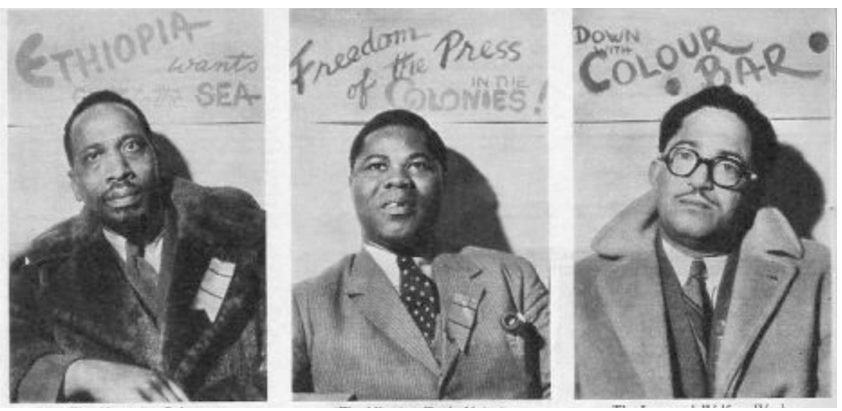
At the heart of the discussions lies the legacy of the Fifth Pan-African Congress, held in Manchester in October 1945, a foundational event that brought together leading intellectuals of the African diaspora with future leaders of African liberation movements. Guided by visionary figures such as W. E. B. Du Bois, George Padmore, Jomo Kenyatta, and Kwame Nkrumah, the Manchester Congress articulated a new, assertive Pan-African agenda. It moved beyond earlier appeals for reform to a clear demand for political independence, social justice, and the dismantling of colonial domination. The Congress forged lasting links between thought and action, making it a catalyst for the wave of African independences that followed in the 1950s and 1960s.
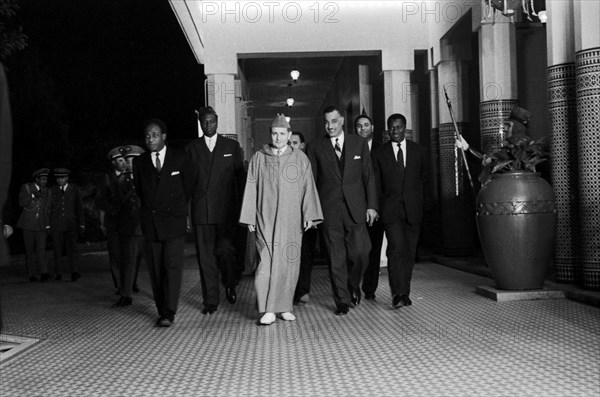
Kwame Nkrumah, President of Ghana; Modibo Keïta, President of Mali; King Mohammed V of Morocco; Gamal Abdel Nasser, President of Egypt; and Ahmed Sékou Touré, President of Guinea.
**January 1961.**
The conference also places a strong spotlight on the Casablanca Conference of 4 January 1961, convened at a decisive moment in Africa’s decolonization process. Hosted in Morocco, the conference brought together influential leaders such as Gamal Abdel Nasser, Modibo Keïta, Ahmed Sékou Touré, Kwame Nkrumah, and King Mohammed V. United by a shared vision of African unity and sovereignty, they affirmed their commitment to accelerating decolonization and strengthening cooperation among newly independent states. The Casablanca Charter, adopted during the conference, was particularly significant for its bold stance on Pan-African solidarity and its critique of the artificial borders inherited from colonial rule—borders seen as obstacles to genuine unity and development.
By revisiting Manchester 1945 and Casablanca 1961 in a single intellectual framework, the Academy of the Kingdom of Morocco seeks to highlight the continuity between diaspora-driven thought and continent-based political action, as well as the shared ideals that underpinned both moments. The conference will explore how memory, collective experience, and shared struggles can inform a renewed understanding of African independences—not as closed historical chapters, but as ongoing processes with contemporary relevance.
Through keynote lectures, panel discussions, and scholarly exchanges, participants will reflect on how the spirit of Manchester and Casablanca can serve as a compass for the future—a source of inspiration for unity, sovereignty, and a renewed engagement with Africa’s common heritage. In doing so, the conference reaffirms the Academy’s commitment to fostering dialogue that places Africa at the center of its own narrative and contributes to shaping inclusive and forward-looking perspectives on the continent’s past and future.