 thesilkroadtoday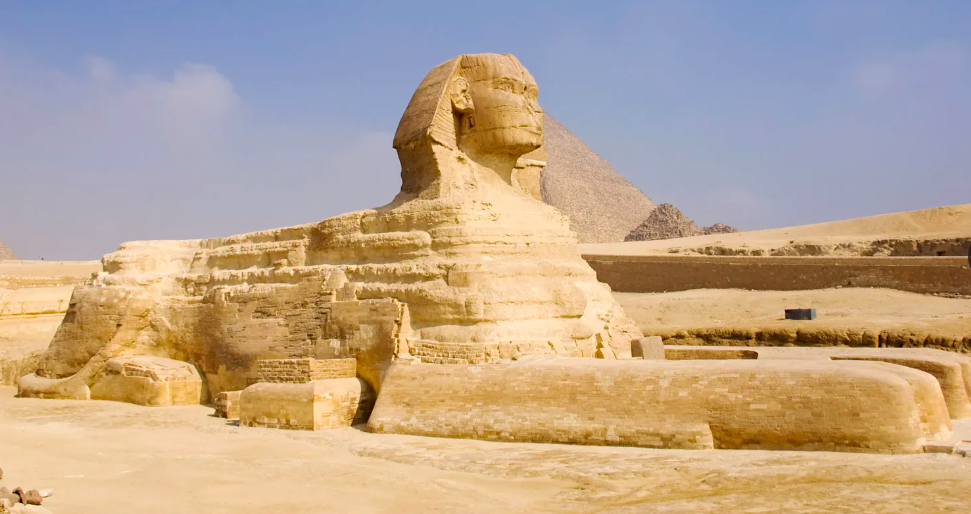
Standing on the Giza Plateau, beneath the vast Egyptian sky, the Great Sphinx of Giza appears not merely as a monument, but as a living witness to human history. For Chinese visitors, whose civilization also measures time in millennia, encountering the Sphinx is not a meeting with a foreign past, but a dialogue between two ancient worlds.
This one-hour visit is not about hurried photographs or surface facts. It is a slow walk through history, symbolism, and silence—guided by stone, sun, and memory.
The Sphinx emerges gradually as one approaches, its massive body stretched across the desert, its human face gazing eternally eastward. Measuring approximately seventy-three meters in length and twenty meters in height, the monument was carved directly from the limestone bedrock more than 4,500 years ago. Long before the Great Wall took its recognizable form, before classical Chinese philosophy was written, this guardian was already standing watch over the Nile Valley.
The name “Sphinx” is Greek. To the ancient Egyptians, the monument was known as Hor-em-Akhet—Horus of the Horizon—protector of the sacred necropolis and divine companion of the rising sun.
Meaning Carved in Stone
The Sphinx combines the body of a lion with the head of a human king. In ancient Egyptian thought, the lion symbolized strength, vigilance, and royal power, while the human face represented intelligence and divine authority. Most scholars believe the face belongs to King Khafre, builder of the second pyramid, whose funerary complex the Sphinx guards.
Much like the stone guardian lions that stand before temples and palaces in China, the Sphinx was created to protect sacred space. It was not decorative, but symbolic, spiritual, and political at once.
The Art of Creation
Unlike the pyramids, which were built block by block, the Sphinx was carved directly from the living rock of the Giza Plateau. Ancient craftsmen used stone hammers, copper tools, and a deep understanding of geology. The head, made from harder limestone, has survived better than the softer stone of the body, revealing the builders’ sophisticated knowledge of materials.
Evidence suggests that the head was originally larger and later reshaped, possibly to preserve it from erosion. This act of re-carving reflects a civilization that did not merely build monuments, but cared for them, adapted them, and passed them on across generations.
Damage, Myths, and Survival
The missing nose of the Sphinx has inspired countless legends. Contrary to popular belief, it was not destroyed by Napoleon’s soldiers. Drawings made before Napoleon’s arrival in Egypt already show the monument without its nose. Most historical evidence points to deliberate damage during the medieval period, likely motivated by religious extremism.
For centuries, the Sphinx lay buried beneath desert sand, with only its head visible above the surface. Sandstorms, neglect, and human interference scarred its body, yet the monument endured—silent, patient, and unbroken.
The Dream Between the Paws
One of the most evocative stories associated with the Sphinx dates to the reign of Thutmose IV. As a young prince, he fell asleep between the Sphinx’s paws and dreamed that the monument spoke to him, promising kingship if he cleared the sand from its body. He fulfilled the task and later became pharaoh. This episode is recorded on the Dream Stela, still standing between the Sphinx’s forepaws.
To the ancient Egyptians, this was not a legend but a divine encounter. Monuments were believed to possess presence, memory, and voice.
A Universal Symbol
As the hour draws to a close, the Sphinx reveals its deeper meaning. It is not only an Egyptian monument, but a universal symbol of humanity’s relationship with time, power, and destiny. Like China’s ancient monuments, it speaks of continuity rather than conquest, endurance rather than domination.
The Sphinx has witnessed the rise and fall of civilizations, the transformation of beliefs, and the passing of languages and empires. Yet it remains, posing the same silent question to every visitor: what will your civilization leave behind?
Closing Reflections
For Chinese travelers, the Great Sphinx of Giza is not a relic of a distant culture, but a mirror reflecting a shared human experience—of building, believing, and remembering. One hour in its presence is enough to feel the weight of history and the humility of standing before something that time itself has failed to erase.
Here, on the edge of the desert, stone remembers what humans often forget: that true greatness lies not in power, but in endurance.