
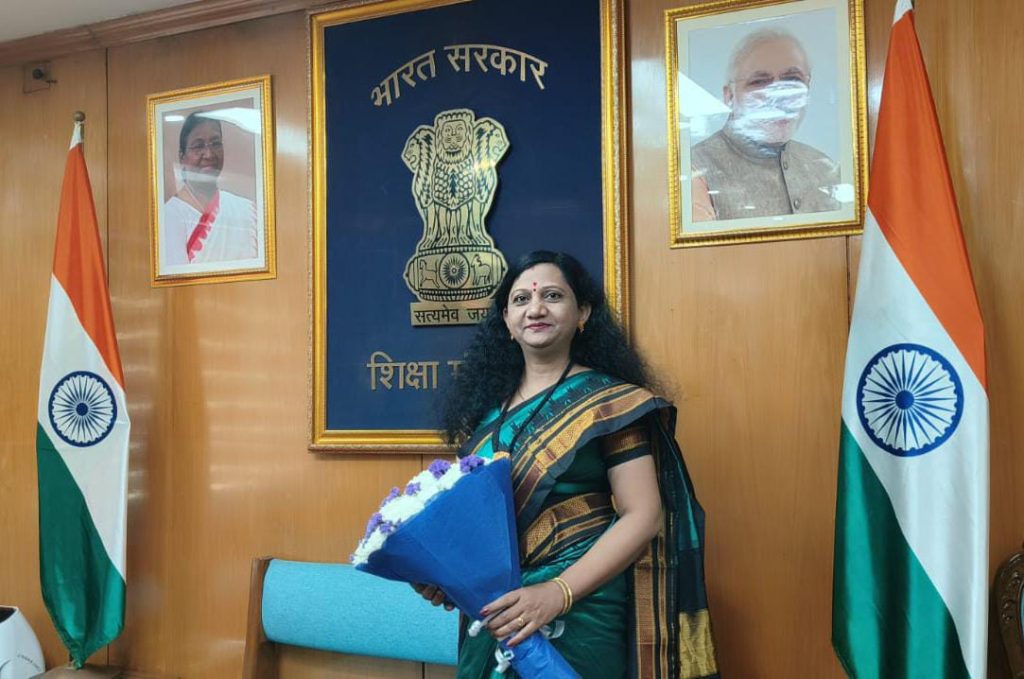
Prof. Swati Haribhau Kate
Head, Department of Sociology
Peoples College, Nanded
Contact: 9890515815
 Prof. Swati Haribhau Kate
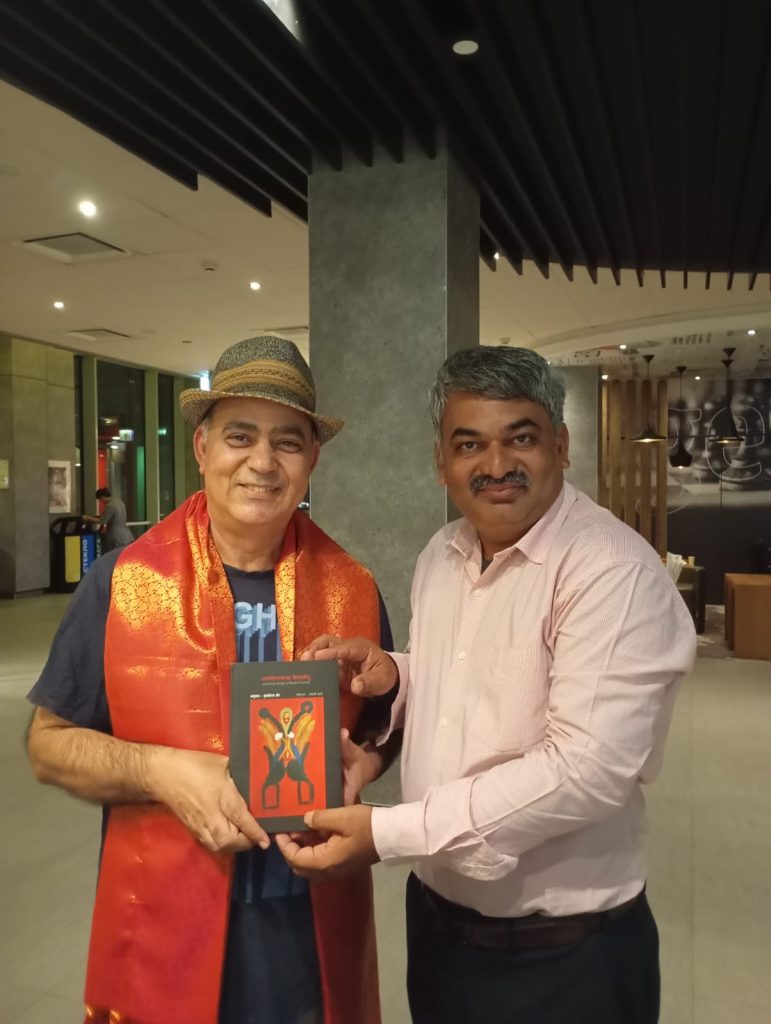
 ‘Anandotsavacha Vishwasetu’ (Universal Bridgr of Blissful Festival) is a Marathi translation of world poetry. This anthology features translations of poems by contemporary poets from India (Dingpuii, Manav Kaul, Mamta Sagar, Rati Saxena, Rashmi Ramesh, Sunita Paul), Russia (Dr. Alexandra Ochirova, Konstantin Aleksandrovich Kedrov, Nicholas Roerich , Margarita Al , Biryukov Sergey), Senegal (Abdoulaye Fodé NDIONE), Palestine (Abdulla Issa), Bangladesh (Aminur Rahman), China (Anna Keiko, Xu Yun), Egypt (Ashraf Aboul-Yazid Dalí), Philippines ( Queen Eden Soriano Trinidad), Azerbaijan (Eldar Akhadov), Nepal (Keshab Sigdel, Santoshkumar Pokharel), Namibia (Keamogetsi Joseph Molapon), South Africa (Jahrose Jafta, Lebogang Lance Nawa), Indonesia (Nia S Amira, Sastri Bakry), Belarus (Nelly Kozyreva), United States of America (Bill F Ndi), Argentina (Mirta Liliana Ramírez), Tanzania (Mwamvingila G.P.), Cameroon (Eugène Ebodé), Morocco (Rabia Marhouchi), Colombia (Rubén Darío Flórez Arcila), Austria (Victor Klykov), Sri Lanka (Shirani Rajapakse), Nigeria (Sheu Usman Oladipo Akanbi), Bolivia (Sulma Montero) and other countries.
Translating poetry is a difficult task; while translating, the translator must perform a balancing act to preserve the essence of the poem. While reading the translations in this collection, one can sense the effort to do justice to each poet’s personality, their unique expression, and specific human sensibilities. While reading poetic translations, it is natural to compare them with the various trends and tendencies of contemporary Marathi poetry. Considering the core of poetry, the global appeal of the poems in this collection easily strikes the reader.
Reading excellent poetry brings a new joy to the connoisseur; this joy definitely reaches us through the emotions expressed in the poems of the anthology ‘Anandotsavacha Vishwasetu’.
This is the sixteenth translated book by the accomplished Marathi translator, Dr. Prithviraj Taur. His name is important as a contemporary translator, especially in the context of translating poetry and children’s literature. While presenting these translations, Dr. Taur has made a meaningful attempt to preserve the poem’s original root while connecting it with Marathi soil and culture. The rhythm of poetry is intrinsic; it carries the touch of a specific region, its environment, and the sensibilities of its cultural life. The rhythm of poetry emerges from the folk culture of a particular geographical area. Preserving this local rhythm in translation is impossible; however, the translator has been successful in conveying the original meaning of the poems to Marathi readers.
Just as humans have been gifted with intellect, they have also received the divine inspiration for expression. However, the gift of expressing through poetry is not bestowed upon everyone. Only those whose inner being contains tenderness, love, affection, warmth, humanity, and a heart that trembles upon seeing the suffering around them, get the opportunity to express the language of the soul through poetry. That is why saints and great souls across the world are seen using the language of poetry to express themselves, to guide, and to convey the resonance of the universe to ordinary people.
Wherever human society exists, although the nature of events concerning happiness and sorrow may differ, their implied meaning that is, ‘Live and let live’. From this alone, the ‘Global Bridge of Celebratory Joy’ is built. This bridge holds the capacity to give spiritual peace to the universe and to embrace the bliss of Brahmananda (divine joy) in the palms of fraternal joy.
In the present collection, there is the solitary lament of human anguish ravaged by war. The crematorium-like silence of devastated villages can be heard here, and similarly, the joyful life blossomed by nature is also here. The existence of rivers, the sun, the moon, stars, and love is connected to the primordial bonds of humanity; these human bonds find expression through poetry.
In the lines of poet Victor Klykov, who resides in Austria, one can hear the voice of universal unity. An optimism that keeps humanity alive exists in his poetry:
‘I dream;
that the borders of every place
are being erased
and people
freed
carrying love in their hearts
are crossing oceans
embracing each other.’
This vision of humanity also unfolds in the poetry of Margarita Al (Russia).
‘When the invisible becomes visible
and the visible invisible
the memories of the visible fade into oblivion
and the invisible becomes manifest, then
humanity is expressed’
Nelly Kozyreva from Belarus has also articulated optimism about the world and living through her poetry. The translation of Nelly’s poem presents various illusions of the word.
‘This world is beautiful
World, this world of ours
Look,
See how beautiful it is
it is Beautiful
You live
Live… breathing deeply
fully…’
The translator’s skill is evident throughout these translations. The first occurrence of the word ‘world’ refers to the universe, while the word ‘live’ in the final lines relates to living/existing. The characteristic of language is underscored through this translation. One also realizes how the meaning of a word differs in the context of Marathi phonetics.
Nia S. Amira is a renowned poetess from Indonesia. Her poetry meaningfully describes the definition of a human being:
‘To be human
is to be faithful to prayer
to lift each step thoughtfully
to utter each word from the heart
to be such a person
like gold from iron’
Amira’s lines hold up a mirror to contemporary humanity. They make us aware of the disparity and distance between our philosophies and our actual way of living.
The translations in this book can be seen as a brush meant to paint more vividly on the canvas of the mind the laughter of an innocent child, the eagerness of lovers’ union, and the awareness related to maternal love and patriotism.
 This poetry collection which advocates for world peace, also brings to us the anti-war voice of the world’s minorities. The Egyptian poet Ashraf Aboul-Yazid Dalí writes poem on the ‘Streets of Cairo’.
The man who returned home,
In his short break, Is seeking a vision
In the hand spread between two cities,
With lines sketched by years,
Made of sands and winds.
The man who returned home,
In his short break, is asking:
“How many last wars will be enough?”
The anti-war sentiment is also prominently expressed in the poetry of Nepal’s Keshab Sigdel.
While editing ‘Anandotsavacha Vishwasetu’, I got to savor the poetry of various poets from around the world. This translation effort reinforces the adage ‘Vasudhaiva Kutumbakam’ (The World is One Family). The poems in this collection are humanistic. Through this, one can understand the creation of poetry for universal joy and social welfare.
The lines of Eden Soriano Trinidad (Philippines) in this collection describe the feelings about poetry of every person who loves poetry. In this poem, the poet has compared themselves to poetry.
‘I am poetry
I am rhythm, beat
I am the verse of unity.
I am poetry
the reflection of the soul
the mirror of the heart
I am the journey to wholeness.
I am poetry
a space-time traveler
the face of human values.’
The translations by Dr. Prithviraj Taur will give readers of poetry a beautiful and insightful joy of understanding poetry, and will also inspire them to work for global peace and happiness.
A glimpse of today’s world’s economic and social culture is reflected in these poems. The anthology includes poems covering many topics: the Roman Empire, Egyptian culture, apartheid in Africa, the devastation caused by world wars, the diversity of Indian culture. There are references to Inanna, Nefertiti, Aphrodite, Saraswati. Alongside these, the journey within the poems, using metaphors like the Kadamba tree, mangrove trees, grassy meadows, snow-capped mountains, and barren deserts, is noteworthy.
The helpless gaze waiting for rain to dispel the dry aridity of the desert, as well as the importance for the existence of life of fields, rivers, ponds, the gentle touch of the night’s coolness, constellations, starlight, and the sun, are impressed upon through poetry. The mental fabric from folk culture seems to be expressed through these poems.
Just as these poems express the sorrow of separation in love, they also express the joy of union. The mother’s lap, which holds the warmth of affection, expresses motherhood and tenderness.
References like vintage swag, akin to Petra and Lora, are also found here. There are dialogues in the collection about Velimir in Rome, the village of Bana on the banks of the Nile, Mowgli’s work in Africa, India rich with diversity, Santa Claus who gives toys to children, St. Peter, Gautam Buddha, Neelkantha, and Trnovo. The various forms of nature are described in these poems.
While this incomparable beauty of nature is being expressed, one can also hear in the poems the society tormented by tanks, bombs, infectious diseases, and prayers for world peace. Poetry is not merely a literary genre; it is the sociology of language that works for global peace by making social consciousness more mature.
Through the medium of translation, Prithviraj Taur has delivered the precious treasure of contemporary global poets’ poems to Marathi readers via the anthology ‘Anandotsavacha Vishwasetu’.
*(Anandotsavacha Vishwasetu (UNIVERSAL BRIDGE OF BLISSFULFUL FESTIVAL) Translation – Prithviraj Taur, Editing – Swati Kate, Hastaksar Prakashan Gruha, Nanded, First Edition – September 2025, Pages 284, Price 450 Rupees) *