 thesilkroadtoday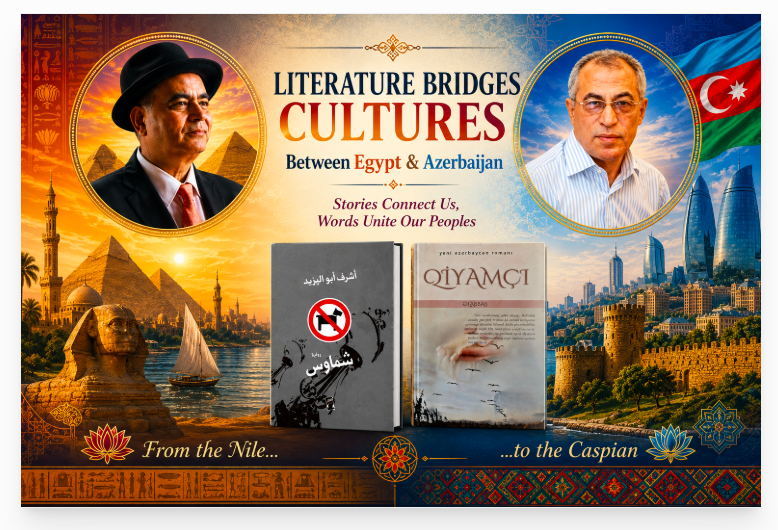

The ancient Silk Road entered the memory of history not merely as a route traversed by caravans carrying material wealth, but as a spiritual bridge that connected the cultures, literatures, and arts of diverse peoples. Along this bridge, the Eastern nations developed a shared aesthetic imagination and philosophical vision of the world, rooted in common moral and spiritual values. Thus, even as geographical borders shifted, the deeper language of cultures remained remarkably constant.
It is from this perspective that one may read The Silk Road Today, the project conceived and created by the distinguished Egyptian writer Ashraf Dali (Ashraf Aboul-Yazid). The project seeks to revive a forgotten collective memory and rebuild the spiritual bridges among peoples through the power of the written word. Dali’s global cultural mission becomes a sacred journey that transcends political and geographical boundaries to reach the human heart, bringing together artists who speak different languages yet belong to the same human spirit.
One of the significant stations of this journey is Alabbas, one of the leading figures of contemporary Azerbaijani prose, a writer distinguished by his inner fire, his unmistakably individual style that reveals itself from the second sentence onward, and his language saturated with regional idioms and the scent of the native soil.
Perhaps the most vivid expression of this literary dialogue and spiritual brotherhood is Ashraf Dali’s generous introduction of Alabbas’s novella Gözəl (Beautiful) to the Arab world. Through translation, he reanimated in Arabic the profound spiritual wounds caused by the violation of human dignity. The significance of this translation lies not only in its aesthetic and literary value but also in its strategic importance: it conveyed to Arab readers the artistic truth of the 1992 Karabakh tragedy, exposing the atrocities committed by Armenian nationalists against civilians, the burning of homes, and the tragic fate of innocent victims.
The novella lays bare the reality that those who returned from captivity physically had, in fact, been spiritually destroyed. Under the merciless burden of social suspicion and accusation, they endured a form of moral death within their own communities.
This convergence, therefore, is far more than an isolated act of translation. The works of both writers, despite emerging from different geographical landscapes, reveal astonishing typological affinities. Their rebellion against moral blindness and spiritual terror constitutes the climax of this literary comparison.
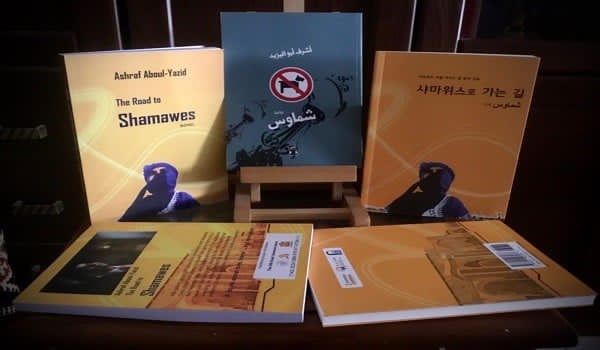
In Ashraf Dali’s novel Shamawes, the fabrication of a fake videotape scandal by Hisham, the general’s son, against Dr. Karim Abdel-Meguid, the embodiment of the artistic spirit, and his strong-willed daughter Dunya, becomes a terrifying cybercrime. Faced with this wave of slander, the artist flees to the countryside, entering a self-imposed exile that exposes his vulnerability and isolation. Yet the novel concludes with the triumph of truth: digital forensic investigation proves Karim’s innocence, and the villagers of Shamawes, moved by Sheikh Abdel-Halim’s sermon after Friday prayer, march with burning torches and set the villa ablaze.
It is a purifying rebellion in which justice is restored by the people themselves. Thus, the stain inflicted upon rural morality by a ruthless modernity and an arrogant elite is washed away through collective popular anger. In both Alabbas and Ashraf Dali, fiction ultimately becomes a geography of the soul and a chronicle of human resistance against oppression, defamation, and moral devastation.
This collective anger converges philosophically with the great outcry that resonates throughout Alabbas’s novella Gözəl (The Beautiful One). After the Armenian atrocities, it is the community itself—the brother, the beloved, and society at large—that casts Gözəl aside as a body supposedly “defiled” by her ordeal. Confronted with the village’s cold, sarcastic silence and merciless suspicion, the woman chooses self-immolation, a tragic final rebellion of violated purity and trampled dignity. Whereas Ashraf Dali invokes a destructive popular uprising to restore justice, Alabbas forces the reader to confront something even more terrifying than the external enemy: the extinction of love and the moral erosion that inhabit our inner selves. In both narratives, the sacrifice of innocence becomes the ultimate manifestation of a profound spiritual crisis within society.
When examining the artistic geography constructed by both writers, one encounters a process of social and spiritual erosion extending from place into symbol. The village of Shamawes in Ashraf Dali’s Shamawes and the homeland of Ayrigar in Alabbas’s The Rebel (Qiyamçı) are not merely narrative settings but artistic models of the wounds inflicted upon human character by globalization, modernity, social pressures, and external influences. Here, a profound parallel emerges in their philosophies of place. In Dali’s novel, Cairo—with its millions of inhabitants and its cold, petrified collectivity—functions as a protagonist in its own right. In Alabbas’s prose, the same merciless collective consciousness materializes within the misty stone houses of Ayrigar. By reducing geographical distances to insignificance, both authors demonstrate that social indifference—the force that suffocates the spirit and attempts to crush solitary individuals who refuse easy compromises—rules everywhere with precisely the same hypocrisy.
Even Alabbas’s statement, “There is no longer any union left within the Union…”, transcends the collapse of the Soviet system itself, becoming a remarkably early artistic and political anticipation of the global moral crises that geopolitical conflicts and great-power rivalries would eventually generate.
In Dali’s work, the legend of “Shamawes” (Little Sun), originating from the ancient Pharaonic language and narrated by the elder Marouf al-Jindi, points toward the primordial spiritual light and original purity of place. Yet the green fields replaced by stone and concrete over recent decades, along with the Gulf returnees who corrupted both nature and customs through local capital, plunge that original radiance into darkness. Likewise, the place names in Alabbas’s artistic universe carry profound philosophical significance. Ayrigar symbolizes rebellion and loneliness against a crooked and unjust environment; Chalmali evokes failure and misfortune; and Naltokan Valley, with its rocky paths, visualizes human obstacles and existential separations.
Just as the inhabitants of Shamawes, detached from their roots and consumed by materialism, forget that the land is a symbol of spiritual abundance and treat it merely as an object of profit, the people of Ayrigar are displaced by historical and political processes, the fearful Soviet regime, and internal betrayals, becoming exiles within their own homeland and victims of an inner migration. In both cases, whether through the gaze of the journalist-writer entering Shamawes or through Alabbas’s role as the chronicler of Ayrigar, alienation is filtered through the consciousness of the national intellectual before reaching the reader.
At the heart of these social and technological transformations, four major typological parallels emerge between the blood-memory of Alabbas’s prose and the artistic principles of Ashraf Dali.
First, both writers portray the destinies shattered by modernity and the assault of urban civilization upon rural morality—particularly the degeneration of the media into an instrument of corruption—as a social diagnosis. The towering walls of the three luxurious villas on the banks of the Nile and their ferocious guard dogs symbolize the abyss between the elite and the villagers, just as Alabbas exposes the mechanisms of fear and adaptation generated by alien ideologies introduced through the Soviet system.
Second, the motif of sacrificed purity constitutes the central pillar of both texts. In Shamawis, the poor village girl and university student Nargis Kamal embodies innocence and a pure spirit striving to help her family, only to become a victim of elite manipulation while attempting to escape the tunnel of social inequality. Similarly, Alabbas’s character Shahriz, whose “only crime is her beauty,” personifies moral purity crushed between outward charm and inner loneliness beneath the crushing weight of social condemnation.
Third, the mystical and metaphysical dimension plays a decisive role in both works. In Dali’s novel, the gypsy fortune-teller and figures such as Shamsiyyali and Marouf al-Jindi, guardians of ancient spiritual memory, become the inner conscience of the other characters. Likewise, in Alabbas’s prose, folk beliefs, dervish-like elements, the wisdom of proverbs, and spiritually sustaining figures such as Teacher Qayyum elevate the narrative to a metaphysical and philosophical plane, transforming storytelling into a meditation upon the human condition itself.
Finally, the fourth point of convergence lies in animal symbolism. The savage guard dogs that tear Nargiz apart in Shamavis are far more than mere animals; through the figure of Hisham Wagih, they become emblems of social ferocity, predatory capitalism, and merciless power. The proverb, “A dog’s tail can never be straightened,” acquires a deeper resonance here, performing the same artistic function as the wolves, dogs, and predatory beasts that populate Alabbas’s fiction, where animal imagery is repeatedly employed to visualize the violence, betrayal, and carnivorous instincts of human nature. The magnitude of this moral collapse and humanity’s estrangement from its natural philosophy is condensed in The Rebel into the bitter statement: “It is better for an animal to remain among animals.”
Alabbas further exposes this ethical and intellectual degradation through another perspective. In the same novel, three “scholars”—Firqat, Sabir, and Teacher Ali—travel from Baku to Ayrigar in an attempt to persuade Babir (Tabriz) to abandon his self-imposed exile. Yet their superficial and ignorant conversations immediately reveal the poverty of their minds. If the rabid dogs in Shamawes represent the physical manifestation of upper-class brutality, these three “academicians,” preoccupied with money, women, and even trivial matters, become symbols of intellectual shallowness and the decline of the cultural elite.
The triviality of the media that forced Dr. Karim into exile and the cheap silence of these pseudo-intellectuals who seek to uproot Babir from his mountain homeland are merely different tonalities of the same sociological corrosion. Even more revealing is their inability to distinguish between ancient artifacts—stone maces, daggers, slings, arrows, and bows—despite their pretensions of conducting academic expeditions to validate Ayrigar’s ancient inscriptions. Their impoverished scholarly vision proves no less destructive than the cyber-slander orchestrated by the general’s son in Dali’s novel. Both writers demonstrate that in societies suffocated by ignorance disguised as wealth and authority, neither Dr. Karim’s devotion to art nor Babir’s fidelity to his ancestral land can remain secure.
In portraying this human tragedy and social injustice, both authors turn to one of fiction’s most demanding dimensions: psychological realism and the interior monologue. Tabriz (Babir) in The Rebel is a complex and resilient figure who has lived for decades in solitude, relentlessly seeking answers to existential questions. His internal monologues and imagined dialogues through letters become expressions of spiritual rebellion and inward vengeance. When he confesses to Shahriz, “Know this, Shahriz: my wholehearted love for you caused everything…”, he paints the portrait of a catastrophe born of love itself. Human emotions, elevated to an almost sacred absolute, render him powerless before both love and family, tearing him apart between divine values and personal desire.
In Dali’s novel, Ahmad appears as Cairo’s equivalent of this inner conflict and this longing to revive violated higher values. Amid the chaos and enormity of the Egyptian metropolis, Ahmad, like Babir, strives to preserve human dignity and relationships crushed beneath materialism, living his own silent rebellion.
At this point, both writers endow the concept of rebellion with a new philosophical significance. Rebellion is neither destruction nor violence, nor the attempt to establish a new order by force. Rather, it is a quiet inward struggle to preserve purity, remain faithful, and defend the principles that give meaning to human existence.
From the ancient streets of Cairo to the wounded yet proud provinces of Azerbaijan, these literary parallels reveal a timeless dialogue between souls. Through their sincerity, their absence of rhetorical excess, and their profound interior monologues, both works remove the reader from the position of passive observer and transform them into an active participant in a process of catharsis.
In the face of ruthless pragmatism, wars, and moral erosion, only one force appears capable of saving humanity: the magic of the truthful word that transcends all borders.
In this sense, this comparative literary reading—which uncovers the intersections between Alabbas and Ashraf Dali and examines the shared wounds of Eastern consciousness—serves directly the higher purpose of Dali’s project, The Silk Road Today. That purpose coincides spiritually with contemporary efforts to reopen the Zangezur Corridor and revive the historic Silk Road itself. The literary and scholarly bridge established by this study thus becomes a tangible act of restoring forgotten spiritual memory and renewing the bonds of affection among peoples.
As long as this word and this mission endure, neither the cries of the world’s “Beauties” shall be lost, nor shall the banner of moral rebellion raised by Babir, Ahmad, and the people of Shamawes ever be lowered.