 thesilkroadtoday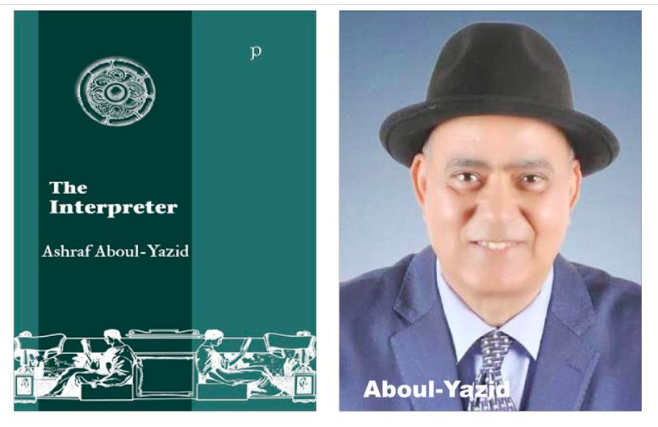

Exile’s cacophany
Rana Mohamed Hassan , Tuesday 4 Aug 2026
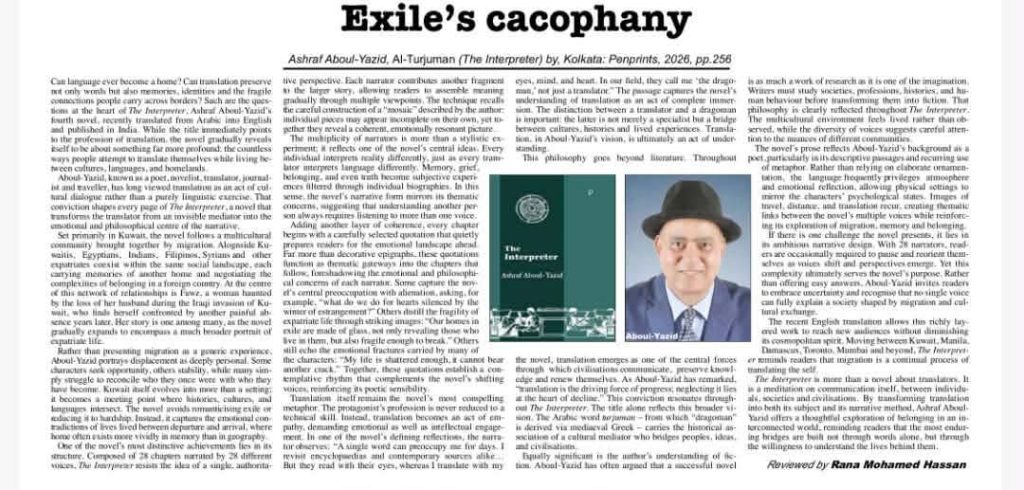
Ashraf Aboul-Yazid, Al-Turjuman (The Interpreter) by, Kolkata: Penprints, 2026, pp.256
Can language ever become a home? Can translation preserve not only words but also memories, identities and the fragile connections people carry across borders? Such are the questions at the heart of The Interpreter, Ashraf Aboul-Yazid’s fourth novel, recently translated from Arabic into English and published in India. While the title immediately points to the profession of translation, the novel gradually reveals itself to be about something far more profound: the countless ways people attempt to translate themselves while living between cultures, languages, and homelands.
Aboul-Yazid, known as a poet, novelist, translator, journalist and traveller, has long viewed translation as an act of cultural dialogue rather than a purely linguistic exercise. That conviction shapes every page of The Interpreter, a novel that transforms the translator from an invisible mediator into the emotional and philosophical centre of the narrative.
Set primarily in Kuwait, the novel follows a multicultural community brought together by migration. Alognside Kuwaitis, Egyptians, Indians, Filipinos, Syrians and other expatriates coexist within the same social landscape, each carrying memories of another home and negotiating the complexities of belonging in a foreign country. At the centre of this network of relationships is Fawz, a woman haunted by the loss of her husband during the Iraqi invasion of Kuwait, who finds herself confronted by another painful absence years later. Her story is one among many, as the novel gradually expands to encompass a much broader portrait of expatriate life.
Rather than presenting migration as a generic experience, Aboul-Yazid portrays displacement as deeply personal. Some characters seek opportunity, others stability, while many simply struggle to reconcile who they once were with who they have become. Kuwait itself evolves into more than a setting; it becomes a meeting point where histories, cultures, and languages intersect. The novel avoids romanticising exile or reducing it to hardship. Instead, it captures the emotional contradictions of lives lived between departure and arrival, where home often exists more vividly in memory than in geography.
One of the novel’s most distinctive achievements lies in its structure. Composed of 28 chapters narrated by 28 different voices, The Interpreter resists the idea of a single, authoritative perspective. Each narrator contributes another fragment to the larger story, allowing readers to assemble meaning gradually through multiple viewpoints. The technique recalls the careful construction of a “mosaic” described by the author: individual pieces may appear incomplete on their own, yet together they reveal a coherent, emotionally resonant picture.
The multiplicity of narrators is more than a stylistic experiment; it reflects one of the novel’s central ideas. Every individual interprets reality differently, just as every translator interprets language differently. Memory, grief, belonging, and even truth become subjective experiences filtered through individual biographies. In this sense, the novel’s narrative form mirrors its thematic concerns, suggesting that understanding another person always requires listening to more than one voice.
Adding another layer of coherence, every chapter begins with a carefully selected quotation that quietly prepares readers for the emotional landscape ahead. Far more than decorative epigraphs, these quotations function as thematic gateways into the chapters that follow, foreshadowing the emotional and philosophical concerns of each narrator. Some capture the novel’s central preoccupation with alienation, asking, for example, “what do we do for hearts silenced by the winter of estrangement?” Others distill the fragility of expatriate life through striking images: “Our homes in exile are made of glass, not only revealing those who live in them, but also fragile enough to break.” Others still echo the emotional fractures carried by many of the characters: “My life is shattered enough, it cannot bear another crack.” Together, these quotations establish a contemplative rhythm that complements the novel’s shifting voices, reinforcing its poetic sensibility.
Translation itself remains the novel’s most compelling metaphor. The protagonist’s profession is never reduced to a technical skill. Instead, translation becomes an act of empathy, demanding emotional as well as intellectual engagement. In one of the novel’s defining reflections, the narrator observes: “A single word can preoccupy me for days. I revisit encyclopaedias and contemporary sources alike… But they read with their eyes, whereas I translate with my eyes, mind, and heart. In our field, they call me ‘the dragoman,’ not just a translator.” The passage captures the novel’s understanding of translation as an act of complete immersion. The distinction between a translator and a dragoman is important: the latter is not merely a specialist but a bridge between cultures, histories and lived experiences. Translation, in Aboul-Yazid’s vision, is ultimately an act of understanding.
This philosophy goes beyond literature. Throughout the novel, translation emerges as one of the central forces through which civilisations communicate, preserve knowledge and renew themselves. As Aboul-Yazid has remarked, “translation is the driving force of progress; neglecting it lies at the heart of decline.” This conviction resonates throughout The Interpreter. The title alone reflects this broader vision. The Arabic word turjuman – from which “dragoman” is derived via mediaeval Greek – carries the historical association of a cultural mediator who bridges peoples, ideas, and civilisations.
Equally significant is the author’s understanding of fiction. Aboul-Yazid has often argued that a successful novel is as much a work of research as it is one of the imagination. Writers must study societies, professions, histories, and human behaviour before transforming them into fiction. That philosophy is clearly reflected throughout The Interpreter. The multicultural environment feels lived rather than observed, while the diversity of voices suggests careful attention to the nuances of different communities.
The novel’s prose reflects Aboul-Yazid’s background as a poet, particularly in its descriptive passages and recurring use of metaphor. Rather than relying on elaborate ornamentation, the language frequently privileges atmosphere and emotional reflection, allowing physical settings to mirror the characters’ psychological states. Images of travel, distance, and translation recur, creating thematic links between the novel’s multiple voices while reinforcing its exploration of migration, memory and belonging.
If there is one challenge the novel presents, it lies in its ambitious narrative design. With 28 narrators, readers are occasionally required to pause and reorient themselves as voices shift and perspectives emerge. Yet this complexity ultimately serves the novel’s purpose. Rather than offering easy answers, Aboul-Yazid invites readers to embrace uncertainty and recognise that no single voice can fully explain a society shaped by migration and cultural exchange.
The recent English translation allows this richly layered work to reach new audiences without diminishing its cosmopolitan spirit. Moving between Kuwait, Manila, Damascus, Toronto, Mumbai and beyond, The Interpreter reminds readers that migration is a continual process of translating the self.
The Interpreter is more than a novel about translators. It is a meditation on communication itself, between individuals, societies and civilisations. By transforming translation into both its subject and its narrative method, Ashraf Aboul-Yazid offers a thoughtful exploration of belonging in an interconnected world, reminding readers that the most enduring bridges are built not through words alone, but through the willingness to understand the lives behind them.
* A version of this article appears in print in the 6 August, 2026 edition of Al-Ahram Weekly