 thesilkroadtoday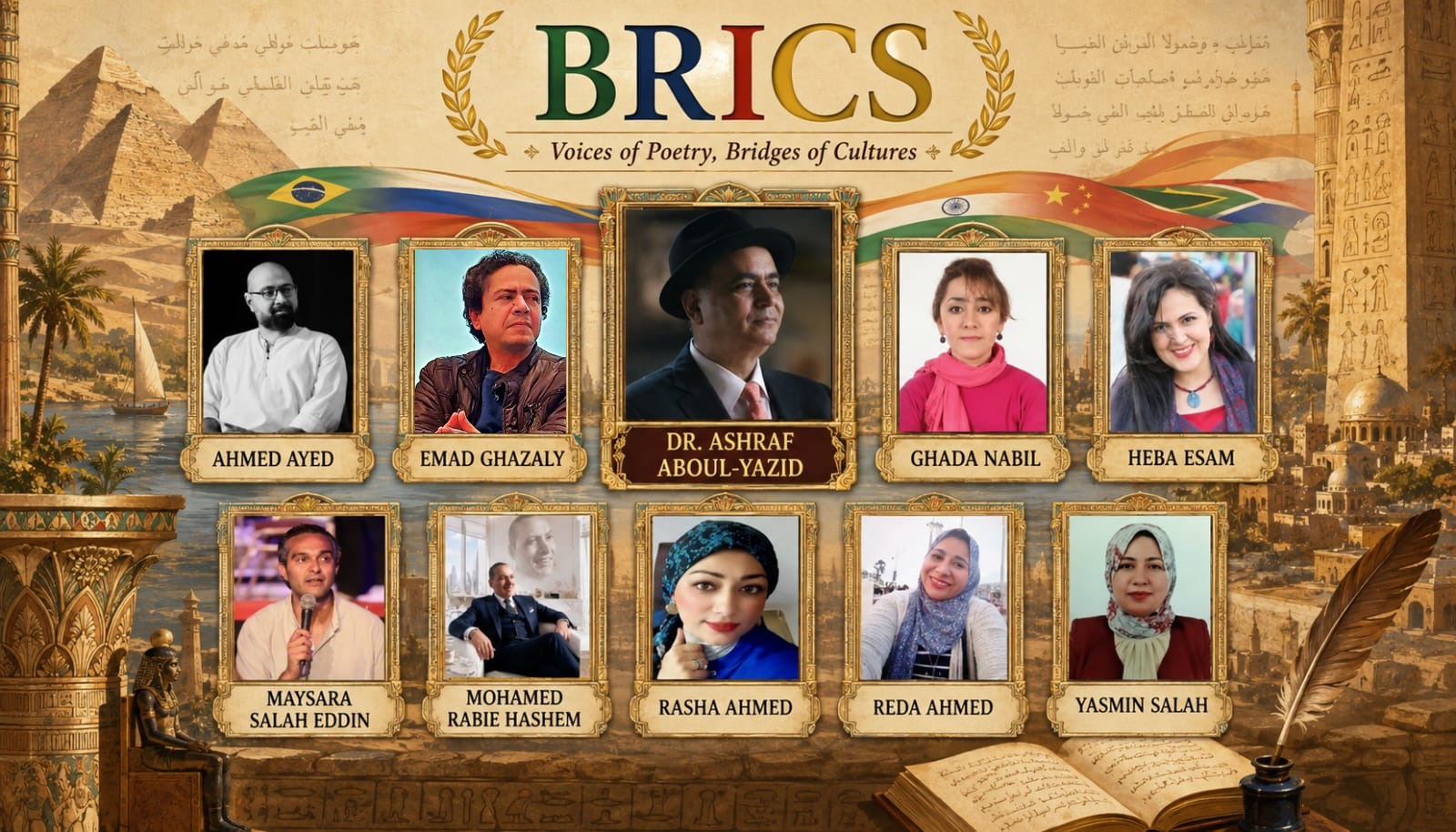
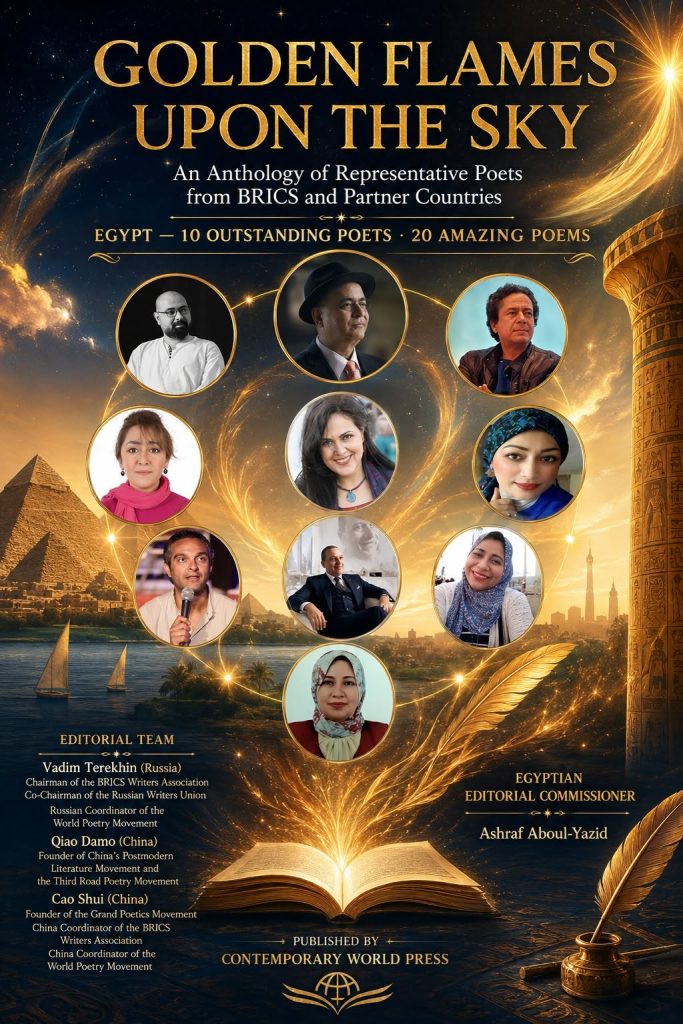
It is with great pride and pleasure that we present the distinguished poets of Egypt participating in Golden Flames Upon the Sky — Anthology of Representative Poets from BRICS and Partner Countries. Their presence in this international literary project brings to the anthology the depth of Egypt’s ancient cultural heritage and the vibrant energy of its contemporary poetic voices. Egypt, a land where civilization, language, memory, and imagination have met for millennia, continues to offer poetry that speaks both from its unique national experience and to the wider human family. Through their selected poems, these Egyptian poets contribute diverse visions, emotions, and artistic expressions to a collective dialogue among BRICS and Partner Countries. Their voices cross geographical and linguistic boundaries, affirming poetry’s enduring power to create understanding, solidarity, and beauty. We warmly congratulate the participating poets and celebrate their valuable contribution to this shared cultural journey, where Egypt’s poetic flames rise to illuminate the skies of the world.
Egyptian Voices, Golden Flames
Ghada Nabil
Ghada Nabil is an Egyptian poet, critic, and cultural writer born in 1960, whose literary career has spanned more than two decades. She is the author of several poetry collections, including Lying in Wait for Herself (1999), As If I Want (2005), Fit for Another Life (2008; second edition 2010), Bin Laden’s Embroidery (2010), Air of the Forgotten (2014), and Without a Pseudonym (2019). In 2024, she coauthored Intersections with poet Atef Abdel Aziz, her only collaborative book, while her forthcoming collection is titled A Chronic Half Moon. Her long poem Les Interdits (2013) was published in Arabic and French through the Lettres Capitales project. Nabil has represented Egypt internationally and participated in poetry festivals and cultural events across France, Tunisia, Morocco, Algeria, and beyond. Her poetry has been translated into Italian, French, Spanish, and Kannada and featured in numerous international anthologies. A finalist for the Mediterranean Poetry Prize in Italy in 2024/2025, she has also served on literary juries and worked as a columnist and critic. Holding a Master’s degree in Modern English and American Literature from the University of East Anglia, she helped found Muqaddima magazine and joined Egypt’s “Angry Poets” movement.
Rasha Ahmed
Rasha Ahmed is an Egyptian poet and journalist whose literary work explores themes of emotion, memory, love, loss, and human experience. She is the author of six poetry collections that reflect her evolving poetic vision and distinctive voice: *Ode to Adoration* (2013), *Boredom of Losses* (2014), *Nothing but the Water of My Heart* (2016), *Magic of the East: An Anthology* (2017), *With the Help of a Fading Light* (2019), and *An Empty Seat, Weary with Light* (2023). Through her poetry, Ahmed combines lyrical sensitivity with contemplative reflections on the inner life, drawing upon personal and cultural imagery to explore the complexities of contemporary existence. As a journalist, she also contributes to the cultural and intellectual landscape, connecting literary creativity with public discourse. Her published collections establish her as an active voice in contemporary Egyptian poetry, while her journalistic work further demonstrates her commitment to literature, culture, and artistic expression.
Heba Esam
Heba Esam is an Egyptian poet and writer born in Cairo, whose work has established her as a distinctive voice in contemporary Arabic poetry. She is a member of the Egyptian Writers Union and the Cairo Atelier for Writers and Artists. Throughout her literary career, she has actively participated in numerous cultural and literary forums in Egypt and abroad, representing Egyptian poetry in events and gatherings held in Jordan, Spain, Algeria, Tunisia, Libya, Syria, and Yemen. Her poems have been widely published in Arab and international newspapers, journals, and literary magazines. Esam is the author of several acclaimed poetry collections, including A Red Garment and a Spider (Ḥullah Ḥamrāʾ wa ʿAnkabūt), published by Sharqiyat Publishing House in Cairo in 2008; That the Flower May Devour Us (An Taʾkulanā al-Wardah), published by Sharqiyat in 2011; and What Remains of the Excess Weight (Mā Yabqā min al-Wazn al-Zāʾid), published by Rawafed Publishing and Distribution in Cairo in 2018. Through poetry marked by rich imagery, emotional depth, and a nuanced lyrical sensibility, Heba Esam explores human experience and its intimate transformations. Her continuing engagement with literary and cultural life reflects her commitment to poetry as a vital space for imagination, dialogue, and expression.
Maysara Salah El-Din
Maysara Salah El-Din is an Egyptian poet, playwright, and translator. He has published numerous poetry collections, verse plays, and musicals, including I’m Not a Knight at Heart, Window of Shyness, Secret Numbers, Pandora, Raml Tram: A Collection of Musicals, Opera Garage: Two Plays, Son of the Morning, and Mas’oud Well: A Musical Trilogy. His work has received several national and Arab awards, including the Ministry of Culture Medal for Egyptian colloquial poetry. He has participated in literary and cultural events in Egypt and abroad, including the World Languages, Literatures, and Cultures Conference at Cleveland State University, the Dibba Al-Hisn Festival for Bilateral Theatre in Sharjah, and the Abu Dhabi and Cairo International Book Fairs. His poetry has been translated into English, Italian, and Spanish, and his collection Secret Numbers was published in Spanish. His plays have been performed on stage and radio. As a translator, he has translated major works including Douglas Stuart’s Booker Prize-winning Shuggie Bain, The Seven Moons of Maali Almeida by Shehan Karunatilaka, The Bell Jar by Sylvia Plath, and The Letters of Stefan Zweig. He has also translated selected poems by Langston Hughes, Robert Frost, and Edna St. Vincent Millay for an anthology of American poetry published by the Egyptian Ministry of Culture.
Yasmin Salah
Yasmin Salah Abdel Rahim Hussein is an Egyptian poet, dermatologist, and academic, born in Assiut, Egypt, in 1992. She earned her Bachelor’s degree in Medicine and Surgery in 2018 and later obtained a Master’s degree in Dermatology, Venereology, and Andrology in 2022. Since 2023, she has been pursuing doctoral research in dermatology. She currently serves as an Assistant Lecturer in the Department of Dermatology at Assiut University Hospital. Alongside her distinguished medical career, Yasmin Hussein has established a growing presence in contemporary Egyptian poetry. Her first poetry collection, *Fire Has Another Mood*, won the Central Competition Prize of Egypt’s General Authority for Cultural Palaces in 2020. Her manuscript *Who Let the Wheel of Darkness Loose?* was shortlisted for the Salah Abdel Sabour دورة of the House of Poetry Award for Best Poetry Manuscript in 2021. In 2022, her manuscript *Seven Sayings for One Truth* won the Poetry Committee Prize of Egypt’s Supreme Council of Culture and was subsequently published in Adonis’s *Ishraqat* series in 2025. Her collection *The First Thing the Clay Saw* won the Mohammed bin Saleh Bashraheel Literary Prize in 2026. Her prose poems have also appeared in major contemporary Egyptian poetry anthologies, including *Springs That Make a River* and *Madmen of the Prose Poem 3*, both published in 2024.
Ahmed Ayed
Ahmed Ayed is an Egyptian poet, language reviewer, literary editor, and researcher in contemporary literary criticism. Born on December 19, 1988, he combines creative writing with academic and linguistic work, while also studying Arabic calligraphy. He graduated from the Faculty of Education at Suez Canal University in 2009 with a Very Good grade and earned a Master’s degree in Contemporary Literary Criticism with Distinction from the University of the Arab League in 2025. He is currently pursuing doctoral research in contemporary literary criticism. Throughout his literary career, Ahmed Ayed has received numerous grants and awards, including the Kalam Youth Grant from the European Union and the Italian Cultural Institute in Cairo, the Talaat Harb Center Prize, the Central Award of the General Authority for Cultural Palaces, the Poetry Committee Prize of the Supreme Council of Culture, the Al-Badr Prize, the Afaq, Safsafa and Tlemceni House Grant, the Luxor House of Poetry Prize, and the Port Said Short Documentary Film Festival Prize. He is the author of ten poetry collections, including *Green Ashes*, *The Recluse*, *Time*, *As Water Describes a Gazelle*, *I Drink My Coffee… I Ramble*, *Seven Blue Words*, *This Is My Kingdom*, *Light and Deadly*, *A Shadow Guards Forgetfulness*, and *I Do Not See Things as They Are*. His poetry is distinguished by imaginative transformations, philosophical reflection, and a striking exploration of human existence, memory, language, and the changing forms of life.
Emad Ghazaly
Emad Ghazaly, born in Cairo in 1962, he is an Egyptian poet and cultural figure whose literary career has been distinguished by a sustained commitment to modern Arabic poetry. He graduated from the Faculty of Engineering at Ain Shams University in 1985, while continuing to develop his poetic voice and literary presence. His poems have been widely published in major Egyptian literary periodicals as well as in several Arab journals. He is a member of the Egyptian Writers’ Union and serves as a member of the Poetry Committee of the Supreme Council of Culture in Egypt. His poetry collections include *A First Song* (1990), *Written on the Door of the Poem* (1990), *Other Spaces for the Straying Bird* (1999), *A Shadow Not Yours* (2004), *Do Not Wound the White* (2005), *The Place Lightly* (2008), *Spoiled Catch* (2009), *Leaning Walls* (2009), *We Get Rid of What We Love* (2013), *The Cactus Garden* (2026), and *The Organizer of Gems* (2026). His forthcoming collection, *A City on the Edge*, is currently in preparation for publication. His literary achievements have been recognized with the Dr. Suad Al-Sabah Prize (1990), the Egyptian State Encouragement Award (2000), and the Egyptian Writers’ Union Prize (2005).
Dr. Mohamed Rabie Hashem
Dr. Mohamed Rabie Hashem is an Egyptian poet and literary figure, born in 1970 in Fayoum Governorate. He began his creative journey with the generation of Egyptian poets who emerged during the 1990s, and his poetry has since been widely published in newspapers and literary journals. Actively involved in Egypt’s cultural and literary life, he served as a member of the Secretariat of the Egypt Writers’ Conference in Mansoura in 1998 and later as Assistant Secretary-General of the conference in Damanhur in 1999. Dr. Hashem has published seven poetry collections: *The Bird of Angels* (1992), *The Biography of Fusion and Instinct* (2002), *The Wind Dwells in His Blood* (2009), *Her Dowry Is Passion* (2012), *The Dervish Sleeps upon His Forehead* (2018), *The Moon’s Most Beautiful Face* (2025), and *Wings Reaching Toward the Light* (2025). Through his sustained poetic career, Mohamed Rabie Hashem has established a distinctive presence in contemporary Egyptian poetry.
Reda Ahmed
Reda Ahmed is an Egyptian poet born in Cairo in 1982. She holds a Bachelor’s degree in Social Work from Helwan University and is recognized as a distinctive voice in contemporary Egyptian poetry. Her work is characterized by imaginative imagery, emotional depth, and a continuous exploration of human experience through the language and possibilities of modern poetry. She has published six poetry collections: *They Have What March Does Not* (2016), *Borrowed Kisses* (2018), *We Ate from His Favorite Tree* (2020), *Confession Is a Common Mistake* (2021), *A Goldfish in the Bowl of Eternity* (2022), and *Until the Chessboard Separates Us* (2026), published by Almutawassit in Milan. Her forthcoming collection, *A Butterfly on a Coffin*, represents a further stage in her continuing literary journey. Reda Ahmed’s poetry has crossed linguistic and cultural boundaries, with translations appearing in French, Greek, English, Kurdish, and Amazigh. Her poems have also been published in numerous Arab and European literary journals and periodicals, contributing to her growing international presence. Her achievements have been recognized through several important literary awards, including the Afifi Matar Award in 2017, the Helmy Salem Award in 2020, the Central Literary Award of Egypt’s General Authority for Cultural Palaces in 2021, and the Tulliola–Renato Filippelli International Poetry Award, Arab Section, in 2022. Through her publications and translations, she continues to enrich contemporary Arab poetry.
Dr. Ashraf Aboul-Yazid
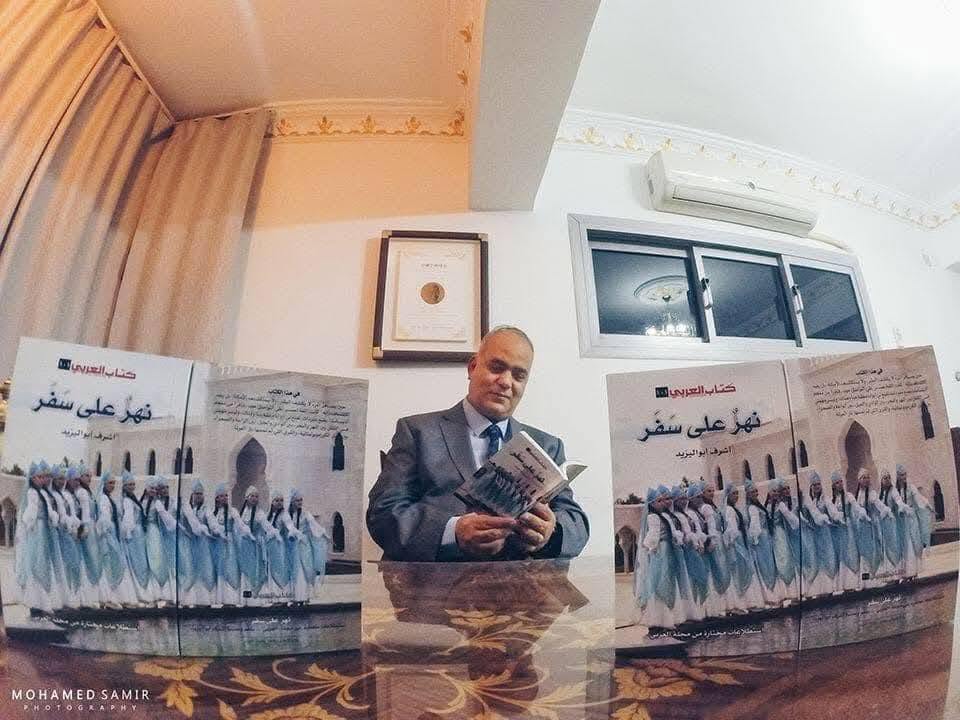
Dr. Ashraf Aboul-Yazid is an Egyptian poet, novelist, translator, journalist, travel writer, and author of children’s literature whose work has established him as a prominent voice on both the Arab and international cultural scenes. He studied English literature and specialized in the sociology of literature, earning his PhD from the American University of Science and Technology (AUST) in Delaware, United States, for his dissertation, “Crisis Management in the Arabic Novel and Its Social Impact.” A member of the Egyptian Writers’ Union, he serves as Vice President for Media of the World Organization of Writers (WOW), Vice President for North Africa of the Pan African Writers Association (PAWA), and Secretary-General of the Congress of African Journalists (CAJ). He is also Editor-in-Chief of the Silk Road Literature Series. He authored and translated more than 40 works, and his books have been translated to a dozen of languages. His distinguished media career includes serving as President of the Asia Journalist Association, Editor-in-Chief of AsiaN Arabic, Senior Editor of Al-Arabi magazine, and Cultural Correspondent for Reuters in Cairo. His literary and cultural achievements have earned him numerous international honors, including the Manhae Prize, Arab Journalism Award, Sawiris Cultural Award, WOW Medal in Translation, and Poet of the Year for Africa. In 2026, he received the Outstanding Cultural Worker Award from the Government and Ministry of Culture of Mongolia.