
 thesilkroadtoday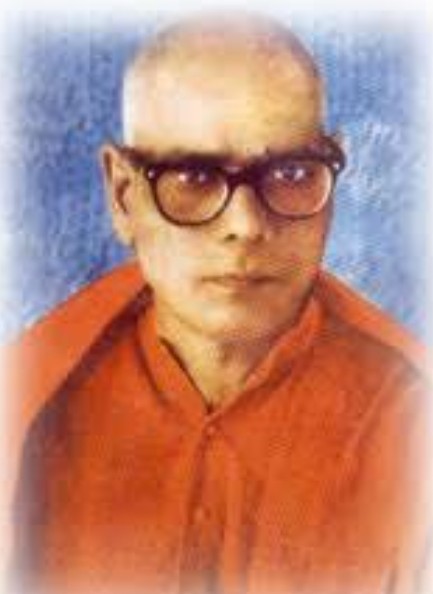
By Prof. Swati Haribhau Kate *
India was fortunate to be blessed with the brilliant personality of Swami Ramanand Tirth, a distinguished son of the nation who dedicated his life to the welfare of the country. Venkatesh was born to Yashoda and Bhavanrao on 3 October 1903 at Sindgi in Karnataka. The spiritual practices of his parents left a deep impression on his tender mind during his childhood. He began his education in his native village of Sindgi and subsequently continued his primary education at Ganagapur.
Impressions of Patriotism
Venkatesh joined the renowned Northcote High School in Solapur. It was at this school that he was exposed to patriotic values and the seeds of nationalism were planted in his mind. During a visit to Mumbai, he listened to a speech by the then Governor, Lord Wellington, at the Maconochie Theatre. The speech generated a strong resentment against British imperialism in young Venkatesh. With the help of his friends, he removed and threw away the Union Jack that had been displayed at the hostel.
During his school years, he developed a close friendship with Eknath Godbole. This friendship became an important influence in shaping his commitment to a selfless way of life.
Hard Work, Study and Writing
Venkatesh proceeded to the National College at Amalner for higher education. He received ten rupees a month from his brother to meet his hostel and daily expenses. To support himself, he worked for three hours every day in the college library and earned fifteen rupees a month. Thus, he pursued his college education through his own hard work and self-reliance.
He would rise at around 3:30 a.m. and study until late at night. During this period, with the cooperation of his friends, he published a handwritten magazine in which he wrote a column titled Vedyache Pratap. The magazine primarily contained reflections based on personal experiences.
Discussions with his classmates about their studies also played an important role in his educational development. The principal of the college, Janardanpant Gune, was a spiritually inclined and celibate householder. His personality and disciplined way of life deeply influenced Venkatesh.
Advocacy of Swadeshi and Khadi
Venkatesh imbibed the qualities of dedication to duty and discipline from his principal. During this period, he established a volunteer corps. Patriotic songs, self-discipline, preservation of moral values and spinning yarn on the charkha were undertaken with dedication and discipline. These activities generally continued for about an hour.
He strongly advocated the use of khadi. During this period, he also developed the habit of regularly reading Young India, the periodical associated with Mahatma Gandhi. In order to promote the use of indigenous goods, he and his friends set fire to piles of mill-made cloth.
Following differences that arose in the hostel, he was compelled to leave it. He subsequently lived in a dilapidated house situated about two miles away, paying two rupees a month for accommodation and sustaining himself on dal and bhakri. Without complaining about his circumstances, he continued his journey with determination.
His Stay in Pune
For further education, he went to Tilak College in Pune. In 1925, he obtained the degree of Vangmaya Visharad. Subsequently, he was selected as a Fellow for two years and earned the postgraduate degree of Vangmaya Parangat, equivalent to an M.A., after writing an excellent dissertation on “The Development of Democracy.”
During his stay in Pune, he came into contact with N. M. Joshi, a prominent leader of the labour movement. Joshi was looking for an assistant and had invited applications in the form of an essay on “Capital and Labour.” Venkatesh responded to the call and wrote the essay. N. M. Joshi was impressed by his work, and Venkatesh was appointed to the position.
His Work in Mumbai
Thus, Venkatesh began using his education for the welfare of society. He joined the Textile Labour Union in Mumbai as a city organiser.
During his stay in Mumbai, he closely observed the exploitation of workers, which generated deep indignation within him. It was during this period that he came into contact with the renowned labour leader S. H. Jhabvala. Venkatesh willingly accepted the responsibility of editing the weekly publication Kamgar, which Jhabvala had started.
He also became a member of the Servants of India Society. Along with labour leader N. B. Saklatwala, he began attending various workers’ meetings and became increasingly involved in labour issues.
Reporting from Delhi
N. M. Joshi arranged a press pass for Venkatesh from the Pune-based newspaper Dnyan Prakash. This enabled him to attend and report on proceedings of the Central Legislative Assembly in Delhi.
During this period, he had the opportunity to listen to speeches by several prominent national leaders and to observe closely how they worked. He gained an understanding of their methods of leadership and public work. He learned about leaders such as Lala Lajpat Rai and Motilal Nehru, and observed their political activities at close quarters.
Return to Solapur
During this period, Venkatesh suffered a paralytic stroke. Although he recovered successfully, he found it difficult to endure excessive physical exertion. Therefore, N. M. Joshi assigned him responsibility for the labour movement in Solapur instead of continuing his work in Mumbai.
During his stay in Solapur, Venkatesh developed a close association with Anantrao Kulkarni, the director of the school at Hipparga. Kulkarni introduced him to the National School at Hipparga and suggested that he take responsibility as its headmaster. Venkatesh informed him that he would visit the school and take a decision after seeing its work.
His Work as a Teacher
After visiting the school and becoming convinced of its mission, Venkatesh began a new chapter in his life. On 9 June 1929, Venkatesh Bhavanrao Khedgikar joined the Hipparga School as its headmaster.
He became deeply involved with the students. He undertook various experiments to inculcate patriotism, morality, discipline and self-reliance among them. Along with the formal curriculum, he introduced value-based education.
While he was at Hipparga, his desire to embrace the life of a monk became increasingly strong. On 14 January 1932, he received initiation into monastic life at Hipparga from Narayan Swami, a disciple of Swami Ram Tirth. From that day, Venkatesh Bhavanrao Khedgikar came to be known as Swami Ramanand Tirth.
The Emergence of Swami Ramanand Tirth
Swami Ramanand Tirth had to struggle considerably to obtain official recognition for the school. Observing his dedication, perseverance and ability to work, Sir Haidari gave a written assurance regarding recognition of the school.
During a visit to Mumbai in 1937, Syed Ali Akbar inspected the school and conducted examinations of the students. Joshi also worked alongside Swamiji to secure recognition for the institution. Their efforts eventually succeeded.
In 1938, the first batch of students completed the tenth standard at Hipparga School. This achievement was not merely a victory concerning the recognition of a school; it represented a powerful source of hope in the effort to create public awareness and resistance against the Nizam’s rule. Subsequently, the educational institution gave rise to Yogeshwari Science College in 1956.
The Raja Dhanrajgir of Hyderabad was an extremely wealthy personality and was regarded as the “Kubera of the Deccan.” He had great respect for Swami Ramanand Tirth. He was invited to the decennial celebration of the Hipparga School.
On 22 January 1932, Raja Dhanrajgir expressed his appreciation of the principles and work adopted by Swamiji. On the occasion of the Amrit Mahotsav of Marathwada, I had the opportunity to meet his daughter, Princess Indiradevi. She was extremely calm and affectionate. We had an extensive discussion about her father, his work in Hyderabad during the Nizam period, and various movements concerning women during that era.
Educational Work in Ambajogai
Following certain ideological differences at the Hipparga School, Swami Ramanand Tirth began to devote attention to the Yogeshwari School at Ambajogai. He had already been thinking of establishing a school at Ambajogai.
Narayanrao Joshi had established the Yogeshwari Nutan Vidyalaya in 1918. The school functioned in a hall near the Yogeshwari temple. Swami Ramanand Tirth arrived there in March 1935.
On 5 May 1935, the auspicious day of Akshaya Tritiya, the eighth standard was newly introduced at the school. Swamiji began serving as the headmaster of Yogeshwari Nutan Vidyalaya. In July 1936, he introduced the ninth standard.
Because of its emphasis on patriotism and its opposition to the Nizam’s rule, as well as the fact that instruction was not provided in Urdu, the Nizam government refused to recognise the school.
In the context of this school, Swamiji expressed the philosophy that:
«“Our school will give students new ideas, but it will not impose any particular ideology upon them. The school will teach them to break down the walls between human beings and recognise the humanity within every heart.”»
Along with Swami Ramanand Tirth, Babasaheb Paranjape worked to communicate this vision to the people.
Leadership of the Freedom Movement
There was a growing realisation that effective leadership was necessary to fight against the Nizam. People began discussing the fact that Swami Ramanand Tirth was capable and well suited to lead the political movement in the Hyderabad State.
Swamiji discussed the matter with the executive committee of Yogeshwari School. All the members encouraged him to take active leadership in the political movement.
Swami Ramanand Tirth subsequently became the secretary of the temporary committee of the Maharashtra Parishad. He resigned from his position as headmaster and left the institution. On 9 June 1938, he proceeded towards Hyderabad with the determination that the people would establish a “responsible government” in the state.
The Educational System under the Nizam
Education under the Nizam was largely designed to serve the interests of the Nizam’s administration. Nizam law was given prominence in the curriculum. The medium of instruction was Urdu, and students were required to wear the prescribed Nizami dress.
The traditional attire consisted of a long jhabba and a Rumi topi. Educational institutions were broadly divided into three categories: primary schools from the first to the fourth standard, known as Madras-e-Tahniya; middle schools from the fifth to the seventh standard, known as Madras-e-Wastania; and secondary schools from the eighth to the tenth standard, known as Madrasa-e-Fauqania.
Later, Osmania University was established. In this period, the first industrial education school in Chhatrapati Sambhajinagar was established in 1881, followed by an agricultural school in 1892.
At Madrasa-e-Fauqania in Chhatrapati Sambhajinagar, education was offered in English as well as Urdu. An Osmania Intermediate College was also established in the city. A law making written examinations compulsory for students to pass was enacted in 1873.
Establishment of National Schools
To oppose Nizam rule and generate a spirit of patriotism among the people, it was essential to establish a large number of national schools imparting education through the mother tongue.
Between approximately 1916 and 1946, several educational institutions in the Hyderabad State played an important role in the national movement. These included institutions in Parbhani, Saraswati Bhuvan in Chhatrapati Sambhajinagar, Maratha High School, Sharada Mandir, Shri Krishna College at Gunjoti, educational institutions at Chakur, Yogeshwari at Ambajogai, educational institutions at Udgir, and Jubilee and Rajasthan institutions at Latur.
The private school established by the daughter of Sushilabai Diwan, who had the honour of presiding over the first Women’s Conference held at Partur, was also highly appreciated during that period.
Emphasis on the Importance of the Mother Tongue
In opposition to the Nizam government and in order to give prominence to the mother tongue, organisations such as the Andhra Sangham and the Arya Samaj began establishing schools, libraries and independent curricula. Similar efforts were also initiated in Marathwada.
Approximately twenty to twenty-one schools were established during this period. Vivek Vardhini in Hyderabad and an educational institution established by Vitthalrao Deulgaonkar at Gulbarga also contributed to this movement.
The Need for National Education
Around 1906, the concept of national education began to gain importance within the Indian freedom movement, with emphasis on patriotism, the mother tongue and Indian culture. Inspired by this approach, schools were established at various places in Marathwada.
Through the educational movement, efforts were made to cultivate patriotism among the people. This eventually proved significant for the larger cause of a united India.
Swami Ramanand Tirth began contributing actively to this educational movement. In 1947–48, an educational institution was established for the study of Sant literature.
At that time, educational institutions throughout Nanded were charged with patriotic spirit. Institutions and initiatives such as Vikas Mandir Library, Banjara Hostel, Hutatma Pansare High School at Dharmabad, Chokhamela Hostel, adult education activities of the Mahila Samata Parishad, Vivek Vardhini Marathi School in Hyderabad, and educational institutions at Kandhar, Bhokar, Khamgaon and Buldhana were deeply inspired by the spirit of nationalism.
Establishment of Physical Education Centres
Education was not understood merely as classroom learning. Along with intellectual development, physical fitness was also considered important. Therefore, several vyayamshalas or physical education centres were established in Nanded and throughout Marathwada during that period.
Music and fine arts schools and libraries were also established. Lecture series were organised, and magazines and newspapers were launched. Many of those associated with these initiatives continued to uphold honesty and dedication to duty throughout their lives.
The Pratibha Niketan educational institution, established in Nanded on 21 June 1940, the Balak Mandir started by Indrayani Bodhankar, and the Marathwada Women’s Education Institution, which later came to be known as Marathwada Mahila Udyog, worked for the benefit of ordinary people.
Educational Development after the Success of the Liberation Movement
After the successful liberation movement, Swamiji realised that genuine development in Marathwada could be achieved primarily through education. He therefore began taking concrete steps in this direction.
The result was the establishment of People’s College in Nanded on 26 June 1950.
The institution was envisioned as a place where knowledge and character would receive the highest priority. Swamiji described it as a small nest. Just as birds lovingly feed their young in a nest, students would be nurtured with knowledge that would make them worthy of serving and loving the nation.
The objective of the institution was to develop the complete human being. Students would be nurtured in the values of democracy and secularism so that they could contribute to building the India of the future.
The Nanded Education Society was established for the management of the college.
In 1953, People’s High School was established under the same organisation, followed by the establishment of the Science College in 1963.
Swamiji believed that the student of today is the architect of the India of tomorrow. From this perspective, educational institutions must create generations committed to goodness and capable of nurturing democratic values.
Inspired by his ideals, a tradition of dedicated service-oriented workers continues to exist in this institution.
Swami Ramanand Tirth realised that genuine development in Marathwada after the liberation struggle could be achieved through education. He therefore initiated several measures in that direction.
People’s College in Marathwada may truly be regarded as the soul of Swami Ramanand Tirth. Even today, the Nanded Education Society continues to function according to the constitution and principles formulated by Swami Ramanand Tirth.
Swami Ramanand Tirth’s Philosophical and Ethical Thought
Swami Ramanand Tirth believed that religion travels from heart to heart. He considered self-governance and self-discipline essential. According to him, a teacher with a pure heart could give strength to the nation.
He believed that when the values of life change, the values of education must also change. Students should remain detached from partisan politics and develop their intellectual abilities. These were among the fundamental principles that Swami Ramanand Tirth incorporated into his life.
Without making a spectacle of celibacy, he successfully practised the difficult discipline of true celibacy while understanding its deeper philosophical meaning. Even after attaining a high spiritual state, he lived naturally among ordinary people without displaying any supernatural accomplishment or claiming special powers.
He had reached a state in which he experienced both the meditative and active dimensions of life. He demonstrated that one who lives with sound moral affection and responsibility can remain spiritually fulfilled while engaging fully with society.
He adopted a difficult way of life without ego. He lived without jealousy, hatred or excessive attachment, while also avoiding artificial detachment. He had reached the spiritual realisation expressed in the Bhagavad Gita:
«“Weapons cannot pierce the Self; fire cannot burn it.”»
He did not consider debates over whether idol worship should or should not be practised to be central to his philosophy.
Swamiji also expressed his thoughts through the periodical Peace.
Shanti Ashram and the Integration of Science and Spirituality
Swamiji used to visit the Shanti Ashram established at Pithapuram. He shared a close relationship with Omkar Swami.
The objective of bringing science and spirituality together for the welfare of humanity led to the establishment of Ram Tirth Shanti College at the Shanti Ashram. It was inaugurated by Jayaprakash Narayan on 21 January 1966, the birth anniversary of Omkar Swami.
The college, however, closed down within two years. Subsequently, the same place began to be used for orientation and training camps for workers engaged in village industries.
Those influenced by the ideals of Lal Bahadur Shastri and Ram Tirth wished to establish a memorial to Swami Ram Tirth. Efforts were therefore undertaken in this direction. In June 1968, a memorial to Ram Tirth was unveiled by Omkar Swami near Periyar village on the banks of the Bhagirathi River.
Swami Ramanand Tirth and the Establishment of Marathwada University
On 23 September 1953, Marathwada University was established at Chhatrapati Sambhajinagar. The establishment of a university in Marathwada had been one of Swami Ramanand Tirth’s dreams, and he had consistently pursued this objective.
On the occasion of the university’s tenth anniversary, the university conferred upon Swamiji the honorary degree of Doctor of Laws. He accepted this honour at the hands of Yashwantrao Chavan.
Conclusion
A study of the life and work of Swami Ramanand Tirth reveals that he lived according to the principle that action and dedicated work are supreme. This great spiritual and social leader gave the motto of People’s College as:
«“Karmache dole, jnan te nirdosh hoave.”»
The essence of this ideal is that knowledge should guide action and action should be rendered pure through knowledge. Every individual is expected to perform his or her responsibilities in the light of this principle.
Swami Ramanand Tirth’s educational philosophy was not confined to the transmission of information. It sought the harmonious development of knowledge, character, discipline, self-reliance, patriotism, democratic values, secular outlook and social responsibility.
His life demonstrates that education becomes meaningful when it contributes to the transformation of individuals and society. For him, the ultimate purpose of education was to create responsible, morally upright and socially committed human beings capable of serving the nation.
His educational thought therefore remains relevant not only to the history of Marathwada but also to contemporary debates on the purpose and values of education in India.
* Prof. Swati Haribhau Kate
Head, Department of Sociology
People’s College, Nanded, India
Contact: +91 9890515815