 thesilkroadtoday
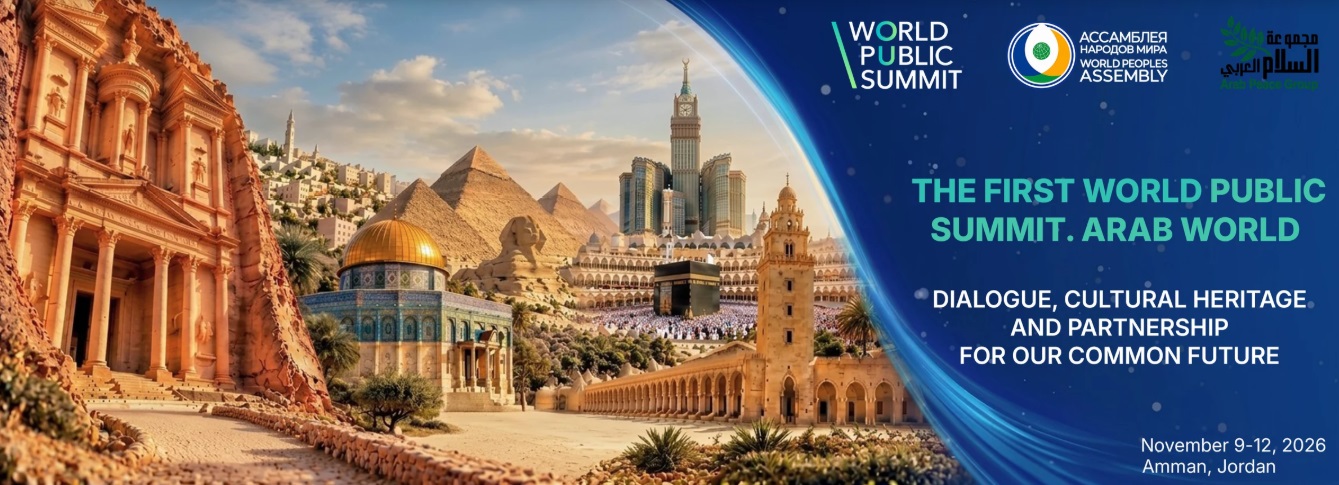
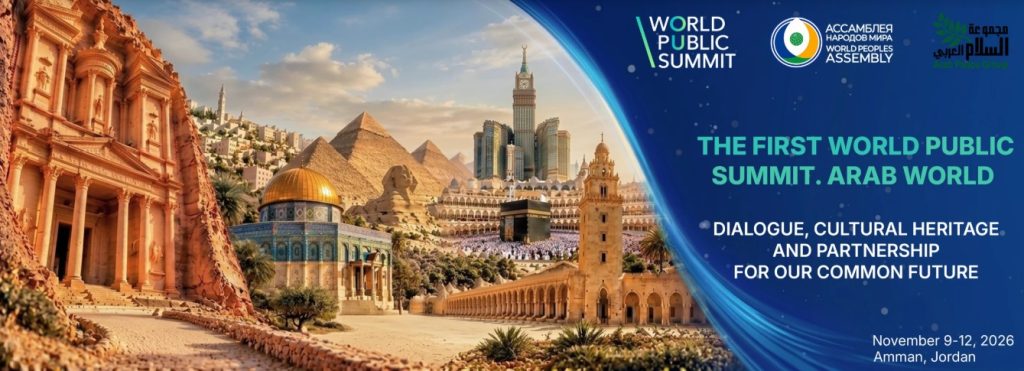
First World Public Summit – Arab World
“Dialogue, Cultural Heritage and Partnership for Our Common Future”
9 November 2026 | Amman, Jordan
Bethany Beyond the Jordan | 10:00–11:00
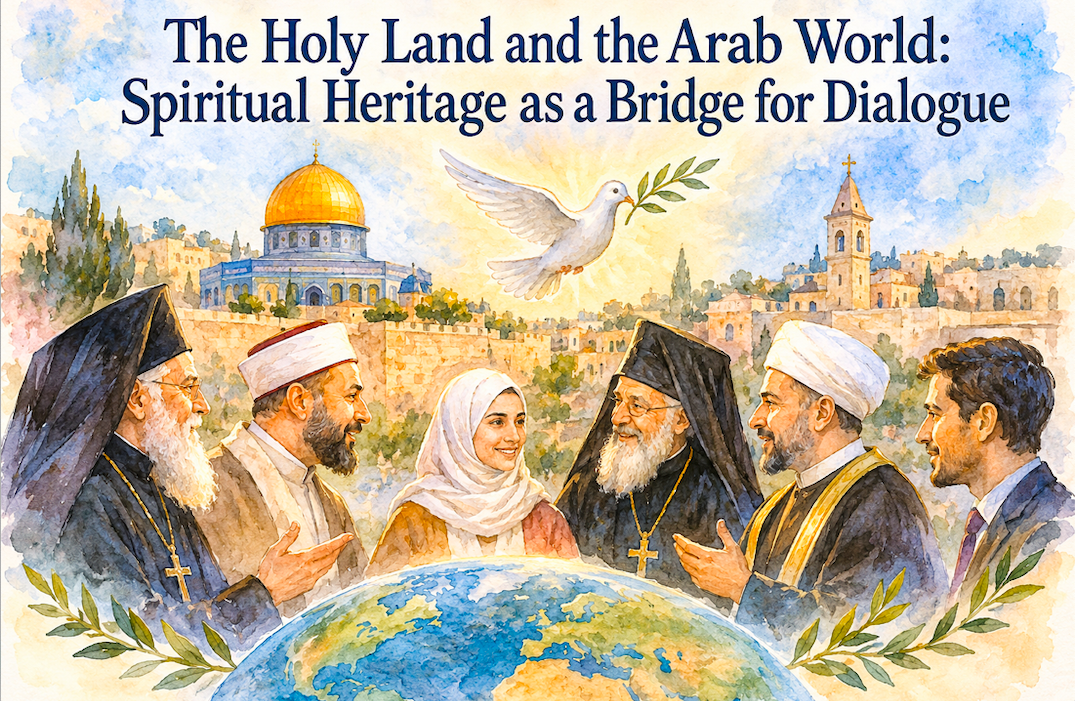
The First World Public Summit – Arab World will open an important space for intercultural and interfaith dialogue with a high-level roundtable discussion entitled “The Holy Land and the Arab World: Spiritual Heritage as a Space for Dialogue,” scheduled for 9 November 2026 at Bethany Beyond the Jordan, one of the region’s most significant spiritual and historical sites.
Held under the overarching theme “Dialogue, Cultural Heritage and Partnership for Our Common Future,” the summit brings together representatives of religious institutions, cultural organizations, public life, and international civil society to explore shared responsibilities in building a more peaceful and cooperative world.
The roundtable will examine the role of spiritual heritage as a living foundation of collective memory and mutual understanding. Rather than viewing religious and cultural traditions merely as remnants of the past, the discussion will consider how they continue to shape contemporary societies and contribute to a more inclusive future.
At its heart is the conviction that interfaith dialogue should extend beyond theological differences and focus on the fundamental values shared by humanity: mercy, justice, human dignity, compassion, and care for one’s neighbour. Religious cooperation, in this perspective, becomes meaningful when shared values are translated into practical action, including humanitarian assistance, the protection of vulnerable communities, peacebuilding, and the education of younger generations.
Four dimensions of dialogue
The discussion will address four interconnected areas.
The first, Spiritual Culture and Moral Foundations, will explore the common ethical principles found in different religious and cultural traditions, the image of the neighbour in various faiths, and the protection of sacred places, prayer languages, and spiritual customs from homogenization and commercialization.
The second, Historical Experience and Regional Context, will consider the Holy Land as a historic meeting point of religious communities and examine the lessons of coexistence within Arab societies, where different peoples and faith traditions have shared centuries of history.
The third, The Practice of Dialogue and Modern Challenges, will focus on transforming interfaith encounters into concrete initiatives. Particular attention will be given to humanitarian projects, family protection, peacebuilding, the responsibility of religious leaders, and the transmission of spiritual values to younger generations in an increasingly complex information environment.
The fourth, Institutional Cooperation and the Mission of the Assembly, will examine the role of specialized councils within the World Peoples Assembly, particularly the Council for Spiritual Culture and the Council for Interaction with Religious Organizations, as instruments for sustained dialogue and coordinated responses to contemporary challenges.
International speakers and participants
The session will be moderated by Alena Dolgopolova, State Secretary of the World Peoples Assembly, Russia.
The distinguished speakers include:
- Hamdi Murad, Professor at the World Islamic Sciences and Education University, Jordan.
- Father Gerasimos Tashman, representing the Patriarchate of the Orthodox Church in Jordan.
- Father Bishara Dehabreh, President of the Orthodox University at the Baptism Site, Jordan.
- Mufti Albir Hazrat Krganov, Chairman of the Spiritual Assembly of Muslims of Russia.
- Father Daoud Matar, representative of the Imperial Orthodox Society in Palestine.
The discussion will also welcome prominent international participants, including:
- Larisa Trunina, Adviser to the Chairman of the General Council of the World Peoples Assembly and member of the Presidium of the World Forum of Spiritual Culture, Russia.
- Waldemar Herdt, Co-Chairperson of the Supreme Advisory Council of the World Peoples Assembly, Chairman of the International Council of Russian Germans, former Member of the German Bundestag (2017–2021), and public figure.
- Yuri Palamarchuk, Member of the Supreme Advisory Council of the World Peoples Assembly, Head of its Representative Office in the Leningrad Region, President of the NGO Council for Interethnic Cooperation, and Head of the House of Friendship of the Leningrad Region, Russia.
A shared responsibility for the future
The choice of Bethany Beyond the Jordan as the venue gives the discussion particular symbolic significance. Located in a landscape deeply associated with religious memory and pilgrimage, it offers an appropriate setting for considering how sacred heritage can become a meeting ground rather than a dividing line.
The roundtable seeks to reaffirm that preserving spiritual heritage is not simply a matter of safeguarding historical monuments or religious traditions. It also means protecting the values that give these traditions their enduring human significance.
By bringing together religious leaders, academics, public representatives, and international civil society figures, the session aims to strengthen mutual understanding and encourage practical cooperation across religious and cultural boundaries.
Ultimately, the discussion advances a message of shared humanity: differences in belief and tradition need not prevent cooperation. On the contrary, they can enrich dialogue when approached with respect, openness, and a commitment to human dignity.
The Holy Land can become more than a place of shared spiritual memory: it can serve as a bridge connecting peoples, faiths, and generations in the pursuit of peace.