 thesilkroadtoday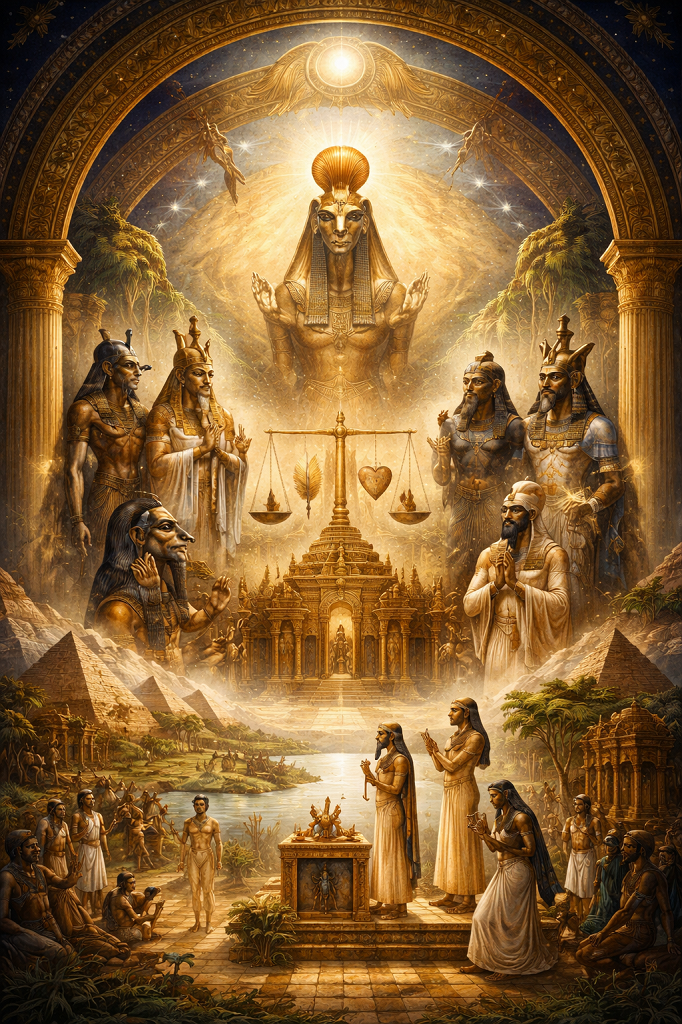
Ancient Egyptian religion was not a separate sphere of life, nor a set of distant rituals performed in hidden sanctuaries. It was the invisible architecture that supported the visible world. It shaped the king’s authority, guided the farmer’s hope for the Nile flood, inspired the artist’s chisel, and consoled the grieving heart before the mystery of death. To understand ancient Egypt is to enter a universe where the divine and the human were intertwined in a continuous dialogue about order, justice, and eternity.
Unlike rigid theological systems, ancient Egyptian thought allowed for multiple visions of creation. Each great religious center offered its own sacred narrative, not in contradiction, but in complementarity. In Heliopolis, the sun god Atum emerged from the primeordial waters of Nun. From his self-generated existence came Shu (air) and Tefnut (moisture), who gave birth to Geb (earth) and Nut (sky). Their union produced Osiris, Isis, Seth, and Nephthys — forming the Ennead, a divine genealogy that explained both cosmic order and human destiny. In Memphis, theology took a more philosophical turn. The creator god Ptah fashioned the world through thought — the heart — and speech — the tongue. Creation here was an intellectual act, a remarkable concept that resonates with later philosophical traditions. In Hermopolis, the Ogdoad — eight primordial deities — represented chaos in its elemental forms: darkness, infinity, hiddenness, and water. From their interplay arose the first light. This plurality reveals a civilization comfortable with complexity, a culture that understood truth as layered rather than singular.
The Egyptian gods were not merely anthropomorphic beings with supernatural powers. They were symbols — living metaphors of natural forces, moral principles, and cosmic functions. Ra was not only the sun in the sky but the daily triumph of light over darkness. Osiris embodied death and resurrection, the eternal cycle of vegetation and rebirth. Isis represented devotion, magic, and maternal protection. Horus symbolized kingship and rightful order, while Anubis guarded the necropolis and oversaw the sacred science of mummification. Animal-headed forms were not primitive fantasies; they were visual theologies. The falcon expressed divine vision and sovereignty; the jackal evoked the desert’s silent guardian of the dead. Each form was a coded language understood by the ancient viewer.
The myth of Osiris is perhaps the most powerful narrative in Egyptian religion. Murdered by his brother Seth, restored by Isis, and avenged by Horus, Osiris becomes ruler of the afterlife. This story is not merely familial drama; it is cosmic allegory. It speaks of fragmentation and restoration, injustice and vindication, death and transcendence. At the moral center of Egyptian belief stood the principle of Ma’at — truth, justice, harmony. In the Hall of Judgment, the heart of the deceased was weighed against the feather of Ma’at. Salvation was not granted through faith alone, but through ethical living. Religion, therefore, was inseparable from morality.
The Egyptian temple was not a congregational space but the literal “house of the god.” In monumental complexes such as Karnak Temple Complex, Philae Temple, and Temple of Edfu, daily rituals sustained the divine presence within the sanctuary. Only priests and the king could enter the innermost chamber. The common people encountered the gods during grand festivals, when sacred statues emerged in procession, dissolving the boundary between sacred and secular space. Temples were also economic and intellectual centers, preserving astronomical knowledge, medical practices, and literary traditions.
For the ancient Egyptians, death was not annihilation but transformation. The preservation of the body through mummification was essential because the soul — composed of multiple spiritual elements — required physical continuity. Texts such as the Book of the Dead provided spells and guidance for navigating the afterlife. Earlier traditions, including Pyramid Texts and Coffin Texts, reveal a long evolution of funerary theology centered on the promise of eternal life. The ultimate hope was union with Osiris or ascent with Ra — to participate eternally in cosmic renewal.
Ancient Egyptian religion was a profound meditation on stability in a fragile world. Surrounded by desert and dependent on the unpredictable Nile, the Egyptians envisioned a cosmos governed by order rather than chaos. Their temples, hymns, myths, and tombs were expressions of this unshakable confidence. They did not fear death as extinction; they prepared for it as continuity. They did not separate art from belief; they carved theology into stone. In the end, ancient Egyptian religion stands as a testament to humanity’s enduring quest for meaning — a reminder that long before modern philosophy, along the banks of the Nile, a civilization had already constructed an architecture of eternity.