 thesilkroadtoday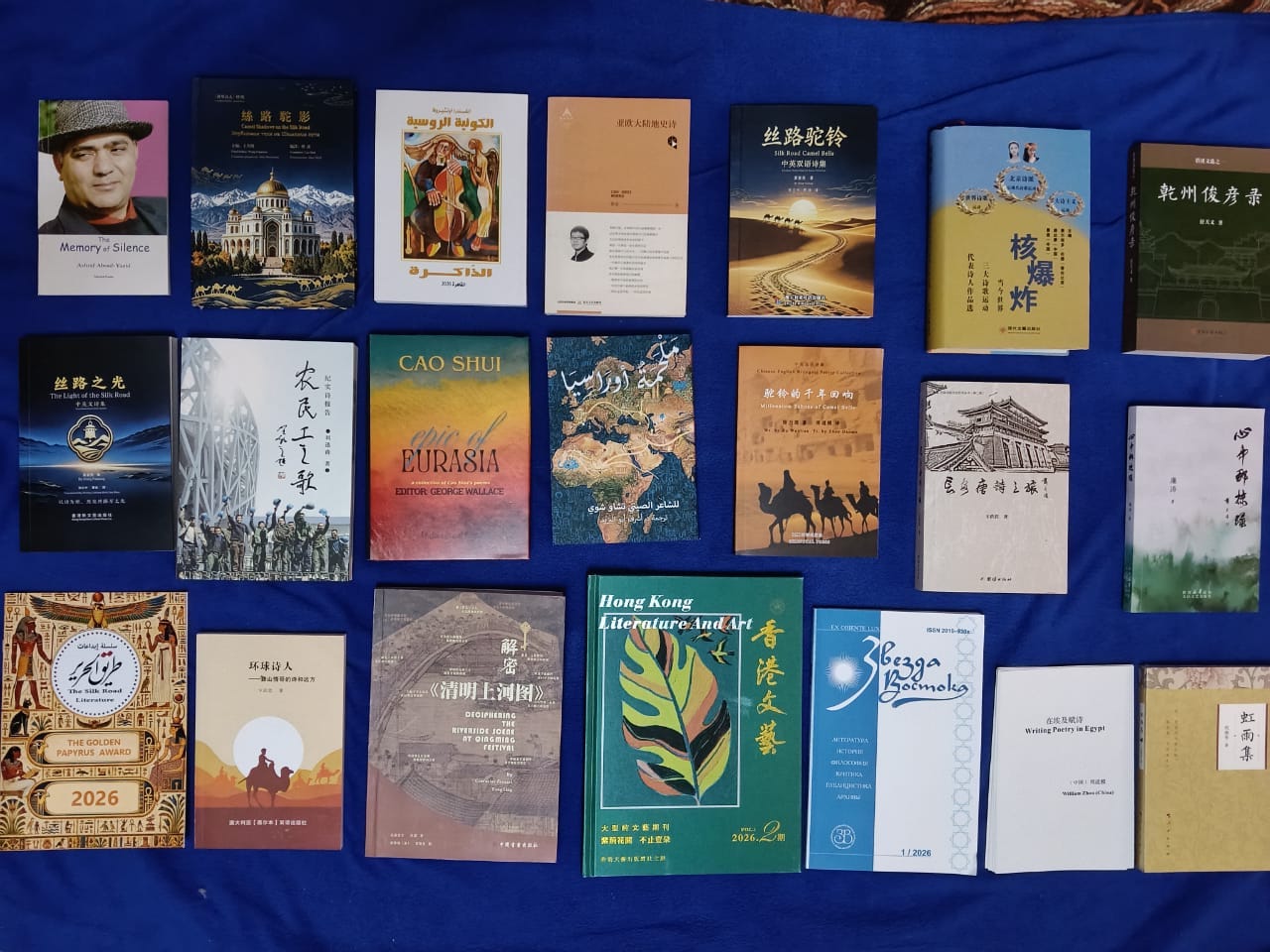
Every literary journey leaves behind more than memories; it leaves books bearing the voices of the people and places encountered along the way. During the 6th Silk Road International Poetry and Art Festival, which brought together writers, poets, translators, and artists across Uzbekistan and Kazakhstan, I had the privilege of receiving a remarkable collection of books directly from their authors.
Each volume was offered not merely as a gift, but as an invitation to enter a distinct cultural landscape, to discover another language of memory, history, imagination, and identity. In this series of articles, I will present these works one by one, offering reviews that go beyond summary to explore their literary merit, cultural significance, and the conversations they create across borders. Together, these books form a living library of the contemporary Silk Road, where literature continues to unite civilizations through the enduring power of the written word.
Walking Through the Living Memory of China’s Ancient Capital
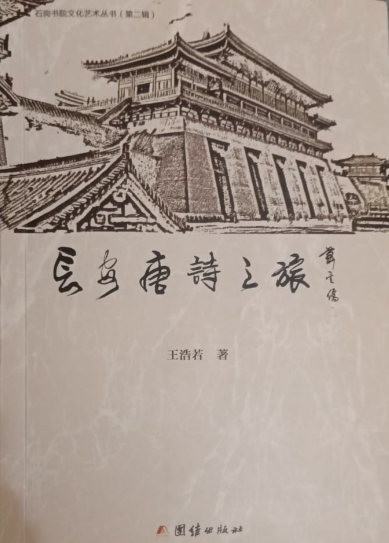
A Review of Wang Haoruo’s The Poetry Journey of Chang’an
There are books that describe a city, and there are books that allow the city itself to become a speaking voice. Wang Haoruo’s The Poetry Journey of Chang’an belongs to the latter category. Published by Unity Press in 2025 as part of the Shifang Academy Cultural and Art Series, this remarkable volume is not merely a guide to Xi’an—ancient Chang’an—but an invitation to experience one of the world’s greatest cultural capitals through the language of poetry, history, and memory.
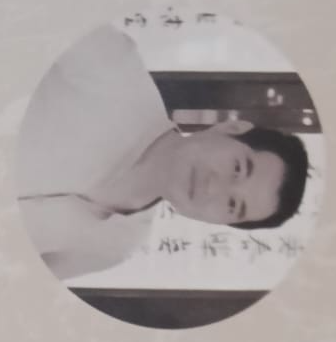
Wang Haoruo is uniquely qualified for this undertaking. A native of Xi’an, cultural scholar, and promoter of Chang’an poetry, he has devoted years to preserving and interpreting the city’s literary heritage. His involvement in cultural institutions and research organizations demonstrates that this work is founded upon both scholarship and profound personal attachment. The book is therefore more than an academic study; it is an act of cultural stewardship.
The central idea of the volume is both elegant and ambitious. Rather than presenting Chang’an as a sequence of historical events, Wang allows poetry to become the city’s map. Every street, monument, temple, gate, and forgotten corner carries echoes of poets who once transformed these places into immortal verse. As readers move through the pages, they discover that Chang’an has never ceased to exist; it survives wherever its poetry continues to be read.
The selected pages reveal the author’s method. Historical narratives intertwine naturally with classical poems, while commentary explains their cultural significance without diminishing their lyrical beauty. Ancient verses are not treated as museum relics but as living voices that continue to converse with the modern city. The result is a seamless dialogue between literature and history, where every monument acquires emotional depth through the words of the poets who celebrated it.
What distinguishes The Poetry Journey of Chang’an is its interdisciplinary character. It is simultaneously literary criticism, cultural history, travel writing, and historical reflection. The illustrations accompanying the text further enrich the reading experience, reminding us that architecture, calligraphy, painting, and poetry have always formed a unified artistic tradition within Chinese civilization.
The symbolic significance of Chang’an extends far beyond China. For centuries it stood at the eastern gateway of the Silk Road, welcoming travelers, monks, merchants, diplomats, and poets from across Asia and beyond. Wang’s work captures this cosmopolitan spirit with remarkable sensitivity. The city emerges not simply as the capital of successive dynasties but as one of humanity’s great crossroads, where civilizations met, exchanged ideas, and enriched one another through culture rather than conquest.
Equally impressive is the accessibility of the author’s style. Despite the depth of historical learning, the prose remains inviting and reflective. Readers unfamiliar with classical Chinese literature are gently introduced to its richness, while specialists will appreciate the careful contextualization of historical and literary references. The book succeeds because it never separates scholarship from storytelling.
The title itself—The Poetry Journey of Chang’an—perfectly expresses the nature of the work. It is indeed a journey, not measured by geographical distance but by centuries of poetic imagination. Each chapter becomes another stop along a literary pilgrimage through China’s cultural memory.
In an age when rapid modernization often overshadows historical consciousness, Wang Haoruo reminds us that cities are sustained not only by stone walls and monuments but also by the words that generations have written about them. Chang’an remains alive because its poets continue to speak, and this book serves as their contemporary guide.
Ultimately, The Poetry Journey of Chang’an is much more than a book about Xi’an. It is a meditation on the enduring relationship between place, memory, and literature. It demonstrates that poetry can preserve a civilization’s soul more faithfully than chronicles alone, transforming history into lived experience. For readers interested in Chinese culture, Silk Road studies, literary geography, or the dialogue between history and poetry, Wang Haoruo has created a work of lasting significance—a volume that invites us not merely to visit Chang’an, but to walk through its verses and discover the timeless city that still resides within them.
Dr. Ashraf Aboul-Yazid