 thesilkroadtoday
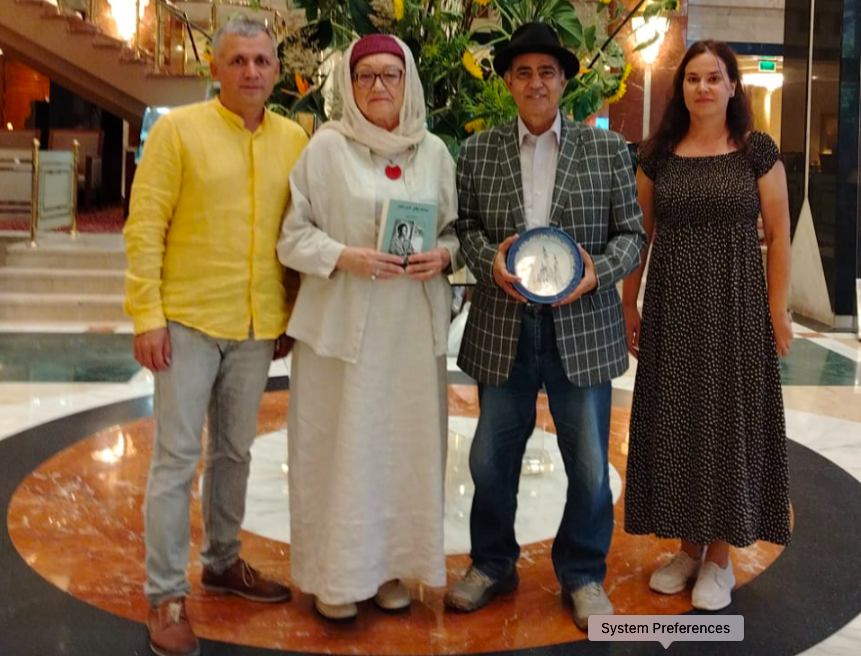
Every literary journey leaves behind more than memories; it leaves books bearing the voices of the people and places encountered along the way. During the 6th Silk Road International Poetry and Art Festival, which brought together writers, poets, translators, and artists across Uzbekistan and Kazakhstan, I had the privilege of receiving a remarkable collection of books directly from their authors.
Each volume was offered not merely as a gift, but as an invitation to enter a distinct cultural landscape, to discover another language of memory, history, imagination, and identity. In this series of articles, I will present these works one by one, offering reviews that go beyond summary to explore their literary merit, cultural significance, and the conversations they create across borders. Together, these books form a living library of the contemporary Silk Road, where literature continues to unite civilizations through the enduring power of the written word.
A Poetic Journey Along the Silk Road
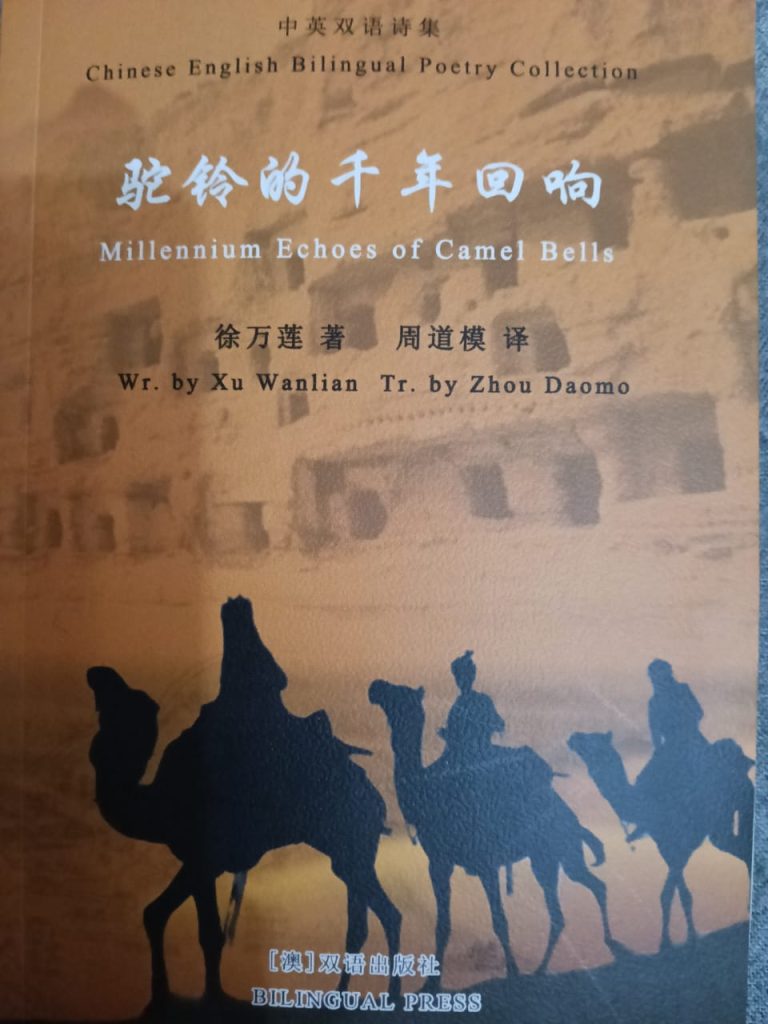
Review of the bilingual collection by Xu Wanlian (Lianzi), translated by Zhou Daomo
Millennium Echoes of Camel Bells is more than a bilingual poetry collection; it is a lyrical pilgrimage across the landscapes, history, and spirit of China’s western frontier. Written by the distinguished Xinjiang poet Xu Wanlian (Lianzi) and translated into English by Zhou Daomo, the volume opens a gateway through which readers from different linguistic and cultural backgrounds may enter the poetic world of the ancient Silk Road.
The title itself evokes the enduring sound of camel bells reverberating across deserts for a thousand years, suggesting that memory, culture, and poetry continue to travel together long after the caravans have disappeared. The collection belongs naturally to the tradition of Silk Road literature, where geography becomes a metaphor for cultural encounter and historical continuity.
Xu Wanlian’s literary achievements, outlined in the author’s biography, reveal a poet deeply rooted in Xinjiang’s cultural life. As a member of major writers’ associations and the recipient of numerous literary awards—including the Silver Camel Award at the Dubai Silk Road International Poetry and Art Festival—she has established herself as a significant contemporary poetic voice whose work has already crossed linguistic boundaries through translation into English, Spanish, and Russian.
One of the most memorable poems presented in the volume, “Dusk in Grape Valley,” demonstrates her remarkable ability to transform ordinary landscapes into living metaphors. The opening image,
> “The Sunshine of Turpan
Making honey on the vines,”
immediately immerses the reader in the warmth and abundance of Turpan, one of the Silk Road’s legendary oasis cities. Nature is not merely described but animated with emotion and memory. The wind becomes a playful participant, stealing “the first bite,” while the sunset colors the world with the purple of ripened grapes.
The imagery continues to deepen as baskets of grapes become “the poetic lines of the earth,” an elegant metaphor that unites agriculture, landscape, and literature into one harmonious vision. Particularly striking is the closing image, where the moon quietly removes a grape and wears it “as an eardrop.” This delicate personification captures the poet’s gift for blending realism with imagination, allowing everyday scenes to acquire almost mythical beauty.
Throughout the collection, Xu Wanlian celebrates not only the physical beauty of Xinjiang but also its cultural identity. Her poems preserve local traditions, landscapes, and memories while speaking a universal language of belonging, beauty, and human connection. The Silk Road appears not simply as an ancient trade route but as a living corridor where civilizations continue to meet through poetry.
Zhou Daomo’s English translation succeeds in preserving much of the simplicity and musicality of the original. Although, as with all poetry in translation, some nuances of rhythm and cultural resonance inevitably remain rooted in the Chinese text, the bilingual presentation allows readers to appreciate both the visual elegance of the original language and the accessibility of the English rendering.
The book is therefore valuable on several levels: as a work of contemporary Chinese poetry, as a document of Xinjiang’s literary culture, and as an instrument of intercultural dialogue. It demonstrates how poetry continues the ancient mission of the Silk Road—not through commerce, but through the exchange of imagination, memory, and shared humanity.
Millennium Echoes of Camel Bells reminds us that while camel caravans may have vanished into history, their echoes remain alive in poetry. Xu Wanlian’s verses carry those echoes into the twenty-first century, inviting readers from every culture to listen to the timeless music of the Silk Road.
Dr. Ashraf Aboul-Yazid