 thesilkroadtoday
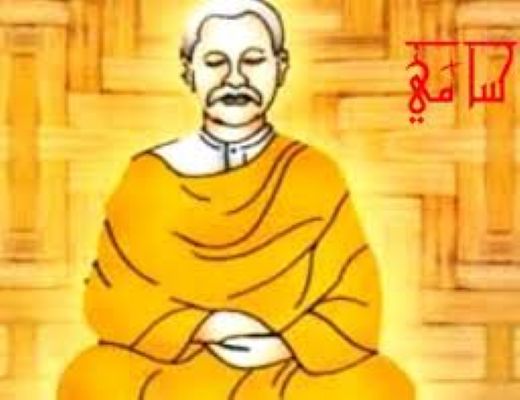
Sami was a saint-poet who appeared on the scene during the last phase of Bhakti Movement
- Sami wrote shlokas embodying everything that the movement espoused, that is, unity of the Godhead, unity of the existence, and equality on the basis of religion, cast and economic status.
Sami Chain Rai Bachomal was a distinguished poet, who vernacularized the Vedic wisdom in his slokas (shlokas), or verses, in the Sindhi ‘bayt’ form. He was born in a well-to do family of businessmen of Shikarpur, Sindh, which had been, because of its peculiar geographical position, the greatest mart of north-west India.
As regards the year of this birth, there is no unanimity of opinion. While Kaouromal Chandanmal Khilnani, the first editor of Sami’s slokas, computed it as 1743, Mulchand Giani, who also published Sami’s 2100 slokas in two volumes, was of the view that Bhai Chainrai Dataramani Lund (for that was Sami’s full name, ‘Sami’ being his pen-name) was born in 1731 and died in 1850, when his son Ghanshayamdas was about 40 years. But the Majority of commentators of Sami, Kaouromal’s view has been more acceptable.
In Shikarpur, the Dataramanis resided in a house, opposite to jugal pyari Thanw, in Nandhi Bazar. They kept this house till 1850. Soon after his father’s death, Ghanshayamdas sold it away, for he used to live in Amritsar where he had his business concern.
It was when he was about 30 years old that he came into contact with the ‘Real friend’, Swami (or Sami in Sindh) Meghraj by name. The Swami originally hailed from Ahamednagar of then Bhawalpur State and came to Sindh to live in the Brahmana Hemandas’ ‘Marhi’, or monastry, at Hathi Dar in Shikarpur. He was well versed in Vedanta and sanskrit kavvya. Chainrai benifitted greatly from his learning and studied Vedanta in the original Sanskrit in about ten years. Besides ‘Sankara’s ‘Advaita’ (non-dualism), which forms the core of this poetry, he seems to have learnt for his Guru something about Nimbarka’s ‘Dvaitdvaita’ or ‘Bhedabedha’ (difference and non-difference which appears in his slokas on ‘bhakti’.
He had already read the Sindhi saint and Sufi poetry and was conversant with Gurumukhi and Devanagri scripts in which the Hindu Sindhis wrote their language at that time. By the age of 40, he developed a great poetical power and composed verses, at once lyrical and mystical. This he did in the name of his Guru, Swami Meghraj; ‘Sami became his pen-name. He wrote the verses in Sindhi. In the Gurumukhi script, on slips of paper and went on depositing them in an earthen pot.
At the ripe age of 68. ‘Sami’ took his wife on pilgrimage. On their way back, they visited Amritsar. There were a holy man granted them a boon they would soon be blessed with a son, and they waited in Amritsar to see the boon come true. Thereafter they decide to live in Amritsar, near the shrine of the Sikhs, where he wrote hundreds of shlokas.
During Sami’s life time, the political power in Sindh changed hands twice from Kalhoras to the Talpurs, and from the Talpurs to the British. Yet we hardly find any direct reference to the worldly, ever-changing facts in his poetry. In one of the shlokas he remotely says, Kalijuga’a ja kura, mire, matamadi chaudhari’ (The rulers, fanatics and landlords represent the liars of the ‘kalijuga’). He led a quiet life given to the contemplation of the Supreme Soul. Yet he performed all the duties peculiar to an existential situation. The kind of life he led reflected in his shlokas, in one of which he says:
He who shuns the diabolic ‘dvaita’ and engages himself in the service of Man,
Disabuses his of the evil and realizes
Him in elephant and ant alike,
Is Mahatma, while others
Grope in the dark and reel in the dirt.
True to the tradition of land, he did not ignore wealth (‘artha’) and pleasure (‘Kama’) and thereby for release (‘moksha’) from the human bondage.
In this view, as in that of the other saint-poets of India, there exists a close relationship between religion and philosophy – the relationship which makes the religion somewhat philosophic and the philosophy a wee bit religious. On the one hand, the Bhagwata, the spiritual book of the laity, induces in him devotion of the Personal deity Krishna, and on the other Brahmasutra of the elite enables him to have knowledge of the nature of reality. But, as the common people would even know studying Brahmasutra in the original text, Sami understands that the personal deity ultimately becomes the Impersonal Brahman and transports us to the region of consciousness where the Personal is realized as that One (‘Tad Ekam’) He say:
I hear Krishna non-stop playing on the flute;
Two ears hear That one and don’t feel satiate;
And I wish I were in the timelessness of the lilt.
Brahman, in contradiction to the western conception of God, creates the world from Himself, and not from any extraneous matter; he is both the material and the efficient cause of the world, ‘the clay and the potter of the pots’. As in the taittriya Upnishads, Sami holds that the being from Brahman, they live by Him on death. He shows himself in the world.
A saint-poet who appeared on the scene during the last phase of Bhakti Movement, Sami who wrote shlokas embodying everything that the movement espoused, that is, unity of the Godhead, unity of the existence, equality on the basis of religion, cast and economic status.