 thesilkroadtoday
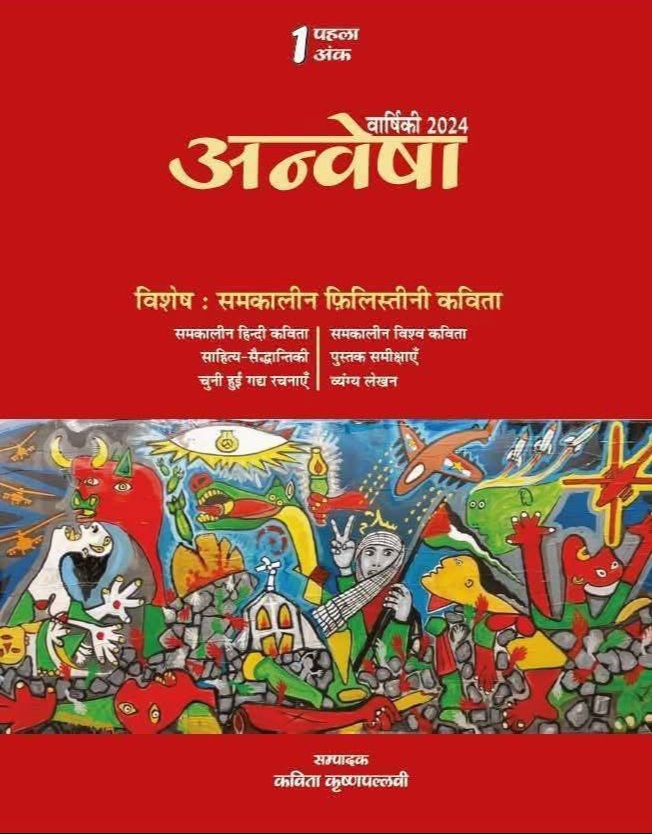
Anvesha Varshiki 2024, a 542-page special issue in Hindi, was recently published in India.Edited by poet and leftist activist Kavita Krishnapallavi and her team, this meticulously crafted volume has garnered international attention for its quality and impact.
The issue takes a firm stand against the genocide in Palestine, with a special focus on contemporary Palestinian poetry. It includes translations of selected poems by 24 Palestinian poets, powerfully articulating the suffering, persecution, and resilience of ordinary Palestinians, including children, under Israeli oppression.The cover and interior design exclusively feature artworks by contemporary Palestinian artists, vividly conveying the anguish of Palestinian atrocities throughout the volume. In a world largely silent on Israel’s inhumane attacks, tacitly supported by powers like the United States, this issue stands as a bold statement.
In the preface, editor Kavita Krishnapallavi writes:
“Palestine is another name for unconquered rebellion. Palestinian life is synonymous with dreams of liberation, struggle, and creation. Palestine is an epic saga of enduring pain, relentless liberation struggles, and resolute optimism. A Palestine beats in the heart of every dreamer and freedom seeker! In these dark times, it is a blazing torch on the horizon.”
Dedicated to Palestine’s fearless freedom fighters and resilient people, Anvesha Varshiki 2024 positions their struggle as central to the broader Arab liberation movement. While Arab elites and regimes, swayed by Western imperialism, have aligned with global capitalist powers, the Palestinian people have been resisting Zionist oppression since the Nakba of 1948.
The issue features fresh poems written amidst ongoing bloodshed, including works by poets like Zakaria Mohammad, Khalid Juma, Mahmoud Darwish, Noor Hindi, Momen Musa, Fawa Hasnat, Lubna Ahmad Gaza, Rashid Hussain, Darin Tatour, and others. These poems, translated into Hindi by senior poets and translators such as Asad Zaidi, Vinod Das, Vinod Chandola, Bhaskar Chaudhuri, and Rajesh Chandra, are complemented by Hindi poems by Indian poets condemning the injustices in Gaza.
Spanning 14 sections, the volume covers:
1. Contemporary Palestinian poetry.
2–14. Contemporary Indian poetry, poetry from other Indian subcontinental languages, Asian poetry (including Turkish, Afghan, Iranian, and Arabic), African poetry, Latin American poetry, Russian and Eastern European poetry, Western European poetry, and anti-capitalist poetry from across the world translated into Hindi. Additional sections include literary discussions, reviews, stories, and satirical essays.
In an era dominated by capitalism, the working class, farmers, and indigenous communities worldwide face relentless exploitation. Anvesha Varshiki amplifies the voices of India’s marginalized—tribals, Dalits, minorities, and women—who remain excluded from mainstream development. It stands in solidarity with Palestine, opposing the forces perpetuating genocidal atrocities that shame humanity.
Through contributions from Indian poets, writers, translators, editors, thinkers, and activists, Anvesha Varshiki 2024 has resonated globally. It serves as a call to action for the world’s proletariat, reminding us that Palestine’s fight is a humanist struggle to preserve hope and dignity. The sooner the world recognizes this, the sooner we can halt humanity’s march toward destruction.
—————————-
About the Author
Bharat Haridas Yadav is an independent journalist, poet, and translator based in Solapur, Maharashtra, India.
He has translated over 2,000 Hindi poems into Marathi and has published three books in Marathi.
He contributes translations to various Indian magazines and web portals.
His translations include interviews and poems by Turkish poetess Bejan Matur into Hindi and
poems by Vietnamese poet Mai Van Phan into Marathi, published on Phan’s personal website.
He also writes columns for newspapers.
Contact Information
——————————-
Email: yadavbh515@gmail.com
Facebook: Bharat Yadav
Blog: Bharat Vakya
Instagram: yadavbharat15
X: BharatYadav55895