 thesilkroadtoday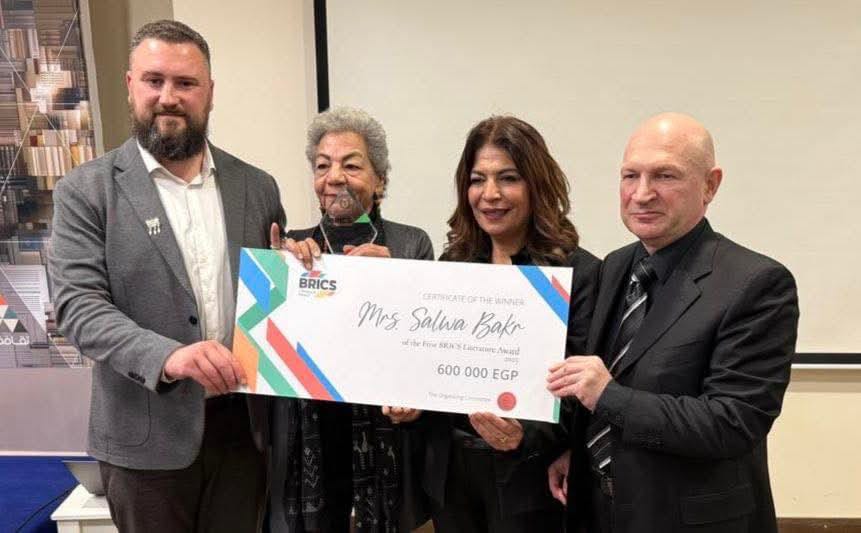
Egyptian Novelist: A different prize, because it belongs to great human civilizations
Writer and novelist Salwa Bakr expressed her happiness and pride at being the first recipient of the BRICS Literary Prize in its inaugural edition, extending her thanks to everyone who made the effort to attend this major celebration, held during one of the most important book fairs in the world.
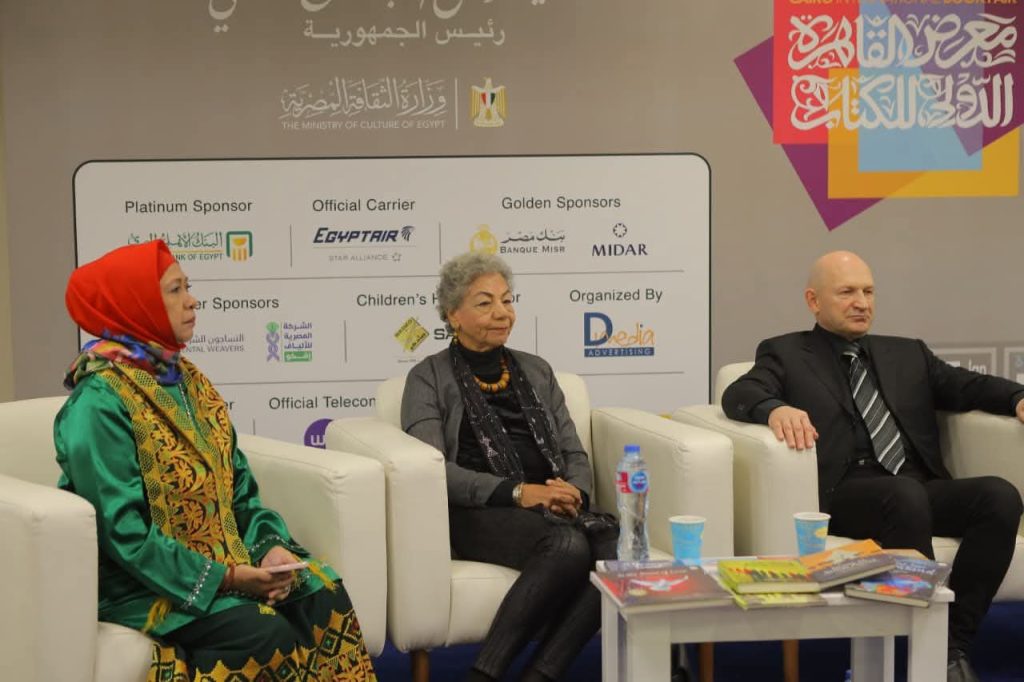 Speaking at the award ceremony for the first edition of the BRICS Literary Prize—held in the International Hall as part of the current Cairo International Book Fair—Bakr said that the BRICS Prize is founded on a deep vision that differs from the vision of the prevailing awards in the world today. This is because BRICS is, first and foremost, a civilizational grouping that has produced a global human culture over decades.
She explained that ancient Egypt knew literature at a time when Europe was living through the Dark Ages, while Russian culture and literature have had the deepest global impact. “Our conscience was nurtured by great Russian literature—by Chekhov, Dostoevsky, Maxim Gorky, and this long line of great writers—alongside the writers of India, China, Brazil, and others from the bloc’s countries,” she said, considering the establishment of this prize a form of re-production in the midst of a cultural chaos imposed by some.
Doha Assi: A serious attempt to re-export literature globally, away from Western polarization
Writer and novelist Doha Assi, a member of the Board of Trustees of the BRICS Prize, described the establishment of the BRICS International Literary Prize as a serious attempt to re-export literature worldwide. She added: “For a long time, there has been polarization by the West, and a defining of which writers we should read. So we proposed establishing the BRICS Literary Prize, and the main question that preoccupied us was: why don’t we launch a prize that celebrates our writers at the global level?”
She continued: “As the saying goes, ideas lie by the roadside, but if there is no strong institution behind them to support them, they may remain just papers that no one cares about. That is why the founding group of the BRICS Prize—in Russia, Brazil, India, China, Egypt, and other countries—came together to turn this idea into reality.” She stressed that having a literary prize named “BRICS” is extremely important, because “writers of the Global South are no less than other writers around the world.”
She added: “I am delighted that the prize is launching from Egypt, and that the first winner is the esteemed Egyptian writer Salwa Bakr. Egypt is part of a different, cultured world that has a free voice and needs to express itself anytime and anywhere.”
For his part, Russian poet Vadim Turykhin, co-chair of the BRICS Literary Association, said that the BRICS Literary Prize was founded with the help and idea of writer Doha Assi, “whom we thank, along with all Egyptians, for contributing to this step and for their kind sentiments.”
Turykhin added: “I thank the Egyptians for being witnesses to an important event—the presentation of the prize in its first edition on Egyptian soil. We hope this prize will continue, helping us understand one another more clearly and exchange literature more deeply.”
He went on to say: “Unfortunately, we are not sufficiently familiar with contemporary literature, even though we know the classics. This is a huge responsibility that falls on our shoulders: to introduce our peoples to the contemporary literature of other countries.” He expressed his happiness that the first BRICS Prize was awarded at the Cairo Book Fair, which has a major impact.
He concluded: “We hope the prize will serve as an incentive for writers to produce more creative works,” noting that the announcement of the longlist for the BRICS Literary Prize took place in Brazil in 2025 and included 27 writers from more than 16 countries, before the number was narrowed down to 10 on the shortlist announced in Indonesia, leading to the announcement of the winner in Russia.
Prize Officials: Proud to be in Egypt… the prize helps promote Eastern literature
Meanwhile, Aleksandr Ostroverkh-Kvanchiani, Executive director of the BRICS literature Awards Prize, expressed his pride at being in Egypt during the Cairo International Book Fair, stressing that “the relationship between Egypt and Russia is extremely strong.”
He said:
“The BRICS Literary Award is an opportunity for writers to engage in a lively dialogue with readers around the world, introduce them to their country’s culture, and reach new trends. The Prize not only helps identify new literary talent and attract attention, but also facilitates the translation, publication, and popularization seen in the BRICS countries. We don’t simply discover authors worthy of the global community—we create a tangible path for them to advance within the BRICS space and in countries willing to share our values.”
Ostroverkh-Kvanchiani conveyed a message from Sergey Stepashin, Chairman of the Board of Trustees of the BRICS Prize and President of the Russian Writers’ Union, who said: “On my own behalf and on behalf of the Russian Writers’ Union, I extend my congratulations to the officials of the International BRICS Prize on the launch of its first edition.”
Stepashin added in his message: “The prize was launched to care for and honor writers whose words transcend geographical boundaries, who deal with the human being as a human being, and who consider their literature a bridge between peoples.”
He continued: “The first prize was awarded to the Egyptian novelist Salwa Bakr, whose name will be immortalized in history as the first recipient of the prize. We also have another unofficial prize, which was awarded to the Indonesian writer Benny Jan.” He described Salwa Bakr as “one of the pioneering female writers in Arabic literature, who has taken upon herself the responsibility of being a voice for those who have no voice.”
The President of the Russian Writers’ Union concluded: “Today, we are not only celebrating Salwa Bakr’s writings or her great talent, but the prize is also an expression of our respect for Egyptian and Arab literature in general. The vocabulary of Arabic literature permeates our culture and becomes one of our shared values. Salwa Bakr’s win is not the end of her journey as a writer, but the beginning of our journey with the BRICS Literary Prize.”
Sastri Bakri, the prize coordinator in Indonesia, said: “I am proud to be here today. The prize has become a source of pride for me because the shortlist was announced in Indonesia, which is a great honor. It is not merely a cultural or social prize between countries; it works to correct systematic cultural errors that have taken root over time.”
She added: “This prize has a clear impact on all individuals from the participating countries and helps foster deeper interaction and communication between societies. It enables literature to transcend borders and geography, allowing these voices to be heard worldwide.”
She concluded: “The BRICS Prize is not just a step in the right direction; it is a responsibility that falls on states to support the delivery of diverse voices to the peoples of the world.”