 thesilkroadtoday
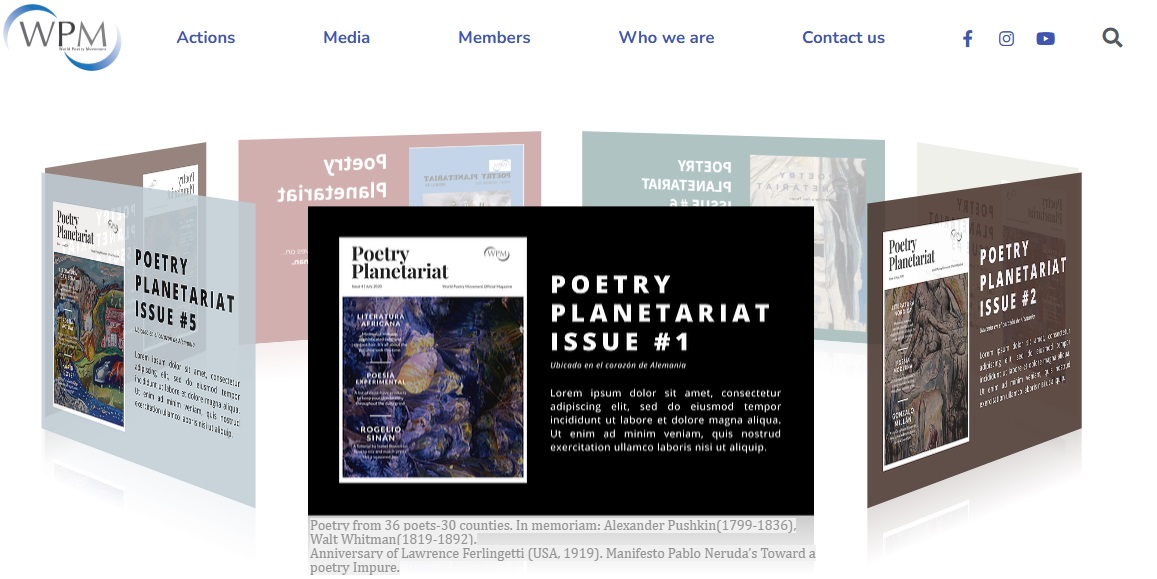
May 2025 – Medellín / Kathmandu
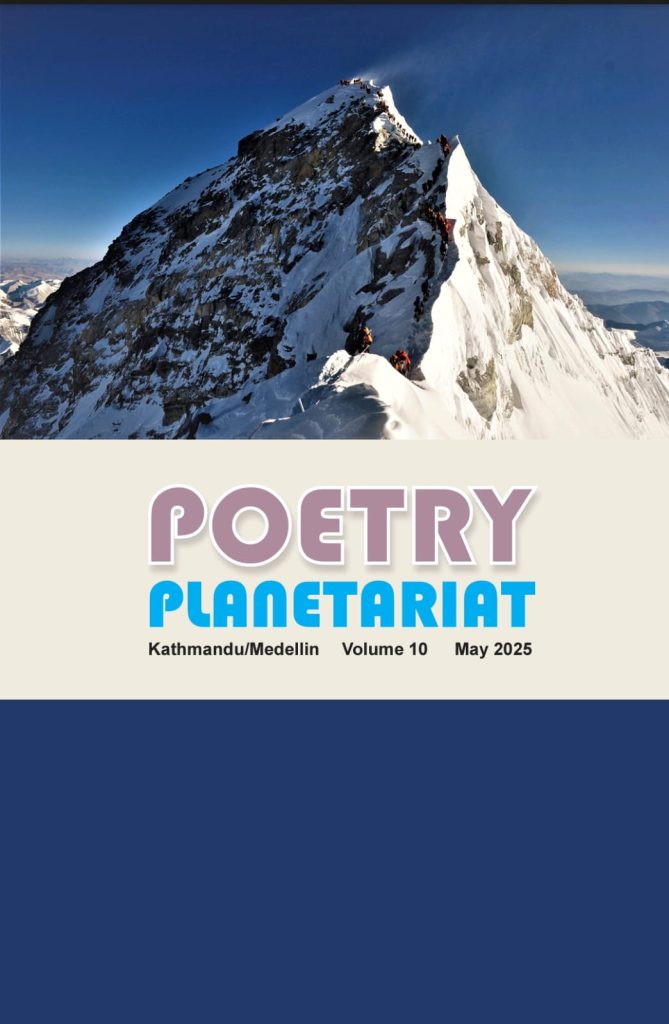
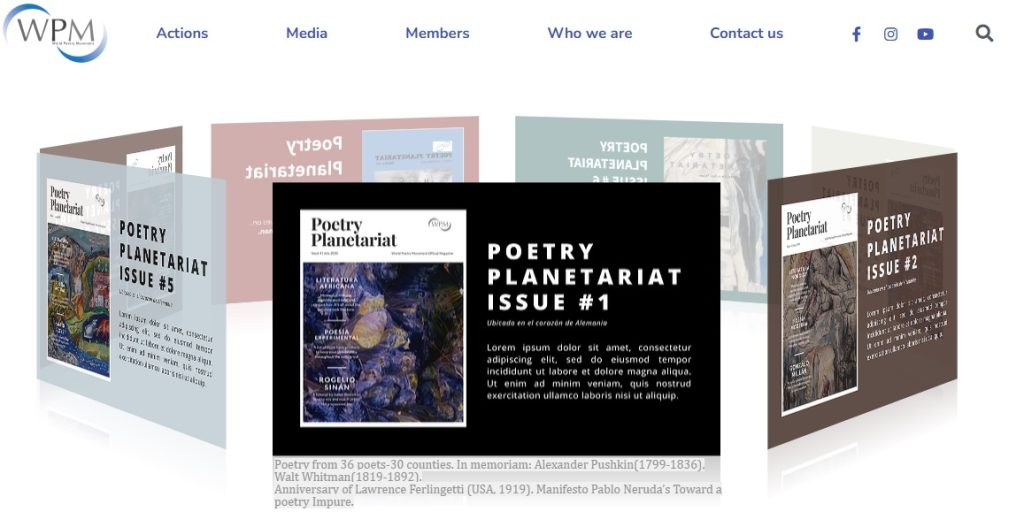
The World Poetry Movement (WPM) proudly announces the publication of the 10th volume of Poetry Planetariat, the organization’s flagship multilingual poetry magazine. This milestone edition brings together 161 poets from 67 countries, affirming poetry’s vital role as a universal voice for solidarity, ecological awareness, cultural preservation, and human dignity.
Edited by Keshab Sigdel and published in May 2025, the volume features a stunning cover photograph by Lhakpa Rangdu Sherpa and stands as a testament to WPM’s global vision: to create a poetic space that transcends borders and fosters intercultural dialogue.
This 10th edition carries the theme “Mountain Poetry”, inviting poets to explore mountains not only as awe-inspiring natural formations but also as powerful metaphors for endurance, solitude, spiritual depth, and environmental vulnerability. From the Himalayas to the Andes, Mount Ossa to the cliffs of Cape Verde, contributors reflect on personal, cultural, and ecological relationships with these towering monuments of the Earth.
Highlights of the volume include:
- Poetry centered on the theme of mountains from writers across all inhabited continents.
- Exclusive interviews with celebrated poets such as Babs Gons (Netherlands), Rati Saxena (India), and Rethabile Masilo (Lesotho).
- Reflections on key global issues including the climate crisis, displacement, resistance, and ancestral memory.
This issue brings together an extraordinary range of voices, including:
Adil Basogul, Alenka Jensterle Doležal, Allan Lake, Altynai Temirova, Anandi Zhang, Antonio Orihuela, Chandra Gurung, David Eggleton, Eldar Akhadov, Fatma Aras, George Wallace, Gloria Sofia, Adisley Mayan Valdés, Ali Al Hazmi, Harihar Timilsina, İbrahim Tiğ, Janette Ayachi, Jiang Yimao, John Guzlowski, Jose Manuel De Vasconcel, Kamala Wijeratne, Karen Melander-Magoon, Lamberto Garzia, Lana Derkač, Laura Garavaglia, Laurent Grison, Lee Kuei-Shien, Lucilla Trapazzo, Mark Andrew Heathcote, Nai Tiwa, Nuray Ongec, Nurduran Duman, Ori Z. Soltes, Robert Epstein, Ron Riddell, Sam Smith, Soledad Benages Amorós, Tahar Bekri, Valeriu Stancu, Abdel Wahed Souayah, Adam Fathi, Adel Al-Maizi, Ahmed Amor Zaabar, Amar Shah, Annabel Villar, Aslihan Tuyluoglu, Assem Bazzi, Bimal Baidya, Bimal Cave, Bishwa Sigdel, Blaž Božič, Brane Mozetic, Brigidina Gentile, Cemal Ozturk, Chen Hsiu-Chen, Christine Peiying Chen, Cyril Wong, Daniel De Culla, Daniel Quintero, David Leo Sirois, Debarati Bhattacharyya, Denja Abdullahi, Dennis Haskell, Diego Alonso Sánchez Barrueto, Diego Rojas Arias, Dimitris P. Kraniotis, Dragan Dragojlovic, Dragan Mitic, Dursun Ozden, Eliza Segiet, Enrique Sánchez Hernani, Faruk Buzhala, Leng Guan, Li Shangchao, Lotfi El Shabi, Ma Di’er, Mahnaz Badihian, Mother Toukour Lawali, Marcia Pfleger, María Ángeles Pérez López, Maria Do Sameiro Barroso, Maria Miraglia, Miguel Ángel Vázquez, Mike Aguzin, Ming Di, Mouldi Farrouj, Muhammad Gaddafi Massoud, Natalie Celio, Nedeljko Terzić, Obediah Michael Smith, Oumar Farouk Sesay, Pilar Rodríguez Aranda, Prollas Sindhuliya, Rabia Celik Çadirci, Radhouane Ajroudi, Randy Barnes, Ranjana Niraula, Regina Ramos, Rita Gustava Pulli, Robert Maddox-Harle, Rozalia Aleksandrova, Evening hills, Sarah Thilykou, Slavica Gadzova Sviderska, Srinewas Prasad Yadav, Stan Lafleur, Sumina, Su Yun, Taghrid Bou Merhi, Tamer Oncul, Taro Hokkyo, Thór Stefánsson, Tilsa Otta, Thakur Belbase, Tone Škrjanec, Tracie Lark, Ülkü Cengiz Taşkin, Viacheslav Kupriyanov, Yanlan Yu, Yeşim Ağaoğlu, Zade Kuqi, and Zhang Zhi.
With voices echoing from mountains, coasts, and valleys, Poetry Planetariat continues to be a literary platform where boundaries dissolve, and the poetic spirit thrives.
This issue also marks the announcement of the upcoming Volume 11, which will be centered on the theme of “Palestine”—a call to global poets to speak out in solidarity with all oppressed and displaced peoples.
A voice for global poetic solidarity
Poetry Planetariat is a multilingual international poetry magazine published by the World Poetry Movement (WPM). It is a platform that unites voices from across the world to share poetry as a tool for peace, resistance, and global consciousness.
Founding Vision
The magazine is closely linked to the vision of two influential poets:
-
• Fernando Rendón (Colombia) Fernando Rendón (Colombia): Founder of the Medellín International Poetry Festival and General Coordinator of the World Poetry Movement, Rendón envisioned Poetry Planetariat as a global poetic space. Through this magazine, he promotes poetry as a transformative cultural force—capable of connecting peoples, celebrating diversity, and addressing pressing human challenges.
-
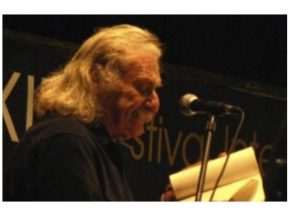
Jack Hirschman (USA) Jack Hirschman (USA): A revolutionary poet and activist, Hirschman coined the concept of the “Planetariat”—a global collective of poets and artists standing in solidarity with the marginalized. He believed poetry should serve as a liberating voice for the people, not an elite art form. His influence inspired Poetry Planetariat to become a poetic manifestation of this ideal.
Mission and Content
The magazine publishes poetry from all continents in multiple languages, thematic issues addressing topics like climate justice, freedom, resistance, cultural memory, and solidarity with oppressed peoples, and interviews, critical essays, and reflections from both emerging and established poets
It provides a rare space where poetic voices from Africa, Asia, Europe, Latin America, and the Middle East converge—highlighting the universal power of poetry.
Impact and Global Collaboration
Poetry Planetariat is part of the broader mission of WPM, which includes Organizing international poetry readings and festivals, Leading poetic actions in response to global crises (e.g., for Gaza, or climate change), and creating solidarity among poets from over 160 countries. The magazine has become a literary archive of the WPM’s vision: that poetry can change hearts, build bridges, and catalyze justice.
World Poetry Movement (WPM) has been founded to promote global poetic exchange and solidarity, the World Poetry Movement is a network of poets, editors, and cultural activists from over 160 countries. WPM organizes literary festivals, solidarity campaigns, and global poetic actions to foster peace, justice, and freedom through the transformative power of poetry.
WPM General Coordinator: Fernando Rendón (Colombia), and continental coordinators are Abdulla Issa (Palestine) • Achour Fenni (Algeria) • Alex Pausides (Cuba) • Aminur Rahaman (Bangladesh) • Ana María Oviedo (Venezuela) • Ashraf Aboul-Yazid (Egypt) • Cao Shui (China) • Christine Peiying Chen (New Zealand) • Christos Koukis (Greece) Fadıl Oktay (Turkiye) • Freddy Ñañez (Venezuela) • Hanan Awwad (Palestine) • Isilda Nunes (Portugal) • Jidi Majia (China) • Keshab Sigdel (Nepal) • Khalid Raissouni (Morocco) • María Ángeles Pérez López (Spain) • Maribel Mora Curriao (Chile) • Oscar Saavedra Villarroel (Chile) • Rati Saxena (India) • Siphiwe Nzima (Lesotho) • Sylvie Marie (Belgium) • Vadim Terekhin (Russia) • Zolani Mkiva (South Africa)